Questions on Numbers, Units and Estimation, the kind your examinations ask. Solve one on paper. Then tell the book how it went. The book believes you, and it uses your answer to plan your revision.
0%
Nothing marked yetMark honestly. Peek at the answer only after your own attempt.
Units, Unit Conversion and Dimensional Analysis
24 questions · after Lesson 5, Dimensional Analysis Derives a Formula
Units and conversion
Q1
Convert each quantity to the unit asked for.
\(72\) km/h to m/s
\(5\) m/s to km/h
\(1\) g/cm\(^3\) to kg/m\(^3\)
\(1\) N to dyne
Answer(i) \(20\) m/s (ii) \(18\) km/h (iii) \(1000\) kg/m\(^3\) (iv) \(10^{5}\) dyne
Solution
\(72\) km/h \(= \dfrac{72 \times 1000}{3600}\) m/s \(= 72 \times \dfrac{5}{18} = 20\) m/s.
Which of these are dimensionless? Give the reason for the angle.
angle in radians
strain
refractive index
relative density
Answerall four; arc/radius
Solution
All four are dimensionless. An angle in radians is \(\dfrac{\text{arc length}}{\text{radius}}\), a length divided by a length. Strain is \(\dfrac{\Delta L}{L}\), refractive index is a ratio of two speeds, and relative density is a ratio of two densities.
How did it go?
Q11
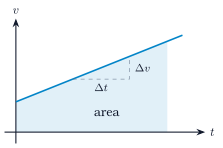
The figure shows a velocity-time graph.
Write the dimensions of the slope \(\frac{\Delta v}{\Delta t}\). Name the quantity.
Write the dimensions of the shaded area. Name the quantity.
Why can a length not be added to a time on this graph?
Answer(i) \(\mathrm{LT^{-2}}\), acceleration (ii) \(\mathrm{L}\), displacement (iii) different dimensions
Solution
\(\dfrac{[v]}{[t]} = \dfrac{\mathrm{LT^{-1}}}{\mathrm{T}} = \mathrm{LT^{-2}}\): the acceleration.
Area \(= v \times t\): \(\mathrm{LT^{-1}\cdot T = L}\), the displacement.
Only quantities with the same dimensions can be added. A length and a time have different dimensions, so their sum has no meaning.
How did it go?
Homogeneity
Q12
Check that \(v^2 = u^2 + 2as\) is dimensionally consistent. Here \(u\) and \(v\) are speeds, \(a\) is an acceleration and \(s\) is a distance.
Answereach term \(\mathrm{L^2T^{-2}}\)
Solution
\([v^2] = [u^2] = \mathrm{L^2T^{-2}}\). \([2as] = \mathrm{LT^{-2}\cdot L} = \mathrm{L^2T^{-2}}\). Every term has the same dimensions, so the equation is consistent.
How did it go?
Q13
A student writes \(s = ut + \frac{1}{2}at^3\). Show by dimensions that the equation is wrong, and write the correct one.
Answer\(at^3\) is \(\mathrm{LT}\), not \(\mathrm{L}\); \(s = ut + \frac{1}{2}at^2\)
Solution
\([s] = \mathrm{L}\) and \([ut] = \mathrm{LT^{-1}\cdot T = L}\). But \([at^3] = \mathrm{LT^{-2}\cdot T^3 = LT}\), which is not a length. So the equation cannot be right.
The correct equation is \(s = ut + \dfrac{1}{2}at^2\), where \([at^2] = \mathrm{LT^{-2}\cdot T^2 = L}\).
How did it go?
Q14
A force varies with time as \(F = a + bt\). Find the dimensions of \(a\) and of \(b\).
Each term must be a force. \([a] = [F] = \mathrm{MLT^{-2}}\). \([bt] = \mathrm{MLT^{-2}}\), so \([b] = \mathrm{MLT^{-2}/T = MLT^{-3}}\).
How did it go?
Q15
A wave is \(y = A\sin(\omega t - kx)\). Here \(y\) and \(x\) are lengths and \(t\) is a time.
Find the dimensions of \(A\), \(\omega\) and \(k\).
Show that \(\frac{\omega}{k}\) is a speed.
Answer(i) \(\mathrm{L}\); \(\mathrm{T^{-1}}\); \(\mathrm{L^{-1}}\) (ii) \(\mathrm{T^{-1}/L^{-1} = LT^{-1}}\)
Solution
\(A\) multiplies a sine, which is a pure number, so \([A] = [y] = \mathrm{L}\). The argument of the sine must be dimensionless: \([\omega t] = 1\) gives \([\omega] = \mathrm{T^{-1}}\), and \([kx] = 1\) gives \([k] = \mathrm{L^{-1}}\).
\(\left[\dfrac{\omega}{k}\right] = \dfrac{\mathrm{T^{-1}}}{\mathrm{L^{-1}}} = \mathrm{LT^{-1}}\), a speed. It is the wave speed.
How did it go?
Q16
The van der Waals equation is \(\left(P + \frac{a}{V^2}\right)(V - b) = RT\). Here \(P\) is a pressure and \(V\) is a volume. Find the dimensions of \(a\) and of \(b\).
Answer\(\mathrm{ML^5T^{-2}}\); \(\mathrm{L^3}\)
Solution
\(\dfrac{a}{V^2}\) is added to \(P\), so \([a] = [P][V^2] = \mathrm{ML^{-1}T^{-2}\cdot L^6 = ML^5T^{-2}}\).
\(b\) is subtracted from \(V\), so \([b] = [V] = \mathrm{L^3}\).
How did it go?
Deducing relations
Q17
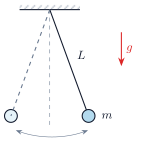
The period \(T\) of a simple pendulum may depend on the mass \(m\) of the bob, the length \(L\) and \(g\). Write \(T = k\,m^aL^bg^c\) with \(k\) a dimensionless constant.
Find \(a\), \(b\) and \(c\) by comparing dimensions.
Write the resulting formula. Why can dimensions not give \(k\)?
Answer(i) \(a = 0\), \(b = \frac{1}{2}\), \(c = -\frac{1}{2}\) (ii) \(T = k\sqrt{L/g}\); \(k\) has no dimensions
Compare powers: M: \(a = 0\). T: \(-2c = 1\), so \(c = -\dfrac{1}{2}\). L: \(b + c = 0\), so \(b = \dfrac{1}{2}\).
\(T = k\sqrt{\dfrac{L}{g}}\). The period does not depend on the mass. A dimensionless number such as \(k = 2\pi\) has no dimensions to compare, so this method cannot find it.
How did it go?
Q18
The period of a mass \(m\) on a spring of stiffness \(k\) (unit N/m) depends only on \(m\) and \(k\). Show by dimensions that \(T \propto \sqrt{\frac{m}{k}}\).
So \(-2b = 1\), \(b = -\dfrac{1}{2}\), and \(a + b = 0\), \(a = \dfrac{1}{2}\). Hence \(T \propto m^{1/2}k^{-1/2} = \sqrt{\dfrac{m}{k}}\).
How did it go?
Q19
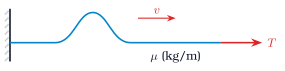
The speed \(v\) of a wave on a string depends on the tension \(T\) (a force) and the mass per unit length \(\mu\). Show by dimensions that \(v \propto \sqrt{\frac{T}{\mu}}\).
\([T] = \mathrm{MLT^{-2}}\) and \([\mu] = \mathrm{ML^{-1}}\). Let \(v = c\,T^a\mu^b\): \(\mathrm{LT^{-1} = M^{a+b}L^{a-b}T^{-2a}}\).
T: \(-2a = -1\), \(a = \dfrac{1}{2}\). M: \(a + b = 0\), \(b = -\dfrac{1}{2}\). Check L: \(a - b = 1\). So \(v \propto \sqrt{\dfrac{T}{\mu}}\).
How did it go?
Q20
The centripetal force on a body depends on its mass \(m\), its speed \(v\) and the radius \(r\) of the circle. Write \(F = k\,m^av^br^c\) and find \(a\), \(b\) and \(c\).
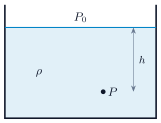
The pressure at depth \(h\) in a liquid of density \(\rho\) is \(P = P_0 + \rho g h\).
Show that \(\rho g h\) has the dimensions of pressure.
Take \(\rho = 1000\) kg/m\(^3\), \(g = 10\) m/s\(^2\) and \(h = 2\) m. Find \(\rho g h\) in pascals and in kPa.
Answer(i) \(\mathrm{ML^{-3}\cdot LT^{-2}\cdot L = ML^{-1}T^{-2}}\) (ii) \(2 \times 10^{4}\) Pa \(= 20\) kPa
Solution
\([\rho g h] = \mathrm{ML^{-3}\cdot LT^{-2}\cdot L = ML^{-1}T^{-2}}\), the same as \([P] = [F/A]\). Each term of the equation is a pressure.
\(\rho g h = 1000 \times 10 \times 2 = 2 \times 10^{4}\) Pa \(= 20\) kPa. This is about one fifth of atmospheric pressure.
How did it go?
Q23
The energy of a photon is \(E = \frac{hc}{\lambda}\). Take \(h = 6.6 \times 10^{-34}\) J s, \(c = 3 \times 10^{8}\) m/s and \(\lambda = 600\) nm. Find \(E\) in joules and in electron volts.
Answer\(3.3 \times 10^{-19}\) J \(\approx 2.1\) eV