Physics is learned by doing it. Not by watching it.
Understand every concept with your own hands, then take on problems up to JEE Advanced level.
Right now, which one?
Understand: the concept.You learn by doing the Physics. Push the block yourself and watch friction answer. Every concept works like this.→
Challenge: your understanding.Solve excellent questions, hand-picked by expert faculty, that take you up to JEE Advanced level.→
Pick one. Both stay one tap away, and one free account keeps your progress in both.
Tap one. It opens right here.
see a progress report
Every concept is something you do.
The whole syllabus, from Mathematical Tools to Modern Physics. Each idea is short. Its figure moves when you press play or drag. A quick check follows, and the feedback explains. All of it is free.
Read itShort ideas, one at a time.
Do itDrag the graph, push the block, predict and then play.
Check itA question after each idea. The feedback names the mistake.
Free, always. Every chapter, every figure, every check.
Try one now. Hold the rope and make a wave with your own hand.
A wave is not the rope moving along/Waves · Introduction to Waves
YOUR HAND, A ROPE
Drag the hand up and down. Whatever your hand does, the rope passes along to the right, one piece after another.
Watch the painted piece. It rises and falls on its dashed line and ends where it started. The pieces stay. Only the wave travels.
Drag the hand up and down.
drag me up and down
A rope held at its left end. Every piece of the rope copies the hand a little later, and the wave runs to the right at 2.5m/s. The painted piece never moves along the rope.
What sets doPhysics apart
flip me
The Learning Spectrum of Physics
From watching to doing — the further right, the more of it is yours.
The whole syllabusEvery concept, done by hand, free
1000+ problemsUp to JEE Advanced level
Designed by expert facultyEvery idea, figure, hint and solution
Students who are serious about JEE Advanced.
Feedback from students who value intellectual honesty over superficial score guarantees.
★★★★★
“Selected questions which are present in this app is helping me a lot and also saving lot's of time for me. I feel like it is giving me as much varieties as i think there is with less number of question and also giving me conceptual clarity. solutions are excellent that i am not taking much help from my teacher. solution is very detailed. Thanks a lot for creating this website .”
VH
Vishnu HarshaJEE Advanced 2027
★★★★★
“The problems given in the website are very interesting and the solutions are some of the most detailed I have seen personally. The hints can be quite helpful and the website is engaging to use.”
AK
Atharv KumaniJEE Advanced 2027
★★★★★
“I believe that the problems on this website gives one a concrete understanding of how well one is in physics for JEE Advanced and physics Olympiads. It's because of the idea of encouraging the student to think for the answer by the use of hints rather than just skipping to the solution, as well as the complexity and quantity of these problems. The solutions to the problems here are clear and concise, as well as elegant.”
NE
NeilJEE Advanced 2027
Note for ParentsWhy this is not another video lecture subscription
Read Note
Real score improvement in JEE Advanced comes exclusively from active problem-solving time.
Your child does not need another library of hundreds of hours of recorded videos to passively sit in front of. True rank advancement demands active pen-on-paper problem engagement:
Active attempt required: Students engage their own minds on authentic problems before viewing guided help.
No spoon-feeding: Structured hints guide intuition back on track without spoiling the final deduction.
Curated by an experienced educator: Crafted by an IIT Madras award-winning mentor, not scraped from random question banks.
“My son was spending 6 hours a day watching video lectures with zero score improvement. Switching to doPhysics forced him to solve on paper daily.”
Every problem on this platform is crafted from first principles. No shortcuts, no formula-plugging, no rote patterns.
doPhysics was created by Asheshanand Acharya out of conviction that Physics cannot be mastered as a spectator sport. In today's coaching ecosystem, students spend 6–8 hours daily watching passive video lectures—creating a dangerous illusion of competence that instantly collapses when confronting an unfamiliar, multi-concept problem in JEE Advanced.
Solve first. Decide later.
Understanding costs nothing, ever. The problems start free, and you pay only if you want all of them.
Understand
₹0always
The complete theory of Class 11 and 12 Physics.
Every chapter, from Mathematical Tools to Modern Physics
Experience the core platform before committing anything.
3 Benchmark JEE Advanced Problems
Understand it. Then challenge it.
One free account keeps your progress in both: every concept you master becomes a star in your sky. No credit card. Understanding stays free; full access to the problems from ₹499/year.
Free to start. No credit card.
Every concept works like this: something you do with your hands, then a check that tells you what you got.
1000+ problems, hand-picked and written from first principles by expert faculty, across every branch. You solve on paper. The page checks your answer, and helps only as much as you ask.
Three problems are open right now. Five more are free with your account.
Three problems are open right now. Try the first one before you open its hint. solve on paper, then check your answer here
Time Calculation from Position vs Inverse Velocity Graph/JEE Advanced Benchmark
PROBLEM STATEMENT
Graph of position x vs inverse of velocity (v1) for a particle moving on a straight line is as shown. Find the time taken (in seconds) by the particle to move from x=3m
Need a nudge?
💡
A nudge, not the answer
Enough to get you unstuck and thinking in the right direction, without giving away the derivation.
📋
Conceptual Approach & Blueprint
The structured sequence top physicists use to tackle this problem category.
📘
Rigorous Mathematical Solution
Complete derivation with limiting case checks and physical interpretations.
The Difficulty Spectrum of Physics Problems
From fundamentals to the frontier — know where you stand, and go beyond.
doPhysics
JEE Advanced level
±20%
Board Exams
JEE Main
JEE Advanced
Easier
Harder
Concepts & basicsStandard applications
Stronger conceptsMulti-step problems
Deep conceptsNon-trivial reasoningHigher level problem solving
±20%
Typical Coaching SheetsAround JEE Main level(JEE Main ± 20%)
Typical coaching sheets stop around JEE Main. These problems sit at the JEE Advanced benchmark, hand-picked and written from first principles.
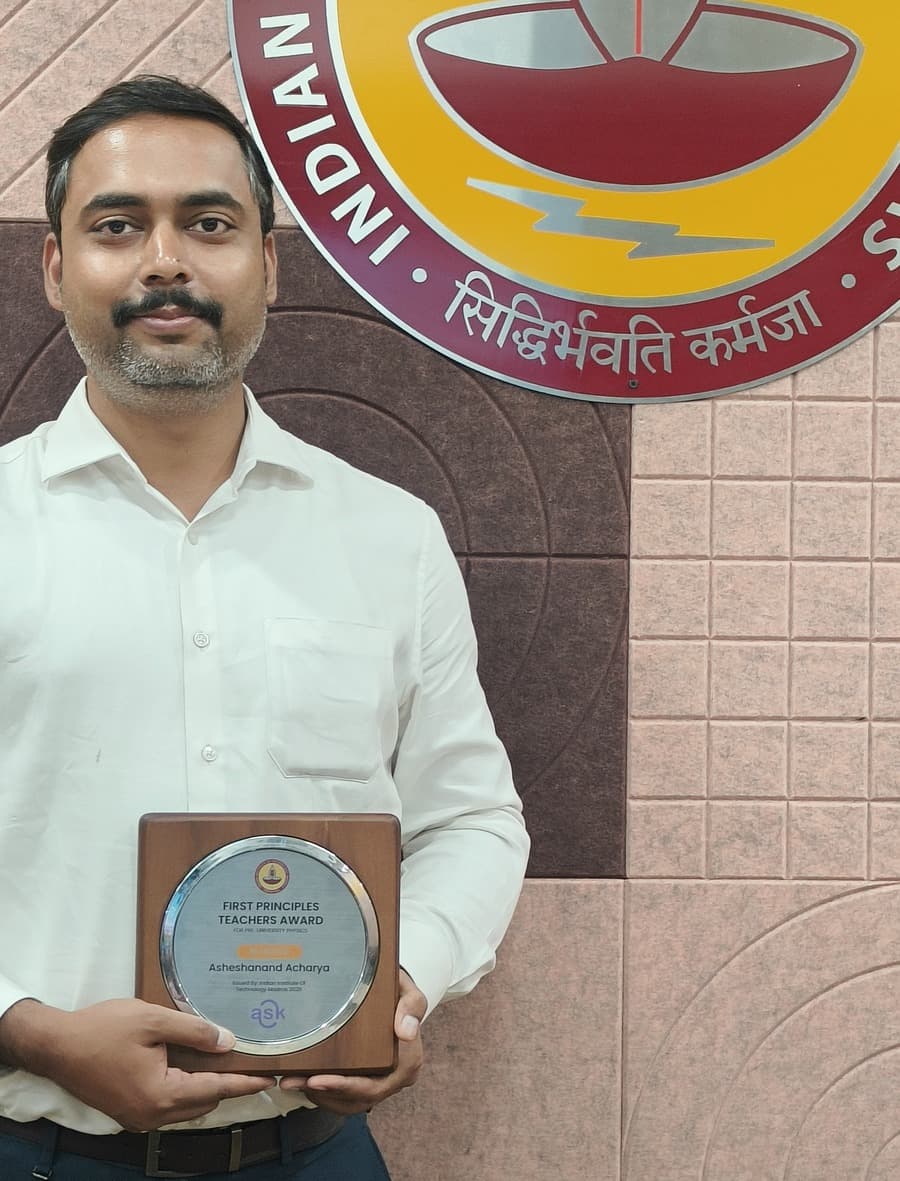
Recipient of the prestigious IIT Madras First Principles Teachers Award 2026 (honored by IIT Madras Director Prof. V. Kamakoti for developing students' genuine scientific temper and analytical depth), Asheshanand is an IIT BHU alumnus who has spent over 11 years training India’s top rankers. His students have secured AIR 13 and AIR 88 in JEE Advanced, placed 15 out of 23 students in the Top 1000 from a single batch in 2025, and represented India at the 23rd International Junior Science Olympiad (IJSO) 2026.
These problems are not scraped from open-source question banks or generated by automated scripts. Every single physical scenario, coordinate decomposition, progressive hint, conceptual roadmap step, and boundary-condition derivation is curated to systematically deconstruct misconceptions and build bulletproof physical intuition.
11+Years Mentoring JEE Adv
AIR 13JEE Advanced Top Result
IJSO '26Team India Mentored
FPTAIIT Madras Award 2026
Featured in National Press & Institutional Recognition
Complete, unrestricted access to the entire problem repository.
1000+ Curated JEE Advanced Problems
All 6 Physics Branches covered comprehensively
Layered Hints, Methods & Rigorous Solutions
Personal Performance & Error Analytics
Continuous updates with fresh Olympiad problems
7-Day Refund: Not loving the platform? Email us within 7 days of purchase and we refund you in full. No questions asked.
to
x=15m
.
Recall the relation v=dtdx and rearrange it to find dt. Consider what the area of a horizontal strip of thickness dx and width v1 represents on the given graph.
Write the kinematic relation v=dtdx.
Rearrange the equation to express a small time interval dt as dt=v1dx.
Identify that on a graph with x on the vertical axis and v1 on the horizontal axis, the term v1dx
Conclude that the total time is the area enclosed by the curve and the vertical x-axis.
Calculate the area of the trapezium formed between x=3m and x=15m.
From the definition of velocity, we have: v=dtdx Rearranging this equation to solve for time dt, we get: dt=v1dx To find the total time t taken to move from x=3m to x=15m, we integrate both sides: t=∫315v1dx Now, let's interpret this integral graphically.
Consider a horizontal strip on the given graph at a position x with an infinitesimally small thickness dx. The width of this strip along the horizontal axis is v1. The area of this small horizontal strip is: dA=width×thickness=(v1)dx
represents the area of a horizontal strip.
Comparing this with our equation for dt, we see that dt=dA. This means the time required for a small displacement dx is equal to the area of the corresponding horizontal strip.
Therefore, the total time t is the total area enclosed by the curve and the vertical x-axis between x=3m and x=15m.
The shape of this enclosed region is a trapezium. The parallel sides are horizontal with lengths 2sm−1 and 4sm−1. The perpendicular distance (height) between these parallel sides is along the vertical axis, which is (15−3)m=12m.