Questions on Measurement and Error, the kind your examinations ask. Solve one on paper. Then tell the book how it went. The book believes you, and it uses your answer to plan your revision.
0%
Nothing marked yetMark honestly. Peek at the answer only after your own attempt.
Errors, Propagation and Significant Figures
24 questions · after Lesson 3, Propagation of Errors
Absolute, relative and percentage error
Q1
A length is measured as \(2.50\) m with an absolute error of \(0.01\) m.
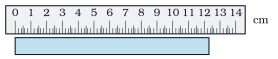
A rod is laid along a scale with millimetre marks.
Read the length of the rod. What is the least count of the scale?
Write the result in the form \(L \pm \Delta L\).
Find the percentage error.
Answer(i) \(12.3\) cm; \(0.1\) cm (ii) \(12.3 \pm 0.1\) cm (iii) \(\approx 0.8\%\)
Solution
The rod runs from \(0\) to \(12.3\) cm. The smallest division is \(1\) mm \(= 0.1\) cm, so the least count is \(0.1\) cm.
The error of a single reading is taken as the least count: \(L = 12.3 \pm 0.1\) cm.
\(\dfrac{0.1}{12.3} \times 100 \approx 0.8\%\).
How did it go?
Q3
Five readings of the period of a pendulum are \(2.1\), \(2.0\), \(2.2\), \(1.9\) and \(2.3\) s.
Find the mean value.
Find the absolute error of each reading and the mean absolute error.
Write the result as \(T \pm \Delta T\) and find the relative error.
Answer(i) \(2.1\) s (ii) \(0\), \(0.1\), \(0.1\), \(0.2\), \(0.2\); \(0.12 \approx 0.1\) s (iii) \(2.1 \pm 0.1\) s; \(\approx 0.05\)
Solution
\(\bar T = \dfrac{2.1 + 2.0 + 2.2 + 1.9 + 2.3}{5} = \dfrac{10.5}{5} = 2.1\) s.
\(|T_i - \bar T|\): \(0\), \(0.1\), \(0.1\), \(0.2\), \(0.2\) s. Mean absolute error \(= \dfrac{0.6}{5} = 0.12\) s, rounded to \(0.1\) s to match the readings.
A wire's diameter is measured as \(0.4\) cm with a least count of \(0.01\) cm. A mass is measured as \(10\) g with a least count of \(1\) g. Find the percentage error of each. Which measurement is more precise?
The diameter has the smaller percentage error, so it is the more precise measurement. The size of the least count alone does not decide precision; the least count compared with the reading does.
How did it go?
Q5
A digital balance reads \(25.30\) g and its least count is \(0.01\) g. Write the mass as \(m \pm \Delta m\) and find the percentage error.
Absolute errors add here too: \(L_1 - L_2 = 6.0 \pm 0.2\) cm.
Sum: \(\dfrac{0.2}{14.0} \approx 1.4\%\). Difference: \(\dfrac{0.2}{6.0} \approx 3.3\%\). The difference has the larger percentage error, because the same absolute error sits on a smaller number.
How did it go?
Q7
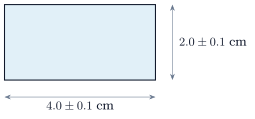
The sides of a rectangular plate are measured as shown.
Find the area.
Find the percentage error in each side and in the area.
\(\dfrac{0.1}{4.0} = 2.5\%\) and \(\dfrac{0.1}{2.0} = 5\%\). For a product the percentage errors add: \(7.5\%\).
\(\Delta A = 0.075 \times 8.0 = 0.6\) cm\(^2\), so \(A = 8.0 \pm 0.6\) cm\(^2\).
How did it go?
Q8
The density of a body is \(\rho = \frac{m}{V}\). The percentage errors in \(m\) and \(V\) are \(2\%\) and \(3\%\). Find the percentage error in \(\rho\).
Answer\(5\%\)
Solution
For a quotient the percentage errors add: \(\dfrac{\Delta\rho}{\rho} = \dfrac{\Delta m}{m} + \dfrac{\Delta V}{V} = 2\% + 3\% = 5\%\).
How did it go?
Q9
The kinetic energy is \(K = \frac{1}{2}mv^2\). The mass is known to \(1\%\) and the speed to \(2\%\). Find the percentage error in \(K\).
Answer\(5\%\)
Solution
\(\dfrac{\Delta K}{K} = \dfrac{\Delta m}{m} + 2\dfrac{\Delta v}{v} = 1\% + 2 \times 2\% = 5\%\). The power \(2\) doubles the error of \(v\). The factor \(\dfrac{1}{2}\) has no error.
How did it go?
Q10
\(g\) is found from a pendulum using \(g = \frac{4\pi^2L}{T^2}\). The percentage errors in \(L\) and \(T\) are \(1\%\) and \(2\%\). Find the percentage error in \(g\).
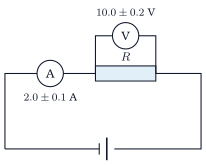
\(\Delta R = 0.07 \times 5.0 = 0.35 \approx 0.4\ \Omega\), so \(R = 5.0 \pm 0.4\ \Omega\).
How did it go?
Q12
A quantity is \(Z = \frac{a^2b}{\sqrt{c}}\). The percentage errors in \(a\), \(b\) and \(c\) are \(1\%\), \(2\%\) and \(4\%\). Find the percentage error in \(Z\).
State the number of significant figures in each value.
\(0.0250\)
\(4.00\)
\(305\)
\(1.20 \times 10^{3}\)
\(0.7\)
Answer(i) \(3\) (ii) \(3\) (iii) \(3\) (iv) \(3\) (v) \(1\)
Solution
\(0.0250\): the leading zeros only fix the decimal point; \(2\), \(5\) and the trailing \(0\) count. Three.
\(4.00\): trailing zeros after a decimal point count. Three.
\(305\): a zero between non-zero digits counts. Three.
\(1.20 \times 10^{3}\): the power of ten does not count. Three.
\(0.7\): one.
How did it go?
Q14
Round each value to three significant figures.
\(3.14159\)
\(2.7183\)
\(0.012345\)
\(12.65\)
\(12.75\)
Answer(i) \(3.14\) (ii) \(2.72\) (iii) \(0.0123\) (iv) \(12.6\) (v) \(12.8\)
Solution
\(3.14\) (the dropped digit \(1\) is less than \(5\)).
\(2.72\) (the dropped digit \(8\) is more than \(5\)).
\(0.0123\).
\(12.65\): the dropped digit is exactly \(5\) and the preceding digit \(6\) is even, so it stays: \(12.6\).
\(12.75\): the preceding digit \(7\) is odd, so it is raised: \(12.8\).
How did it go?
Q15
Add \(12.3 + 1.234 + 0.05\) and give the answer to the correct number of decimal places. State the rule you used.
Answer\(13.6\); one decimal place
Solution
\(12.3 + 1.234 + 0.05 = 13.584\). In addition the answer keeps as many decimal places as the term with the fewest, here one (\(12.3\)). So the sum is \(13.6\).
How did it go?
Q16
Give each answer to the correct number of significant figures.
\(2.5 \times 3.14\)
\(10.0 \div 3.0\)
\(20.46 - 3.2\)
Answer(i) \(7.9\) (ii) \(3.3\) (iii) \(17.3\)
Solution
\(2.5 \times 3.14 = 7.85\). The answer keeps the fewer significant figures, two: \(7.9\).
\(10.0 \div 3.0 = 3.33\ldots\), to two significant figures: \(3.3\).
\(20.46 - 3.2 = 17.26\), to one decimal place: \(17.3\).
How did it go?
Q17
The side of a cube is \(2.5\) cm. Find its volume to the correct number of significant figures.
Answer\(16\) cm\(^3\)
Solution
\(V = 2.5^3 = 15.625\) cm\(^3\). The side has two significant figures, so \(V = 16\) cm\(^3\).
How did it go?
Q18
A body has mass \(12.4\) g and volume \(3.2\) cm\(^3\). Find its density to the correct number of significant figures.
Answer\(3.9\) g/cm\(^3\)
Solution
\(\rho = \dfrac{12.4}{3.2} = 3.875\) g/cm\(^3\). The volume has two significant figures, so \(\rho = 3.9\) g/cm\(^3\).
How did it go?
Small situations
Q19
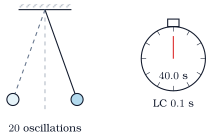
A stopwatch of least count \(0.1\) s reads \(40.0\) s for \(20\) oscillations of a pendulum.
Find the period \(T\).
Find the absolute error in \(T\).
Why is it better to time \(20\) oscillations than one?
Answer(i) \(2.00\) s (ii) \(0.005\) s (iii) error divided by \(20\)
Solution
\(T = \dfrac{40.0}{20} = 2.00\) s.
The whole timing carries the error \(0.1\) s, so \(\Delta T = \dfrac{0.1}{20} = 0.005\) s.
Timing one oscillation would give \(\Delta T = 0.1\) s, twenty times worse. Dividing a long timed interval by the number of oscillations divides the error by that number.
How did it go?
Q20
In a pendulum experiment \(L = 100.0 \pm 0.1\) cm and \(T = 2.00 \pm 0.02\) s. Use \(g = \frac{4\pi^2L}{T^2}\).
Find \(g\).
Find the percentage error in \(g\).
Answer(i) \(\pi^2 \approx 9.87\) m/s\(^2\) (ii) \(2.1\%\)
One student measures \(1\) m with an error of \(1\) cm. Another measures \(10\) m with an error of \(5\) cm. Which measurement is more accurate? Give the reason.
Answersecond, \(0.5\%\) against \(1\%\)
Solution
First: \(\dfrac{1}{100} = 1\%\). Second: \(\dfrac{5}{1000} = 0.5\%\). The second measurement is more accurate, because accuracy is judged by the relative error, not by the absolute error.
How did it go?
Q23
Two resistors \(R_1 = 100 \pm 3\ \Omega\) and \(R_2 = 200 \pm 4\ \Omega\) are joined in series. Write the total resistance with its error.
Answer\(300 \pm 7\ \Omega\)
Solution
\(R = R_1 + R_2 = 300\ \Omega\). Absolute errors add in a sum: \(\Delta R = 3 + 4 = 7\ \Omega\). So \(R = 300 \pm 7\ \Omega\).
How did it go?
Q24
Four readings of a wire's diameter are \(2.01\), \(2.03\), \(1.99\) and \(2.01\) mm. Find the mean, the mean absolute error and the percentage error.
Answer\(2.01\) mm; \(0.01\) mm; \(0.5\%\)
Solution
Mean \(= \dfrac{2.01 + 2.03 + 1.99 + 2.01}{4} = \dfrac{8.04}{4} = 2.01\) mm.
Deviations: \(0\), \(0.02\), \(0.02\), \(0\) mm. Mean absolute error \(= \dfrac{0.04}{4} = 0.01\) mm. Percentage error \(= \dfrac{0.01}{2.01} \times 100 \approx 0.5\%\).
How did it go?
Vernier Caliper, Screw Gauge and Spherometer
24 questions · after Lesson 4, Vernier Calliper, Screw Gauge and Spherometer
Least count
Q25
On a vernier caliper, \(10\) vernier divisions equal \(9\) main-scale divisions, and one main-scale division is \(1\) mm.
Find the size of one vernier division.
Find the least count in mm and in cm.
Answer(i) \(0.9\) mm (ii) \(0.1\) mm \(= 0.01\) cm
Solution
\(1\) VSD \(= \dfrac{9}{10}\) MSD \(= 0.9\) mm.
LC \(= 1\) MSD \(- 1\) VSD \(= 1 - 0.9 = 0.1\) mm \(= 0.01\) cm.
How did it go?
Q26
On another vernier, \(20\) vernier divisions equal \(19\) main-scale divisions, and one main-scale division is \(0.5\) mm. Find the least count.
Answer\(0.025\) mm
Solution
\(1\) VSD \(= \dfrac{19}{20} \times 0.5 = 0.475\) mm. LC \(= 0.5 - 0.475 = 0.025\) mm. Equivalently LC \(= \dfrac{\text{1 MSD}}{20} = \dfrac{0.5}{20} = 0.025\) mm.
How did it go?
Q27
Find the least count of a screw gauge with
pitch \(1\) mm and \(100\) circular divisions,
pitch \(0.5\) mm and \(50\) circular divisions.
Answer(i) \(0.01\) mm (ii) \(0.01\) mm
Solution
LC \(= \dfrac{\text{pitch}}{\text{number of circular divisions}}\).
\(\dfrac{1}{100} = 0.01\) mm.
\(\dfrac{0.5}{50} = 0.01\) mm.
How did it go?
Q28
The screw of a gauge advances \(2\) mm in \(4\) full rotations. Its circular scale has \(100\) divisions. Find the pitch and the least count.
Answer\(0.5\) mm; \(0.005\) mm
Solution
Pitch \(=\) distance per rotation \(= \dfrac{2}{4} = 0.5\) mm. LC \(= \dfrac{0.5}{100} = 0.005\) mm.
How did it go?
Reading the instruments
Q29
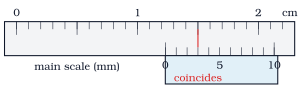
The figure shows a vernier caliper with least count \(0.01\) cm.
Read the main-scale reading, that is, the mark just before the vernier zero.
Which vernier division coincides with a main-scale line?
Find the reading.
Answer(i) \(1.2\) cm (ii) \(3\)rd (iii) \(1.23\) cm
Solution
The vernier zero lies between \(1.2\) and \(1.3\) cm, so the main-scale reading is \(1.2\) cm.
The \(3\)rd vernier line is exactly in line with a main-scale line.
A vernier of least count \(0.01\) cm gives a main-scale reading of \(2.4\) cm, and the \(7\)th vernier division coincides. The instrument has a zero error of \(+0.02\) cm. Find the observed reading and the true reading.
Answer\(2.47\) cm; \(2.45\) cm
Solution
Observed \(= 2.4 + 7 \times 0.01 = 2.47\) cm. True \(=\) observed \(-\) zero error \(= 2.47 - 0.02 = 2.45\) cm.
How did it go?
Q31
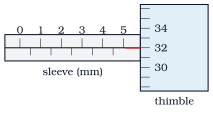
The figure shows a screw gauge of pitch \(1\) mm with \(100\) circular divisions.
Read the sleeve (main scale) and the thimble (circular scale).
Find the reading in mm.
Answer(i) \(5\) mm; \(32\) (ii) \(5.32\) mm
Solution
The edge of the thimble is past the \(5\) mm mark and before any further mark: sleeve \(= 5\) mm. The reference line meets the circular scale at \(32\).
Reading \(= 5 + 32 \times 0.01 = 5.32\) mm.
How did it go?
Q32
A screw gauge of pitch \(1\) mm and \(100\) divisions gives a sleeve reading of \(3\) mm and a circular reading of \(45\). Its zero error is \(-0.03\) mm. Find the observed and the true diameter.
Answer\(3.45\) mm; \(3.48\) mm
Solution
Observed \(= 3 + 45 \times 0.01 = 3.45\) mm. True \(= 3.45 - (-0.03) = 3.48\) mm. A negative zero error makes readings too small, so it is added back.
How did it go?
Q33
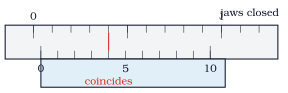
The figure shows a vernier caliper of least count \(0.01\) cm with its jaws closed.
Is the zero error positive or negative? Give the reason.
Find the zero error.
With this caliper a rod reads \(3.26\) cm. Find the true length.
Answer(i) positive, vernier zero to the right (ii) \(+0.04\) cm (iii) \(3.22\) cm
Solution
Positive. With nothing between the jaws the instrument already shows a reading, because the vernier zero is to the right of the main zero.
The \(4\)th division coincides: zero error \(= +4 \times 0.01 = +0.04\) cm.
True \(= 3.26 - 0.04 = 3.22\) cm.
How did it go?
Zero errors
Q34
With the jaws of a vernier closed, the vernier zero lies to the left of the main-scale zero and the \(6\)th vernier division coincides. The vernier has \(10\) divisions and least count \(0.01\) cm.
Find the zero error.
An observed reading is \(3.26\) cm. Find the true reading.
Answer(i) \(-0.04\) cm (ii) \(3.30\) cm
Solution
The vernier zero is to the left, so the error is negative. Its size is \((10 - 6) \times 0.01 = 0.04\) cm: zero error \(= -0.04\) cm.
True \(= 3.26 - (-0.04) = 3.30\) cm.
How did it go?
Q35
A screw gauge has least count \(0.01\) mm. The observed reading of a wire is \(2.40\) mm. Find the zero error and the true reading in each case.
With the jaws closed, the zero of the circular scale is \(5\) divisions above the reference line.
With the jaws closed, the zero of the circular scale is \(3\) divisions below the reference line.
Answer(i) \(-0.05\) mm; \(2.45\) mm (ii) \(+0.03\) mm; \(2.37\) mm
Solution
The zero has not reached the line, so the error is negative: \(-5 \times 0.01 = -0.05\) mm. True \(= 2.40 + 0.05 = 2.45\) mm.
The zero has gone past the line, so the error is positive: \(+0.03\) mm. True \(= 2.40 - 0.03 = 2.37\) mm.
How did it go?
Q36
Why is a screw gauge preferred over a vernier caliper for the diameter of a thin wire? What is backlash error, and how is it avoided?
Answersmaller least count; play in the screw, turn one way
Solution
A screw gauge has a least count of \(0.01\) mm, ten times smaller than the usual vernier's \(0.1\) mm. For a wire of diameter about \(0.5\) mm the vernier would give an error of \(20\%\), the screw gauge \(2\%\).
Backlash error: the screw has a little play in its nut. On reversing the direction of rotation the thimble turns a little before the screw moves. It is avoided by always turning the screw in the same direction when taking a reading.
How did it go?
Spherometer
Q37
The screw of a spherometer moves \(5\) mm in \(5\) full rotations. The circular scale has \(100\) divisions. Find the pitch and the least count.
Answer\(1\) mm; \(0.01\) mm
Solution
Pitch \(= \dfrac{5}{5} = 1\) mm. LC \(= \dfrac{1}{100} = 0.01\) mm.
How did it go?
Q38
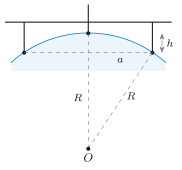
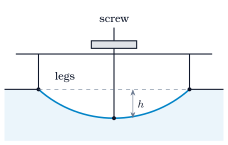
The three legs of a spherometer stand on a sphere of radius \(R\) at distance \(a\) from the axis. The central screw touches the surface \(h\) above the plane of the legs.
Use the right triangle in the figure to show that \(R^2 = a^2 + (R - h)^2\).
Hence show that \(R = \frac{a^2}{2h} + \frac{h}{2}\).
The legs form an equilateral triangle of side \(l\), so \(a = \frac{l}{\sqrt{3}}\). Show that \(R = \frac{l^2}{6h} + \frac{h}{2}\).
The centre \(O\), a leg and the foot of the screw form a right triangle. The hypotenuse is \(R\) (centre to leg), one side is \(a\), and the other is \(R - h\) (centre to the plane of the legs). Pythagoras gives \(R^2 = a^2 + (R - h)^2\).
For an equilateral triangle of side \(l\) the distance from the centre to a vertex is \(\dfrac{l}{\sqrt{3}}\), so \(a^2 = \dfrac{l^2}{3}\). Then \(R = \dfrac{l^2}{6h} + \dfrac{h}{2}\).
How did it go?
Q39
For a convex lens \(l = 3\) cm and \(h = 0.05\) cm. Find \(R\). Which term is negligible?
Answer\(30.025 \approx 30\) cm; \(\frac{h}{2}\)
Solution
\(R = \dfrac{9}{6 \times 0.05} + \dfrac{0.05}{2} = 30 + 0.025 = 30.025 \approx 30\) cm. The \(\dfrac{h}{2}\) term is negligible because \(h\) is far smaller than \(l\).
How did it go?
Q40
A spherometer has pitch \(1\) mm and \(100\) divisions. From the plane-glass position it is turned \(1\) full rotation and \(50\) divisions to touch a curved surface. The legs are \(30\) mm apart.
Find \(h\).
Find \(R\).
Answer(i) \(1.5\) mm (ii) \(100.75 \approx 101\) mm
Solution
\(h = 1 \times 1\) mm \(+ 50 \times 0.01\) mm \(= 1.50\) mm.
\(R = \dfrac{30^2}{6 \times 1.5} + \dfrac{1.5}{2} = 100 + 0.75 = 100.75 \approx 101\) mm, about \(10\) cm.
How did it go?
Q41
The spherometer is placed on a concave surface.
Does the central screw move up or down from the plane-glass position?
Does the formula for \(R\) change? Give the reason.
With \(l = 3\) cm and \(h = 0.15\) cm, find \(R\).
Answer(i) down (ii) no, same triangle (iii) \(10.075 \approx 10.1\) cm
Solution
Down. The surface dips below the plane of the legs, so the screw must be lowered to touch it.
No. The same right triangle with sides \(a\) and \(R - h\) and hypotenuse \(R\) still holds, now with the centre of curvature above the surface. \(h\) is simply the size of the screw's movement.
A vernier caliper gives the diameter of a cylinder as \(1.20\) cm and its length as \(5.00\) cm. Find the volume, leaving \(\pi\) in the answer, and then as a number.
Answer\(1.8\pi \approx 5.65\) cm\(^3\)
Solution
\(r = 0.60\) cm. \(V = \pi r^2 h = \pi \times 0.36 \times 5.00 = 1.8\pi \approx 5.65\) cm\(^3\).
How did it go?
Q45
A wire's diameter is \(0.50\) mm by a screw gauge of least count \(0.01\) mm. Find the percentage error in the diameter and in the area of cross-section.
Answer\(2\%\); \(4\%\)
Solution
\(\dfrac{\Delta d}{d} = \dfrac{0.01}{0.50} = 2\%\). The area is \(\dfrac{\pi d^2}{4}\), so its percentage error is \(2 \times 2\% = 4\%\).
How did it go?
Q46
Name the instrument you would use for each measurement.
internal diameter of a tube
diameter of a thin wire
radius of curvature of a lens
length of a pencil.
Answer(i) vernier (ii) screw gauge (iii) spherometer (iv) metre scale
Solution
Vernier caliper, using its inside jaws.
Screw gauge.
Spherometer.
Metre scale; a least count of \(1\) mm is enough.
How did it go?
Q47
A screw gauge has pitch \(0.5\) mm and \(50\) circular divisions. The sleeve shows the \(2.5\) mm mark and the circular scale reads \(24\). Find the least count and the reading.
Answer\(0.01\) mm; \(2.74\) mm
Solution
LC \(= \dfrac{0.5}{50} = 0.01\) mm. Reading \(= 2.5 + 24 \times 0.01 = 2.74\) mm.
How did it go?
Q48
A vernier has \(25\) divisions equal to \(24\) mm. The main-scale reading is \(10\) mm and the \(12\)th vernier division coincides. Find the least count and the reading.
Answer\(0.04\) mm; \(10.48\) mm
Solution
\(1\) VSD \(= \dfrac{24}{25} = 0.96\) mm, so LC \(= 1 - 0.96 = 0.04\) mm. Reading \(= 10 + 12 \times 0.04 = 10.48\) mm.