Questions on Vectors, the kind your examinations ask. Solve one on paper. Then tell the book how it went. The book believes you, and it uses your answer to plan your revision.
0%
Nothing marked yetMark honestly. Peek at the answer only after your own attempt.
Dot Product and Cross Product
24 questions · after Lesson 5, The Cross Product
Dot product
Q1
Let \(\vec A = \hat i + \hat j\) and \(\vec B = \hat i\).
Find \(\vec A\cdot\vec B\).
Find \(|\vec A|\) and \(|\vec B|\).
Find the angle between \(\vec A\) and \(\vec B\).
Answer(i) \(1\) (ii) \(\sqrt{2}\); \(1\) (iii) \(45^\circ\)
\(|\vec A| = 4\) and \(|\vec B| = 5\). Find \(\vec A\cdot\vec B\) when the angle between them is
\(60^\circ\),
\(90^\circ\),
\(180^\circ\).
Answer(i) \(10\) (ii) \(0\) (iii) \(-20\)
Solution
\(\vec A\cdot\vec B = AB\cos\theta = 20\cos\theta\).
\(20 \times \dfrac{1}{2} = 10\).
\(20 \times 0 = 0\). Perpendicular vectors have zero dot product.
\(20 \times (-1) = -20\). Opposite vectors give the most negative value.
How did it go?
Q3
Show that \(2\hat i + 3\hat j\) and \(3\hat i - 2\hat j\) are perpendicular.
Find \(k\) so that \(k\hat i + 4\hat j\) is perpendicular to \(2\hat i - \hat j\).
Answer(i) \(6 - 6 = 0\) (ii) \(k = 2\)
Solution
\((2\hat i + 3\hat j)\cdot(3\hat i - 2\hat j) = 6 - 6 = 0\). A zero dot product between non-zero vectors means they are perpendicular.
\((k\hat i + 4\hat j)\cdot(2\hat i - \hat j) = 2k - 4 = 0\) gives \(k = 2\).
How did it go?
Q4
Write the values of \(\hat i\cdot\hat i\) and \(\hat i\cdot\hat j\). Use \(\vec A\cdot\vec A = |\vec A|^2\) to find the magnitude of \(\vec A = 2\hat i - 2\hat j + \hat k\).
The normal force is perpendicular to the displacement, so \(\cos 90^\circ = 0\) and \(W = 0\).
The weight \(20\) N points down and the displacement is up: \(\theta = 180^\circ\). \(W = 20 \times 3 \times (-1) = -60\) J.
How did it go?
Q8
A force \(\vec F = 2\hat i + 3\hat j\) N acts on a particle moving with velocity \(\vec v = 4\hat i - 2\hat j\) m/s. Find the power \(P = \vec F\cdot\vec v\).
Answer\(2\) W
Solution
\(P = \vec F\cdot\vec v = 2 \times 4 + 3 \times (-2) = 8 - 6 = 2\) W.
How did it go?
Q9
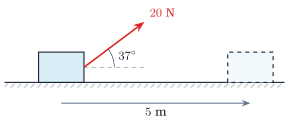
A block is pulled \(5\) m along a floor by a rope at \(37^\circ\) to the floor. The tension is \(20\) N. Take \(\cos 37^\circ = 0.8\) and \(\sin 37^\circ = 0.6\).
Find the work done by the tension.
Find the work done by the weight of the block.
The rope is now made horizontal with the same tension. Find the work done.
\(\hat i\times\hat j = \hat k\), \(\hat j\times\hat k = \hat i\), \(\hat k\times\hat i = \hat j\) (cyclic order). \(\hat i\times\hat i = 0\) because the angle is zero. \(\hat j\times\hat i = -\hat k\) because reversing the order reverses the product.
How did it go?
Q11
\(|\vec A| = 4\) and \(|\vec B| = 5\). Find \(|\vec A\times\vec B|\) when the angle between them is
\(\vec A\cdot(\vec A\times\vec B) = 1 \times (-3) + 2 \times 6 + 3 \times (-3) = -3 + 12 - 9 = 0\). So the product is perpendicular to \(\vec A\), as a cross product must be.
How did it go?
Q14
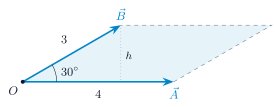
The figure shows the parallelogram on \(\vec A\) (\(4\) units, along \(x\)) and \(\vec B\) (\(3\) units, at \(30^\circ\) to \(\vec A\)).
Find the height \(h\) of the parallelogram and its area.
Find \(|\vec A\times\vec B|\) and compare with part (i).
State the direction of \(\vec A\times\vec B\): into the page or out of it.
Answer(i) \(1.5\); \(6\) (ii) \(6\), equal (iii) out of the page
Solution
\(h = 3\sin 30^\circ = 1.5\) units. Area \(=\) base \(\times\) height \(= 4 \times 1.5 = 6\) square units.
\(|\vec A\times\vec B| = 4 \times 3 \times \sin 30^\circ = 6\). The magnitude of the cross product is the area of the parallelogram on the two vectors.
Curl the fingers of the right hand from \(\vec A\) towards \(\vec B\) (anticlockwise). The thumb points out of the page.
How did it go?
Torque and angular momentum
Q15
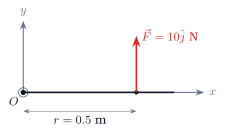
A rod is pivoted at \(O\). A force \(\vec F = 10\hat j\) N acts at \(\vec r = 0.5\hat i\) m from \(O\).
Find the torque \(\vec\tau = \vec r\times\vec F\).
Does the rod turn clockwise or anticlockwise? Give the reason.
The same force is applied at \(\vec r = 0.2\hat i\) m. Find the torque.
Answer(i) \(5\hat k\) N m (ii) anticlockwise (iii) \(2\hat k\) N m
Solution
\(\vec\tau = 0.5\hat i\times 10\hat j = 5\hat k\) N m.
\(+\hat k\) points out of the page. By the right-hand rule the rod turns anticlockwise, which the picture also shows: an upward push on the right end.
\(\vec\tau = 0.2\hat i\times 10\hat j = 2\hat k\) N m. A shorter arm gives a smaller torque for the same force.
How did it go?
Q16
A force \(\vec F = 4\hat i + 2\hat j\) N acts at the point \(\vec r = 2\hat i + 3\hat j\) m. Find the torque about the origin and state its sense.
Answer\(-8\hat k\) N m, clockwise
Solution
\(\vec\tau = \vec r\times\vec F = (2 \times 2 - 3 \times 4)\hat k = (4 - 12)\hat k = -8\hat k\) N m.
The minus sign means the torque points into the page: a clockwise turning effect.
How did it go?
Q17
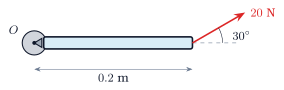
A spanner of arm \(0.2\) m turns a nut at \(O\). A force of \(20\) N acts at the end of the arm at \(30^\circ\) to it.
Find the torque about \(O\).
At what angle to the arm should the force act for the greatest torque? Find that torque.
Answer(i) \(2\) N m (ii) \(90^\circ\); \(4\) N m
Solution
\(\tau = rF\sin\theta = 0.2 \times 20 \times \sin 30^\circ = 2\) N m.
\(\sin\theta\) is largest at \(\theta = 90^\circ\): the force should be perpendicular to the arm. Then \(\tau = 0.2 \times 20 = 4\) N m.
How did it go?
Q18
A particle of mass \(2\) kg is at \(\vec r = 3\hat i\) m and moves with \(\vec v = 4\hat j\) m/s. Find its momentum \(\vec p\) and its angular momentum \(\vec L = \vec r\times\vec p\) about the origin.
Answer\(8\hat j\) kg m/s; \(24\hat k\) kg m\(^2\)/s
Solution
\(\vec p = m\vec v = 2 \times 4\hat j = 8\hat j\) kg m/s.
\(\vec L = \vec r\times\vec p = 3\hat i\times 8\hat j = 24\hat k\) kg m\(^2\)/s.
How did it go?
Q19
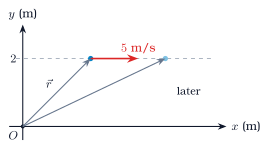
A particle of mass \(1\) kg moves along the line \(y = 2\) m with velocity \(5\hat i\) m/s. Its position is \(\vec r = x\hat i + 2\hat j\).
Find \(\vec L = \vec r\times\vec p\) about \(O\).
Show that \(\vec L\) does not depend on \(x\). What does this say about the angular momentum of a free particle?
Answer(i) \(-10\hat k\) kg m\(^2\)/s (ii) \(x\hat i\times 5\hat i = 0\); constant
Solution
\(\vec p = 5\hat i\) kg m/s. \(\vec L = (x\hat i + 2\hat j)\times 5\hat i = 5x(\hat i\times\hat i) + 10(\hat j\times\hat i) = -10\hat k\) kg m\(^2\)/s.
The term with \(x\) is \(\hat i\times\hat i = 0\), so \(\vec L\) is the same at every point of the line. Only the perpendicular distance (\(2\) m) from \(O\) to the line matters. A free particle moving in a straight line has constant angular momentum about any fixed point.
How did it go?
Mixed
Q20
For two vectors \(\vec A\cdot\vec B = |\vec A\times\vec B|\). Find the angle between them.
Expand: \((\vec A + \vec B)\cdot(\vec A - \vec B) = \vec A\cdot\vec A - \vec A\cdot\vec B + \vec B\cdot\vec A - \vec B\cdot\vec B = A^2 - B^2\), because \(\vec A\cdot\vec B = \vec B\cdot\vec A\).
In a rhombus the sides \(\vec A\) and \(\vec B\) have equal length, so \(A^2 - B^2 = 0\). The diagonals \(\vec A + \vec B\) and \(\vec A - \vec B\) then have zero dot product: they are perpendicular.
How did it go?
Q23
The magnetic force on a charge is \(\vec F = q\,\vec v\times\vec B\). A charge \(q = 2\) C moves with \(\vec v = 3\hat i\) m/s in a field \(\vec B = 4\hat k\) T. Find \(\vec F\).
Answer\(-24\hat j\) N
Solution
\(\vec v\times\vec B = 3\hat i\times 4\hat k = 12(\hat i\times\hat k) = -12\hat j\). So \(\vec F = 2 \times (-12\hat j) = -24\hat j\) N.
The force is perpendicular to both the velocity and the field, as a cross product must be.
How did it go?
Q24
Find a unit vector perpendicular to both \(\vec A = \hat i + \hat j\) and \(\vec B = \hat i - \hat j\).
Answer\(\pm\hat k\)
Solution
\(\vec A\times\vec B = (\hat i + \hat j)\times(\hat i - \hat j) = -\hat i\times\hat j + \hat j\times\hat i = -\hat k - \hat k = -2\hat k\).
Dividing by the magnitude \(2\) gives \(-\hat k\). Its opposite \(+\hat k\) is also perpendicular to both, so the answer is \(\pm\hat k\). Both given vectors lie in the \(xy\) plane, so this makes sense.