Questions on Differentiation, the kind your examinations ask. Solve one on paper. Then tell the book how it went. The book believes you, and it uses your answer to plan your revision.
0%
Nothing marked yetMark honestly. Peek at the answer only after your own attempt.
Differentiation, Rates of Change and Extrema
24 questions · after Lesson 6, Related Rates and Small Changes
Read the derivative
Q1
Let \(y = 3x^2 + 2x - 5\).
Find \(\frac{dy}{dx}\).
Find the slope at \(x = 2\).
Where is the slope zero?
Answer(i) \(6x + 2\) (ii) \(14\) (iii) \(x = -\frac{1}{3}\)
Solution
Differentiate term by term: \(\dfrac{dy}{dx} = 6x + 2\).
At \(x = 2\): \(6 \times 2 + 2 = 14\).
\(6x + 2 = 0\) gives \(x = -\dfrac{1}{3}\). The tangent is horizontal there.
How did it go?
Q2
Differentiate each function with respect to \(x\).
\(x^5\)
\(\frac{1}{x^2}\)
\(\sqrt{x}\)
\(7\)
Answer(i) \(5x^4\) (ii) \(-\frac{2}{x^3}\) (iii) \(\frac{1}{2\sqrt{x}}\) (iv) \(0\)
\(e^{x}\); this function equals its own derivative.
\(\dfrac{1}{x}\).
The slope of \(\sin x\) is \(\cos x\), which is first zero at \(x = \dfrac{\pi}{2}\). That is the top of the sine curve.
How did it go?
Read the slope from a graph
Q5
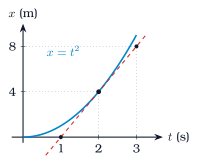
The figure shows \(x = t^2\) for a moving particle. Here \(x\) is in metres and \(t\) is in seconds. The dashed line is the tangent at \(t = 2\) s. It passes through \((1, 0)\) and \((3, 8)\).
Read \(x\) at \(t = 2\) s from the graph.
Find the slope of the tangent from the two points.
Find \(\frac{dx}{dt}\) at \(t = 2\) s and compare with part (ii).
Answer(i) \(4\) m (ii) \(4\) m/s (iii) \(2t = 4\) m/s, equal
Solution
At \(t = 2\) s the curve is at \(x = 2^2 = 4\) m.
Slope \(= \dfrac{8 - 0}{3 - 1} = 4\) m/s.
\(\dfrac{dx}{dt} = 2t = 4\) m/s at \(t = 2\) s. The derivative equals the slope of the tangent, as it must.
How did it go?
Q6
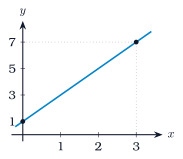
The figure shows a straight-line graph of \(y\) against \(x\).
Read the slope and the intercept. Write the equation of the line.
Find \(\frac{dy}{dx}\) at \(x = 1\) and at \(x = 2\). Why are the two values equal?
Answer(i) \(2\); \(1\); \(y = 2x + 1\) (ii) \(2\), \(2\); straight line
Solution
The line passes through \((0, 1)\) and \((3, 7)\). Slope \(= \dfrac{7 - 1}{3 - 0} = 2\); intercept \(= 1\). So \(y = 2x + 1\).
\(\dfrac{dy}{dx} = 2\) at every \(x\), so it is \(2\) at \(x = 1\) and at \(x = 2\). A straight line has the same slope everywhere.
How did it go?
Q7
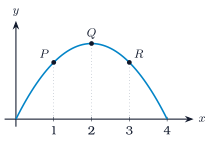
The figure shows \(y = 4x - x^2\). \(P\), \(Q\) and \(R\) are at \(x = 1\), \(2\) and \(3\).
State the sign of \(\frac{dy}{dx}\) at \(P\), at \(Q\) and at \(R\).
Find \(\frac{dy}{dx}\) and check your answer to part (i).
At \(P\) the curve rises, so the slope is positive. At \(Q\) the curve is at its top, so the slope is zero. At \(R\) the curve falls, so the slope is negative.
\(\dfrac{dy}{dx} = 4 - 2x\). At \(x = 1\): \(+2\). At \(x = 2\): \(0\). At \(x = 3\): \(-2\). The signs agree.
\(y = 4 \times 2 - 2^2 = 4\).
How did it go?
Q8
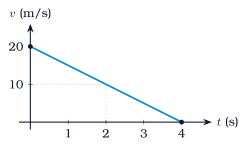
The figure shows the velocity of a car against time.
Read \(v\) at \(t = 0\) and at \(t = 4\) s.
Find the slope of the line. What physical quantity is this slope?
What does the sign of the slope tell you about the motion?
Answer(i) \(20\) m/s; \(0\) (ii) \(-5\) m/s\(^2\); acceleration (iii) slowing down
Solution
\(v = 20\) m/s at \(t = 0\) and \(v = 0\) at \(t = 4\) s.
Slope \(= \dfrac{0 - 20}{4 - 0} = -5\) m/s\(^2\). The slope of a \(v\)-\(t\) graph is the acceleration.
The slope is negative, so the velocity decreases. The car slows down and stops at \(t = 4\) s.
How did it go?
Chain, product and quotient rules
Q9
Use the chain rule to differentiate each function with respect to \(x\) or \(t\). Here \(\omega\) and \(\phi\) are constants.
\((2x + 1)^3\)
\(\sin 3t\)
\(e^{-2t}\)
\(\cos(\omega t + \phi)\)
Answer(i) \(6(2x + 1)^2\) (ii) \(3\cos 3t\) (iii) \(-2e^{-2t}\) (iv) \(-\omega\sin(\omega t + \phi)\)
Solution
Chain rule: differentiate the outer function, then multiply by the derivative of the inner one.
\(3(2x + 1)^2 \times 2 = 6(2x + 1)^2\).
\(\cos 3t \times 3 = 3\cos 3t\).
\(e^{-2t} \times (-2) = -2e^{-2t}\).
\(-\sin(\omega t + \phi) \times \omega = -\omega\sin(\omega t + \phi)\).
How did it go?
Q10
Use the product rule to differentiate each function.
\(x^2 \sin x\)
\(t\,e^{t}\)
Answer(i) \(2x\sin x + x^2\cos x\) (ii) \(e^{t}(1 + t)\)
Solution
Product rule: \((uv)' = u'v + uv'\).
\(2x\sin x + x^2\cos x\).
\(1 \times e^{t} + t\,e^{t} = e^{t}(1 + t)\).
How did it go?
Q11
Use the quotient rule to differentiate each function.
\(\frac{x}{x + 1}\)
\(\frac{\sin x}{x}\)
Answer(i) \(\frac{1}{(x + 1)^2}\) (ii) \(\frac{x\cos x - \sin x}{x^2}\)
At \(x = \dfrac{3}{4}\): \(\sqrt{1 + \dfrac{9}{16}} = \dfrac{5}{4}\), so the slope is \(\dfrac{3/4}{5/4} = \dfrac{3}{5}\).
How did it go?
Rates of change
Q13
A spherical balloon is inflated. Its radius grows at a steady \(0.2\) cm/s. Find the rate at which the volume \(V = \frac{4}{3}\pi r^3\) grows when \(r = 10\) cm.
The charge that has passed a point in a wire is \(q = 2t^2 + 3t\). Here \(q\) is in coulombs and \(t\) is in seconds.
Find the current \(i = \frac{dq}{dt}\) at \(t = 2\) s.
Find the rate at which the current changes.
Answer(i) \(11\) A (ii) \(4\) A/s
Solution
\(i = \dfrac{dq}{dt} = 4t + 3\). At \(t = 2\) s: \(i = 11\) A.
\(\dfrac{di}{dt} = 4\) A/s, the same at every instant.
How did it go?
Q15
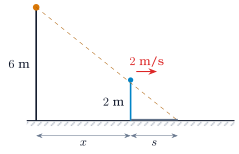
A man \(2\) m tall walks away from a lamp fixed \(6\) m above the ground at \(2\) m/s. His distance from the post is \(x\) and the length of his shadow is \(s\).
Use similar triangles to show that \(s = \frac{x}{2}\).
Find the rate at which the shadow lengthens.
Find the speed of the tip of the shadow.
Answer(i) \(\frac{s}{2} = \frac{x + s}{6}\) (ii) \(1\) m/s (iii) \(3\) m/s
Solution
The lamp, the top of the head and the tip of the shadow lie on one line. The two right triangles are similar: \(\dfrac{2}{s} = \dfrac{6}{x + s}\). So \(2x + 2s = 6s\), which gives \(s = \dfrac{x}{2}\).
\(\dfrac{d^2y}{dx^2} = -6x\). At \(x = 2\) this is \(-12 < 0\): a maximum, \(y = 24 - 8 = 16\). At \(x = -2\) it is \(+12 > 0\): a minimum, \(y = -24 + 8 = -16\).
How did it go?
Q21
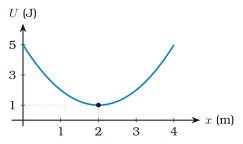
The potential energy of a particle is \(U = x^2 - 4x + 5\). Here \(U\) is in joules and \(x\) is in metres. The force on the particle is \(F = -\frac{dU}{dx}\).
Find \(F\) as a function of \(x\). Where is \(F = 0\)?
Find \(\frac{d^2U}{dx^2}\) there. Is the equilibrium stable or unstable?
Read the least potential energy from the graph and check it.
Answer(i) \(4 - 2x\); \(x = 2\) m (ii) \(2 > 0\), stable (iii) \(1\) J
Solution
\(F = -\dfrac{dU}{dx} = -(2x - 4) = 4 - 2x\). \(F = 0\) at \(x = 2\) m, the bottom of the curve.
\(\dfrac{d^2U}{dx^2} = 2 > 0\), so \(U\) is a minimum at \(x = 2\) m. A small push either way raises \(U\), so the force pushes the particle back. The equilibrium is stable.
The graph bottoms at \(U = 1\) J. Check: \(U(2) = 4 - 8 + 5 = 1\) J.
How did it go?
Q22
The range of a projectile thrown at \(20\) m/s at an angle \(\theta\) to the ground is \(R = 40\sin 2\theta\), in metres. Take \(g = 10\) m/s\(^2\).
Find \(\frac{dR}{d\theta}\).
Find the angle for the greatest range.
Find the greatest range.
Answer(i) \(80\cos 2\theta\) (ii) \(45^\circ\) (iii) \(40\) m
\(\cos 2\theta = 0\) gives \(2\theta = 90^\circ\), so \(\theta = 45^\circ\). Also \(\dfrac{d^2R}{d\theta^2} = -160\sin 2\theta < 0\) there, so it is a maximum.
\(R_{\max} = 40\sin 90^\circ = 40\) m. This is \(\dfrac{u^2}{g} = \dfrac{400}{10}\).
How did it go?
Q23
A ball is thrown up. Its height is \(h = 20t - 5t^2\). Here \(h\) is in metres and \(t\) is in seconds.
Find the time at which \(\frac{dh}{dt} = 0\).
Find the greatest height.
What is \(\frac{d^2h}{dt^2}\) physically?
Answer(i) \(2\) s (ii) \(20\) m (iii) \(-10\) m/s\(^2\), acceleration due to gravity
Solution
\(\dfrac{dh}{dt} = 20 - 10t = 0\) gives \(t = 2\) s. The velocity is zero at the top.
\(h_{\max} = 20 \times 2 - 5 \times 4 = 20\) m.
\(\dfrac{d^2h}{dt^2} = -10\) m/s\(^2\): the acceleration due to gravity, downward. It is negative, so \(t = 2\) s gives a maximum.
How did it go?
Q24
A wire of length \(40\) cm is bent into a rectangle of sides \(x\) and \(20 - x\), in centimetres.
Write the area \(A\) as a function of \(x\).
Find \(x\) for the greatest area.
Find the greatest area.
Answer(i) \(20x - x^2\) (ii) \(10\) cm (iii) \(100\) cm\(^2\)
Solution
\(A = x(20 - x) = 20x - x^2\).
\(\dfrac{dA}{dx} = 20 - 2x = 0\) gives \(x = 10\) cm. \(\dfrac{d^2A}{dx^2} = -2 < 0\), a maximum. The rectangle is a square.