Questions on Integration, the kind your examinations ask. Solve one on paper. Then tell the book how it went. The book believes you, and it uses your answer to plan your revision.
0%
Nothing marked yetMark honestly. Peek at the answer only after your own attempt.
Integration and Area Under Curves
24 questions · after Lesson 5, Average Value and Root Mean Square
Indefinite integrals
Q1
Integrate each function with respect to \(x\). Add the constant of integration.
\(x^3\)
\(\frac{1}{x}\)
\(\cos x\)
\(e^{2x}\)
Answer(i) \(\frac{x^4}{4} + C\) (ii) \(\ln x + C\) (iii) \(\sin x + C\) (iv) \(\frac{e^{2x}}{2} + C\)
Solution
Use \(\int x^n\,dx = \dfrac{x^{n+1}}{n + 1} + C\) for \(n \ne -1\).
\(\dfrac{x^4}{4} + C\).
\(\ln x + C\). The power rule fails for \(n = -1\); the logarithm takes its place.
\(\sin x + C\), because \(\dfrac{d}{dx}\sin x = \cos x\).
\(\dfrac{e^{2x}}{2} + C\). Check: differentiating brings down the \(2\).
How did it go?
Q2
Integrate each function with respect to its variable.
From \(0\) to \(\pi\) the curve is above the axis and the area counts \(+2\). From \(\pi\) to \(2\pi\) the curve is below the axis and the area counts \(-2\). A definite integral adds signed areas, so the total is zero.
How did it go?
Q5
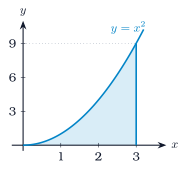
The figure shows \(y = x^2\) with the region under the curve from \(x = 0\) to \(x = 3\) shaded.
Write the shaded area as a definite integral.
Find the area.
The triangle with corners \((0, 0)\), \((3, 0)\) and \((3, 9)\) has area \(13.5\). Why is the shaded area smaller?
Answer(i) \(\int_0^3 x^2\,dx\) (ii) \(9\) (iii) curve lies below the chord
Solution
Area \(= \int_0^3 x^2\,dx\).
\(\left[\dfrac{x^3}{3}\right]_0^3 = 9\).
The chord from \((0, 0)\) to \((3, 9)\) lies above the curve, because the curve bends upward. The region under the curve is inside the triangle, so its area is less than \(13.5\).
How did it go?
Q6
Find the area between the line \(y = 2x\) and the \(x\)-axis from \(x = 0\) to \(x = 4\) by integration. Check the answer with the formula for the area of a triangle.
\(\int_0^8 (10 - 2t)\,dt = 80 - 64 = 16\) m. This is the displacement.
From \(5\) s to \(8\) s the velocity is negative and the particle moves back: \(\int_5^8 (10 - 2t)\,dt = (80 - 64) - (50 - 25) = -9\) m. The distance travelled is \(25 + 9 = 34\) m.
How did it go?
Q11
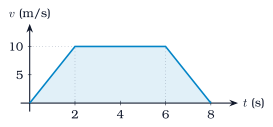
The figure shows the velocity of a train against time.
Find the displacement in \(8\) s from the area under the graph.
Find the acceleration during the first \(2\) s.
Find the average velocity over the \(8\) s.
Answer(i) \(60\) m (ii) \(5\) m/s\(^2\) (iii) \(7.5\) m/s
Solution
Area of the trapezium: triangle \(\dfrac{1}{2} \times 2 \times 10 = 10\) m, rectangle \(4 \times 10 = 40\) m, triangle \(\dfrac{1}{2} \times 2 \times 10 = 10\) m. Total \(60\) m.
Slope of the first segment: \(a = \dfrac{10 - 0}{2} = 5\) m/s\(^2\).
\(\bar v = \dfrac{60}{8} = 7.5\) m/s.
How did it go?
Q12
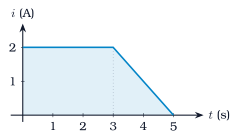
The figure shows the current \(i\) in a wire against time. The charge that passes is \(q = \int i\,dt\).
Find the charge that passes in the first \(3\) s.
Find the charge that passes from \(t = 3\) s to \(t = 5\) s.
The acceleration of a particle is \(a = 6t\). Here \(a\) is in m/s\(^2\) and \(t\) is in seconds. At \(t = 0\) the particle is at \(x = 0\) with velocity \(2\) m/s.
\(\int_0^2 5\sin\pi t\,dt = \left[-\dfrac{5\cos\pi t}{\pi}\right]_0^2 = 0\). During the second second the current is negative, so the same charge flows back. The net charge is zero.
How did it go?
Work from a variable force
Q15
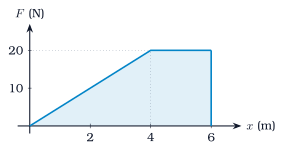
The figure shows the force on a body against its displacement \(x\). The work done is \(W = \int F\,dx\).
Find the work done from \(x = 0\) to \(x = 4\) m.
Find the work done from \(x = 4\) m to \(x = 6\) m.
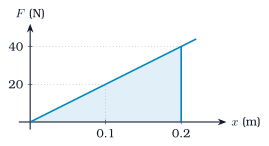
The figure shows the force needed to stretch a spring against its extension \(x\).
Read the spring constant \(k\) from the graph.
Show that the work done in stretching the spring by \(x\) is \(\frac{1}{2}kx^2\).
Find the work done in stretching it by \(0.2\) m.
Answer(i) \(200\) N/m (ii) \(\int_0^x kx\,dx\) (iii) \(4\) J
Solution
\(F = kx\), so \(k\) is the slope: \(k = \dfrac{40}{0.2} = 200\) N/m.
\(W = \int_0^x kx\,dx = k\left[\dfrac{x^2}{2}\right]_0^x = \dfrac{1}{2}kx^2\). This is the area of the triangle under the line.
\(W = \dfrac{1}{2} \times 200 \times 0.04 = 4\) J. Check: \(\dfrac{1}{2} \times 0.2 \times 40 = 4\) J.
How did it go?
Q17
A force \(F = 2x + 3\) acts on a body along \(x\). Here \(F\) is in newtons and \(x\) is in metres. Find the work done as the body moves from \(x = 0\) to \(x = 2\) m.
A force \(F = \frac{6}{x^2}\) acts on a particle along \(x\). Here \(F\) is in newtons and \(x\) is in metres. Find the work done by the force as the particle moves from \(x = 1\) m to \(x = 3\) m.
The gravitational force on a body of mass \(m\) at distance \(r\) from the centre of the earth is \(F = \frac{GMm}{r^2}\). Show that the work needed to take the body from \(r = R\) to a very large distance is \(\frac{GMm}{R}\).
The applied force must balance gravity at each \(r\). \(W = \int_R^{\infty}\dfrac{GMm}{r^2}\,dr = GMm\left[-\dfrac{1}{r}\right]_R^{\infty} = GMm\left(0 + \dfrac{1}{R}\right) = \dfrac{GMm}{R}\).
The integral converges because the force falls as \(1/r^2\); a finite amount of work removes the body completely.
How did it go?
Small situations
Q20
A rod \(2\) m long has mass per unit length \(\lambda = 3x\). Here \(\lambda\) is in kg/m and \(x\) is the distance in metres from one end. Find the mass of the rod.
Answer\(6\) kg
Solution
A piece of length \(dx\) at \(x\) has mass \(\lambda\,dx = 3x\,dx\). \(M = \int_0^2 3x\,dx = \left[\dfrac{3x^2}{2}\right]_0^2 = 6\) kg.
How did it go?
Q21
The power delivered to a motor is \(P = 20t\). Here \(P\) is in watts and \(t\) is in seconds. Find the energy delivered in the first \(4\) s.
The average value of a function \(f(t)\) over \(0\) to \(T\) is \(\frac{1}{T}\int_0^T f\,dt\).
Find the average of \(v = 3t^2\) over \(t = 0\) to \(2\) s. Compare with Question 9.
Show that the average of \(\sin\theta\) over \(0\) to \(\pi\) is \(\frac{2}{\pi}\).
Answer(i) \(4\) m/s, same (ii) \(\frac{1}{\pi}[-\cos\theta]_0^{\pi}\)
Solution
\(\bar v = \dfrac{1}{2}\int_0^2 3t^2\,dt = \dfrac{8}{2} = 4\) m/s, the same as the average velocity in Question 9. The average of \(v\) over time is the displacement divided by the time.
Think of a disc of radius \(R\) as a set of thin rings. A ring of radius \(r\) and width \(dr\) has area \(2\pi r\,dr\). Integrate to show that the area of the disc is \(\pi R^2\).
With \(\omega T = 2\pi\), \(\sin 2\omega T = \sin 4\pi = 0\). So the integral is \(\dfrac{T}{2}\). The average of \(\sin^2\) over a full cycle is \(\dfrac{1}{2}\).