Questions on Functions and Graphs, the kind your examinations ask. Solve one on paper. Then tell the book how it went. The book believes you, and it uses your answer to plan your revision.
0%
Nothing marked yetMark honestly. Peek at the answer only after your own attempt.
Graphs and Coordinate Geometry for Physics
24 questions · after Lesson 6, Coordinate Geometry for Physics
Straight lines
Q1
Consider the line \(y = 3x + 2\).
Write the slope and the \(y\)-intercept.
Find \(y\) at \(x = 4\).
Find \(x\) where \(y = 0\).
Answer(i) \(3\); \(2\) (ii) \(14\) (iii) \(-\frac{2}{3}\)
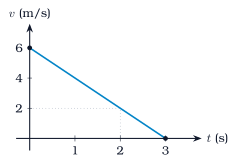
\(u = 6\) m/s; \(a = -2\) m/s\(^2\), opposite to the initial velocity.
For \(t > 3\) s the line goes below the axis: \(v\) is negative. The body has stopped and now moves back the way it came.
How did it go?
Q4
For each graph state whether it is a straight line, and if so whether it passes through the origin.
Spring force \(F = kx\) against \(x\).
Velocity \(v = u + at\) against \(t\), with \(u \ne 0\).
Kinetic energy \(K = \frac{1}{2}mv^2\) against \(v\).
\(K\) against \(v^2\).
Answer(i) line, \(O\) (ii) line, not \(O\) (iii) parabola (iv) line, \(O\)
Solution
\(F = kx\) is \(y = mx\): a straight line through the origin with slope \(k\).
\(v = u + at\) is \(y = mx + c\): a straight line of slope \(a\), cutting the \(v\)-axis at \(u\), not through the origin.
\(K \propto v^2\): a parabola, not a straight line.
Against \(v^2\) the same relation is \(K = \dfrac{m}{2}(v^2)\): a straight line through the origin with slope \(\dfrac{m}{2}\).
How did it go?
Q5
For a resistor, \(V = IR\). The graph of \(V\) against \(I\) passes through \((2\text{ A}, 10\text{ V})\).
Find the slope.
What physical quantity is the slope?
Find \(V\) at \(I = 3\) A.
Answer(i) \(5\) V/A (ii) resistance (iii) \(15\) V
Solution
The line passes through the origin, so the slope is \(\dfrac{10}{2} = 5\) V/A.
\(V = IR\) is \(y = mx\) with \(m = R\). The slope is the resistance, \(5\ \Omega\).
\(V = 5 \times 3 = 15\) V.
How did it go?
Q6
A body starts from rest with constant acceleration, so \(s = \frac{1}{2}at^2\). The graph of \(s\) against \(t^2\) is a straight line of slope \(5\) m/s\(^2\). Find \(a\).
Answer\(10\) m/s\(^2\)
Solution
\(s = \dfrac{a}{2}(t^2)\) is a straight line in \(t^2\) with slope \(\dfrac{a}{2}\). So \(\dfrac{a}{2} = 5\) and \(a = 10\) m/s\(^2\).
How did it go?
Parabolas
Q7
Consider \(y = x^2 - 4\).
Find where the curve cuts the \(x\)-axis.
Find the lowest point.
Does the parabola open upward or downward?
Answer(i) \(x = \pm 2\) (ii) \((0, -4)\) (iii) upward
Solution
\(x^2 - 4 = 0\) gives \(x = \pm 2\).
\(x^2 \ge 0\), so \(y\) is least when \(x = 0\): the lowest point is \((0, -4)\).
The coefficient of \(x^2\) is positive, so the parabola opens upward.
How did it go?
Q8
Write \(y = 4x - x^2\) in the form \(y = 4 - (x - 2)^2\). Find the vertex of the parabola and the points where it cuts the \(x\)-axis.
Answer(i) \((0, 0)\); \(5\) (ii) yes (iii) outside
Solution
\(x^2 + y^2 = r^2\) with \(r = 5\): centre \((0, 0)\), radius \(5\).
\(3^2 + 4^2 = 25\): yes, \((3, 4)\) lies on the circle.
\(4^2 + 4^2 = 32 > 25\): the point is farther than \(5\) from the centre, so it is outside.
How did it go?
Q13
Write the centre and the radius of the circle \((x - 2)^2 + (y + 1)^2 = 9\). Write the equation of a circle of radius \(3\) centred at \((0, 3)\). Where does the second circle touch the \(x\)-axis?
\((x - a)^2 + (y - b)^2 = r^2\) has centre \((a, b)\) and radius \(r\). So the centre is \((2, -1)\) and \(r = 3\).
Radius \(3\) about \((0, 3)\): \(x^2 + (y - 3)^2 = 9\). The lowest point of this circle is \(3\) below its centre, at \((0, 0)\). The circle touches the \(x\)-axis at the origin.
How did it go?
Q14
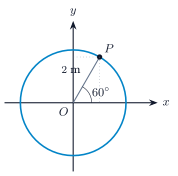
A particle \(P\) moves on a circle of radius \(2\) m centred at \(O\). At the instant shown, \(OP\) makes \(60^\circ\) with the \(x\)-axis.
Write the equation of the circle.
Find the coordinates of \(P\).
Find the length of the arc from the \(x\)-axis to \(P\).
Answer(i) \(x^2 + y^2 = 4\) (ii) \((1, \sqrt{3})\) (iii) \(\frac{2\pi}{3} \approx 2.1\) m
Solution
\(x^2 + y^2 = 4\).
\(x = 2\cos 60^\circ = 1\) m and \(y = 2\sin 60^\circ = \sqrt{3}\) m. Check: \(1 + 3 = 4\).
Arc \(= r\theta\) with \(\theta\) in radians: \(2 \times \dfrac{\pi}{3} = \dfrac{2\pi}{3} \approx 2.1\) m.
How did it go?
Q15
A satellite moves on the ellipse \(\frac{x^2}{25} + \frac{y^2}{9} = 1\), with distances in thousands of kilometres.
Write the semi-major axis \(a\) and the semi-minor axis \(b\).
The foci are at \((\pm c, 0)\) with \(c^2 = a^2 - b^2\). Find \(c\).
The earth's centre is at the focus \((4, 0)\). Find the nearest and the farthest distance of the satellite from it.
Answer(i) \(5\); \(3\) (ii) \(4\) (iii) \(1\); \(9\)
Solution
\(\dfrac{x^2}{a^2} + \dfrac{y^2}{b^2} = 1\) with \(a^2 = 25\) and \(b^2 = 9\): \(a = 5\), \(b = 3\).
\(c^2 = 25 - 9 = 16\), so \(c = 4\).
The ellipse cuts the \(x\)-axis at \(x = \pm 5\). From the focus at \(x = 4\): nearest distance \(5 - 4 = 1\), farthest \(5 + 4 = 9\), in thousands of kilometres.
How did it go?
Q16
Find the points where the line \(y = x + 1\) meets the circle \(x^2 + y^2 = 13\).
Answer\((2, 3)\) and \((-3, -2)\)
Solution
Put \(y = x + 1\) into the circle: \(x^2 + (x + 1)^2 = 13\), so \(2x^2 + 2x - 12 = 0\), that is, \(x^2 + x - 6 = 0\).
\((x + 3)(x - 2) = 0\): \(x = 2\) or \(x = -3\). The points are \((2, 3)\) and \((-3, -2)\). Check: \(4 + 9 = 13\) and \(9 + 4 = 13\).
How did it go?
Reading graphs
Q17
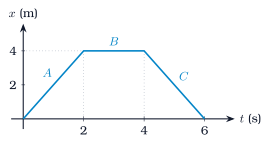
The figure shows the position of a body against time in three straight segments \(A\), \(B\) and \(C\).
Find the velocity in each segment from the slope.
Describe the motion in words.
Find the total distance travelled and the final displacement.
Answer(i) \(2\); \(0\); \(-2\) m/s (ii) forward, rest, back (iii) \(8\) m; \(0\)
Solution
\(A\): \(\dfrac{4 - 0}{2} = 2\) m/s. \(B\): the line is flat, \(0\). \(C\): \(\dfrac{0 - 4}{6 - 4} = -2\) m/s.
The body moves forward at \(2\) m/s for \(2\) s and stays at rest for \(2\) s. Then it returns at \(2\) m/s and reaches the start at \(t = 6\) s.
Distance \(= 4 + 0 + 4 = 8\) m. The body ends where it began, so the displacement is \(0\).
How did it go?
Q18
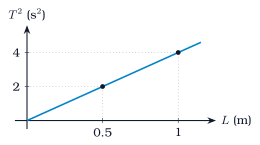
For a simple pendulum \(T = 2\pi\sqrt{\frac{L}{g}}\), so \(T^2 = \frac{4\pi^2}{g}L\). The figure shows \(T^2\) against \(L\) from an experiment.
Why is the graph a straight line through the origin?
\(T^2 = \dfrac{4\pi^2}{g}L\) is \(y = mx\): \(T^2\) is proportional to \(L\), with no constant term. So the graph is a straight line through the origin.
Two lines are perpendicular when the product of their slopes is \(-1\). Write the equation of the line through \((2, 3)\) perpendicular to \(y = 2x + 1\).
Answer\(y = -\frac{x}{2} + 4\)
Solution
The given slope is \(2\), so the perpendicular slope is \(-\dfrac{1}{2}\). Through \((2, 3)\): \(y - 3 = -\dfrac{1}{2}(x - 2)\), so \(y = -\dfrac{x}{2} + 4\).
How did it go?
Q23
A gas at constant temperature obeys \(PV = 200\). Here \(P\) is in kPa and \(V\) is in litres.
Name the shape of the graph of \(P\) against \(V\).
What is the shape of the graph of \(P\) against \(\frac{1}{V}\)? Give its slope.
Find \(P\) when \(V = 4\) litres.
Answer(i) hyperbola (ii) line, slope \(200\) (iii) \(50\) kPa
Solution
\(PV = \) constant is \(xy = c\): a rectangular hyperbola. \(P\) falls as \(V\) grows, never reaching zero.
\(P = 200\left(\dfrac{1}{V}\right)\) is \(y = mx\): a straight line through the origin with slope \(200\) kPa L.
\(P = \dfrac{200}{4} = 50\) kPa.
How did it go?
Q24
The graph of \(\ln N\) against \(t\) for a decaying sample is a straight line of slope \(-0.5\) per second and intercept \(\ln 1000\). Write \(N(t)\) and find \(N\) at \(t = 2\) s in terms of \(e\).
Answer\(1000e^{-0.5t}\); \(1000/e \approx 368\)
Solution
\(\ln N = \ln 1000 - 0.5t\). Taking the exponential: \(N = 1000e^{-0.5t}\). At \(t = 2\) s: \(N = 1000e^{-1} = \dfrac{1000}{e} \approx 368\).
A straight line on a \(\ln N\) graph means exponential decay; the slope is minus the decay constant.