Questions on Motion in One Dimension, the kind your examinations ask. Solve one on paper. Then tell the book how it went. The book believes you, and it uses your answer to plan your revision.
0%
Nothing marked yetMark honestly. Peek at the answer only after your own attempt.
Displacement, Velocity and Acceleration
24 questions · after Lesson 6, Equations of Motion
Distance and displacement
Q1
A man walks \(3\) km east and then \(4\) km north.
Find the distance walked.
Find the magnitude of the displacement.
Answer(i) \(7\) km (ii) \(5\) km
Solution
Distance \(= 3 + 4 = 7\) km.
The two legs are perpendicular: \(|\vec s| = \sqrt{3^2 + 4^2} = 5\) km.
How did it go?
Q2
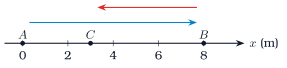
A particle moves along a straight line from \(A\) to \(B\) and then back to \(C\), as shown.
Find the distance travelled.
Find the displacement.
Find the ratio of displacement to distance.
Answer(i) \(13\) m (ii) \(+3\) m (iii) \(\frac{3}{13}\)
Solution
\(A \to B\) is \(8\) m and \(B \to C\) is \(5\) m: distance \(= 13\) m.
Displacement \(= x_C - x_A = 3 - 0 = +3\) m.
\(\dfrac{3}{13}\). The ratio can never exceed \(1\).
How did it go?
Q3
A body moves on a circle of radius \(7\) m. Take \(\pi = \frac{22}{7}\). Find the distance and the displacement after
half a revolution,
one full revolution.
Answer(i) \(22\) m; \(14\) m (ii) \(44\) m; \(0\)
Solution
Distance \(= \pi r = \dfrac{22}{7} \times 7 = 22\) m. The body is at the opposite end of a diameter: displacement \(= 2r = 14\) m.
Distance \(= 2\pi r = 44\) m. The body is back at the start: displacement \(= 0\).
How did it go?
Q4
Answer yes or no, with a reason.
Can the displacement be larger than the distance?
Can the distance be non-zero while the displacement is zero?
Answer(i) no (ii) yes, round trip
Solution
No. The straight line between two points is the shortest path, so the distance is at least the displacement.
Yes. On a round trip the body returns to the start: the displacement is zero but the distance is not.
How did it go?
Average speed and velocity
Q5
A car covers the first half of a distance at \(40\) km/h and the second half at \(60\) km/h. Show that the average speed is \(\frac{2v_1v_2}{v_1 + v_2}\) and find it.
Answer\(\frac{2d}{d/v_1 + d/v_2}\); \(48\) km/h
Solution
Let each half be \(d\). Time \(= \dfrac{d}{v_1} + \dfrac{d}{v_2}\). Average speed \(= \dfrac{2d}{d/v_1 + d/v_2} = \dfrac{2v_1v_2}{v_1 + v_2}\).
\(= \dfrac{2 \times 40 \times 60}{100} = 48\) km/h. It is less than \(50\) because the car spends more time at the slower speed.
How did it go?
Q6
A car moves at \(40\) km/h for the first half of the time and at \(60\) km/h for the second half. Find the average speed. Why does it differ from Question 5?
Answer\(50\) km/h; more time at the higher speed
Solution
Let each half of the time be \(t\). Distance \(= 40t + 60t = 100t\). Average speed \(= \dfrac{100t}{2t} = 50\) km/h, the plain average.
In Question 5 the slow part took more time than the fast part; here both take the same time.
How did it go?
Q7
A car goes \(100\) km at \(50\) km/h and then \(100\) km at \(25\) km/h.
Find the time for each part.
Find the average speed.
Answer(i) \(2\) h; \(4\) h (ii) \(\frac{100}{3} \approx 33\) km/h
Solution
\(\dfrac{100}{50} = 2\) h and \(\dfrac{100}{25} = 4\) h.
\(\dfrac{200}{6} = \dfrac{100}{3} \approx 33\) km/h. Check with Question 5: \(\dfrac{2 \times 50 \times 25}{75} = \dfrac{100}{3}\).
How did it go?
Q8
A body covers three equal distances at \(20\), \(30\) and \(60\) km/h. Find the average speed.
Answer\(30\) km/h
Solution
Let each part be \(d\). Time \(= \dfrac{d}{20} + \dfrac{d}{30} + \dfrac{d}{60} = d\left(\dfrac{3 + 2 + 1}{60}\right) = \dfrac{d}{10}\).
Average speed \(= \dfrac{3d}{d/10} = 30\) km/h.
How did it go?
Q9
A body moves \(10\) m east in \(2\) s and then \(4\) m west in the next \(2\) s.
Find the average speed.
Find the average velocity.
Answer(i) \(3.5\) m/s (ii) \(1.5\) m/s east
Solution
Distance \(= 14\) m in \(4\) s: \(3.5\) m/s.
Displacement \(= 10 - 4 = 6\) m east in \(4\) s: \(1.5\) m/s east.
How did it go?
Q10
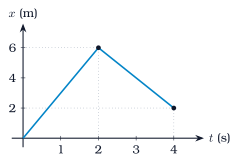
The figure shows the position of a particle against time.
Find the average velocity from \(t = 0\) to \(2\) s and from \(t = 2\) to \(4\) s.
Find the average velocity from \(t = 0\) to \(4\) s.
Find the average speed from \(t = 0\) to \(4\) s.
Answer(i) \(3\) m/s; \(-2\) m/s (ii) \(0.5\) m/s (iii) \(2.5\) m/s
Solution
\(0\) to \(2\) s: \(\dfrac{6 - 0}{2} = 3\) m/s. \(2\) to \(4\) s: \(\dfrac{2 - 6}{2} = -2\) m/s.
\(\dfrac{2 - 0}{4} = 0.5\) m/s.
Distance \(= 6 + 4 = 10\) m in \(4\) s: \(2.5\) m/s.
How did it go?
Calculus kinematics
Q11
The position of a particle is \(x = t^3 - 6t^2 + 9t\). Here \(x\) is in metres and \(t\) is in seconds.
Find \(v(t)\) and the times at which the particle is at rest.
Find \(a(t)\) and the time at which \(a = 0\).
Answer(i) \(3t^2 - 12t + 9\); \(1\) s, \(3\) s (ii) \(6t - 12\); \(2\) s
Solution
\(v = \dfrac{dx}{dt} = 3t^2 - 12t + 9 = 3(t - 1)(t - 3)\). \(v = 0\) at \(t = 1\) s and \(t = 3\) s.
\(a = \dfrac{dv}{dt} = 6t - 12\). \(a = 0\) at \(t = 2\) s.
How did it go?
Q12
The velocity of a particle is \(v = 4t - t^2\). Here \(v\) is in m/s and \(t\) is in seconds.
Find the acceleration at \(t = 1\) s.
When is the velocity greatest?
Find the displacement from \(t = 0\) to \(4\) s.
Answer(i) \(2\) m/s\(^2\) (ii) \(2\) s (iii) \(\frac{32}{3} \approx 10.7\) m
Solution
\(a = 4 - 2t = 2\) m/s\(^2\) at \(t = 1\) s.
\(v\) is greatest when \(a = 0\), at \(t = 2\) s (\(v = 4\) m/s).
\(\Delta x = \int_0^4 (4t - t^2)\,dt = \left[2t^2 - \dfrac{t^3}{3}\right]_0^4 = 32 - \dfrac{64}{3} = \dfrac{32}{3} \approx 10.7\) m.
How did it go?
Q13
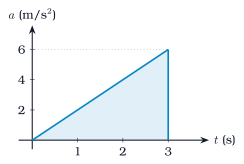
The acceleration of a particle is \(a = 2t\) in m/s\(^2\), with \(t\) in seconds. At \(t = 0\) the particle is at rest at \(x = 0\). Find \(v\) and \(x\) at \(t = 3\) s.
Answer\(9\) m/s; \(9\) m
Solution
\(v = \int_0^3 2t\,dt = [t^2]_0^3 = 9\) m/s. In general \(v = t^2\), so \(x = \int_0^3 t^2\,dt = \left[\dfrac{t^3}{3}\right]_0^3 = 9\) m.
How did it go?
Q14
The velocity of a particle depends on its position: \(v = 2x\), with \(v\) in m/s and \(x\) in metres. Use \(a = v\frac{dv}{dx}\) to find the acceleration at \(x = 3\) m.
A particle starts at \(x = 0\) with \(u = 10\) m/s and its acceleration is \(a = -2v\), in SI units.
Use \(a = v\frac{dv}{dx}\) to show that \(v = u - 2x\).
Find the distance at which the particle stops.
Answer(i) \(\frac{dv}{dx} = -2\) (ii) \(5\) m
Solution
\(v\dfrac{dv}{dx} = -2v\) gives \(\dfrac{dv}{dx} = -2\). Integrate: \(v = -2x + C\), and \(v = u\) at \(x = 0\), so \(v = u - 2x\).
\(v = 0\) when \(x = \dfrac{u}{2} = 5\) m.
How did it go?
Q16
The acceleration of a particle is \(a = 4x\) in m/s\(^2\), with \(x\) in metres. It starts from rest at \(x = 0\). Find \(v\) as a function of \(x\), and its value at \(x = 3\) m.
Answer\(v = 2x\); \(6\) m/s
Solution
\(v\dfrac{dv}{dx} = 4x\), so \(v\,dv = 4x\,dx\). Integrate from the start: \(\dfrac{v^2}{2} = 2x^2\), hence \(v = 2x\). At \(x = 3\) m: \(v = 6\) m/s.
How did it go?
Q17
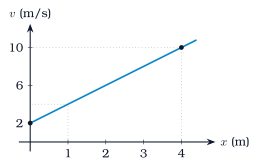
The figure shows the velocity of a particle against its position.
Write \(v\) as a function of \(x\).
Find \(\frac{dv}{dx}\) and hence \(a = v\frac{dv}{dx}\) at \(x = 1\) m.
Is the acceleration constant? Give the reason.
Answer(i) \(v = 2 + 2x\) (ii) \(2\) s\(^{-1}\); \(8\) m/s\(^2\) (iii) no, \(a = 2v\)
\(a = 2t\). \(v = 2 + \int_0^t 2t\,dt = 2 + t^2\), which gives \(11\) m/s at \(t = 3\) s.
How did it go?
Instantaneous and average
Q19
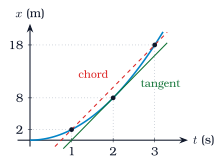
The figure shows \(x = 2t^2\), in SI units, with the chord from \(t = 1\) s to \(t = 3\) s and the tangent at \(t = 2\) s.
Find the average velocity from \(t = 1\) to \(3\) s from the chord.
Find the instantaneous velocity at \(t = 2\) s from \(\frac{dx}{dt}\).
Why are the two equal here?
Answer(i) \(8\) m/s (ii) \(8\) m/s (iii) uniform \(a\), midpoint
Solution
\(\bar v = \dfrac{x(3) - x(1)}{3 - 1} = \dfrac{18 - 2}{2} = 8\) m/s, the slope of the chord.
\(v = \dfrac{dx}{dt} = 4t = 8\) m/s at \(t = 2\) s, the slope of the tangent.
The acceleration is constant (\(4\) m/s\(^2\)), so \(v\) changes uniformly. The average over an interval then equals the instantaneous value at its midpoint, \(t = 2\) s.
How did it go?
Q20
Answer with an example.
Can the velocity be zero while the acceleration is not?
Can the speed stay constant while the velocity changes?
Answer(i) yes, top of a throw (ii) yes, circular motion
Solution
Yes. A ball thrown up is at rest for an instant at the top, while its acceleration is still \(g\) downward.
Yes. In uniform circular motion the speed is constant but the direction of the velocity keeps changing.
How did it go?
Q21
A ball moves at \(5\) m/s to the right at \(t = 0\) and at \(5\) m/s to the left at \(t = 2\) s. Find the average acceleration and its direction.
Answer\(5\) m/s\(^2\) to the left
Solution
Take right as positive: \(\Delta v = -5 - 5 = -10\) m/s. \(\bar a = \dfrac{-10}{2} = -5\) m/s\(^2\), that is, \(5\) m/s\(^2\) towards the left.
How did it go?
Small situations
Q22
An athlete runs \(100\) m in \(10\) s and then walks back \(50\) m in \(25\) s.
Find the average speed.
Find the average velocity.
Answer(i) \(\frac{30}{7} \approx 4.3\) m/s (ii) \(\frac{10}{7} \approx 1.4\) m/s
Solution
Distance \(= 150\) m in \(35\) s: \(\dfrac{150}{35} = \dfrac{30}{7} \approx 4.3\) m/s.
Displacement \(= 50\) m in \(35\) s: \(\dfrac{50}{35} = \dfrac{10}{7} \approx 1.4\) m/s, in the direction of the run.
How did it go?
Q23
Find the average acceleration in each case.
A car goes from \(10\) m/s to \(30\) m/s in \(5\) s.
A train slows from \(20\) m/s to rest in \(10\) s.
Answer(i) \(4\) m/s\(^2\) (ii) \(-2\) m/s\(^2\)
Solution
\(\dfrac{30 - 10}{5} = 4\) m/s\(^2\).
\(\dfrac{0 - 20}{10} = -2\) m/s\(^2\). The minus sign means the acceleration opposes the motion.
How did it go?
Q24
The position of a particle is \(x = 8 + 4t - 2t^2\). Here \(x\) is in metres and \(t\) is in seconds.
Write the initial position, the initial velocity and the acceleration.
When does it stop, and where?
Answer(i) \(8\) m; \(4\) m/s; \(-4\) m/s\(^2\) (ii) \(1\) s; \(10\) m
Solution
At \(t = 0\), \(x = 8\) m. \(v = 4 - 4t\), so \(u = 4\) m/s. \(a = -4\) m/s\(^2\).
\(v = 0\) at \(t = 1\) s. Then \(x = 8 + 4 - 2 = 10\) m.
How did it go?
Equations of Motion with Uniform Acceleration
24 questions · after Lesson 6, Equations of Motion
The three equations
Q25
A body starts at \(5\) m/s and accelerates at \(2\) m/s\(^2\) for \(4\) s.
Find the final velocity.
Find the distance covered.
Answer(i) \(13\) m/s (ii) \(36\) m
Solution
\(v = u + at = 5 + 2 \times 4 = 13\) m/s.
\(s = ut + \dfrac{1}{2}at^2 = 20 + \dfrac{1}{2} \times 2 \times 16 = 36\) m.
How did it go?
Q26
A body moving at \(20\) m/s decelerates at \(4\) m/s\(^2\).
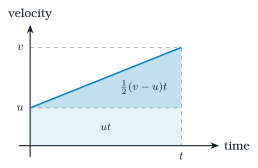
The slope of the \(v\)-\(t\) line is the acceleration: \(a = \dfrac{v - u}{t}\), so \(v = u + at\).
The displacement is the area under the graph: rectangle \(ut\) plus triangle \(\dfrac{1}{2}(v - u)t = \dfrac{1}{2}(at)t\). So \(s = ut + \dfrac{1}{2}at^2\).
A particle with uniform acceleration is at \(x = 0\) at \(t = 0\), at \(x = 3\) m at \(t = 1\) s and at \(x = 10\) m at \(t = 2\) s. Find \(u\) and \(a\).
Answer\(u = 1\) m/s; \(a = 4\) m/s\(^2\)
Solution
\(s = ut + \dfrac{1}{2}at^2\). At \(t = 1\): \(u + \dfrac{a}{2} = 3\). At \(t = 2\): \(2u + 2a = 10\), that is, \(u + a = 5\).
Subtract: \(\dfrac{a}{2} = 2\), so \(a = 4\) m/s\(^2\) and \(u = 1\) m/s.
How did it go?
Q32
A body with uniform acceleration covers \(20\) m in the \(2\)nd second and \(30\) m in the \(4\)th second. Use \(s_n = u + \frac{a}{2}(2n - 1)\) to find \(a\) and \(u\).
Show that the distance covered in the \(n\)th second is \(s_n = u + \frac{a}{2}(2n - 1)\). Start from the distance covered in \(n\) seconds and in \((n - 1)\) seconds.
Answer\(s_n = s(n) - s(n - 1)\)
Solution
Distance in \(n\) seconds: \(s(n) = un + \dfrac{1}{2}an^2\). In \((n - 1)\) seconds: \(s(n - 1) = u(n - 1) + \dfrac{1}{2}a(n - 1)^2\).
A body starts from rest with uniform acceleration. Show that the distances covered in the \(1\)st, \(2\)nd and \(3\)rd seconds are in the ratio \(1 : 3 : 5\). If the first second gives \(3\) m, find the distance in the \(3\)rd second.
Answer\(s_n \propto 2n - 1\); \(15\) m
Solution
With \(u = 0\), \(s_n = \dfrac{a}{2}(2n - 1)\), so \(s_1 : s_2 : s_3 = 1 : 3 : 5\). The distance in the \(3\)rd second is \(5 \times 3 = 15\) m.
How did it go?
Two-stage motion
Q36
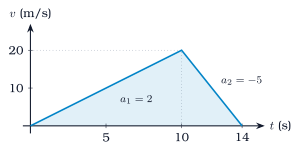
A car starts from rest, accelerates at \(2\) m/s\(^2\) for \(10\) s, and then brakes at \(5\) m/s\(^2\) until it stops.
Find the greatest speed.
Find the braking time and the total time.
Find the total distance from the area under the graph.
Answer(i) \(20\) m/s (ii) \(4\) s; \(14\) s (iii) \(140\) m
Solution
\(v = at = 2 \times 10 = 20\) m/s.
Braking: \(0 = 20 - 5t\), so \(t = 4\) s. Total time \(= 14\) s.
Area of the triangle \(= \dfrac{1}{2} \times 14 \times 20 = 140\) m. Check: \(\dfrac{1}{2} \times 2 \times 100 + \dfrac{20^2}{2 \times 5} = 100 + 40 = 140\) m.
How did it go?
Q37
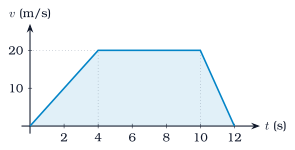
A lift starts from rest and accelerates at \(1\) m/s\(^2\) for \(4\) s. It moves uniformly for \(6\) s and then decelerates at \(2\) m/s\(^2\) to rest. Find the distance in each stage and the total height climbed.
Answer\(8\) m; \(24\) m; \(4\) m; \(36\) m
Solution
Stage 1: \(s = \dfrac{1}{2} \times 1 \times 16 = 8\) m, reaching \(v = 4\) m/s. Stage 2: \(s = 4 \times 6 = 24\) m. Stage 3: \(s = \dfrac{v^2}{2b} = \dfrac{16}{4} = 4\) m. Total \(= 8 + 24 + 4 = 36\) m.
How did it go?
Q38
A train accelerates from rest at \(a\) for time \(t_1\) and then decelerates at \(b\) to rest in time \(t_2\).
Show that the greatest speed is \(v = at_1 = bt_2\) and that the total distance is \(\frac{1}{2}v(t_1 + t_2)\).
Take \(a = 1\) m/s\(^2\), \(b = 2\) m/s\(^2\) and a total time of \(6\) s. Find \(t_1\), \(t_2\), \(v\) and the distance.
Answer(i) area of triangle (ii) \(4\) s; \(2\) s; \(4\) m/s; \(12\) m
Solution
The speed rises from \(0\) to \(v\) in \(t_1\) at rate \(a\): \(v = at_1\). It falls from \(v\) to \(0\) in \(t_2\) at rate \(b\): \(v = bt_2\). The \(v\)-\(t\) graph is a triangle of base \(t_1 + t_2\) and height \(v\), so the distance is \(\dfrac{1}{2}v(t_1 + t_2)\).
A body moving at \(10\) m/s accelerates at \(2\) m/s\(^2\) for \(5\) s and then moves uniformly for another \(5\) s. Find the total distance.
Answer\(175\) m
Solution
Stage 1: \(s = 10 \times 5 + \dfrac{1}{2} \times 2 \times 25 = 75\) m, and \(v = 10 + 10 = 20\) m/s. Stage 2: \(20 \times 5 = 100\) m. Total \(= 175\) m.
How did it go?
Stopping distance
Q40
A car moving at \(20\) m/s brakes with a deceleration of \(5\) m/s\(^2\).
Find the stopping distance \(s\).
Find the stopping distance if the speed is \(40\) m/s. How many times larger is it?
Show in general that \(s = \frac{u^2}{2a}\).
Answer(i) \(40\) m (ii) \(160\) m, \(4\) times (iii) \(0 = u^2 - 2as\)
Solution
\(0 = 20^2 - 2 \times 5 \times s\), so \(s = \dfrac{400}{10} = 40\) m.
\(s = \dfrac{1600}{10} = 160\) m, four times as much. Doubling the speed multiplies the stopping distance by four.
With \(v = 0\): \(0 = u^2 - 2as\), so \(s = \dfrac{u^2}{2a}\).
How did it go?
Q41
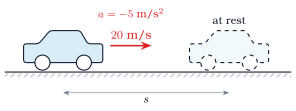
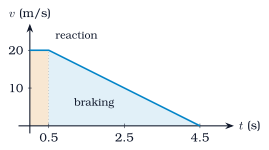
A driver at \(20\) m/s sees an obstacle. The reaction time is \(0.5\) s, and then the brakes give a deceleration of \(5\) m/s\(^2\).
Find the distance covered during the reaction time.
Find the braking distance.
Find the total stopping distance.
Answer(i) \(10\) m (ii) \(40\) m (iii) \(50\) m
Solution
The car moves at a steady \(20\) m/s for \(0.5\) s: \(20 \times 0.5 = 10\) m.
\(\dfrac{u^2}{2a} = \dfrac{400}{10} = 40\) m.
\(10 + 40 = 50\) m, the whole area under the graph.
How did it go?
Q42
With the same reaction time and brakes as Question 17, a driver sees an obstacle \(60\) m ahead. Can the car stop in time at \(20\) m/s? At \(25\) m/s?
Answeryes (\(50\) m); no (\(75\) m)
Solution
At \(20\) m/s the stopping distance is \(50\) m, less than \(60\) m: the car stops in time.
At \(25\) m/s: reaction \(25 \times 0.5 = 12.5\) m, braking \(\dfrac{625}{10} = 62.5\) m, total \(75\) m. That is more than \(60\) m, so the car hits the obstacle.
How did it go?
Q43
A car needs \(90\) m to stop from a certain speed with a deceleration of \(5\) m/s\(^2\). Find the speed.
A body with uniform acceleration has velocity \(1\) m/s at point \(A\) and \(7\) m/s at point \(B\). Show that its velocity at the midpoint of \(AB\) is \(\sqrt{\frac{u^2 + v^2}{2}}\), and find it.
Answer\(v_m^2 = u^2 + as\); \(5\) m/s
Solution
Let \(AB = s\). Over the whole length \(v^2 = u^2 + 2as\). Over half the length \(v_m^2 = u^2 + as = u^2 + \dfrac{v^2 - u^2}{2} = \dfrac{u^2 + v^2}{2}\).
\(v_m = \sqrt{\dfrac{1 + 49}{2}} = \sqrt{25} = 5\) m/s. Note that this is more than the plain average \(4\) m/s.
How did it go?
Q45
A body speeds up uniformly from \(4\) m/s to \(16\) m/s in \(6\) s. Use the average velocity \(\frac{u + v}{2}\) to find the distance covered.
Answer\(60\) m
Solution
\(\bar v = \dfrac{4 + 16}{2} = 10\) m/s. \(s = \bar v t = 10 \times 6 = 60\) m.
How did it go?
Q46
A particle with uniform acceleration covers \(10\) m in the first \(2\) s and \(20\) m in the next \(2\) s. Find \(u\) and \(a\).
Answer\(u = 2.5\) m/s; \(a = 2.5\) m/s\(^2\)
Solution
First \(2\) s: \(2u + 2a = 10\), so \(u + a = 5\). First \(4\) s: \(4u + 8a = 30\), so \(u + 2a = 7.5\). Subtract: \(a = 2.5\) m/s\(^2\) and \(u = 2.5\) m/s.
How did it go?
Q47
A body with uniform acceleration has velocities \(10\) m/s and \(20\) m/s at two points \(75\) m apart. Find the acceleration and the time between the two points.
\(v = gt\): \(10\) m/s at \(1\) s, \(20\) m/s at \(2\) s, \(30\) m/s at \(3\) s.
How did it go?
Thrown upward
Q54
A ball is thrown straight up at \(20\) m/s.
Find the time to reach the top.
Find the greatest height.
Find the total time in the air and the speed on return.
Answer(i) \(2\) s (ii) \(20\) m (iii) \(4\) s; \(20\) m/s
Solution
\(0 = 20 - 10t\) gives \(t = 2\) s.
\(H = \dfrac{u^2}{2g} = \dfrac{400}{20} = 20\) m.
The way down takes as long as the way up: \(4\) s in all. The ball returns at \(20\) m/s, the speed of the throw.
How did it go?
Q55
A ball is thrown up at \(30\) m/s. Find its height at \(t = 1\) s and at \(t = 5\) s. Why are the two heights equal?
Answer\(25\) m; \(25\) m; same height up and down
Solution
\(h = 30t - 5t^2\). At \(t = 1\) s: \(30 - 5 = 25\) m. At \(t = 5\) s: \(150 - 125 = 25\) m.
The ball reaches the top at \(t = 3\) s. The instants \(1\) s and \(5\) s are \(2\) s before and \(2\) s after the top. So the ball is at the same height, once going up and once coming down.
How did it go?
Q56
A ball is thrown up at \(40\) m/s. Find the two times at which it is \(60\) m above the launch point. Explain why there are two.
Answer\(2\) s, \(6\) s; up and down
Solution
\(60 = 40t - 5t^2\), so \(t^2 - 8t + 12 = 0\) and \((t - 2)(t - 6) = 0\): \(t = 2\) s and \(t = 6\) s.
The ball passes \(60\) m on the way up at \(2\) s and again on the way down at \(6\) s. The top is at \(t = 4\) s, midway.
How did it go?
Q57
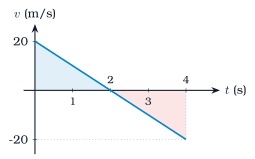
The figure shows the \(v\)-\(t\) graph of a ball thrown up at \(20\) m/s, with up taken as positive.
Read the time at which the ball is at the top. What is \(v\) there?
Find the slope of the line. What is it?
Find the area from \(0\) to \(2\) s and from \(2\) to \(4\) s. What does each mean?
Answer(i) \(2\) s; \(0\) (ii) \(-10\) m/s\(^2\), \(-g\) (iii) \(+20\) m up; \(-20\) m down
Solution
The line crosses the axis at \(t = 2\) s: there \(v = 0\), the top of the flight.
Slope \(= \dfrac{-20 - 20}{4} = -10\) m/s\(^2\): the acceleration, \(-g\), the same throughout.
\(0\) to \(2\) s: \(\dfrac{1}{2} \times 2 \times 20 = +20\) m, the rise to the top. \(2\) to \(4\) s: \(-20\) m, the fall back. The net displacement is zero.
How did it go?
Q58
Take up as positive. Write \(v(t)\) and \(h(t)\) for a ball thrown up at speed \(u\). State the velocity and the acceleration of the ball at the highest point.
Answer\(v = u - gt\); \(h = ut - \frac{1}{2}gt^2\); \(0\); \(-g\)
Solution
With up positive the acceleration is \(-g\): \(v = u - gt\) and \(h = ut - \dfrac{1}{2}gt^2\).
At the top the velocity is zero for an instant, but the acceleration is still \(-g\): the ball does not stay there.
How did it go?
Q59
A ball is thrown up at \(20\) m/s from the roof of a building \(25\) m high. Find the time it takes to reach the ground and its speed on arrival.
Answer\(5\) s; \(30\) m/s
Solution
Take the roof as the origin and up as positive. The ground is at \(h = -25\) m: \(-25 = 20t - 5t^2\), so \(t^2 - 4t - 5 = 0\) and \((t - 5)(t + 1) = 0\): \(t = 5\) s.
\(v = 20 - 50 = -30\) m/s: the ball arrives at \(30\) m/s, moving down.
How did it go?
Thrown downward and two bodies
Q60
A ball is thrown straight down at \(10\) m/s from a height of \(75\) m. Find the time to reach the ground and the speed on arrival.
Answer\(3\) s; \(40\) m/s
Solution
Take down as positive: \(75 = 10t + 5t^2\), so \(t^2 + 2t - 15 = 0\) and \((t + 5)(t - 3) = 0\): \(t = 3\) s. \(v = 10 + 30 = 40\) m/s.
How did it go?
Q61
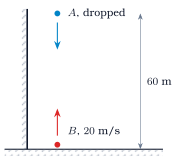
Ball \(A\) is dropped from the top of a \(60\) m tower. At the same instant ball \(B\) is thrown up from the ground at \(20\) m/s.
Write the height of each ball above the ground as a function of \(t\).
Find when and where they meet.
Show that the time to meet is \(\frac{h}{u}\) for any tower height \(h\) and throw speed \(u\).
Answer(i) \(60 - 5t^2\); \(20t - 5t^2\) (ii) \(3\) s; \(15\) m (iii) \(h - \frac{1}{2}gt^2 = ut - \frac{1}{2}gt^2\)
\(h_A = h_B\) gives \(60 = 20t\), so \(t = 3\) s. Then \(h = 60 - 45 = 15\) m above the ground.
\(h - \dfrac{1}{2}gt^2 = ut - \dfrac{1}{2}gt^2\) gives \(t = \dfrac{h}{u}\). The \(\dfrac{1}{2}gt^2\) terms cancel: gravity affects both balls equally, so they approach each other at the steady relative speed \(u\).
How did it go?
Q62
A ball thrown up passes a point \(15\) m above the launch point twice, \(2\) s apart. Find the speed of the throw.
Answer\(20\) m/s
Solution
\(15 = ut - 5t^2\), so \(5t^2 - ut + 15 = 0\). Its roots \(t_1\), \(t_2\) satisfy \(t_1 + t_2 = \dfrac{u}{5}\) and \(t_1t_2 = 3\).
\((t_2 - t_1)^2 = (t_1 + t_2)^2 - 4t_1t_2\): \(4 = \dfrac{u^2}{25} - 12\), so \(u^2 = 400\) and \(u = 20\) m/s. Check: the roots are \(1\) s and \(3\) s.
How did it go?
Q63
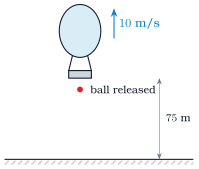
A balloon rises at a steady \(10\) m/s. When it is \(75\) m above the ground a ball is released from it.
What is the initial velocity of the ball? Give the reason.
Find the time the ball takes to reach the ground.
Find its speed on reaching the ground.
Answer(i) \(10\) m/s up (ii) \(5\) s (iii) \(40\) m/s
Solution
\(10\) m/s upward. The ball shares the balloon's velocity at the moment of release; only after that does gravity act on it alone.
Up positive, ground at \(-75\) m: \(-75 = 10t - 5t^2\), so \(t^2 - 2t - 15 = 0\) and \((t - 5)(t + 3) = 0\): \(t = 5\) s.
\(v = 10 - 50 = -40\) m/s: \(40\) m/s downward.
How did it go?
nth second and relations
Q64
A body is dropped from rest. Use \(s_n = u + \frac{g}{2}(2n - 1)\) to find the second in which it falls \(45\) m.
Answer\(5\)th
Solution
\(5(2n - 1) = 45\) gives \(2n - 1 = 9\), so \(n = 5\): the fifth second.
How did it go?
Q65
A body falling from rest covers \(45\) m in the last second of its fall. Find the total time of fall and the height from which it fell.
Answer\(5\) s; \(125\) m
Solution
The last second is the \(n\)th second with \(5(2n - 1) = 45\), so \(n = 5\): the fall lasts \(5\) s. Height \(= \dfrac{1}{2} \times 10 \times 25 = 125\) m.
How did it go?
Q66
A ball thrown up takes time \(T\) to reach its greatest height \(H\). Show that \(u = gT\) and \(H = \frac{1}{2}gT^2\). Find \(u\) and \(H\) for \(T = 3\) s.
Answer\(0 = u - gT\); \(30\) m/s; \(45\) m
Solution
At the top \(v = 0\): \(0 = u - gT\), so \(u = gT\). Then \(H = uT - \dfrac{1}{2}gT^2 = gT^2 - \dfrac{1}{2}gT^2 = \dfrac{1}{2}gT^2\).
\(T = 3\) s: \(u = 30\) m/s and \(H = 5 \times 9 = 45\) m.
How did it go?
Q67
Show that a ball thrown up at speed \(u\) stays in the air for \(\frac{2u}{g}\) and rises to \(\frac{u^2}{2g}\). What happens to each if \(u\) is doubled?
Time to the top: \(0 = u - gt\), \(t = \dfrac{u}{g}\); the whole flight takes twice that, \(\dfrac{2u}{g}\). Height: \(0 = u^2 - 2gH\), so \(H = \dfrac{u^2}{2g}\).
Doubling \(u\) doubles the time of flight and multiplies the height by four.
How did it go?
Small situations
Q68
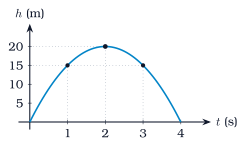
The figure shows the height of a ball thrown up at \(20\) m/s against time.
Read the greatest height and the time of flight.
Read the two times at which the ball is \(15\) m high. Check them from \(h = 20t - 5t^2\).
What does the slope of the curve give? Where is the slope zero?
Answer(i) \(20\) m; \(4\) s (ii) \(1\) s, \(3\) s (iii) velocity; \(t = 2\) s
Solution
The top of the curve is at \(20\) m, at \(t = 2\) s. The curve returns to zero at \(t = 4\) s: the time of flight.
\(1\) s and \(3\) s. Check: \(20 - 5 = 15\) and \(60 - 45 = 15\).
The slope of \(h\) against \(t\) is the velocity. It is zero at the top, \(t = 2\) s.
How did it go?
Q69
A parachutist falls freely for \(2\) s before the parachute opens. Find the distance fallen and the speed reached in that time.
Answer\(20\) m; \(20\) m/s
Solution
\(s = 5 \times 4 = 20\) m and \(v = 10 \times 2 = 20\) m/s.
How did it go?
Q70
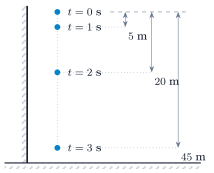
Drops of water leave a tap \(5\) m above the floor at equal time intervals. When the third drop leaves, the first drop reaches the floor.
Find the time interval between drops.
Find the height of the second drop at that instant.
Answer(i) \(0.5\) s (ii) \(3.75\) m
Solution
The first drop falls \(5\) m in \(t\) with \(5 = 5t^2\), so \(t = 1\) s. Two intervals fit in this time: the interval is \(0.5\) s.
The second drop has fallen for \(0.5\) s: \(5 \times 0.25 = 1.25\) m. It is \(5 - 1.25 = 3.75\) m above the floor.
How did it go?
Q71
On the Moon \(g = 1.6\) m/s\(^2\). A ball is thrown up at \(8\) m/s. Find the greatest height and the time of flight, and compare with the same throw on the Earth.
Answer\(20\) m; \(10\) s; Earth \(3.2\) m, \(1.6\) s
Solution
Moon: \(H = \dfrac{64}{2 \times 1.6} = 20\) m and \(T = \dfrac{2 \times 8}{1.6} = 10\) s.
Earth: \(H = \dfrac{64}{20} = 3.2\) m and \(T = \dfrac{16}{10} = 1.6\) s. On the Moon the ball goes about six times higher and stays up six times longer.
How did it go?
Q72
A ball dropped from height \(h\) reaches the ground at speed \(v\) after time \(t\). Find the speed and the time when it is dropped from \(4h\). Give the reasons.
Answer\(2v\); \(2t\)
Solution
\(v = \sqrt{2gh}\), so four times the height gives \(\sqrt{4} = 2\) times the speed: \(2v\). \(t = \sqrt{\dfrac{2h}{g}}\), so the time also doubles: \(2t\).