Questions on Relative Velocity in One Dimension, the kind your examinations ask. Solve one on paper. Then tell the book how it went. The book believes you, and it uses your answer to plan your revision.
0%
Nothing marked yetMark honestly. Peek at the answer only after your own attempt.
Relative Velocity in One Dimension
24 questions · after Lesson 5, Free Fall Together, and Graphs of Relative Motion
Basics
Q1
Car \(A\) moves east at \(20\) m/s and car \(B\) moves east at \(15\) m/s. Use \(\vec v_{AB} = \vec v_A - \vec v_B\).
Find the velocity of \(A\) relative to \(B\).
Find the velocity of \(B\) relative to \(A\).
Answer(i) \(5\) m/s east (ii) \(5\) m/s west
Solution
\(v_{AB} = 20 - 15 = 5\) m/s east. Seen from \(B\), \(A\) creeps ahead at \(5\) m/s.
\(v_{BA} = 15 - 20 = -5\) m/s, that is, \(5\) m/s west. Seen from \(A\), \(B\) falls behind.
How did it go?
Q2
Car \(A\) moves east at \(20\) m/s and car \(B\) moves west at \(15\) m/s. Find the velocity of \(A\) relative to \(B\). How fast does the gap between them close?
Answer\(35\) m/s east; \(35\) m/s
Solution
Take east as positive: \(v_B = -15\) m/s. \(v_{AB} = 20 - (-15) = 35\) m/s east. The gap closes at \(35\) m/s.
How did it go?
Q3
A train \(100\) m long moves at \(20\) m/s.
Find the time it takes to pass a pole.
Find the time it takes to pass a platform \(300\) m long.
Answer(i) \(5\) s (ii) \(20\) s
Solution
The train must move its own length: \(\dfrac{100}{20} = 5\) s.
It must move its length plus the platform: \(\dfrac{400}{20} = 20\) s.
How did it go?
Q4
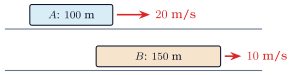
Train \(A\) (\(100\) m, \(20\) m/s) overtakes train \(B\) (\(150\) m, \(10\) m/s) on a parallel track.
Find the relative velocity of \(A\) with respect to \(B\).
What distance must \(A\) cover relative to \(B\) to pass it completely? Find the time.
Find the time if the trains move in opposite directions.
Answer(i) \(10\) m/s (ii) \(250\) m; \(25\) s (iii) \(\frac{25}{3} \approx 8.3\) s
Solution
\(v_{AB} = 20 - 10 = 10\) m/s.
Relative to \(B\), the front of \(A\) must move from the rear of \(B\) to a full train length past its front: \(100 + 150 = 250\) m. Time \(= \dfrac{250}{10} = 25\) s.
Relative speed \(= 30\) m/s, the same \(250\) m: \(\dfrac{250}{30} = \dfrac{25}{3} \approx 8.3\) s.
How did it go?
Q5
A train moves at \(10\) m/s. A man inside walks at \(2\) m/s relative to the train. Find his velocity relative to the ground when he walks
Car \(A\) at \(30\) m/s is \(200\) m behind car \(B\) at \(20\) m/s, both moving the same way.
Find the time \(A\) takes to catch \(B\).
Find the distance \(A\) covers in that time.
Answer(i) \(20\) s (ii) \(600\) m
Solution
Relative speed \(= 10\) m/s, gap \(200\) m: \(t = 20\) s.
\(30 \times 20 = 600\) m. Check: \(B\) moves \(400\) m, and \(400 + 200 = 600\).
How did it go?
Q7
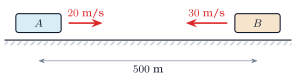
Cars \(A\) and \(B\) are \(500\) m apart and move towards each other at \(20\) m/s and \(30\) m/s.
Find the speed at which the gap closes.
Find the time until they meet.
How far from \(A\)'s starting point do they meet?
Answer(i) \(50\) m/s (ii) \(10\) s (iii) \(200\) m
Solution
\(20 + 30 = 50\) m/s.
\(\dfrac{500}{50} = 10\) s.
\(A\) covers \(20 \times 10 = 200\) m. Check: \(B\) covers \(300\) m, and \(200 + 300 = 500\).
How did it go?
Q8
A police car at \(40\) m/s chases a thief's car at \(30\) m/s that is \(1\) km ahead. Find the time to catch it and the distance the police car travels.
Answer\(100\) s; \(4\) km
Solution
Relative speed \(= 10\) m/s, gap \(1000\) m: \(t = 100\) s. Police car distance \(= 40 \times 100 = 4000\) m \(= 4\) km.
How did it go?
Q9
A man runs at \(5\) m/s towards a bus \(30\) m ahead. At that instant the bus starts from rest with acceleration \(1\) m/s\(^2\) away from him.
Write the gap between them as a function of time.
Show that the man never catches the bus.
Find the least gap and the time at which it occurs.
Answer(i) \(30 - 5t + \frac{1}{2}t^2\) (ii) \(t^2 - 10t + 60 = 0\) has no root (iii) \(17.5\) m at \(5\) s
Gap \(= 0\) gives \(t^2 - 10t + 60 = 0\), with discriminant \(100 - 240 < 0\). There is no real \(t\), so the gap never closes.
The gap is least when the relative velocity is zero: \(5 = t\), at \(t = 5\) s. Gap \(= 30 - 25 + 12.5 = 17.5\) m.
How did it go?
Q10
Two balls are thrown up from the ground at \(20\) m/s, the second \(1\) s after the first. Take \(g = 10\) m/s\(^2\).
What is the acceleration of one ball relative to the other while both are in the air?
Find the relative velocity while both are in the air.
Find the time (from the first throw) and the height at which they pass each other.
Answer(i) \(0\) (ii) \(10\) m/s (iii) \(2.5\) s; \(18.75\) m
Solution
Both have acceleration \(g\) downward, so the relative acceleration is zero.
At \(t = 1\) s the first ball has \(v = 20 - 10 = 10\) m/s up and the second has \(20\) m/s up. Relative velocity \(= 10\) m/s, and it stays so because the relative acceleration is zero.
At \(t = 1\) s the first ball is at \(20 - 5 = 15\) m. The second closes this gap at \(10\) m/s: \(1.5\) s more, so \(t = 2.5\) s. Height \(= 20 \times 2.5 - 5 \times 6.25 = 18.75\) m.
How did it go?
Relative acceleration
Q11
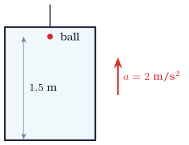
A lift accelerates upward at \(2\) m/s\(^2\). A ball is released from its ceiling, \(1.5\) m above the floor.
Find the acceleration of the ball relative to the lift.
Find the time the ball takes to reach the floor.
Would the time change if the lift moved up at a steady \(2\) m/s? Give the reason.
Answer(i) \(12\) m/s\(^2\) down (ii) \(0.5\) s (iii) yes, \(\sqrt{0.3} \approx 0.55\) s
Solution
Ball: \(g = 10\) m/s\(^2\) down. Lift: \(2\) m/s\(^2\) up. Relative to the lift the ball accelerates at \(10 + 2 = 12\) m/s\(^2\) downward.
Relative to the lift the ball starts from rest: \(1.5 = \dfrac{1}{2} \times 12 \times t^2\), so \(t^2 = 0.25\) and \(t = 0.5\) s.
Yes. With a steady velocity the lift has no acceleration, so the relative acceleration is only \(g\): \(1.5 = 5t^2\), \(t = \sqrt{0.3} \approx 0.55\) s. Only the acceleration of the lift matters, not its velocity.
How did it go?
Q12
Two stones are dropped from a tower \(1\) s apart. Find the separation between them \(2\) s after the second is dropped, and their relative velocity then.
Answer\(25\) m; \(10\) m/s
Solution
Second stone falls \(2\) s: \(20\) m. First stone falls \(3\) s: \(45\) m. Separation \(= 25\) m. Velocities \(30\) and \(20\) m/s: relative velocity \(10\) m/s, and it stays \(10\) m/s because the relative acceleration is zero.
How did it go?
Q13
Two cars start from rest at the same point and instant along one road. \(A\) accelerates at \(2\) m/s\(^2\) and \(B\) at \(3\) m/s\(^2\). Find their separation and their relative velocity after \(10\) s.
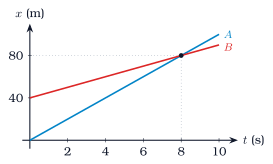
The lines cross: \(A\), which started \(40\) m behind, catches \(B\) at \(x = 80\) m and overtakes it. Check: \(\dfrac{40}{5} = 8\) s.
How did it go?
Q16
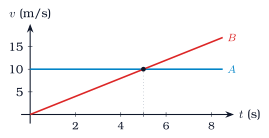
The figure shows the \(v\)-\(t\) graphs of two bodies that start from the same point at \(t = 0\).
At what time are the two velocities equal?
Which body is ahead at that instant, and by how much?
When does \(B\) catch \(A\)?
Answer(i) \(5\) s (ii) \(A\), \(25\) m (iii) \(10\) s
Solution
\(v_B = 2t = 10\) at \(t = 5\) s.
Up to \(5\) s, \(A\) is faster, so \(A\) is ahead. Gap \(=\) area between the graphs \(= 10 \times 5 - \dfrac{1}{2} \times 5 \times 10 = 25\) m. After this the gap shrinks.
\(10t = \dfrac{1}{2} \times 2 \times t^2\) gives \(t = 10\) s, when the two areas are equal.
How did it go?
Q17
Two trains \(10\) km apart approach each other at \(60\) km/h and \(40\) km/h. A bird flies back and forth between them at \(100\) km/h until they meet. Find the time until they meet and the distance the bird flies.
Answer\(6\) min; \(10\) km
Solution
Closing speed \(= 100\) km/h, so they meet after \(\dfrac{10}{100}\) h \(= 6\) min. The bird flies at \(100\) km/h for \(\dfrac{1}{10}\) h: \(10\) km. Its many turns do not matter; only its speed and the time count.
How did it go?
Small situations
Q18
A boat moves at \(5\) m/s in still water. A river flows at \(2\) m/s. The boat goes \(21\) m upstream and then \(21\) m back downstream.
Find the time for each leg.
Compare the total with the time in still water.
Answer(i) \(7\) s; \(3\) s (ii) \(10\) s against \(8.4\) s
Total \(= 10\) s. In still water each leg takes \(\dfrac{21}{5} = 4.2\) s, total \(8.4\) s. The current always costs time, because the slow leg takes longer than the fast leg saves.
How did it go?
Q19
A person standing on a moving escalator reaches the top in \(60\) s. Walking up the stopped escalator takes \(30\) s. Find the time taken when the person walks up the moving escalator.
Answer\(20\) s
Solution
Let the length be \(L\). Escalator speed \(= \dfrac{L}{60}\), walking speed \(= \dfrac{L}{30}\). Together: \(\dfrac{L}{60} + \dfrac{L}{30} = \dfrac{L}{20}\), so the time is \(20\) s.
How did it go?
Q20
A car \(5\) m long at \(20\) m/s overtakes a truck \(15\) m long at \(15\) m/s.
Find the time taken to overtake.
Find the distance the car moves on the road meanwhile.
Answer(i) \(4\) s (ii) \(80\) m
Solution
Relative speed \(= 5\) m/s; relative distance \(= 5 + 15 = 20\) m. Time \(= 4\) s.
\(20 \times 4 = 80\) m.
How did it go?
Q21
Two cars move the same way at \(72\) km/h and \(54\) km/h, \(100\) m apart. Find the relative speed in m/s and the time for the faster car to catch the slower one.
Answer\(5\) m/s; \(20\) s
Solution
\(72\) km/h \(= 20\) m/s and \(54\) km/h \(= 15\) m/s. Relative speed \(= 5\) m/s. Time \(= \dfrac{100}{5} = 20\) s.
How did it go?
Q22
A lift moves down at a steady \(3\) m/s. A man inside throws a ball up at \(5\) m/s relative to the lift.
Find the ball's velocity relative to the ground.
After how long does the ball return to his hand?
Answer(i) \(2\) m/s up (ii) \(1\) s
Solution
Up positive: \(\vec v_{\text{lift}} = -3\) m/s. Ball: \(5 + (-3) = 2\) m/s upward relative to the ground.
The lift has no acceleration, so relative to the lift the ball is an ordinary throw at \(5\) m/s: it returns after \(\dfrac{2 \times 5}{10} = 1\) s.
How did it go?
Q23
A car moves at \(10\) m/s. A ball is thrown backward from it at \(10\) m/s relative to the car. Describe the ball's motion as seen from the ground.
Answerfalls straight down
Solution
Ground velocity \(= 10 + (-10) = 0\). The ball has no horizontal velocity, so it simply falls straight down from the point where it was released.
How did it go?
Q24
Show that two bodies moving freely under gravity have zero relative acceleration, so their relative velocity stays constant. Use this to check Question 10 (iii) in one line.
Answer\(\vec a_{12} = \vec g - \vec g = 0\); \(10 \times 2.5 = 5 + 20 \times 1\)
Solution
\(\vec a_1 = \vec a_2 = \vec g\), so \(\vec a_{12} = \vec a_1 - \vec a_2 = 0\). A zero relative acceleration means the relative velocity never changes.
Question 10: the second ball closes the \(15\) m gap at a steady \(10\) m/s in \(1.5\) s, so they meet at \(t = 2.5\) s.