Questions on Relative Velocity in Two Dimensions, the kind your examinations ask. Solve one on paper. Then tell the book how it went. The book believes you, and it uses your answer to plan your revision.
0%
Nothing marked yetMark honestly. Peek at the answer only after your own attempt.
Relative Velocity in Two Dimensions
24 questions · after Lesson 5, Two Bodies and the Closest Approach
Vector relative velocity
Q1
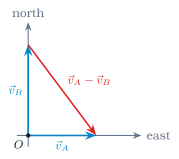
Car \(A\) moves east at \(3\) m/s and car \(B\) moves north at \(4\) m/s.
Write \(\vec v_{AB} = \vec v_A - \vec v_B\) in \(\hat i\), \(\hat j\) form, with \(\hat i\) east and \(\hat j\) north.
Find its magnitude.
Describe its direction: an angle south of east.
Answer(i) \(3\hat i - 4\hat j\) (ii) \(5\) m/s (iii) \(53^\circ\) south of east
Solution
\(\vec v_{AB} = 3\hat i - 4\hat j\) m/s.
\(\sqrt{9 + 16} = 5\) m/s.
\(\tan\theta = \dfrac{4}{3}\), so \(\theta = 53^\circ\) south of east. Seen from \(B\), \(A\) moves east and falls behind southward.
How did it go?
Q2
Two cars move at \(20\) m/s each, one east and one north. Find the magnitude of their relative velocity and the angle it makes with the east direction.
Answer\(20\sqrt{2} \approx 28\) m/s; \(45^\circ\)
Solution
\(\vec v_{AB} = 20\hat i - 20\hat j\): magnitude \(20\sqrt{2} \approx 28\) m/s, at \(45^\circ\) south of east.
How did it go?
Q3
An aeroplane flies with airspeed \(80\) m/s pointing north. The wind blows towards the east at \(60\) m/s. Find the plane's velocity relative to the ground: magnitude and direction.
Answer\(100\) m/s at \(37^\circ\) east of north
Solution
\(\vec v_{\text{ground}} = \vec v_{\text{air}} + \vec v_{\text{wind}} = 80\hat j + 60\hat i\). Magnitude \(\sqrt{6400 + 3600} = 100\) m/s. \(\tan\phi = \dfrac{60}{80}\), so \(\phi = 37^\circ\) east of north: the wind pushes it off course.
How did it go?
Q4
Another plane has airspeed \(100\) m/s in the same \(60\) m/s wind and must travel due north over the ground. In which direction must it point, and what is its ground speed? Take \(\sin 37^\circ = 0.6\).
Answer\(37^\circ\) west of north; \(80\) m/s
Solution
The plane must point partly into the wind so that the westward part of its airspeed cancels the wind. \(100\sin\alpha = 60\), so \(\sin\alpha = 0.6\) and \(\alpha = 37^\circ\) west of north. Ground speed \(= 100\cos 37^\circ = 80\) m/s, all of it northward.
How did it go?
Rain and man
Q5
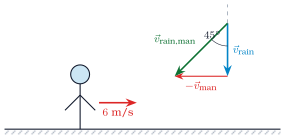
Rain falls vertically at \(4\) m/s. A man walks at \(3\) m/s.
Write the velocity of the rain relative to the man, taking his direction as \(\hat i\) and up as \(\hat j\).
Find its magnitude and the angle it makes with the vertical.
In which direction should he tilt his umbrella?
Answer(i) \(-3\hat i - 4\hat j\) (ii) \(5\) m/s; \(37^\circ\) (iii) forward, \(37^\circ\)
\(\tan\phi = \dfrac{12}{6} = 2\), so \(\phi \approx 63^\circ\): faster walking makes the rain seem more slanted.
How did it go?
Q7
A man walking at \(3\) m/s sees the rain at \(37^\circ\) to the vertical, coming towards his face. The rain is vertical for the ground. Find the speed of the rain. Take \(\tan 37^\circ = \frac{3}{4}\).
Answer\(4\) m/s
Solution
\(\tan 37^\circ = \dfrac{v_{\text{man}}}{v_{\text{rain}}}\), so \(\dfrac{3}{4} = \dfrac{3}{v_{\text{rain}}}\) and \(v_{\text{rain}} = 4\) m/s.
How did it go?
Q8
Rain falls at \(10\) m/s at \(37^\circ\) to the vertical, blown from the east. At what speed and in which direction should a man walk to see the rain falling vertically?
Answer\(6\) m/s towards the west
Solution
Rain velocity: horizontal \(10\sin 37^\circ = 6\) m/s towards the west, vertical \(8\) m/s down. For the rain to appear vertical, the man must move with its horizontal part: \(6\) m/s towards the west. Then \(\vec v_{\text{rain}} - \vec v_{\text{man}}\) has no horizontal component.
How did it go?
Q9
Rain appears vertical at \(4\) m/s to a man walking east at \(3\) m/s. Find the true velocity of the rain for the ground: speed and angle to the vertical.
Answer\(5\) m/s; \(37^\circ\) from vertical
Solution
\(\vec v_{\text{rain}} = \vec v_{\text{rain,man}} + \vec v_{\text{man}} = -4\hat j + 3\hat i\). Speed \(= 5\) m/s, at \(\tan^{-1}\dfrac{3}{4} = 37^\circ\) from the vertical, leaning towards the east.
How did it go?
River and boat
Q10
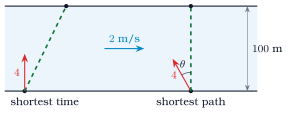
A river \(100\) m wide flows at \(2\) m/s. A boat with speed \(4\) m/s in still water heads straight across, perpendicular to the banks.
Find the time to cross.
Find the drift downstream.
Find the boat's speed over the ground.
Answer(i) \(25\) s (ii) \(50\) m (iii) \(2\sqrt{5} \approx 4.5\) m/s
Solution
Only the boat's own velocity carries it across: \(t = \dfrac{100}{4} = 25\) s.
The river carries it \(2 \times 25 = 50\) m downstream.
The same boat now wants to land directly opposite its starting point.
Find the angle \(\theta\) at which it must head upstream from the perpendicular.
Find its speed over the ground and the time to cross.
Which crossing is quicker, this one or the one in Question 10? Give the reason.
Answer(i) \(30^\circ\) (ii) \(2\sqrt{3} \approx 3.5\) m/s; \(\frac{50}{\sqrt{3}} \approx 29\) s (iii) Question 10, full \(v_b\) across
Solution
The upstream part of the boat's velocity must cancel the current: \(4\sin\theta = 2\), so \(\theta = 30^\circ\).
Ground speed \(= 4\cos 30^\circ = 2\sqrt{3} \approx 3.5\) m/s, straight across. Time \(= \dfrac{100}{2\sqrt{3}} = \dfrac{50}{\sqrt{3}} \approx 29\) s.
Question 10 is quicker (\(25\) s). Heading straight across uses the whole \(4\) m/s to cross; heading upstream spends part of it fighting the current.
How did it go?
Q12
A river of width \(d\) flows at \(v_r\) and a boat has speed \(v_b\). Write the shortest crossing time, the drift in that crossing, and the time along the shortest path.
Shortest time: head perpendicular, \(t_{\min} = \dfrac{d}{v_b}\), with drift \(v_r t_{\min} = \dfrac{v_r d}{v_b}\). Shortest path: head upstream with \(v_b\sin\theta = v_r\); the speed across is \(\sqrt{v_b^2 - v_r^2}\), so \(t = \dfrac{d}{\sqrt{v_b^2 - v_r^2}}\).
How did it go?
Q13
A boat with speed \(3\) m/s in still water is on a river \(100\) m wide flowing at \(5\) m/s.
Can it reach the point directly opposite? Give the reason.
The drift is least when the boat heads at angle \(\theta\) to the upstream bank with \(\cos\theta = \frac{v_b}{v_r}\). Find the least drift.
Answer(i) no, \(v_b < v_r\) (ii) \(\frac{400}{3} \approx 133\) m
Solution
No. To cancel the current it would need \(3\sin\theta = 5\), which is impossible; the boat is slower than the river, so it is always carried downstream.
\(\sin\theta = \dfrac{0.5}{1}\), \(\theta = 30^\circ\) upstream. Speed across \(= \cos 30^\circ = \dfrac{\sqrt{3}}{2}\) m/s, so \(t = \dfrac{40}{\sqrt{3}} \approx 23\) s.
How did it go?
Q15
A boat crosses a river in \(10\) min when it heads straight across and in \(12.5\) min along the shortest path. Find the ratio of the river speed to the boat speed.
Answer\(0.6\)
Solution
\(t_1 = \dfrac{d}{v_b}\) and \(t_2 = \dfrac{d}{\sqrt{v_b^2 - v_r^2}}\). \(\dfrac{t_2}{t_1} = \dfrac{1}{\sqrt{1 - (v_r/v_b)^2}} = 1.25\), so \(1 - (v_r/v_b)^2 = 0.64\) and \(\dfrac{v_r}{v_b} = 0.6\).
How did it go?
Q16
A river \(400\) m wide flows at \(2\) m/s. A swimmer's speed in still water is also \(2\) m/s. Can the swimmer reach the point directly opposite? Find the shortest crossing time and the drift then.
Answerno; \(200\) s; \(400\) m
Solution
To go straight across the swimmer would need \(2\sin\theta = 2\), that is, \(\theta = 90^\circ\), pointing straight upstream with no speed left to cross. So no. Shortest time: \(\dfrac{400}{2} = 200\) s, with drift \(2 \times 200 = 400\) m.
How did it go?
Minimum distance of approach
Q17
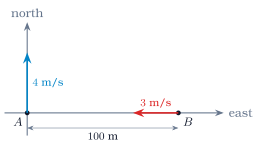
Ship \(A\) moves north at \(4\) m/s. Ship \(B\) is \(100\) m east of \(A\) and moves west at \(3\) m/s.
Find the velocity of \(B\) relative to \(A\): components, magnitude and direction.
Seen from \(A\), \(B\) moves along a straight line. Find the least distance between the ships.
Find the time at which this happens.
Answer(i) \(-3\hat i - 4\hat j\); \(5\) m/s; \(53^\circ\) south of west (ii) \(80\) m (iii) \(12\) s
Solution
\(\vec v_{BA} = \vec v_B - \vec v_A = -3\hat i - 4\hat j\): magnitude \(5\) m/s, pointing \(53^\circ\) south of west.
From \(A\), \(B\) starts at \(\vec r_0 = 100\hat i\) and moves along \(\vec v_{BA}\). The least distance is the perpendicular from \(A\) to that line: \(d = r_0\sin\alpha\), where \(\alpha\) is the angle between \(\vec r_0\) and \(\vec v_{BA}\). \(\sin\alpha = \dfrac{4}{5}\), so \(d = 80\) m.
\(B\) must travel \(r_0\cos\alpha = 60\) m along the line at \(5\) m/s: \(t = 12\) s.
How did it go?
Q18
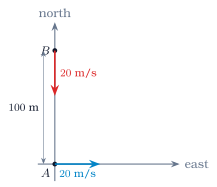
Car \(A\) passes the crossing \(O\) moving east at \(20\) m/s. At that instant car \(B\) is \(100\) m north of \(O\) moving south at \(20\) m/s.
Find the velocity of \(B\) relative to \(A\).
Find the closest distance between the cars.
Find the time at which they are closest.
Answer(i) \(-20\hat i - 20\hat j\) (ii) \(50\sqrt{2} \approx 71\) m (iii) \(2.5\) s
Solution
\(\vec v_{BA} = -20\hat j - 20\hat i\): \(20\sqrt{2}\) m/s towards the south-west.
\(\vec r_0 = 100\hat j\) makes \(45^\circ\) with \(\vec v_{BA}\): \(d = 100\sin 45^\circ = 50\sqrt{2} \approx 71\) m.
\(t = \dfrac{r_0\cos 45^\circ}{v} = \dfrac{100/\sqrt{2}}{20\sqrt{2}} = 2.5\) s.
How did it go?
Q19
Two roads cross at right angles. Car \(P\) is \(200\) m from the crossing and moves towards it at \(20\) m/s. Car \(Q\) is \(150\) m from it on the other road, moving at \(15\) m/s. Do they collide? Give the reason.
Answeryes, both reach \(O\) at \(10\) s
Solution
\(P\) reaches the crossing after \(\dfrac{200}{20} = 10\) s and \(Q\) after \(\dfrac{150}{15} = 10\) s. They arrive together, so they collide. In relative terms the relative velocity points exactly along the initial separation, so the least distance is zero.
How did it go?
Q20
Particle \(B\) starts \(100\) m east of particle \(A\). \(A\) moves east at \(5\) m/s and \(B\) moves north at \(5\) m/s. Find the closest distance between them and when it occurs.
Answer\(50\sqrt{2} \approx 71\) m; \(10\) s
Solution
\(\vec r_0 = 100\hat i\), \(\vec v_{BA} = 5\hat j - 5\hat i\), of magnitude \(5\sqrt{2}\) at \(135^\circ\) to \(\vec r_0\). \(d = 100\sin 135^\circ = 50\sqrt{2} \approx 71\) m. Time \(= \dfrac{-\vec r_0\cdot\vec v}{v^2} = \dfrac{500}{50} = 10\) s.
How did it go?
Q21
Two particles have initial separation \(\vec r_0\) (from \(A\) to \(B\)) and relative velocity \(\vec v\) (of \(B\) with respect to \(A\)). Show that the least distance is \(d = \frac{|\vec r_0 \times \vec v|}{|\vec v|}\) and that it occurs at \(t = -\frac{\vec r_0\cdot\vec v}{|\vec v|^2}\). Check with Question 20.
Answer\(d = r_0\sin\alpha\); \(t = \frac{r_0\cos\alpha}{v}\); \(71\) m at \(10\) s
Solution
Seen from \(A\), \(B\) moves along a straight line through \(\vec r_0\) in the direction of \(\vec v\). The least distance from \(A\) to this line is \(r_0\sin\alpha = \dfrac{|\vec r_0\times\vec v|}{|\vec v|}\).
\(B\) reaches the foot of the perpendicular after moving \(-r_0\cos\alpha\) along the line (the minus sign because \(\vec v\) points back towards \(A\)): \(t = \dfrac{-\vec r_0\cdot\vec v}{|\vec v|^2}\). Question 20: \(|\vec r_0\times\vec v| = 100 \times 5 = 500\), \(|\vec v| = 5\sqrt{2}\), so \(d = \dfrac{500}{5\sqrt{2}} \approx 71\) m and \(t = \dfrac{500}{50} = 10\) s.
How did it go?
Small situations
Q22
A car moves north at \(20\) m/s. The wind blows towards the east at \(20\) m/s. In which direction does a flag on the car point? Give the reason.
Answersouth-east
Solution
A flag points along the wind relative to the car: \(\vec v_{\text{wind}} - \vec v_{\text{car}} = 20\hat i - 20\hat j\), towards the south-east. The car's own motion adds an apparent wind from the north.
How did it go?
Q23
A boat heads straight across a river at \(4\) m/s in a current of \(3\) m/s. A person on the bank sees it move at some speed and angle. Find both.
Answer\(5\) m/s at \(53^\circ\) to the bank
Solution
Ground velocity \(= 4\hat j + 3\hat i\): speed \(5\) m/s, at \(\tan^{-1}\dfrac{4}{3} = 53^\circ\) to the bank, leaning downstream.
How did it go?
Q24
A boat heads at angle \(\theta\) to the bank, upstream, in a river of width \(d\) with speeds \(v_b\) and \(v_r\). Show that the crossing time is \(\frac{d}{v_b\sin\theta}\) and the drift is \((v_r - v_b\cos\theta)\frac{d}{v_b\sin\theta}\). What does \(\theta = 90^\circ\) give?
Across the river the boat's velocity component is \(v_b\sin\theta\), so \(t = \dfrac{d}{v_b\sin\theta}\). Along the river the ground velocity is \(v_r - v_b\cos\theta\), so the drift is \((v_r - v_b\cos\theta)t\).
\(\theta = 90^\circ\): \(t = \dfrac{d}{v_b}\), the shortest time, with drift \(\dfrac{v_r d}{v_b}\).