Questions on Objects in Equilibrium, the kind your examinations ask. Solve one on paper. Then tell the book how it went. The book believes you, and it uses your answer to plan your revision.
0%
Nothing marked yetMark honestly. Peek at the answer only after your own attempt.
Vector Addition and Resolution
24 questions · after Lesson 3, Components, the Triangle and Lami's Theorem
Components
Q1
A force of \(10\) N acts at \(37^\circ\) above the \(x\)-axis. Take \(\sin 37^\circ = 0.6\) and \(\cos 37^\circ = 0.8\) throughout this sheet.
Find the \(x\)-component.
Find the \(y\)-component.
Write the force as \(F_x\hat i + F_y\hat j\).
Answer(i) \(8\) N (ii) \(6\) N (iii) \(8\hat i + 6\hat j\)
Solution
\(F_x = F\cos 37^\circ = 10 \times 0.8 = 8\) N.
\(F_y = F\sin 37^\circ = 10 \times 0.6 = 6\) N.
\(\vec F = 8\hat i + 6\hat j\) N. Check: \(\sqrt{64 + 36} = 10\).
How did it go?
Q2
Let \(\vec A = 3\hat i + 4\hat j\).
Find \(|\vec A|\).
Find the angle \(\vec A\) makes with the \(x\)-axis.
Write the unit vector along \(\vec A\).
Answer(i) \(5\) (ii) \(53^\circ\) (iii) \(\frac{3\hat i + 4\hat j}{5}\)
Solution
\(|\vec A| = \sqrt{3^2 + 4^2} = 5\).
\(\tan\theta = \dfrac{4}{3}\), so \(\theta = 53^\circ\).
\(\hat A = \dfrac{\vec A}{|\vec A|} = \dfrac{3\hat i + 4\hat j}{5} = 0.6\hat i + 0.8\hat j\).
How did it go?
Q3
A force of \(20\) N acts at \(120^\circ\) from the \(+x\) direction, measured anticlockwise. Find its \(x\) and \(y\) components. State the sign of each.
Answer\(-10\) N; \(+10\sqrt{3} \approx 17.3\) N
Solution
\(F_x = 20\cos 120^\circ = 20 \times \left(-\dfrac{1}{2}\right) = -10\) N. It points along \(-x\).
\(F_y = 20\sin 120^\circ = 20 \times \dfrac{\sqrt{3}}{2} = 10\sqrt{3} \approx 17.3\) N, along \(+y\).
How did it go?
Q4
Write a vector of magnitude \(10\) in the direction of \(3\hat i + 4\hat j\).
Answer\(6\hat i + 8\hat j\)
Solution
The unit vector along \(3\hat i + 4\hat j\) is \(\dfrac{3\hat i + 4\hat j}{5}\). Multiply by \(10\): \(6\hat i + 8\hat j\).
How did it go?
Q5
A person walks \(6\) km east and then \(8\) km north.
Find the magnitude of the displacement.
Find its direction, as an angle north of east.
Find the distance walked.
Answer(i) \(10\) km (ii) \(53^\circ\) (iii) \(14\) km
Solution
The two legs are perpendicular: \(|\vec s| = \sqrt{6^2 + 8^2} = 10\) km.
\(\tan\theta = \dfrac{8}{6} = \dfrac{4}{3}\), so \(\theta = 53^\circ\) north of east.
Distance \(= 6 + 8 = 14\) km. Distance adds the lengths; displacement adds the vectors.
How did it go?
Adding vectors
Q6
Let \(\vec A = 2\hat i + 3\hat j\) and \(\vec B = 4\hat i - \hat j\).
Find \(\vec A + \vec B\) and its magnitude.
Find \(\vec A - \vec B\).
Answer(i) \(6\hat i + 2\hat j\); \(2\sqrt{10} \approx 6.3\) (ii) \(-2\hat i + 4\hat j\)
Solution
\(\vec A + \vec B = (2 + 4)\hat i + (3 - 1)\hat j = 6\hat i + 2\hat j\). Magnitude \(= \sqrt{36 + 4} = \sqrt{40} = 2\sqrt{10} \approx 6.3\).
\(\vec A - \vec B = (2 - 4)\hat i + (3 + 1)\hat j = -2\hat i + 4\hat j\).
How did it go?
Q7
Two forces of \(3\) N and \(4\) N act on a particle.
Find the largest possible resultant.
Find the smallest possible resultant.
Find the resultant when the forces are perpendicular.
Answer(i) \(7\) N (ii) \(1\) N (iii) \(5\) N
Solution
Same direction: \(3 + 4 = 7\) N.
Opposite directions: \(4 - 3 = 1\) N.
Perpendicular: \(\sqrt{9 + 16} = 5\) N.
The resultant of two forces always lies between their difference and their sum.
How did it go?
Q8
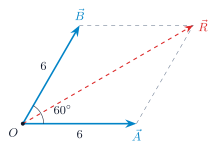
Two vectors have equal magnitude \(A\). Use \(R^2 = A^2 + B^2 + 2AB\cos\theta\) to find the magnitude of their resultant when the angle \(\theta\) between them is
\(60^\circ\),
\(90^\circ\),
\(120^\circ\).
Answer(i) \(\sqrt{3}A\) (ii) \(\sqrt{2}A\) (iii) \(A\)
The two vectors are equal in magnitude, so the parallelogram is a rhombus. Its diagonal bisects the angle: \(\vec R\) is at \(30^\circ\) to \(\vec A\).
\(|\vec A - \vec B|^2 = 36 + 36 - 2 \times 36 \times \cos 60^\circ = 36\), so \(|\vec A - \vec B| = 6\). It is the other diagonal of the rhombus.
How did it go?
Resolution in physical situations
Q11
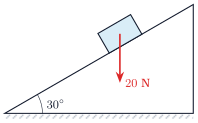
A block of weight \(20\) N rests on a \(30^\circ\) incline.
Find the component of the weight along the incline.
Find the component perpendicular to the incline.
Check that the two components add back to \(20\) N.
Answer(i) \(10\) N (ii) \(10\sqrt{3} \approx 17.3\) N (iii) \(\sqrt{100 + 300} = 20\)
Solution
Along the incline: \(W\sin 30^\circ = 20 \times \dfrac{1}{2} = 10\) N, pointing down the slope.
Perpendicular to the incline: \(W\cos 30^\circ = 20 \times \dfrac{\sqrt{3}}{2} = 10\sqrt{3} \approx 17.3\) N, pressing into the slope.
\(\sqrt{10^2 + (10\sqrt{3})^2} = \sqrt{100 + 300} = 20\) N.
How did it go?
Q12
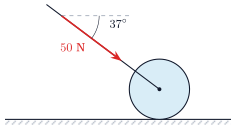
A lawn roller is pushed with a force of \(50\) N along its handle, which makes \(37^\circ\) with the ground.
Find the horizontal component of the push.
Find the vertical component. Does it press the roller into the ground or lift it?
The roller is now pulled with the same force along the handle. State the vertical component.
Answer(i) \(40\) N (ii) \(30\) N, presses (iii) \(30\) N upward
Solution
\(F_x = 50\cos 37^\circ = 40\) N, forward along the ground.
\(F_y = 50\sin 37^\circ = 30\) N. A push along the handle points downward at the roller, so this component presses the roller into the ground.
A pull along the handle points upward: the vertical component is \(30\) N upward. It lifts the roller a little, which is why pulling is easier than pushing.
How did it go?
Q13
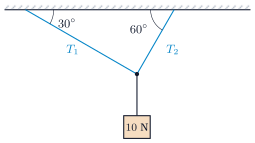
A lamp of weight \(10\) N hangs from a knot. Two strings run from the knot to the ceiling, at \(30^\circ\) and \(60^\circ\) to the ceiling as shown.
Find the angle between the two strings at the knot.
Use Lami's theorem to find \(T_1\) and \(T_2\).
Check the answer by resolving the forces horizontally.
Answer(i) \(90^\circ\) (ii) \(5\) N; \(5\sqrt{3} \approx 8.7\) N (iii) \(T_1\cos 30^\circ = T_2\cos 60^\circ\)
Solution
\(T_1\) makes \(30^\circ\) with the ceiling on one side and \(T_2\) makes \(60^\circ\) on the other. The angle between them at the knot is \(180^\circ - 30^\circ - 60^\circ = 90^\circ\).
The angle between \(T_1\) and the weight is \(90^\circ + 30^\circ = 120^\circ\); between \(T_2\) and the weight it is \(90^\circ + 60^\circ = 150^\circ\).
Lami: \(\dfrac{T_1}{\sin 150^\circ} = \dfrac{T_2}{\sin 120^\circ} = \dfrac{10}{\sin 90^\circ}\). So \(T_1 = 10 \times \dfrac{1}{2} = 5\) N and \(T_2 = 10 \times \dfrac{\sqrt{3}}{2} = 5\sqrt{3} \approx 8.7\) N.
Horizontal: \(T_1\cos 30^\circ = 5 \times 0.866 = 4.33\) N and \(T_2\cos 60^\circ = 8.66 \times 0.5 = 4.33\) N. They balance. Vertical check: \(5 \times 0.5 + 8.66 \times 0.866 = 2.5 + 7.5 = 10\) N.
How did it go?
Q14
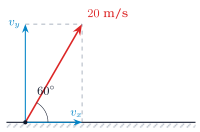
A ball leaves the ground at \(20\) m/s at \(60^\circ\) to the horizontal.
Find \(v_x\) and \(v_y\).
Write the velocity as \(v_x\hat i + v_y\hat j\).
Which component changes during the flight, and which stays the same? Give the reason.
Answer(i) \(10\) m/s; \(10\sqrt{3} \approx 17.3\) m/s (ii) \(10\hat i + 10\sqrt{3}\hat j\) (iii) \(v_y\) changes; \(v_x\) same
Gravity acts only vertically. So \(v_y\) decreases, becomes zero at the top and then grows downward, while \(v_x\) stays \(10\) m/s throughout.
How did it go?
Lami's theorem and equilibrium
Q15
State Lami's theorem for three concurrent forces \(P\), \(Q\) and \(R\) in equilibrium. Three forces of \(3\) N, \(4\) N and \(5\) N keep a particle at rest. Find the angle between the \(3\) N and the \(4\) N forces.
Lami's theorem: three concurrent forces keep a particle in equilibrium. Then each force is proportional to the sine of the angle between the other two: \(\dfrac{P}{\sin\alpha} = \dfrac{Q}{\sin\beta} = \dfrac{R}{\sin\gamma}\).
For equilibrium the \(5\) N force must balance the resultant of \(3\) N and \(4\) N, so that resultant is \(5\) N. \(25 = 9 + 16 + 24\cos\theta\) gives \(\cos\theta = 0\): the angle between the \(3\) N and \(4\) N forces is \(90^\circ\).
How did it go?
Q16
Three forces of equal magnitude keep a particle in equilibrium. Find the angle between any two of them.
Answer\(120^\circ\)
Solution
By Lami's theorem the sines of the three angles are equal, and the three angles add to \(360^\circ\). So each angle is \(120^\circ\). Check: two forces \(F\) at \(120^\circ\) have resultant \(F\), which the third force cancels.
How did it go?
Q17
Forces of \(6\) N along \(+x\) and \(8\) N along \(+y\) act on a particle. A third force keeps the particle in equilibrium.
Write the third force in \(\hat i\), \(\hat j\) form.
Find its magnitude.
Find the angle it makes with the \(-x\) direction.
Answer(i) \(-6\hat i - 8\hat j\) (ii) \(10\) N (iii) \(53^\circ\)
Solution
The third force cancels the sum: \(\vec F_3 = -(6\hat i + 8\hat j) = -6\hat i - 8\hat j\) N.
Three forces act on a particle: \(10\) N towards east, \(10\) N towards north and \(10\sqrt{2}\) N towards south-west. Show that the particle is in equilibrium.
Answer\(10\sqrt{2}\) N south-west cancels \(10\hat i + 10\hat j\)
Solution
Take east as \(\hat i\) and north as \(\hat j\). The first two forces add to \(10\hat i + 10\hat j\), of magnitude \(10\sqrt{2}\) N towards north-east.
The third force is \(10\sqrt{2}\) N towards south-west, exactly opposite: \(10\sqrt{2}\left(-\dfrac{\hat i + \hat j}{\sqrt{2}}\right) = -10\hat i - 10\hat j\). The three forces add to zero, so the particle is in equilibrium.
How did it go?
Small situations
Q19
A car moving at \(10\) m/s towards east turns and moves at \(10\) m/s towards north. Find the magnitude and the direction of the change in velocity \(\Delta\vec v = \vec v_2 - \vec v_1\).
Magnitude \(= \sqrt{100 + 100} = 10\sqrt{2} \approx 14\) m/s. The direction \(-\hat i + \hat j\) points towards north-west.
How did it go?
Q20
An aeroplane flies \(3\) km east, then \(4\) km north, and climbs \(12\) km during the flight. Write its displacement in \(\hat i\), \(\hat j\), \(\hat k\) form and find its magnitude.
Answer\(3\hat i + 4\hat j + 12\hat k\); \(13\) km
Solution
\(\vec r = 3\hat i + 4\hat j + 12\hat k\) km. \(|\vec r| = \sqrt{9 + 16 + 144} = \sqrt{169} = 13\) km.
How did it go?
Q21
Vectors \(\vec A\) and \(\vec B\) have magnitudes \(5\) and \(12\) and are perpendicular.
Find \(|\vec A + \vec B|\).
Find \(\tan\alpha\), where \(\alpha\) is the angle between the resultant and \(\vec B\).
Answer(i) \(13\) (ii) \(\frac{5}{12}\)
Solution
\(|\vec A + \vec B| = \sqrt{25 + 144} = 13\).
The resultant and \(\vec B\) form a right triangle with \(\vec A\) as the opposite side: \(\tan\alpha = \dfrac{5}{12}\).
How did it go?
Q22
The magnitude of \(\vec A + \vec B\) equals the magnitude of \(\vec A - \vec B\). Show that \(\vec A\) and \(\vec B\) are perpendicular.
Answer\(4AB\cos\theta = 0\)
Solution
\(|\vec A + \vec B|^2 = A^2 + B^2 + 2AB\cos\theta\) and \(|\vec A - \vec B|^2 = A^2 + B^2 - 2AB\cos\theta\).
Setting them equal gives \(4AB\cos\theta = 0\). Neither magnitude is zero, so \(\cos\theta = 0\) and \(\theta = 90^\circ\). The two diagonals of a rectangle are equal.
How did it go?
Q23
\(|\vec A| = |\vec B| = |\vec A + \vec B|\). Show that the angle between \(\vec A\) and \(\vec B\) is \(120^\circ\).
Answer\(\cos\theta = -\frac{1}{2}\)
Solution
Let the common magnitude be \(A\). \(|\vec A + \vec B|^2 = A^2 + A^2 + 2A^2\cos\theta = A^2\).
So \(2 + 2\cos\theta = 1\), \(\cos\theta = -\dfrac{1}{2}\) and \(\theta = 120^\circ\).
How did it go?
Q24
The resultant of two forces \(P\) and \(Q\) has magnitude \(R\). When \(Q\) is doubled, the resultant still has magnitude \(R\). Show that \(\cos\theta = -\frac{3Q}{2P}\), where \(\theta\) is the angle between \(P\) and \(Q\).
Answer\(3Q^2 + 2PQ\cos\theta = 0\)
Solution
First case: \(R^2 = P^2 + Q^2 + 2PQ\cos\theta\). Second case, with \(2Q\): \(R^2 = P^2 + 4Q^2 + 4PQ\cos\theta\).
Subtract the first from the second: \(0 = 3Q^2 + 2PQ\cos\theta\), so \(\cos\theta = -\dfrac{3Q}{2P}\). The angle is obtuse.