Questions on Accelerated Objects, the kind your examinations ask. Solve one on paper. Then tell the book how it went. The book believes you, and it uses your answer to plan your revision.
0%
Nothing marked yetMark honestly. Peek at the answer only after your own attempt.
Free Body Diagrams and Equilibrium
24 questions · after Lesson 4, Weight in a Lift
Drawing free body diagrams
Q1
A \(2\) kg block rests on a table. Take \(g = 10\) m/s\(^2\) throughout this sheet.
Name the two forces on the block.
Find the normal force.
Answer(i) weight, normal force (ii) \(20\) N
Solution
The weight \(mg\) downward and the normal force \(N\) from the table upward.
At rest the forces balance: \(N = mg = 20\) N.
How did it go?
Q2
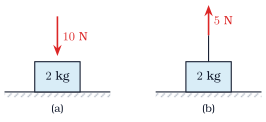
The \(2\) kg block is (a) pushed down with \(10\) N and (b) pulled up by a string with \(5\) N. It stays at rest.
Draw the free body diagram for each case.
Find the normal force in (a).
Find the normal force in (b).
Answer(i) \(N\), \(mg\), applied force (ii) \(30\) N (iii) \(15\) N
Solution
(a) \(mg = 20\) N down, the push \(10\) N down, \(N\) up. (b) \(mg = 20\) N down, the tension \(5\) N up, \(N\) up.
\(N = 20 + 10 = 30\) N. The push adds to the weight that the table must support.
\(N + 5 = 20\), so \(N = 15\) N. The string carries part of the weight.
How did it go?
Q3
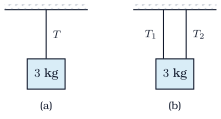
A \(3\) kg block hangs at rest (a) from one string and (b) from two vertical strings.
Find the tension \(T\) in (a).
In (b) the two tensions are equal. Find each.
Why must \(T_1 = T_2\) in (b) if the block hangs level and the strings are symmetric?
Answer(i) \(30\) N (ii) \(15\) N each (iii) symmetry
Solution
\(T = mg = 30\) N.
\(T_1 + T_2 = 30\) N with \(T_1 = T_2\): \(15\) N each.
The strings are placed symmetrically about the centre of the block. If the tensions differed, the block would tilt; a level block with symmetric strings means equal shares.
How did it go?
Q4
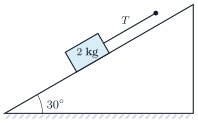
A \(2\) kg block rests on a smooth \(30^\circ\) incline, held by a string along the slope.
Draw the free body diagram: weight, normal force and tension.
Resolve along the slope to find \(T\).
Resolve perpendicular to the slope to find \(N\).
Answer(i) \(mg\) down, \(N\), \(T\) up the slope (ii) \(10\) N (iii) \(10\sqrt{3} \approx 17\) N
Solution
\(mg = 20\) N vertically down, \(N\) perpendicular to the slope, \(T\) up along the slope.
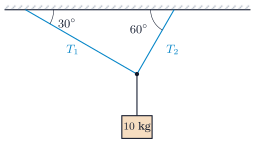
From the first, \(T_2 = \sqrt{3}\,T_1\). Then \(\dfrac{T_1}{2} + \dfrac{3T_1}{2} = 100\), so \(T_1 = 50\) N and \(T_2 = 50\sqrt{3} \approx 87\) N.
The strings are \(90^\circ\) apart; \(T_1\) and \(W\) are \(120^\circ\) apart; \(T_2\) and \(W\) are \(150^\circ\) apart. Lami: \(\dfrac{T_1}{\sin 150^\circ} = \dfrac{T_2}{\sin 120^\circ} = \dfrac{100}{\sin 90^\circ}\) gives \(T_1 = 50\) N and \(T_2 = 50\sqrt{3}\) N.
How did it go?
Q7
A \(20\) N weight hangs from the middle of a rope whose two ends are fixed at the same height. Each half of the rope makes \(30^\circ\) with the horizontal.
Find the tension in the rope.
Find the tension if each half makes only \(5^\circ\) with the horizontal. Take \(\sin 5^\circ = 0.087\).
Why can a loaded rope never be perfectly straight?
Answer(i) \(20\) N (ii) \(\approx 115\) N (iii) \(T \to \infty\) as the angle \(\to 0\)
Solution
Two tensions each pull up with \(T\sin 30^\circ\): \(2T\sin 30^\circ = 20\), so \(T = 20\) N.
\(2T \times 0.087 = 20\) gives \(T \approx 115\) N. A flatter rope needs a much larger tension.
A straight rope would have \(\sin\theta = 0\), so no vertical component at all to hold the weight. The tension would have to be infinite; the rope always sags a little.
How did it go?
Q8
A \(6\) kg block hangs from a string \(A\) that makes \(37^\circ\) with the vertical, while a horizontal string \(B\) pulls it sideways. Take \(\sin 37^\circ = 0.6\) and \(\cos 37^\circ = 0.8\). Find the tensions in \(A\) and \(B\).
Answer\(A\): \(75\) N; \(B\): \(45\) N
Solution
Vertical: \(T_A\cos 37^\circ = 60\), so \(T_A = \dfrac{60}{0.8} = 75\) N. Horizontal: \(T_B = T_A\sin 37^\circ = 75 \times 0.6 = 45\) N.
How did it go?
Q9
Three forces of \(60\) N, \(80\) N and \(W\) keep a particle in equilibrium. The \(60\) N and \(80\) N forces are perpendicular.
Find \(W\).
Find the angle between \(W\) and the \(80\) N force.
Answer(i) \(100\) N (ii) \(143^\circ\)
Solution
\(W\) balances the resultant of the other two: \(W = \sqrt{60^2 + 80^2} = 100\) N.
The resultant makes \(\tan^{-1}\dfrac{60}{80} = 37^\circ\) with the \(80\) N force. \(W\) points opposite to the resultant, so the angle between \(W\) and the \(80\) N force is \(180^\circ - 37^\circ = 143^\circ\).
How did it go?
Q10
A \(2\) kg block is held at rest on a smooth \(30^\circ\) incline by a horizontal force \(F\). Find \(F\) and the normal force.
Answer\(\frac{20}{\sqrt{3}} \approx 11.5\) N; \(\frac{40}{\sqrt{3}} \approx 23\) N
Solution
Along the slope: \(F\cos 30^\circ = mg\sin 30^\circ\), so \(F = mg\tan 30^\circ = \dfrac{20}{\sqrt{3}} \approx 11.5\) N.
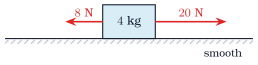
Two horizontal forces act on a \(4\) kg block on a smooth floor, as shown.
Find the net force and the acceleration.
Find the normal force from the floor.
The \(8\) N force is now turned to point right. Find the new acceleration.
Answer(i) \(12\) N; \(3\) m/s\(^2\) (ii) \(40\) N (iii) \(7\) m/s\(^2\)
Solution
Net force \(= 20 - 8 = 12\) N to the right. \(a = \dfrac{12}{4} = 3\) m/s\(^2\).
Vertically nothing moves: \(N = mg = 40\) N.
Net force \(= 28\) N, \(a = 7\) m/s\(^2\).
How did it go?
Q13
A \(1000\) kg car speeds up from rest to \(20\) m/s in \(10\) s on a straight road. Find the net force on it.
Answer\(2000\) N
Solution
\(a = \dfrac{20}{10} = 2\) m/s\(^2\). \(F = ma = 1000 \times 2 = 2000\) N.
How did it go?
Q14
A lift of mass \(500\) kg hangs from a cable. Find the tension in the cable in each case.
The lift accelerates up at \(2\) m/s\(^2\).
It accelerates down at \(2\) m/s\(^2\).
It moves at a steady speed.
Answer(i) \(6000\) N (ii) \(4000\) N (iii) \(5000\) N
Solution
Up positive: \(T - mg = ma\), so \(T = m(g + a)\).
\(T = 500 \times 12 = 6000\) N.
\(T = 500 \times (10 - 2) = 4000\) N.
\(a = 0\): \(T = mg = 5000\) N.
How did it go?
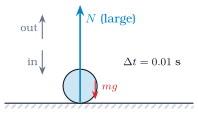
Q15
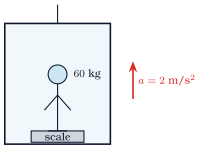
A \(60\) kg person stands on a weighing machine in a lift. The machine reads the normal force on the person.
Find the reading when the lift accelerates up at \(2\) m/s\(^2\).
Find the reading when it accelerates down at \(2\) m/s\(^2\).
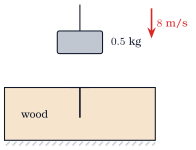
Find the reading if the cable snaps and the lift falls freely.
Answer(i) \(720\) N (ii) \(480\) N (iii) \(0\)
Solution
\(N - mg = ma\), so \(N = m(g + a)\) with \(a\) positive upward.
\(N = 60 \times 12 = 720\) N. The person feels heavier.
\(N = 60 \times 8 = 480\) N.
\(a = -g\): \(N = 0\). The person and the machine fall together and nothing presses on the scale.
How did it go?
Q16
A \(5\) kg block on a smooth floor is pulled by a rope with \(30\) N at \(37^\circ\) above the horizontal. Find the acceleration and the normal force. Use \(\sin 37^\circ = 0.6\).
Answer\(4.8\) m/s\(^2\); \(32\) N
Solution
Horizontal: \(30\cos 37^\circ = 24\) N, so \(a = \dfrac{24}{5} = 4.8\) m/s\(^2\). Vertical: \(N + 30\sin 37^\circ = 50\), so \(N = 50 - 18 = 32\) N.
How did it go?
Third law
Q17
A book rests on a table. Write the action-reaction pair for the normal force and the pair for the gravitational force. Why do action and reaction never cancel each other?
Answertable on book, book on table; Earth on book, book on Earth; different bodies
Solution
Normal pair: the table pushes the book up with \(N\), and the book pushes the table down with \(N\). Gravity pair: the Earth pulls the book down with \(mg\), and the book pulls the Earth up with \(mg\).
The two forces of a pair act on different bodies, so they can never cancel in the equation of any one body. What balances the book's weight is the table's normal force, a different force on the same body.
How did it go?
Q18
A horse pulls a cart with force \(F\), and the cart pulls the horse back with the same \(F\). How does the cart move forward? Name the force that makes the whole system move.
Answerfriction of the ground on the horse
Solution
The forces \(F\) between horse and cart act on different bodies and do not cancel. The horse pushes the ground backward with its hooves, and the ground pushes the horse forward by friction. This external force moves the horse and the cart together.
How did it go?
Q19
Blocks of \(2\) kg and \(3\) kg touch each other on a smooth floor. A force of \(10\) N pushes the \(2\) kg block towards the \(3\) kg block.
The \(3\) kg block is pushed only by the contact force: \(F_c = 3 \times 2 = 6\) N. Check on the \(2\) kg block: \(10 - 6 = 4 = 2 \times 2\).
How did it go?
Q20
Blocks of \(2\) kg and \(3\) kg on a smooth floor are joined by a string. A force of \(10\) N pulls the \(3\) kg block away from the \(2\) kg block. Find the acceleration and the tension.
Answer\(2\) m/s\(^2\); \(4\) N
Solution
System: \(a = \dfrac{10}{5} = 2\) m/s\(^2\). The \(2\) kg block is pulled only by the string: \(T = 2 \times 2 = 4\) N.
How did it go?
Small situations
Q21
Two horizontal ropes pull a \(10\) kg block on a smooth floor with \(30\) N and \(40\) N at right angles to each other. Find the net force and the acceleration.
Answer\(50\) N; \(5\) m/s\(^2\)
Solution
The forces are perpendicular: net \(= \sqrt{30^2 + 40^2} = 50\) N. \(a = \dfrac{50}{10} = 5\) m/s\(^2\) along the resultant.
How did it go?
Q22
A rope can bear a tension of at most \(600\) N. A \(50\) kg monkey climbs it. Find the largest upward acceleration the monkey can have without breaking the rope.
Answer\(2\) m/s\(^2\)
Solution
\(T - mg = ma\): \(600 - 500 = 50a\), so \(a = 2\) m/s\(^2\). Any larger acceleration needs a tension above \(600\) N.
How did it go?
Q23
A \(4\) kg block hangs from a string and is lowered with a downward acceleration of \(2\) m/s\(^2\). Find the tension.
Answer\(32\) N
Solution
Down positive: \(mg - T = ma\), so \(T = m(g - a) = 4 \times 8 = 32\) N.
How did it go?
Q24
A \(2\) kg block hangs from a spring balance in a lift. The balance reads \(24\) N. Find the acceleration of the lift and its direction.
Answer\(2\) m/s\(^2\) upward
Solution
The balance reads the tension: \(24 - 20 = 2a\), so \(a = 2\) m/s\(^2\). The reading exceeds the weight, so the lift accelerates upward.
How did it go?
String, Pulley and Wedge Constraints
24 questions · after Lesson 5, The Pseudo Force
Atwood and simple pulleys
Q25
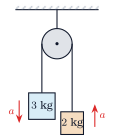
Blocks of \(3\) kg and \(2\) kg hang from a light string over a smooth, light pulley. Take \(g = 10\) m/s\(^2\) throughout this sheet.
Write Newton's second law for each block, with \(a\) as shown.
Find \(a\) and the tension \(T\).
Why is the tension the same on both sides of the pulley?
Answer(i) \(30 - T = 3a\); \(T - 20 = 2a\) (ii) \(2\) m/s\(^2\); \(24\) N (iii) light string, smooth pulley
Solution
\(3\) kg (moving down): \(30 - T = 3a\). \(2\) kg (moving up): \(T - 20 = 2a\).
Adding: \(10 = 5a\), so \(a = 2\) m/s\(^2\). Then \(T = 20 + 4 = 24\) N.
The string is light, so no net force is needed to accelerate it. The pulley is smooth, so it cannot change the tension as the string slides over it.
How did it go?
Q26
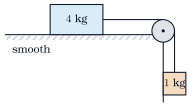
A \(4\) kg block on a smooth table is joined by a string over a pulley to a hanging \(1\) kg block.
Why do the two blocks have the same acceleration?
Find the acceleration and the tension.
Why is the tension less than \(10\) N?
Answer(i) one string, fixed length (ii) \(2\) m/s\(^2\); \(8\) N (iii) the \(1\) kg accelerates down
Solution
They are joined by one string of fixed length. When the hanging block falls \(x\), the table block moves \(x\); equal displacements at every instant mean equal accelerations.
The hanging block accelerates downward, so the net force on it must point down: its weight \(10\) N must exceed the tension.
How did it go?
Q27
A \(2\) kg block rests on a smooth \(30^\circ\) incline. A string over a pulley at the top joins it to a hanging \(3\) kg block. Find the acceleration and the tension.
Answer\(4\) m/s\(^2\); \(18\) N
Solution
Along the incline the \(2\) kg block feels \(mg\sin 30^\circ = 10\) N down the slope. Hanging block: \(30 - T = 3a\). Incline block: \(T - 10 = 2a\). Adding: \(20 = 5a\), \(a = 4\) m/s\(^2\); \(T = 10 + 8 = 18\) N.
How did it go?
Q28
An Atwood machine has masses \(4\) kg and \(6\) kg.
Find \(a\) and \(T\).
Find the force on the pulley's axle.
Why is it less than \(100\) N?
Answer(i) \(2\) m/s\(^2\); \(48\) N (ii) \(96\) N (iii) blocks accelerate
The string pulls down on the pulley on both sides: \(2T = 96\) N.
The total weight is \(100\) N, but both blocks are accelerating, so the string does not have to carry the full weight. Only if \(a = 0\) would the axle carry \(100\) N.
How did it go?
Q29
A block of \(m_1\) is on a smooth table and \(m_2\) hangs from the string over the edge pulley. Show that \(a = \frac{m_2 g}{m_1 + m_2}\) and \(T = \frac{m_1 m_2 g}{m_1 + m_2}\).
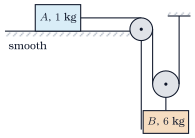
Block \(A\) (\(1\) kg) is on a smooth table. Its string passes over a fixed pulley, under a movable pulley that carries block \(B\) (\(6\) kg), and up to a fixed point.
If \(B\) moves down by \(y\), by how much does \(A\) move? Use the length of the string.
Hence relate the accelerations \(a_A\) and \(a_B\).
What is the total upward force on \(B\)'s pulley in terms of \(T\)?
Answer(i) \(2y\) (ii) \(a_A = 2a_B\) (iii) \(2T\)
Solution
The two vertical segments on either side of \(B\)'s pulley each lengthen by \(y\) when \(B\) drops \(y\). The string is of fixed length, so the segment attached to \(A\) shortens by \(2y\): \(A\) moves \(2y\).
Differentiating twice: \(a_A = 2a_B\).
Two segments of the same string pull the pulley up: \(2T\).
How did it go?
Q31
For the system of Question 6, write Newton's second law for \(A\) and for \(B\) (with its pulley, taken as light). Solve for \(a_B\), \(a_A\) and \(T\).
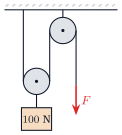
A \(100\) N load hangs from a movable pulley. The rope is fixed at one end and pulled with force \(F\) at the other.
Find \(F\) needed to lift the load at a steady speed.
To raise the load by \(1\) m, how much rope must be pulled through?
Show that the work done by \(F\) equals the gain in potential energy of the load.
Answer(i) \(50\) N (ii) \(2\) m (iii) \(50 \times 2 = 100 \times 1\)
Solution
Two rope segments support the movable pulley, each with tension \(F\): \(2F = 100\), so \(F = 50\) N.
Raising the load by \(1\) m shortens both segments by \(1\) m, so \(2\) m of rope must be pulled through.
Work by \(F\): \(50 \times 2 = 100\) J. Gain in potential energy: \(100 \times 1 = 100\) J. The pulley halves the force but doubles the distance.
How did it go?
Q33
Blocks of \(2\) kg and \(4\) kg on a smooth table are joined by a string. A \(12\) N force pulls the \(4\) kg block away from the \(2\) kg block. Find the acceleration and the tension.
Answer\(2\) m/s\(^2\); \(4\) N
Solution
System: \(a = \dfrac{12}{6} = 2\) m/s\(^2\). The \(2\) kg block is pulled only by the string: \(T = 2 \times 2 = 4\) N.
How did it go?
Q34
A string of fixed length passes over a fixed pulley with blocks at its two ends, at distances \(x_1\) and \(x_2\) below the pulley. Write the constraint on \(x_1 + x_2\) and show that \(a_1 = -a_2\).
Answer\(x_1 + x_2 = \) const; differentiate twice
Solution
\(x_1 + x_2 = L\), a constant (the string over the pulley has fixed length). Differentiate: \(v_1 + v_2 = 0\), and again: \(a_1 + a_2 = 0\), so \(a_1 = -a_2\). When one block goes down the other goes up by the same amount.
How did it go?
Q35
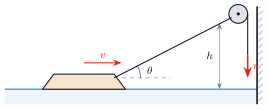
A boat is pulled towards a quay by a rope that passes over a pulley at height \(h\). The rope is hauled in at a steady \(u\), and it makes angle \(\theta\) with the water.
The rope shortens at \(u\). Which component of the boat's velocity \(v\) is along the rope?
Show that \(v = \frac{u}{\cos\theta}\).
Find \(v\) when \(u = 1\) m/s and \(\theta = 60^\circ\). What happens to \(v\) as the boat nears the quay?
The component of \(v\) along the rope, \(v\cos\theta\), is the rate at which the rope between the boat and the pulley shortens.
The rope is hauled in at \(u\), so \(v\cos\theta = u\) and \(v = \dfrac{u}{\cos\theta}\).
\(v = \dfrac{1}{\cos 60^\circ} = 2\) m/s. As the boat nears the quay, \(\theta\) grows and \(\cos\theta\) falls, so \(v\) increases even though \(u\) is steady.
How did it go?
Q36
Two \(2\) kg blocks are joined by a string over a pulley at the top of a smooth \(30^\circ\) incline. One block is on the incline and the other hangs. Find the acceleration and the tension.
Answer\(2.5\) m/s\(^2\); \(15\) N
Solution
Hanging: \(20 - T = 2a\). On the incline: \(T - 20\sin 30^\circ = 2a\), that is, \(T - 10 = 2a\). Adding: \(10 = 4a\), \(a = 2.5\) m/s\(^2\); \(T = 20 - 5 = 15\) N.
How did it go?
Wedge constraints
Q37
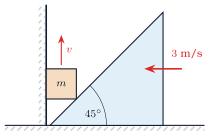
A \(45^\circ\) wedge is pushed to the left at \(3\) m/s. A block rests on its sloping face and is held against a vertical wall, so the block can only move up or down.
The block and the wedge stay in contact. What must be equal for the two?
Find the speed \(v\) of the block.
Find \(v\) if the wedge angle is \(30^\circ\) instead.
Answer(i) velocity components perpendicular to the face (ii) \(3\) m/s (iii) \(\sqrt{3} \approx 1.7\) m/s
Solution
Their velocity components perpendicular to the sloping face must be equal; otherwise the block would either sink into the wedge or leave it.
Wedge: \(3\) m/s horizontal, component perpendicular to the face \(3\sin 45^\circ\). Block: \(v\) vertical, component \(v\cos 45^\circ\). Equating: \(v = 3\tan 45^\circ = 3\) m/s.
\(v = 3\tan 30^\circ = \sqrt{3} \approx 1.7\) m/s. A flatter wedge lifts the block more slowly.
How did it go?
Q38
A wedge of angle \(60^\circ\) moves to the left at \(4\) m/s. A block slides down its face at \(4\) m/s relative to the wedge. Find the velocity of the block relative to the ground: magnitude and direction.
Answer\(4\) m/s at \(60^\circ\) below the horizontal, leftward
Solution
\(\vec v_{\text{block}} = \vec v_{\text{block,wedge}} + \vec v_{\text{wedge}}\). Take right as \(\hat i\): wedge \(-4\hat i\); block relative to wedge, down a \(60^\circ\) face to the right: \(4\cos 60^\circ\,\hat i - 4\sin 60^\circ\,\hat j = 2\hat i - 2\sqrt{3}\hat j\).
Sum: \(-2\hat i - 2\sqrt{3}\hat j\), magnitude \(\sqrt{4 + 12} = 4\) m/s, pointing \(60^\circ\) below the horizontal towards the left. The three vectors form an equilateral triangle.
How did it go?
Q39
A ladder \(5\) m long leans against a wall with its foot \(3\) m from the wall. The foot slides away from the wall at \(2\) m/s. Find the speed of the top end at this instant.
Answer\(1.5\) m/s downward
Solution
The ladder's length is fixed: \(x^2 + y^2 = 25\). Differentiating: \(2x\dot x + 2y\dot y = 0\), so \(\dot y = -\dfrac{x}{y}\dot x = -\dfrac{3}{4} \times 2 = -1.5\) m/s. The top slides down at \(1.5\) m/s.
How did it go?
Q40
A block slides on a moving wedge. Explain in words why the two velocity components perpendicular to the wedge face must be equal. What would happen if they were not?
Answerthey would separate or overlap
Solution
The block touches the face. Along the face it may slide freely, but perpendicular to the face it cannot move relative to the wedge. If the block's perpendicular component were larger, it would rise off the wedge and lose contact. If smaller, it would have to pass into the solid wedge. So the two perpendicular components are equal.
How did it go?
Q41
A \(3\) kg block on a smooth table is joined over an edge pulley to a hanging \(2\) kg block. The system is released from rest. Find the acceleration, the tension, and the distance the hanging block falls in \(1\) s.
The Atwood machine of Question 1 is released from rest. Find the speed of the blocks and the distance each has moved after \(1\) s.
Answer\(2\) m/s; \(1\) m
Solution
\(a = 2\) m/s\(^2\) from Question 1. \(v = at = 2\) m/s and \(s = \dfrac{1}{2}at^2 = 1\) m.
How did it go?
Q43
A \(10\) kg block hangs from a rope that passes over a fixed pulley to a person's hands. The person pulls so that the block accelerates upward at \(1\) m/s\(^2\). Find the pull.
Answer\(110\) N
Solution
\(T - 100 = 10 \times 1\), so \(T = 110\) N. The person must pull the rope with \(110\) N.
How did it go?
Q44
Blocks of \(1\) kg, \(2\) kg and \(3\) kg lie in a row on a smooth table, joined by strings. A \(12\) N force pulls the \(3\) kg block. Find the acceleration and the tension in each string.
Answer\(2\) m/s\(^2\); \(6\) N; \(2\) N
Solution
\(a = \dfrac{12}{6} = 2\) m/s\(^2\). String between \(3\) kg and \(2\) kg pulls the \(1 + 2 = 3\) kg ahead of it: \(T_1 = 3 \times 2 = 6\) N. String between \(2\) kg and \(1\) kg pulls only the \(1\) kg: \(T_2 = 2\) N.
How did it go?
Q45
A \(6\) kg block on a smooth table is joined over an edge pulley to a hanging \(4\) kg block. Find the tension and the net force on the pulley, given that the two string segments are perpendicular.
Answer\(24\) N; \(24\sqrt{2} \approx 34\) N
Solution
\(a = \dfrac{40}{10} = 4\) m/s\(^2\) and \(T = 6 \times 4 = 24\) N. The string pulls the pulley with \(24\) N horizontally and \(24\) N vertically: resultant \(24\sqrt{2} \approx 34\) N, at \(45^\circ\) to each.
How did it go?
Q46
One end of a rope over a fixed pulley is pulled down at \(3\) m/s.
How fast does the other end rise?
If the other end passes under a movable pulley carrying a load and is then fixed, how fast does the load rise?
Answer(i) \(3\) m/s (ii) \(1.5\) m/s
Solution
The rope has fixed length, so the other end rises at \(3\) m/s.
Two segments shorten as the load rises, so the load rises at half the rate: \(1.5\) m/s.
How did it go?
Q47
For an Atwood machine with masses \(m_1 > m_2\), show that \(a = \frac{(m_1 - m_2)g}{m_1 + m_2}\) and \(T = \frac{2m_1m_2g}{m_1 + m_2}\).
Answeradd the two equations; subtract
Solution
\(m_1g - T = m_1a\) and \(T - m_2g = m_2a\). Adding: \((m_1 - m_2)g = (m_1 + m_2)a\), so \(a = \dfrac{(m_1 - m_2)g}{m_1 + m_2}\).
Then \(T = m_2(g + a) = m_2g\left(1 + \dfrac{m_1 - m_2}{m_1 + m_2}\right) = \dfrac{2m_1m_2g}{m_1 + m_2}\).
How did it go?
Q48
Use the result of Question 23 to show that the tension lies between the two weights: \(m_2 g < T < m_1 g\). Check with the numbers of Question 1.
From the two equations of motion, \(T = m_2(g + a) > m_2g\) because \(a > 0\), and \(T = m_1(g - a) < m_1g\) for the same reason. So \(m_2g < T < m_1g\).
Question 1: \(20 < 24 < 30\) N. The heavier block loses a little support and falls; the lighter gains a little and rises.
How did it go?
Pseudo Forces in Accelerating Frames
24 questions · after Lesson 5, The Pseudo Force
The idea
Q49
A frame accelerates at \(\vec a_0\). To use Newton's second law in that frame, a pseudo force is added to the real forces on a body of mass \(m\). Write this force and state its direction. Take \(g = 10\) m/s\(^2\) throughout this sheet.
Answer\(\vec F_p = -m\vec a_0\), opposite to \(\vec a_0\)
Solution
\(\vec F_{\text{pseudo}} = -m\vec a_0\): its magnitude is \(ma_0\) and it points opposite to the acceleration of the frame. It is not exerted by any body; it only makes \(\vec F = m\vec a\) work for an observer who accelerates.
How did it go?
Q50
A \(60\) kg person stands in a lift accelerating upward at \(2\) m/s\(^2\). Work in the lift's frame.
Write the pseudo force on the person.
Find the normal force from the floor.
Answer(i) \(120\) N down (ii) \(720\) N
Solution
\(ma_0 = 60 \times 2 = 120\) N, downward (opposite to the lift's upward acceleration).
In the lift's frame the person is at rest: \(N = mg + 120 = 600 + 120 = 720\) N.
How did it go?
Q51
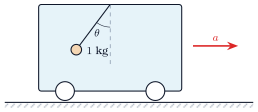
A \(1\) kg bob hangs from the roof of a car accelerating at \(7.5\) m/s\(^2\). The string settles at angle \(\theta\) to the vertical.
In the car's frame, name the three forces on the bob and draw them.
Show that \(\tan\theta = \frac{a}{g}\) and find \(\theta\). Take \(\tan 37^\circ = 0.75\).
Find the tension.
Answer(i) \(mg\), \(T\), \(ma\) backward (ii) \(37^\circ\) (iii) \(12.5\) N
Solution
Weight \(mg\) down, tension \(T\) along the string, and the pseudo force \(ma\) backward (opposite to the car's acceleration).
The bob is at rest in the car's frame. Horizontal: \(T\sin\theta = ma\). Vertical: \(T\cos\theta = mg\). Dividing: \(\tan\theta = \dfrac{a}{g} = 0.75\), so \(\theta = 37^\circ\).
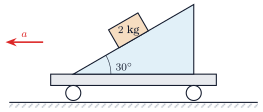
A \(2\) kg block rests on a smooth \(30^\circ\) wedge fixed to a cart. The cart accelerates at \(a\) so that the block stays at rest on the wedge.
In the cart's frame, resolve the forces along the incline and show that \(a = g\tan 30^\circ\).
Find \(a\).
Find the normal force.
Answer(i) \(ma\cos 30^\circ = mg\sin 30^\circ\) (ii) \(\frac{10}{\sqrt{3}} \approx 5.8\) m/s\(^2\) (iii) \(\frac{40}{\sqrt{3}} \approx 23\) N
Solution
The pseudo force \(ma\) points opposite to \(\vec a\), that is, up the slope's horizontal direction. Along the incline: \(ma\cos 30^\circ = mg\sin 30^\circ\), so \(a = g\tan 30^\circ\).
In free fall \(g_{\text{eff}} = g - g = 0\). There is no restoring force, so the pendulum does not oscillate at all: the period becomes infinite.
How did it go?
Q55
A \(50\) kg man stands on a scale in a lift accelerating down at \(4\) m/s\(^2\).
Find the reading.
At what downward acceleration would the reading be zero?
Answer(i) \(300\) N (ii) \(10\) m/s\(^2\)
Solution
In the lift's frame the pseudo force \(ma_0 = 200\) N acts upward. \(N = mg - 200 = 500 - 200 = 300\) N.
\(N = m(g - a_0) = 0\) when \(a_0 = g = 10\) m/s\(^2\): free fall.
How did it go?
Q56
A bucket of water is in a lift accelerating up at \(2\) m/s\(^2\).
Is the water surface still horizontal? Give the reason.
Find the pressure due to the water at a depth of \(0.5\) m. Take the density of water as \(1000\) kg/m\(^3\).
Answer(i) yes, pseudo force vertical (ii) \(6000\) Pa
Solution
Yes. The pseudo force is vertical, so \(\vec g_{\text{eff}}\) is still vertical and the surface, which is perpendicular to it, stays horizontal.
\(P = \rho g_{\text{eff}}h = 1000 \times 12 \times 0.5 = 6000\) Pa, more than the \(5000\) Pa at rest.
How did it go?
Q57
A \(2\) kg block hangs from a spring balance in a lift and the balance reads \(16\) N. Find the acceleration of the lift and its direction.
Answer\(2\) m/s\(^2\) downward
Solution
The reading is the tension: \(16 = m(g + a_0)\) with up positive, so \(g + a_0 = 8\) and \(a_0 = -2\) m/s\(^2\). The lift accelerates downward at \(2\) m/s\(^2\).
How did it go?
Horizontal acceleration
Q58
A block lies on the smooth floor of a truck that starts to accelerate at \(3\) m/s\(^2\).
Describe the motion of the block as seen from the ground.
Describe it as seen from the truck. What force does the truck observer use?
How far does the block move relative to the truck in \(2\) s?
Answer(i) at rest (ii) accelerates backward at \(3\) m/s\(^2\); pseudo force (iii) \(6\) m
Solution
No horizontal force acts on the block (the floor is smooth), so it stays at rest while the truck moves away under it.
The truck observer sees the block accelerate backward at \(3\) m/s\(^2\). To explain this with \(\vec F = m\vec a\) the observer adds a pseudo force \(3m\) backward.
\(s = \dfrac{1}{2} \times 3 \times 4 = 6\) m towards the rear.
How did it go?
Q59
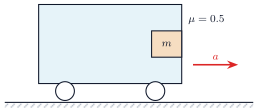
A block of mass \(m\) is held against the vertical front wall of a truck by the truck's acceleration alone. The coefficient of friction is \(0.5\).
In the truck's frame, which force presses the block on the wall? Find the normal force.
Which force holds the block up? Write the condition for it not to slip.
Find the least acceleration of the truck.
Answer(i) pseudo force; \(N = ma\) (ii) friction; \(\mu ma \ge mg\) (iii) \(20\) m/s\(^2\)
Solution
The pseudo force \(ma\) pushes the block backward, that is, onto the front wall. The wall replies with \(N = ma\).
Static friction acts upward along the wall. It must balance the weight: \(f = mg\) and \(f \le \mu N\), so \(\mu ma \ge mg\).
\(a \ge \dfrac{g}{\mu} = \dfrac{10}{0.5} = 20\) m/s\(^2\). The mass cancels.
How did it go?
Q60
In a car that starts to accelerate, a hanging ball swings backward but a helium balloon tied to the seat leans forward. Explain both with the pseudo force.
Answerpseudo force back; balloon lighter than displaced air
Solution
In the car's frame every mass feels a pseudo force backward. The ball is pushed backward and swings back. The balloon is pushed backward too. But the denser air around it is pushed backward more strongly. The air crowds towards the rear and pushes the light balloon forward, like buoyancy in a tilted effective gravity.
How did it go?
Q61
A bob hanging in a car settles at \(45^\circ\) to the vertical. Find the acceleration of the car.
Answer\(10\) m/s\(^2\)
Solution
\(\tan\theta = \dfrac{a}{g}\) with \(\theta = 45^\circ\) gives \(a = g = 10\) m/s\(^2\).
How did it go?
Q62
A \(1\) kg block on the smooth floor of a train is tied by a string to the front wall. The train accelerates at \(2\) m/s\(^2\). Find the tension using the train's frame, and check it from the ground frame.
Answer\(2\) N
Solution
Train's frame: the block is at rest under the tension forward and the pseudo force \(1 \times 2 = 2\) N backward, so \(T = 2\) N.
Ground frame: the block accelerates forward at \(2\) m/s\(^2\) with the train, and the only horizontal force is \(T\): \(T = ma = 2\) N. Both frames agree.
How did it go?
Q63
A tank of water is in a car accelerating at \(5\) m/s\(^2\). The surface tilts by angle \(\theta\).
Which way is the surface lower, front or back? Give the reason.
The surface is perpendicular to the effective gravity. Show that \(\tan\theta = \frac{a}{g}\) and find \(\tan\theta\).
Find the magnitude of the effective gravity.
Answer(i) front (ii) \(0.5\) (iii) \(5\sqrt{5} \approx 11.2\) m/s\(^2\)
Solution
The pseudo force pushes the water backward, so the water piles up at the back. The surface is lower at the front.
\(\vec g_{\text{eff}}\) has components \(g\) down and \(a\) backward, so it is tilted from the vertical by \(\tan\theta = \dfrac{a}{g}\). The surface is perpendicular to \(\vec g_{\text{eff}}\) and so tilts by the same angle: \(\tan\theta = \dfrac{5}{10} = 0.5\).
A \(60\) kg passenger sits in a car taking a bend of radius \(20\) m at \(10\) m/s. In the car's frame, find the magnitude and the direction of the pseudo force on the passenger.
Answer\(300\) N outward
Solution
The car accelerates towards the centre at \(\dfrac{v^2}{r} = \dfrac{100}{20} = 5\) m/s\(^2\). The pseudo force is \(m \times 5 = 300\) N, directed away from the centre of the bend. This is the centrifugal force the passenger feels.
How did it go?
Q65
The effective gravity in an accelerating frame is \(\vec g_{\text{eff}} = \vec g - \vec a_0\). Find its magnitude for a frame accelerating
upward at \(2\) m/s\(^2\),
downward at \(2\) m/s\(^2\),
horizontally at \(7.5\) m/s\(^2\).
Answer(i) \(12\) (ii) \(8\) (iii) \(12.5\) m/s\(^2\)
A ball lies on the smooth floor of a bus. When the bus starts, the ball rolls backward although nothing pushes it. Why does Newton's second law appear to fail in the bus? How is it repaired?
Answerbus is non-inertial; add \(-m\vec a_0\)
Solution
The bus is accelerating, so it is not an inertial frame. Newton's laws hold only in inertial frames; in the bus the ball accelerates with no real force on it. The law is repaired by adding the pseudo force \(-m\vec a_0\) to the real forces, after which \(\vec F = m\vec a\) gives the correct backward acceleration.
How did it go?
Small situations
Q67
A \(2\) kg block lies on the floor of a lift accelerating up at \(5\) m/s\(^2\). Find the normal force on the block.
Answer\(30\) N
Solution
\(N = m(g + a_0) = 2 \times 15 = 30\) N.
How did it go?
Q68
A coin lies on the floor of a lift.
Find the normal force if the lift accelerates down at \(10\) m/s\(^2\).
What happens if the lift accelerates down at \(12\) m/s\(^2\)?
Answer(i) \(0\) (ii) coin rises off the floor
Solution
\(N = m(g - a_0) = m(10 - 10) = 0\). The coin and the floor fall together.
The floor accelerates down faster than the coin can fall freely. Relative to the lift the coin accelerates upward at \(2\) m/s\(^2\): it rises off the floor.
How did it go?
Q69
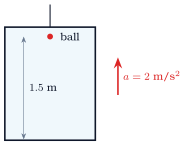
A ball is dropped from a height of \(2\) m above the floor of a lift. Find the time to reach the floor when the lift accelerates
down at \(2\) m/s\(^2\),
up at \(2\) m/s\(^2\).
Answer(i) \(\frac{1}{\sqrt{2}} \approx 0.71\) s (ii) \(\frac{1}{\sqrt{3}} \approx 0.58\) s
Solution
\(g_{\text{eff}} = 8\) m/s\(^2\): \(2 = \dfrac{1}{2} \times 8 \times t^2\), so \(t = \dfrac{1}{\sqrt{2}} \approx 0.71\) s.
\(g_{\text{eff}} = 12\) m/s\(^2\): \(2 = 6t^2\), so \(t = \dfrac{1}{\sqrt{3}} \approx 0.58\) s.
How did it go?
Q70
A simple pendulum of length \(1.25\) m hangs in a lift accelerating down at \(5\) m/s\(^2\). Find its period.
A block slides on a smooth \(30^\circ\) incline fixed inside a lift that accelerates up at \(2\) m/s\(^2\). Find the acceleration of the block relative to the incline.
Answer\(6\) m/s\(^2\) down the slope
Solution
In the lift's frame \(g_{\text{eff}} = 12\) m/s\(^2\). Along the smooth incline: \(a = g_{\text{eff}}\sin 30^\circ = 6\) m/s\(^2\) down the slope.
How did it go?
Q72
A \(2\) kg block rests on a smooth table in a train that accelerates at \(2\) m/s\(^2\). Describe the block's motion and the forces used by (i) an observer in the train and (ii) an observer on the ground.
Answer(i) backward at \(2\) m/s\(^2\), pseudo \(4\) N (ii) at rest, no horizontal force
Solution
Train observer: the block accelerates backward at \(2\) m/s\(^2\). The observer explains it by a pseudo force \(2 \times 2 = 4\) N backward; the table is smooth and gives no horizontal force.
Ground observer: the block stays at rest, because no horizontal force acts on it; the table slides forward beneath it. No pseudo force is needed.
How did it go?
Springs, Cutting of Strings and Jerk
24 questions · after Lesson 6, Impulse and Momentum
Spring force
Q73
A spring has stiffness \(k = 200\) N/m. Take \(g = 10\) m/s\(^2\) throughout this sheet.
Find the force when it is stretched by \(5\) cm.
A \(2\) kg block hangs from it at rest. Find the stretch.
Answer(i) \(10\) N (ii) \(10\) cm
Solution
\(F = kx = 200 \times 0.05 = 10\) N.
\(kx = mg\): \(x = \dfrac{20}{200} = 0.1\) m \(= 10\) cm.
How did it go?
Q74
Springs of \(100\) N/m and \(300\) N/m are joined (i) in series and (ii) in parallel. Find the effective stiffness in each case.
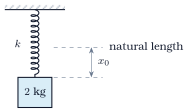
A \(2\) kg block hangs at rest from a spring of \(k = 100\) N/m.
Find the stretch \(x_0\).
The block is now made to accelerate upward at \(2\) m/s\(^2\). Find the stretch.
Find the stretch when the block accelerates downward at \(2\) m/s\(^2\).
Answer(i) \(20\) cm (ii) \(24\) cm (iii) \(16\) cm
Solution
\(kx_0 = mg\): \(x_0 = \dfrac{20}{100} = 0.2\) m \(= 20\) cm.
\(kx - mg = ma\): \(100x = 20 + 4 = 24\), so \(x = 24\) cm.
\(mg - kx = ma\): \(100x = 20 - 4 = 16\), so \(x = 16\) cm.
How did it go?
Q76
A string and a spring both pull a block. When the block is suddenly released from some other support, which of the two can change its force instantly, and which cannot? Give the reason.
Answerstring instantly; spring not, must change length
Solution
A string can change its tension instantly, because a string does not need to change its length to change its pull. A spring's force is \(kx\), and its length cannot change in zero time. So its force just after a sudden change equals its force just before.
How did it go?
Cutting strings
Q77
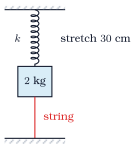
A \(2\) kg block hangs from a spring of \(k = 100\) N/m stretched by \(30\) cm. A string tied to the floor holds it down.
Find the spring force and the tension in the string.
The string is cut. Find the acceleration of the block just after.
Why does the spring force not change at the instant of cutting?
Answer(i) \(30\) N; \(10\) N (ii) \(5\) m/s\(^2\) up (iii) length unchanged at that instant
Solution
Spring force \(= kx = 100 \times 0.3 = 30\) N upward. At rest: \(30 = mg + T\), so \(T = 30 - 20 = 10\) N.
The tension vanishes; the spring still pulls with \(30\) N. Net force \(= 30 - 20 = 10\) N up, so \(a = \dfrac{10}{2} = 5\) m/s\(^2\) upward.
The spring is still stretched by \(30\) cm at that instant; its force depends only on its stretch.
How did it go?
Q78
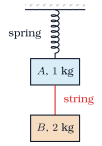
Block \(A\) (\(1\) kg) hangs from the ceiling by a spring. Block \(B\) (\(2\) kg) hangs from \(A\) by a string. All is at rest.
Find the spring force and the string tension.
The string is cut. Find the accelerations of \(A\) and \(B\) just after.
Instead, the spring is cut. Find the accelerations of \(A\) and \(B\) just after.
Answer(i) \(30\) N; \(20\) N (ii) \(A\): \(20\) m/s\(^2\) up; \(B\): \(10\) m/s\(^2\) down (iii) both \(10\) m/s\(^2\) down
Solution
String: \(T = m_Bg = 20\) N. Spring: it holds both blocks, \(F = (1 + 2) \times 10 = 30\) N.
\(A\): spring \(30\) N up, weight \(10\) N down: \(a_A = \dfrac{20}{1} = 20\) m/s\(^2\) upward. \(B\): only its weight, \(a_B = 10\) m/s\(^2\) downward.
With the spring gone, \(A\) and \(B\) hang from nothing. The string goes slack and each falls freely: \(10\) m/s\(^2\) downward for both.
How did it go?
Q79
A \(2\) kg block hangs from the ceiling by a string. A \(3\) kg block hangs below it by a spring. The upper string is cut. Find the acceleration of each block just after.
Before cutting, the spring pulls the \(3\) kg block up with \(30\) N and pulls the \(2\) kg block down with \(30\) N. Just after the cut the spring is unchanged. \(2\) kg: \(20 + 30 = 50\) N down, \(a = 25\) m/s\(^2\) down. \(3\) kg: \(30\) N up and \(30\) N down, \(a = 0\).
How did it go?
Q80
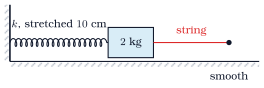
A \(2\) kg block on a smooth table is joined to a wall by a spring of \(k = 100\) N/m, stretched \(10\) cm. A string to a peg on the other side holds it.
Find the tension in the string.
The string is cut. Find the acceleration of the block just after, and its direction.
What is the acceleration when the spring reaches its natural length?
Answer(i) \(10\) N (ii) \(5\) m/s\(^2\) towards the wall (iii) \(0\)
Solution
The spring pulls the block towards the wall with \(kx = 100 \times 0.1 = 10\) N. The string balances it: \(T = 10\) N.
Only the spring force remains: \(a = \dfrac{10}{2} = 5\) m/s\(^2\) towards the wall.
At natural length the spring force is zero, so \(a = 0\); the block is then moving at its greatest speed.
How did it go?
Q81
At the instant a string is cut its tension vanishes, but a spring keeps its force. Explain this with the fact that a spring must change its length to change its force.
Answera string changes tension without changing length
Solution
A spring's force is \(kx\). To change the force the spring must change its length, which takes time. A string, however, is only a constraint: its tension is whatever is needed, and cutting it removes that constraint at once. So the string's pull disappears instantly, while the spring keeps the force it had.
How did it go?
Q82
A \(1\) kg bob hangs from a vertical string. A horizontal string pulls it aside so that the vertical string makes \(37^\circ\) with the vertical. Take \(\sin 37^\circ = 0.6\), \(\cos 37^\circ = 0.8\).
Find the tension in the vertical string.
The horizontal string is cut. Find the acceleration of the bob just after.
The vertical string is replaced by a spring of the same tension and the horizontal string is cut again. Find the acceleration just after.
Answer(i) \(12.5\) N (ii) \(6\) m/s\(^2\) along the arc (iii) \(7.5\) m/s\(^2\) horizontal
Solution
Vertical: \(T\cos 37^\circ = mg\), so \(T = \dfrac{10}{0.8} = 12.5\) N.
The tension adjusts at once so that the bob moves on a circle. Along the tangent: \(a = g\sin 37^\circ = 6\) m/s\(^2\), along the arc.
The spring keeps its \(12.5\) N along the same direction. Its vertical part \(12.5 \times 0.8 = 10\) N balances the weight; its horizontal part \(12.5 \times 0.6 = 7.5\) N is unbalanced. \(a = 7.5\) m/s\(^2\) horizontally.
How did it go?
Q83
A \(2\) kg block hangs from a spring of \(k = 100\) N/m. It is pulled down a further \(5\) cm from its rest position and released. Find its acceleration at the instant of release.
Answer\(2.5\) m/s\(^2\) up
Solution
At rest the spring force balances the weight. The extra \(5\) cm adds \(kx = 100 \times 0.05 = 5\) N upward, so \(a = \dfrac{5}{2} = 2.5\) m/s\(^2\) upward.
How did it go?
Jerk: a string becoming taut
Q84
Blocks of \(2\) kg and \(3\) kg lie on smooth ice, joined by a slack string. The \(2\) kg block is given \(5\) m/s away from the \(3\) kg block, which is at rest, until the string becomes taut.
What is conserved during the jerk? Find the common velocity just after.
Find the kinetic energy lost.
Answer(i) momentum; \(2\) m/s (ii) \(15\) J
Solution
The tension is internal to the pair, so the total momentum is conserved: \(2 \times 5 = 5v\), \(v = 2\) m/s.
Before: \(\dfrac{1}{2} \times 2 \times 25 = 25\) J. After: \(\dfrac{1}{2} \times 5 \times 4 = 10\) J. Lost: \(15\) J, in the sudden stretch of the string.
How did it go?
Q85
For Question 12, find the impulse given by the string to the \(3\) kg block and to the \(2\) kg block.
Answer\(6\) N s each, opposite directions
Solution
\(3\) kg: \(\Delta p = 3 \times 2 = 6\) N s in the direction of motion. \(2\) kg: \(\Delta p = 2 \times 2 - 2 \times 5 = -6\) N s, opposite. Equal and opposite, as internal impulses must be.
How did it go?
Q86
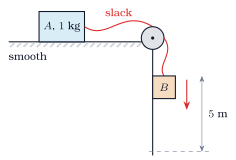
Block \(A\) (\(1\) kg) rests on a smooth table. A slack string over the edge pulley joins it to block \(B\) (\(1\) kg), which falls \(5\) m before the string becomes taut.
Find the speed of \(B\) just before the string tightens.
Find the common speed just after, and the impulse in the string.
Find the acceleration of the blocks after the jerk.
Answer(i) \(10\) m/s (ii) \(5\) m/s; \(5\) N s (iii) \(5\) m/s\(^2\)
Solution
Free fall through \(5\) m: \(v = \sqrt{2 \times 10 \times 5} = 10\) m/s.
The jerk gives both blocks the same speed along the string: \(1 \times 10 = (1 + 1)v\), \(v = 5\) m/s. Impulse on \(A\): \(1 \times 5 = 5\) N s.
After the jerk the system is the usual table-and-hanging pair: \(a = \dfrac{10}{2} = 5\) m/s\(^2\).
How did it go?
Q87
During a jerk, the weight of the blocks is ignored and only the string's impulse is counted. Why is that allowed?
Answerimpulsive tension \(\gg mg\) over the short time
Solution
The jerk lasts a very short time. The impulse of the weight, \(mg\,\Delta t\), is tiny in that time, while the string's tension is huge and its impulse is finite. So the weight's impulse is negligible during the jerk, though the weight matters again afterwards.
How did it go?
Q88
A \(2\) kg block tied to the ceiling by a slack string falls \(1.25\) m before the string becomes taut and stops it.
Find the speed just before the jerk.
Find the impulse in the string.
Find the kinetic energy lost.
Answer(i) \(5\) m/s (ii) \(10\) N s (iii) \(25\) J
Solution
\(v = \sqrt{2 \times 10 \times 1.25} = 5\) m/s.
The string stops the block: \(J = \Delta p = 2 \times 5 = 10\) N s.
All the kinetic energy goes: \(\dfrac{1}{2} \times 2 \times 25 = 25\) J.
How did it go?
Q89
Block \(A\) (\(2\) kg) moves at \(6\) m/s on smooth ice. A slack string joins it to block \(B\) (\(4\) kg), at rest. Find the common velocity after the string tightens and the energy lost.
Answer\(2\) m/s; \(24\) J
Solution
\(2 \times 6 = 6v\), so \(v = 2\) m/s. Before: \(\dfrac{1}{2} \times 2 \times 36 = 36\) J. After: \(\dfrac{1}{2} \times 6 \times 4 = 12\) J. Lost: \(24\) J.
How did it go?
Small situations
Q90
A spring of \(k = 100\) N/m is compressed by \(20\) cm between a wall and a \(2\) kg block on a smooth table, and then released. Find the acceleration of the block at the instant of release.
Answer\(10\) m/s\(^2\)
Solution
Spring force \(= 100 \times 0.2 = 20\) N pushing the block away from the wall: \(a = \dfrac{20}{2} = 10\) m/s\(^2\).
How did it go?
Q91
A spring of \(k = 100\) N/m joins a \(1\) kg block to a \(2\) kg block on a smooth table. A steady \(6\) N pulls the \(2\) kg block away from the \(1\) kg block. Find the acceleration and the stretch of the spring once the motion is steady.
Answer\(2\) m/s\(^2\); \(2\) cm
Solution
Once the stretch is steady both blocks share the acceleration: \(a = \dfrac{6}{3} = 2\) m/s\(^2\). The spring alone pulls the \(1\) kg block: \(kx = 1 \times 2 = 2\) N, so \(x = \dfrac{2}{100} = 0.02\) m \(= 2\) cm.
How did it go?
Q92
A \(4\) kg block hangs from the ceiling by a string. A \(2\) kg block hangs below it by a spring. The string is cut. Find the acceleration of each block just after.
The spring pulls the \(4\) kg block down with \(20\) N (it holds the \(2\) kg block). Just after the cut: \(4\) kg has \(40 + 20 = 60\) N down, \(a = 15\) m/s\(^2\) down. \(2\) kg: spring \(20\) N up and weight \(20\) N down, \(a = 0\).
How did it go?
Q93
A light spring pulls a block at one end while a hand holds its other end. Why is the force at the two ends of the spring the same, even when the spring is accelerating?
Answer\(m = 0\), so net force \(= 0\)
Solution
The spring is light, so \(F = ma\) with \(m = 0\) gives a zero net force on it whatever its acceleration. The pulls at its two ends must therefore be equal and opposite.
How did it go?
Q94
A spring of \(k = 100\) N/m is cut into two equal halves.
Find the stiffness of each half.
Check by joining the halves in series.
Answer(i) \(200\) N/m (ii) \(\frac{200 \times 200}{400} = 100\) N/m
Solution
Half the coils stretch half as much for the same force, so each half is twice as stiff: \(200\) N/m.
Series: \(\dfrac{200 \times 200}{200 + 200} = 100\) N/m, the original spring.
How did it go?
Q95
A \(1\) kg block hangs from a spring of \(k = 100\) N/m in a lift. The spring is stretched by \(12\) cm. Find the acceleration of the lift and its direction.
Answer\(2\) m/s\(^2\) upward
Solution
Spring force \(= 100 \times 0.12 = 12\) N up; weight \(10\) N. \(12 - 10 = 1 \times a\), so \(a = 2\) m/s\(^2\) upward.
How did it go?
Q96
Why does a car with spring suspension give a gentler ride over a bump than one with rigid rods? Use the idea of impulse and the time over which a force acts.
Answersame impulse over a longer time, smaller force
Solution
The bump gives the car the same change of momentum either way. With rigid rods the change happens in a very short time, so the force \(\dfrac{\Delta p}{\Delta t}\) is large. A spring lets the wheel move relative to the body, spreading the same impulse over a longer time and so making the force much smaller.
How did it go?
Impulse and Impulsive Forces
24 questions · after Lesson 6, Impulse and Momentum
Impulse basics
Q97
A force of \(50\) N acts on a \(0.2\) kg ball for \(0.02\) s. Take \(g = 10\) m/s\(^2\) throughout this sheet.
Find the impulse.
Find the change in momentum.
Find the change in velocity.
Answer(i) \(1\) N s (ii) \(1\) kg m/s (iii) \(5\) m/s
Solution
\(J = F\Delta t = 50 \times 0.02 = 1\) N s.
\(\Delta p = J = 1\) kg m/s.
\(\Delta v = \dfrac{\Delta p}{m} = \dfrac{1}{0.2} = 5\) m/s.
How did it go?
Q98
A \(0.5\) kg ball moving at \(10\) m/s hits a wall straight on and returns at \(10\) m/s. The contact lasts \(0.01\) s.
Find the change in momentum.
Find the average force of the wall on the ball.
Answer(i) \(10\) N s (ii) \(1000\) N
Solution
Take the return direction as positive: \(\Delta p = 0.5 \times 10 - 0.5 \times (-10) = 10\) N s.
\(F = \dfrac{\Delta p}{\Delta t} = \dfrac{10}{0.01} = 1000\) N, away from the wall.
How did it go?
Q99
A \(0.2\) kg ball is dropped from \(5\) m and rebounds to \(1.25\) m. Find its speed just before and just after the bounce, and the impulse given by the floor.
Up positive: \(J = 0.2 \times 5 - 0.2 \times (-10) = 3\) N s, upward.
How did it go?
Q100
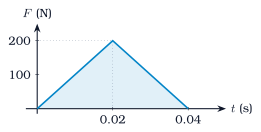
The figure shows the force of a kick on a \(0.4\) kg ball at rest.
What does the area under the graph give?
Find the impulse.
Find the speed of the ball after the kick and the average force.
Answer(i) impulse (ii) \(4\) N s (iii) \(10\) m/s; \(100\) N
Solution
\(\int F\,dt\): the impulse, which equals the change in momentum.
Area of the triangle \(= \dfrac{1}{2} \times 0.04 \times 200 = 4\) N s.
\(v = \dfrac{4}{0.4} = 10\) m/s. Average force \(= \dfrac{4}{0.04} = 100\) N, half the peak.
How did it go?
Q101
Write the SI unit of impulse in two ways and its dimensional formula. Why is it the same as that of momentum?
AnswerN s \(=\) kg m/s; \(\mathrm{MLT^{-1}}\); \(J = \Delta p\)
Solution
N s, or kg m/s. \([F][t] = \mathrm{MLT^{-2}\cdot T = MLT^{-1}}\). Impulse equals the change in momentum, so it must have the units and dimensions of momentum.
How did it go?
Impulse-momentum theorem
Q102
A fielder catches a \(0.15\) kg ball moving at \(20\) m/s.
Find the average force on the hands if the ball stops in \(0.1\) s.
Find it if the ball stops in \(0.01\) s.
Why does the fielder draw the hands back while catching?
Answer(i) \(30\) N (ii) \(300\) N (iii) longer time, smaller force
Solution
\(\Delta p = 0.15 \times 20 = 3\) N s. \(F = \dfrac{3}{0.1} = 30\) N.
\(F = \dfrac{3}{0.01} = 300\) N.
The change in momentum is fixed. Drawing the hands back stretches the stopping time, so the same impulse is delivered by a smaller force, and the catch does not hurt.
How did it go?
Q103
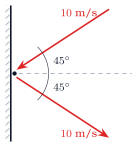
A \(0.1\) kg ball hits a wall at \(45^\circ\) with speed \(10\) m/s and rebounds at \(45^\circ\) with the same speed.
Which component of the velocity changes, and which stays the same?
Find the impulse given by the wall: magnitude and direction.
Answer(i) normal changes; parallel same (ii) \(\sqrt{2} \approx 1.4\) N s, away from the wall
Solution
The component parallel to the wall, \(10\cos 45^\circ\), is unchanged. The component perpendicular to the wall reverses from \(-10\sin 45^\circ\) to \(+10\sin 45^\circ\).
\(J = 2mv\sin 45^\circ = 2 \times 0.1 \times 10 \times \dfrac{1}{\sqrt{2}} = \sqrt{2} \approx 1.4\) N s, perpendicular to the wall and away from it.
How did it go?
Q104
A \(10\) g bullet moving at \(400\) m/s embeds itself in a \(1.99\) kg block resting on a smooth table.
Find the impulse on the block.
Find the common velocity after the impact.
Answer(i) \(4\) N s (ii) \(2\) m/s
Solution
The bullet loses almost all its momentum to the block: \(J \approx 0.01 \times 400 = 4\) N s.
Momentum is conserved: \(4 = (0.01 + 1.99)v\), so \(v = 2\) m/s.
How did it go?
Q105
A jet delivers \(2\) kg of water every second at \(10\) m/s onto a wall, where the water stops. Find the average force on the wall.
Answer\(20\) N
Solution
Each second \(2\) kg of water loses \(10\) m/s: momentum lost per second \(= 2 \times 10 = 20\) kg m/s. The wall provides this impulse every second, so the force is \(20\) N.
How did it go?
Q106
A force \(F = 6t\) (newtons, \(t\) in seconds) acts on a \(3\) kg body at rest from \(t = 0\) to \(t = 2\) s. Find the impulse and the final velocity.
Answer\(12\) N s; \(4\) m/s
Solution
\(J = \int_0^2 6t\,dt = [3t^2]_0^2 = 12\) N s. \(v = \dfrac{J}{m} = \dfrac{12}{3} = 4\) m/s.
How did it go?
Impulsive and non-impulsive forces
Q107
A \(1\) kg ball hits the floor at \(10\) m/s and rebounds at \(10\) m/s. The contact lasts \(0.01\) s.
Find the impulse of the floor on the ball.
Find the average normal force and compare it with the weight.
Find the impulse of gravity during the contact. Why is it neglected?
Answer(i) \(20\) N s up (ii) \(2000\) N, \(200\) times \(mg\) (iii) \(0.1\) N s, tiny
Solution
Up positive: \(J = 1 \times 10 - 1 \times (-10) = 20\) N s upward.
\(N = \dfrac{20}{0.01} = 2000\) N, \(200\) times the weight of \(10\) N.
\(mg\,\Delta t = 10 \times 0.01 = 0.1\) N s, only \(0.5\%\) of the floor's impulse. Gravity acts the whole time, but during the short contact its impulse is too small to matter.
How did it go?
Q108
State whether each force is impulsive or non-impulsive during a sudden collision, with a reason.
Gravity.
The normal force in a crash.
A spring force.
Answer(i) non-impulsive (ii) impulsive (iii) non-impulsive
Solution
Non-impulsive: \(mg\) is finite and small, so its impulse over a very short time is negligible.
Impulsive: the normal force grows very large during the crash and gives a finite impulse in a tiny time.
Non-impulsive: a spring force is \(kx\), and the spring cannot stretch much in a very short time, so its force stays finite.
How did it go?
Q109
A \(2\) kg block hangs at rest from a string. It is struck horizontally with an impulse of \(4\) N s.
Find its velocity just after.
Is the string's impulse during the blow zero? Give the reason.
Answer(i) \(2\) m/s (ii) yes, string perpendicular to the blow
Solution
\(v = \dfrac{J}{m} = \dfrac{4}{2} = 2\) m/s horizontally.
Yes. The string is vertical and the blow is horizontal. A horizontal velocity does not change the string's length at that instant, so the string gives no impulse.
How did it go?
Q110
Blocks \(A\) (\(1\) kg) and \(B\) (\(2\) kg) lie on a smooth table joined by a taut string. \(A\) is struck with an impulse of \(6\) N s directed away from \(B\).
Find the common velocity just after.
Find the impulse in the string.
Answer(i) \(2\) m/s (ii) \(4\) N s
Solution
The taut string makes the pair move together: \(6 = (1 + 2)v\), so \(v = 2\) m/s.
The string alone gives \(B\) its momentum: \(J = 2 \times 2 = 4\) N s. Check on \(A\): \(6 - 4 = 1 \times 2\).
How did it go?
Q111
A hammer head of \(0.5\) kg moving at \(8\) m/s strikes a nail and stops in \(0.002\) s.
Find the impulse on the nail.
Find the average force on the nail.
Why can the same hammer not push the nail in slowly with the same effect?
Answer(i) \(4\) N s (ii) \(2000\) N (iii) force, not impulse, drives the nail
Solution
\(J = 0.5 \times 8 = 4\) N s.
\(F = \dfrac{4}{0.002} = 2000\) N.
Pushing slowly gives at most a force of a few hundred newtons. The blow delivers its impulse in a very short time, so the force is far larger and overcomes the wood's resistance.
How did it go?
Small situations
Q112
A \(1000\) kg car moving at \(20\) m/s crashes into a wall and stops.
Find the average force if it stops in \(0.5\) s.
Find it if a crumple zone stretches the stop to \(1\) s.
Answer(i) \(40000\) N (ii) \(20000\) N
Solution
\(\Delta p = 1000 \times 20 = 20000\) N s. \(F = \dfrac{20000}{0.5} = 40000\) N.
\(F = \dfrac{20000}{1} = 20000\) N. A crumple zone halves the force by doubling the stopping time.
How did it go?
Q113
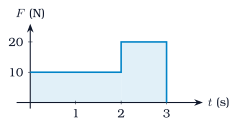
The figure shows the force on a \(4\) kg body that starts from rest.
Find the impulse in the first \(2\) s and in the next \(1\) s.
Find the velocity at \(t = 3\) s.
Find the average force over the \(3\) s.
Answer(i) \(20\) N s; \(20\) N s (ii) \(10\) m/s (iii) \(\frac{40}{3} \approx 13\) N
Solution
\(10 \times 2 = 20\) N s and \(20 \times 1 = 20\) N s.
Total impulse \(40\) N s: \(v = \dfrac{40}{4} = 10\) m/s.
\(\bar F = \dfrac{40}{3} \approx 13\) N.
How did it go?
Q114
A person jumping from a height lands either with stiff legs or with bent knees. Which gives the smaller force on the legs, and why?
Answerbent knees, longer stopping time
Solution
The change in momentum on landing is the same either way. Bending the knees lengthens the stopping time, so the force on the legs is smaller. Stiff legs stop the body in a very short time and the force is large enough to injure.
How did it go?
Q115
A rocket engine throws out \(2\) kg of gas every second at \(500\) m/s relative to the rocket. Find the thrust from the impulse given to the gas each second.
Answer\(1000\) N
Solution
Every second the engine gives \(2\) kg of gas a momentum of \(2 \times 500 = 1000\) kg m/s backward. By Newton's third law the gas pushes the rocket forward with the same impulse each second: thrust \(= 1000\) N.
How did it go?
Q116
A golf club is in contact with a \(50\) g ball for \(0.5\) ms, and the ball leaves at \(60\) m/s. Find the impulse and the average force.
Answer\(3\) N s; \(6000\) N
Solution
\(J = 0.05 \times 60 = 3\) N s. \(F = \dfrac{3}{0.0005} = 6000\) N.
How did it go?
Q117
A \(0.5\) kg ball dropped from \(1.25\) m rebounds at \(4\) m/s. The contact with the floor lasts \(0.05\) s.
Find the impulse of the floor.
Find the average normal force.
Answer(i) \(4.5\) N s (ii) \(95\) N
Solution
Speed before \(= \sqrt{2 \times 10 \times 1.25} = 5\) m/s. Up positive: \(J = 0.5 \times 4 - 0.5 \times (-5) = 4.5\) N s.
The net average force is \(\dfrac{4.5}{0.05} = 90\) N upward. The floor must also carry the weight: \(N = 90 + 5 = 95\) N.
How did it go?
Q118
Hailstones fall on a flat roof at \(20\) m/s and stop there. Every second \(5\) kg of hail arrives. Find the average force on the roof.
Answer\(100\) N
Solution
Momentum stopped each second \(= 5 \times 20 = 100\) kg m/s, so the average force is \(100\) N. The weight of the hail resting on the roof is extra.
How did it go?
Q119
Start from \(F = \frac{dp}{dt}\) and show that \(\int_{t_1}^{t_2} F\,dt = p_2 - p_1\). State this result in words.
Answer\(\int F\,dt = \int dp\); impulse \(=\) change in momentum
In words: the impulse of the net force over an interval equals the change in momentum over that interval.
How did it go?
Q120
A \(0.2\) kg ball moving with velocity \(3\hat i\) m/s is struck and moves off with velocity \(4\hat j\) m/s. Find the impulse as a vector and its magnitude.
Answer\(-0.6\hat i + 0.8\hat j\) N s; \(1\) N s
Solution
\(\vec J = m(\vec v_2 - \vec v_1) = 0.2(4\hat j - 3\hat i) = -0.6\hat i + 0.8\hat j\) N s. Magnitude \(= \sqrt{0.36 + 0.64} = 1\) N s.