Questions on Friction, Part 1, the kind your examinations ask. Solve one on paper. Then tell the book how it went. The book believes you, and it uses your answer to plan your revision.
0%
Nothing marked yetMark honestly. Peek at the answer only after your own attempt.
Static and Kinetic Friction, Inclines and Angle of Repose
24 questions · after Lesson 4, A Block on a Rough Incline
Static and kinetic friction
Q1
A \(5\) kg block rests on a floor with \(\mu_s = 0.4\) and \(\mu_k = 0.3\). Take \(g = 10\) m/s\(^2\) throughout this sheet.
Find the largest static friction and the kinetic friction.
A horizontal push of \(10\) N is applied. Find the friction and the acceleration.
The push is \(25\) N. Find the friction and the acceleration.
Answer(i) \(20\) N; \(15\) N (ii) \(10\) N; \(0\) (iii) \(15\) N; \(2\) m/s\(^2\)
Solution
\(N = mg = 50\) N. \(f_{\max} = \mu_sN = 20\) N; \(f_k = \mu_kN = 15\) N.
\(10\) N is less than \(20\) N, so the block stays at rest. Static friction equals the push: \(f = 10\) N, \(a = 0\).
\(25\) N exceeds \(20\) N, so the block slides and kinetic friction acts: \(f = 15\) N. \(a = \dfrac{25 - 15}{5} = 2\) m/s\(^2\).
How did it go?
Q2
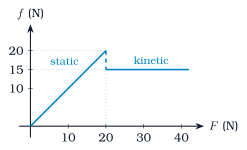
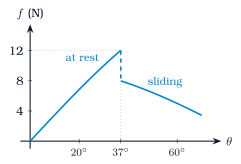
The figure shows the friction on a block against the horizontal force applied to it. The normal force is \(50\) N.
Read the limiting friction and find \(\mu_s\).
Read the kinetic friction and find \(\mu_k\).
Why is the first part of the graph a line of slope \(1\)?
Answer(i) \(20\) N; \(0.4\) (ii) \(15\) N; \(0.3\) (iii) \(f = F\) while at rest
Solution
The peak is \(20\) N: \(\mu_s = \dfrac{20}{50} = 0.4\).
The flat part is \(15\) N: \(\mu_k = \dfrac{15}{50} = 0.3\).
While the block is at rest the friction exactly balances the applied force, so \(f = F\). That is a line of slope \(1\), up to the limiting value.
How did it go?
Q3
Why is static friction called self-adjusting? Why is kinetic friction usually less than the limiting static friction?
Answerequals the applied force up to a limit; sliding surfaces grip less
Solution
Static friction takes whatever value is needed to keep the body at rest, from zero up to the limit \(\mu_sN\). It adjusts itself to the applied force. Once sliding starts the surfaces touch only briefly at their high points and grip less, so kinetic friction is smaller than the limiting static friction.
How did it go?
Q4
A \(2\) kg block is pulled along a floor at a steady speed by a horizontal force of \(6\) N.
Find \(\mu_k\).
The pull is removed at \(6\) m/s. Find the deceleration and the stopping distance.
Answer(i) \(0.3\) (ii) \(3\) m/s\(^2\); \(6\) m
Solution
Steady speed means \(f_k = 6\) N. \(\mu_k = \dfrac{6}{20} = 0.3\).
With the pull removed only friction acts: \(a = \dfrac{6}{2} = 3\) m/s\(^2\) backward. \(s = \dfrac{u^2}{2a} = \dfrac{36}{6} = 6\) m.
How did it go?
Q5
A \(10\) kg box pushed with \(30\) N does not move. Find the friction on it. What can you say about \(\mu_s\)?
Answer\(30\) N; \(\mu_s \ge 0.3\)
Solution
The box is at rest, so friction balances the push: \(f = 30\) N. This must not exceed the limit: \(\mu_s \times 100 \ge 30\), so \(\mu_s \ge 0.3\). The exact value cannot be found.
How did it go?
Pulling and pushing
Q6
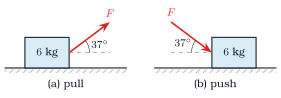
A \(6\) kg block is on a floor with \(\mu = 0.75\). Take \(\sin 37^\circ = 0.6\) and \(\cos 37^\circ = 0.8\).
Find the least pull \(F\) at \(37^\circ\) above the horizontal that just moves the block.
Find the least push at \(37^\circ\) below the horizontal that just moves it.
Why are the two so different?
Answer(i) \(36\) N (ii) \(\approx 129\) N (iii) push adds to \(N\), pull reduces it
Push: \(N = 60 + 0.6F\). \(0.8F = 0.75(60 + 0.6F) = 45 + 0.45F\), so \(0.35F = 45\) and \(F \approx 129\) N.
The pull's upward part reduces the normal force and so the friction. The push's downward part increases both. The same horizontal part must then beat a much larger friction.
How did it go?
Q7
A heavy roller is easier to pull than to push. Explain with the normal force and the friction.
A pull along a handle tilted upward has an upward component that lifts part of the roller's weight off the ground, reducing \(N\). A push along the handle presses the roller down and increases \(N\). Friction is proportional to \(N\), so pulling meets less friction.
How did it go?
Q8
A block of weight \(W\) is pulled by a force \(F\) at angle \(\theta\) above the horizontal on a floor with coefficient \(\mu\).
Show that the block just moves when \(F = \frac{\mu W}{\cos\theta + \mu\sin\theta}\).
This \(F\) is least when \(\tan\theta = \mu\). For \(\mu = 0.75\) and \(W = 60\) N find the best angle and the least force. Compare with Question 6.
Answer(i) \(F\cos\theta = \mu(W - F\sin\theta)\) (ii) \(37^\circ\); \(36\) N, same
Solution
Vertical: \(N = W - F\sin\theta\). Horizontal, at the point of moving: \(F\cos\theta = \mu N = \mu(W - F\sin\theta)\). So \(F(\cos\theta + \mu\sin\theta) = \mu W\) and \(F = \dfrac{\mu W}{\cos\theta + \mu\sin\theta}\).
\(\tan\theta = 0.75\) gives \(\theta = 37^\circ\). \(F = \dfrac{0.75 \times 60}{0.8 + 0.75 \times 0.6} = \dfrac{45}{1.25} = 36\) N. Question 6 used exactly this angle, so its \(36\) N is the least possible pull.
How did it go?
Inclines
Q9
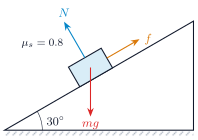
A \(2\) kg block rests on a \(30^\circ\) incline with \(\mu_s = 0.8\).
Find the friction needed to hold the block.
Find the largest friction the surface can supply.
Does the block stay? Is the friction equal to \(\mu_s N\)?
Answer(i) \(10\) N (ii) \(8\sqrt{3} \approx 13.9\) N (iii) yes; no
Solution
Along the slope the weight pulls with \(mg\sin 30^\circ = 10\) N, so friction must supply \(10\) N up the slope.
\(N = mg\cos 30^\circ = 10\sqrt{3}\) N. \(f_{\max} = 0.8 \times 10\sqrt{3} = 8\sqrt{3} \approx 13.9\) N.
\(10 < 13.9\), so the block stays. The friction is \(10\) N, only what is needed, not the full \(\mu_sN\).
How did it go?
Q10
The angle of repose is the largest incline angle at which a block stays at rest. Show that \(\tan\theta_r = \mu_s\), and find \(\theta_r\) for \(\mu_s = 0.75\) and for \(\mu_s = \frac{1}{\sqrt{3}}\).
A block slides down a \(37^\circ\) incline with \(\mu_k = 0.25\). Find its acceleration.
Answer\(4\) m/s\(^2\) down the slope
Solution
Down the slope: \(ma = mg\sin\theta - \mu_kmg\cos\theta\), so \(a = 10(0.6 - 0.25 \times 0.8) = 10 \times 0.4 = 4\) m/s\(^2\).
How did it go?
Q12
The block of Question 11 is projected up the incline at \(8\) m/s.
Find the deceleration on the way up and the distance it travels.
Does it slide back? Give the reason.
Find its speed when it returns to the start.
Answer(i) \(8\) m/s\(^2\); \(4\) m (ii) yes, \(\tan 37^\circ > \mu\) (iii) \(4\sqrt{2} \approx 5.7\) m/s
Solution
Going up, both gravity and friction act down the slope: \(a = 10(0.6 + 0.2) = 8\) m/s\(^2\). Distance \(= \dfrac{64}{16} = 4\) m.
Yes. At the top the block is at rest and \(\tan 37^\circ = 0.75\) exceeds \(\mu = 0.25\), so friction cannot hold it.
Coming down, \(a = 4\) m/s\(^2\) over \(4\) m: \(v = \sqrt{2 \times 4 \times 4} = 4\sqrt{2} \approx 5.7\) m/s, less than the \(8\) m/s it started with.
How did it go?
Q13
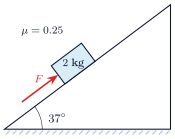
A \(2\) kg block is on a \(37^\circ\) incline with \(\mu = 0.25\). A force \(F\) acts up along the slope.
Find the least \(F\) that stops the block from sliding down.
Find the \(F\) that pushes the block up at a steady speed.
In which direction does friction act in each case?
Answer(i) \(8\) N (ii) \(16\) N (iii) up; down
Solution
The block tends to slide down, so friction acts up the slope at its limit \(\mu N = 0.25 \times 16 = 4\) N. \(F + 4 = mg\sin 37^\circ = 12\), so \(F = 8\) N.
Now the block moves up, so friction acts down the slope: \(F = 12 + 4 = 16\) N.
Up the slope in (i), down the slope in (ii). Friction always opposes the sliding, or the tendency to slide.
How did it go?
Q14
A block starts from rest at the top of a \(5\) m long \(30^\circ\) incline with \(\mu_k = \frac{1}{2\sqrt{3}}\). Find its acceleration and the time to reach the bottom.
The greatest braking force is \(\mu mg\), so \(a = \mu g = 5\) m/s\(^2\).
\(s = \dfrac{u^2}{2a} = \dfrac{400}{10} = 40\) m.
No. The mass cancels: a heavier car has more friction and more inertia in the same proportion.
How did it go?
Q17
A box lies on the floor of a truck with \(\mu_s = 0.4\). Find the greatest acceleration of the truck for which the box does not slip.
Answer\(4\) m/s\(^2\)
Solution
Only friction can accelerate the box: \(\mu_smg \ge ma\), so \(a_{\max} = \mu_sg = 4\) m/s\(^2\).
How did it go?
Q18
A block lies on the floor of a bus with \(\mu = 0.4\). The bus brakes at \(5\) m/s\(^2\). Find the acceleration of the block relative to the bus and its direction.
Answer\(1\) m/s\(^2\) forward
Solution
In the bus's frame the block feels a pseudo force \(5m\) forward. Friction can supply at most \(\mu mg = 4m\) backward, which is not enough. Net \(= m\), so the block slides forward relative to the bus at \(1\) m/s\(^2\).
How did it go?
Q19
A book on a board begins to slide when the board is tilted to \(30^\circ\). Find \(\mu_s\).
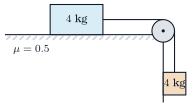
At rest the hanging weight must not exceed \(20\) N: \(m = 2\) kg.
How did it go?
Q21
A \(4\) kg block rests on a floor with \(\mu_s = 0.3\). State the friction when the horizontal push is \(5\) N, \(10\) N and \(15\) N.
Answer\(5\) N; \(10\) N; \(12\) N (sliding)
Solution
Limit \(= 0.3 \times 40 = 12\) N. Push \(5\) N: friction \(5\) N. Push \(10\) N: friction \(10\) N. Push \(15\) N: the block slides and friction is the kinetic value, about \(12\) N (taking \(\mu_k \approx \mu_s\) here).
How did it go?
Q22
For the pull of Question 8, show that the normal force is \(N = W - F\sin\theta\). What happens to \(N\), and hence to the friction, as \(\theta\) increases?
Answervertical balance; \(N\) and \(f\) decrease
Solution
Vertically the block does not move: \(N + F\sin\theta = W\), so \(N = W - F\sin\theta\). As \(\theta\) grows, \(F\sin\theta\) grows and \(N\) falls, so the friction \(\mu N\) falls too. That is why a tilted pull helps, up to the best angle.
How did it go?
Q23
On a dry road \(\mu = 0.8\); on a wet road \(\mu = 0.2\). Find the stopping distance from \(20\) m/s in each case.
Answer\(25\) m; \(100\) m
Solution
\(s = \dfrac{u^2}{2\mu g}\). Dry: \(\dfrac{400}{16} = 25\) m. Wet: \(\dfrac{400}{4} = 100\) m, four times as far.
How did it go?
Q24
A block slides down a rough incline at a steady speed. Show that \(\mu_k = \tan\theta\), and find \(\mu_k\) for a \(37^\circ\) incline.