Questions on Friction, Part 2, the kind your examinations ask. Solve one on paper. Then tell the book how it went. The book believes you, and it uses your answer to plan your revision.
0%
Nothing marked yetMark honestly. Peek at the answer only after your own attempt.
Block-on-Block Friction Systems
24 questions · after Lesson 4, Block on Block
Force on the lower block
Q1
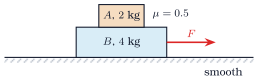
Block \(A\) (\(2\) kg) rests on block \(B\) (\(4\) kg), which lies on a smooth floor. \(\mu = 0.5\) between the blocks. A force \(F\) pulls \(B\). Take \(g = 10\) m/s\(^2\) throughout this sheet.
Which force moves \(A\)? Find the largest acceleration it can give \(A\).
Find the largest \(F\) for which \(A\) does not slip on \(B\).
Answer(i) friction from \(B\); \(5\) m/s\(^2\) (ii) \(30\) N
Solution
Only friction from \(B\) acts on \(A\) horizontally. Its largest value is \(\mu m_Ag = 0.5 \times 20 = 10\) N, giving \(a_{\max} = \dfrac{10}{2} = 5\) m/s\(^2\).
Without slipping the pair accelerates together: \(F = (2 + 4)a \le 6 \times 5 = 30\) N.
How did it go?
Q2
In Question 1, \(F = 18\) N. Find the common acceleration and the friction on \(A\). Is it static or kinetic?
Answer\(3\) m/s\(^2\); \(6\) N; static
Solution
\(18 < 30\), so no slipping: \(a = \dfrac{18}{6} = 3\) m/s\(^2\). Friction on \(A\) \(= m_Aa = 6\) N, less than the limit of \(10\) N, so it is static.
How did it go?
Q3
In Question 1, \(F = 48\) N. Show that \(A\) slips, and find the acceleration of each block.
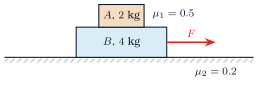
The floor is now rough, with \(\mu_2 = 0.2\) between \(B\) and the floor; \(\mu_1 = 0.5\) between the blocks. \(F\) pulls \(B\).
Find the friction from the floor when the blocks move.
Find the largest \(F\) for which \(A\) does not slip.
Find the least \(F\) that moves the blocks at all.
Answer(i) \(12\) N (ii) \(42\) N (iii) \(12\) N
Solution
The floor carries both blocks: \(N = 60\) N, so \(f_2 = 0.2 \times 60 = 12\) N.
Together: \((F - 12) = 6a\) with \(a \le 5\): \(F \le 42\) N.
The blocks move once \(F\) exceeds the floor's limiting friction, \(12\) N.
How did it go?
Q7
For Question 6, draw the free body diagram of each block when they move together. State the direction of every friction force.
Answeron \(A\): forward; on \(B\): backward from \(A\), backward from floor
Solution
\(A\): weight \(20\) N down, normal force \(20\) N up from \(B\), friction from \(B\) forward (it drags \(A\) along). \(B\): weight \(40\) N, \(20\) N down from \(A\), normal force \(60\) N up from the floor, \(F\) forward. Two frictions act backward on \(B\): the reaction from \(A\) and the floor's friction.
How did it go?
Q8
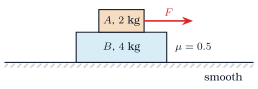
In the setup of Question 6, \(F = 12\) N is applied to \(A\) instead of \(B\). Does \(B\) move? Does \(A\) slip? Find the acceleration of \(A\).
Answer\(B\) stays; \(A\) slips; \(1\) m/s\(^2\)
Solution
\(B\) can be pushed only by the friction from \(A\), at most \(10\) N. The floor can hold \(B\) with up to \(12\) N, so \(B\) stays at rest. \(A\) needs \(12\) N of friction to stay with \(B\), but only \(10\) N is available, so \(A\) slips: \(a_A = \dfrac{12 - 10}{2} = 1\) m/s\(^2\).
How did it go?
Q9
Show that the largest acceleration friction can give the upper block is \(\mu g\), whatever its mass.
Answer\(f \le \mu m_1 g\), \(a = f/m_1\)
Solution
The only horizontal force on the upper block is friction, \(f \le \mu N = \mu m_1g\). Its acceleration is \(a = \dfrac{f}{m_1} \le \dfrac{\mu m_1g}{m_1} = \mu g\). The mass cancels.
How did it go?
Other arrangements
Q10
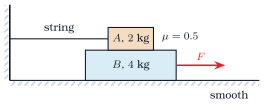
Block \(A\) (\(2\) kg) is tied to a wall by a string and rests on block \(B\) (\(4\) kg). \(\mu = 0.5\) between them, and the floor is smooth. \(F = 30\) N pulls \(B\).
Find the friction between the blocks and its direction on each.
Find the tension in the string.
Find the acceleration of \(B\).
Answer(i) \(10\) N; on \(A\) forward, on \(B\) backward (ii) \(10\) N (iii) \(5\) m/s\(^2\)
Solution
\(B\) slides under \(A\), so kinetic friction \(\mu m_Ag = 10\) N acts: forward on \(A\) (in the direction of \(F\)) and backward on \(B\).
\(A\) is at rest: the string balances the friction, \(T = 10\) N.
\(B\): \(30 - 10 = 4a\), so \(a = 5\) m/s\(^2\).
How did it go?
Q11
Block \(A\) (\(2\) kg) lies on plank \(B\) (\(8\) kg) on a smooth floor, with \(\mu = 0.4\) between them. \(A\) is pushed with \(12\) N. Check whether they move together and find the acceleration of each.
If together: \(a = \dfrac{12}{10} = 1.2\) m/s\(^2\), and \(B\) would need friction \(8 \times 1.2 = 9.6\) N. The limit is \(0.4 \times 20 = 8\) N, so they slip. \(A\): \(a = \dfrac{12 - 8}{2} = 2\) m/s\(^2\). \(B\): \(a = \dfrac{8}{8} = 1\) m/s\(^2\).
How did it go?
Q12
In Question 11, \(A\) starts at the rear end of the plank, which is \(2\) m long. Find the time for \(A\) to reach the front end.
A block is placed gently on a conveyor belt moving at \(2\) m/s. \(\mu = 0.2\) between block and belt.
Find the block's acceleration and the time until it moves with the belt.
Find the distance the block moves and the distance the belt moves in that time.
How far does the block slide on the belt?
Answer(i) \(2\) m/s\(^2\); \(1\) s (ii) \(1\) m; \(2\) m (iii) \(1\) m
Solution
Kinetic friction drives the block: \(a = \mu g = 2\) m/s\(^2\). It reaches \(2\) m/s after \(t = 1\) s.
Block: \(\dfrac{1}{2} \times 2 \times 1 = 1\) m. Belt: \(2 \times 1 = 2\) m.
The block slides \(2 - 1 = 1\) m backward relative to the belt.
How did it go?
Small situations
Q14
A coin lies on a book. The book is pulled with acceleration \(6\) m/s\(^2\), and \(\mu = 0.5\) between coin and book. Does the coin slip? Find its acceleration.
Answeryes; \(5\) m/s\(^2\)
Solution
Friction can give the coin at most \(\mu g = 5\) m/s\(^2\), less than \(6\) m/s\(^2\). The coin slips, accelerating at \(5\) m/s\(^2\) while the book pulls ahead.
How did it go?
Q15
A \(1\) kg block rests on a \(3\) kg block on a smooth floor, with \(\mu = 0.3\) between them. Find the largest force on the lower block for which the blocks move together.
Answer\(12\) N
Solution
\(a_{\max} = \mu g = 3\) m/s\(^2\). \(F_{\max} = (1 + 3) \times 3 = 12\) N.
How did it go?
Q16
A crate lies on the floor of a truck with \(\mu = 0.6\).
Find the greatest deceleration of the truck for which the crate does not slide.
Find the shortest stopping distance from \(18\) m/s.
Answer(i) \(6\) m/s\(^2\) (ii) \(27\) m
Solution
Friction can decelerate the crate at most at \(\mu g = 6\) m/s\(^2\).
\(s = \dfrac{18^2}{2 \times 6} = 27\) m.
How did it go?
Q17
Block \(A\) (\(1\) kg) rests on block \(B\) (\(2\) kg) on a smooth floor, with \(\mu = 0.2\) between them. \(B\) is pulled with \(9\) N. Find the acceleration of each block.
Together: \(a = \dfrac{9}{3} = 3\) m/s\(^2\), needing \(1 \times 3 = 3\) N on \(A\); the limit is \(0.2 \times 10 = 2\) N, so they slip. \(A\): \(a = \dfrac{2}{1} = 2\) m/s\(^2\). \(B\): \(a = \dfrac{9 - 2}{2} = 3.5\) m/s\(^2\).
How did it go?
Q18
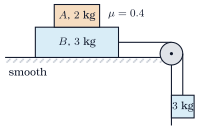
Block \(A\) (\(2\) kg) rests on block \(B\) (\(3\) kg) on a smooth table. A string from \(B\) over the edge pulley carries a hanging \(3\) kg block. \(\mu = 0.4\) between \(A\) and \(B\).
Assume no slipping and find the acceleration.
Find the friction needed on \(A\) and check that it is available.
Find the tension in the string.
Answer(i) \(3.75\) m/s\(^2\) (ii) \(7.5\) N \(\le 8\) N (iii) \(18.75\) N
\(A\) needs \(f = 2 \times 3.75 = 7.5\) N. Available: \(0.4 \times 20 = 8\) N. So there is no slipping.
Hanging block: \(30 - T = 3 \times 3.75\), so \(T = 18.75\) N.
How did it go?
Q19
Explain why the friction between the two blocks is an internal force for the pair taken together but an external force for either block alone.
Answeraction-reaction pair inside the pair
Solution
The friction on \(A\) from \(B\) and the friction on \(B\) from \(A\) are an action-reaction pair, equal and opposite. Added over the pair they cancel, so they do not change the pair's total momentum: internal. For \(A\) alone, the friction from \(B\) comes from outside \(A\) and does change \(A\)'s motion: external.
How did it go?
Q20
Two stacked blocks on a smooth floor are to accelerate together at \(3\) m/s\(^2\) when the lower one is pulled. Find the least \(\mu\) between them.
Block \(A\) (\(2\) kg) rests on block \(B\) (\(4\) kg) on a smooth floor, with \(\mu = 0.5\) between them. \(B\) is suddenly given a velocity of \(6\) m/s while \(A\) is at rest.
Find the acceleration of \(A\) and the deceleration of \(B\) while they slip.
Find their common velocity and the time at which slipping stops.
Answer(i) \(5\) m/s\(^2\); \(2.5\) m/s\(^2\) (ii) \(4\) m/s; \(0.8\) s
Solution
Kinetic friction \(= 0.5 \times 20 = 10\) N. \(A\) speeds up at \(\dfrac{10}{2} = 5\) m/s\(^2\); \(B\) slows at \(\dfrac{10}{4} = 2.5\) m/s\(^2\).
Friction is internal, so momentum is conserved: \(4 \times 6 = 6v\), \(v = 4\) m/s. Time: \(A\) reaches \(4\) m/s at \(t = \dfrac{4}{5} = 0.8\) s; check \(B\): \(6 - 2.5 \times 0.8 = 4\) m/s.
How did it go?
Q22
For Question 21, find the distance \(A\) slides over \(B\) before slipping stops.
Answer\(2.4\) m
Solution
Relative to \(B\), \(A\) starts at \(6\) m/s backward and decelerates at \(5 + 2.5 = 7.5\) m/s\(^2\). Distance \(= \dfrac{6^2}{2 \times 7.5} = 2.4\) m.
How did it go?
Q23
A \(2\) kg block rests on a \(6\) kg plank. \(\mu = 0.25\) between them and \(\mu = 0.1\) between the plank and the floor. The plank is pulled with \(20\) N. Do they move together? Find the acceleration.
Answeryes; \(1.5\) m/s\(^2\)
Solution
Floor friction \(= 0.1 \times 80 = 8\) N. If together: \(a = \dfrac{20 - 8}{8} = 1.5\) m/s\(^2\), needing \(2 \times 1.5 = 3\) N on the block; available \(0.25 \times 20 = 5\) N. So yes, they move together at \(1.5\) m/s\(^2\).
How did it go?
Q24
Blocks \(m_1\) (upper) and \(m_2\) (lower) rest on a smooth floor with \(\mu\) between them. Show that the largest force for no slipping is \(\mu g(m_1 + m_2)\) when applied to the lower block, and \(\mu g\frac{m_1(m_1 + m_2)}{m_2}\) when applied to the upper block.
Answer\(a_{\max} = \mu g\); \(a_{\max} = \mu g m_1/m_2\)
Solution
Force on the lower block: the upper block is driven by friction, \(a \le \mu g\), and \(F = (m_1 + m_2)a\), so \(F_{\max} = \mu g(m_1 + m_2)\).
Force on the upper block: the lower block is driven by friction \(\le \mu m_1g\), so \(a \le \dfrac{\mu m_1g}{m_2}\), and \(F = (m_1 + m_2)a \le \mu g\dfrac{m_1(m_1 + m_2)}{m_2}\).