Questions on Kinematics of Circular Motion, the kind your examinations ask. Solve one on paper. Then tell the book how it went. The book believes you, and it uses your answer to plan your revision.
0%
Nothing marked yetMark honestly. Peek at the answer only after your own attempt.
Kinematics of Circular Motion and Radius of Curvature
24 questions · after Lesson 6, The Radius of Curvature
Angular quantities
Q1
A particle moves on a circle of radius \(2\) m with angular speed \(\omega = 3\) rad/s.
Find its speed \(v = \omega r\).
Find the time period.
Find the frequency.
Answer(i) \(6\) m/s (ii) \(\frac{2\pi}{3} \approx 2.1\) s (iii) \(\frac{3}{2\pi} \approx 0.48\) Hz
Solution
\(v = \omega r = 3 \times 2 = 6\) m/s.
\(T = \dfrac{2\pi}{\omega} = \dfrac{2\pi}{3} \approx 2.1\) s.
\(f = \dfrac{1}{T} = \dfrac{3}{2\pi} \approx 0.48\) Hz.
How did it go?
Q2
A wheel turns at \(120\) revolutions per minute. Find its angular speed in rad/s and the speed of a point \(0.5\) m from the axis.
Answer\(4\pi \approx 12.6\) rad/s; \(2\pi \approx 6.3\) m/s
No. Its magnitude is fixed but its direction keeps turning, so the vector changes.
How did it go?
Q8
A \(1000\) kg car rounds a curve of radius \(50\) m at \(10\) m/s. Find its centripetal acceleration and the force needed. Which force supplies it on a level road?
Answer\(2\) m/s\(^2\); \(2000\) N; friction
Solution
\(a = \dfrac{100}{50} = 2\) m/s\(^2\). \(F = ma = 2000\) N, supplied by the friction between the tyres and the road.
How did it go?
Q9
The Moon orbits the Earth at radius \(3.84 \times 10^{8}\) m with period \(2.36 \times 10^{6}\) s. Find its centripetal acceleration using \(a = \frac{4\pi^2 r}{T^2}\). Take \(\pi^2 = 9.87\).
A stone is whirled on a string of length \(1\) m at \(2\) revolutions per second. Find its speed and its centripetal acceleration, leaving \(\pi\) in the answers.
\(a = \sqrt{2^2 + 2^2} = 2\sqrt{2} \approx 2.8\) m/s\(^2\), at \(45^\circ\) to the radius (and to the tangent).
How did it go?
Q12
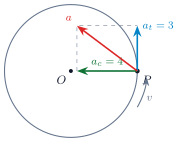
At point \(P\) a particle moving anticlockwise on a circle has \(a_t = 3\) m/s\(^2\) and \(a_c = 4\) m/s\(^2\).
Is the particle speeding up or slowing down? Give the reason.
Find the total acceleration and its angle with the velocity.
Which component changes the speed, and which changes the direction?
Answer(i) speeding up, \(a_t\) along \(v\) (ii) \(5\) m/s\(^2\); \(53^\circ\) (iii) \(a_t\); \(a_c\)
Solution
Speeding up: \(a_t\) points along the velocity (anticlockwise tangent), so the speed grows.
\(a = \sqrt{9 + 16} = 5\) m/s\(^2\). \(\tan\phi = \dfrac{a_c}{a_t} = \dfrac{4}{3}\), so \(\phi = 53^\circ\) from the velocity, leaning towards the centre.
\(a_t\) changes the speed; \(a_c\) changes only the direction.
How did it go?
Q13
A car starts from rest on a circular track of radius \(100\) m with a steady tangential acceleration of \(2\) m/s\(^2\). Find its speed, its centripetal acceleration and its total acceleration after \(5\) s.
In circular motion, when is the total acceleration perpendicular to the velocity? When is it along the velocity?
Answeruniform speed; at the start from rest
Solution
Perpendicular when \(a_t = 0\), that is, when the speed is constant: only the centripetal part remains. Along the velocity when \(a_c = 0\), that is, at the instant the particle starts from rest, since \(v = 0\) gives \(\dfrac{v^2}{r} = 0\).
How did it go?
Radius of curvature
Q16
The radius of curvature of a path is \(R = \frac{v^2}{a_\perp}\), where \(a_\perp\) is the acceleration perpendicular to the velocity. A ball is thrown at \(20\) m/s at \(60^\circ\). Find \(R\) at the top of its path. Take \(g = 10\) m/s\(^2\).
Answer\(10\) m
Solution
At the top \(v = u\cos 60^\circ = 10\) m/s, horizontal, and the whole of \(g\) is perpendicular to it. \(R = \dfrac{100}{10} = 10\) m.
How did it go?
Q17
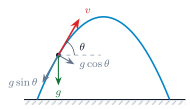
For the same ball, just after launch:
Find the component of \(g\) perpendicular to the velocity.
Find the radius of curvature there.
Why is \(R\) larger here than at the top?
Answer(i) \(5\) m/s\(^2\) (ii) \(80\) m (iii) \(v\) larger, \(a_\perp\) smaller
Solution
\(a_\perp = g\cos 60^\circ = 5\) m/s\(^2\); the other part, \(g\sin 60^\circ\), only slows the ball.
\(R = \dfrac{v^2}{a_\perp} = \dfrac{400}{5} = 80\) m.
Near launch the speed is greater and the perpendicular acceleration smaller, so the path bends less: a larger \(R\).
How did it go?
Q18
A particle moves at \(5\) m/s. Its acceleration is \(2\) m/s\(^2\) at \(30^\circ\) to the velocity. Find \(a_t\), \(a_\perp\) and the radius of curvature of its path.
Answer\(\sqrt{3} \approx 1.7\); \(1\) m/s\(^2\); \(25\) m
\(\omega = \dfrac{v}{r} = \dfrac{10}{0.5} = 20\) rad/s. Revolutions per second \(= \dfrac{\omega}{2\pi} = \dfrac{10}{\pi} \approx 3.2\).
How did it go?
Q23
In uniform circular motion, which of these are constant: speed, velocity, magnitude of acceleration, acceleration? Give the reasons.
Answerspeed, \(|a|\) constant; \(\vec v\), \(\vec a\) not
Solution
Speed is constant by definition, and so is \(|a| = \dfrac{v^2}{r}\). The velocity is not constant, because its direction turns. The acceleration is not constant either, because it always points to the centre and so keeps turning too.
How did it go?
Q24
A particle of speed \(v\) turns through a small angle \(\Delta\theta\) in time \(\Delta t\) on a circle of radius \(r\). Show that \(|\Delta\vec v| = v\,\Delta\theta\) and hence that \(a = \frac{v^2}{r}\).
The velocity vectors at the two instants have the same length \(v\) and differ in direction by \(\Delta\theta\). Placed tail to tail they form an isosceles triangle whose third side is \(\Delta\vec v\). For a small angle its length is the arc, \(v\,\Delta\theta\).
\(a = \dfrac{|\Delta\vec v|}{\Delta t} = v\dfrac{\Delta\theta}{\Delta t} = v\omega = v \times \dfrac{v}{r} = \dfrac{v^2}{r}\). As \(\Delta\theta \to 0\), \(\Delta\vec v\) becomes perpendicular to \(\vec v\), pointing to the centre.