Questions on Dynamics of Circular Motion, the kind your examinations ask. Solve one on paper. Then tell the book how it went. The book believes you, and it uses your answer to plan your revision.
0%
Nothing marked yetMark honestly. Peek at the answer only after your own attempt.
Banking of Roads and the Conical Pendulum
24 questions · after Lesson 5, Banked Roads and Railway Tracks
Level road
Q1
A car takes a level curve of radius \(80\) m. The coefficient of friction between the tyres and the road is \(0.5\). Take \(g = 10\) m/s\(^2\) throughout this sheet. Find the greatest safe speed.
Show that the greatest speed on a level curve is \(v = \sqrt{\mu r g}\). Why does the mass of the car not appear?
Answer\(\mu mg = \frac{mv^2}{r}\); \(m\) cancels
Solution
On a level road only friction can point towards the centre. The largest friction is \(\mu N = \mu mg\), so \(\mu mg \ge \dfrac{mv^2}{r}\), giving \(v \le \sqrt{\mu rg}\). The mass appears on both sides and cancels: friction and the needed force both grow with \(m\).
How did it go?
Q3
A cyclist takes a curve of radius \(20\) m at \(10\) m/s. Find \(\tan\theta\), where \(\theta\) is the angle by which the cyclist leans from the vertical.
Answer\(0.5\)
Solution
The cyclist leans so that the resultant of \(N\) and friction passes through the centre of mass: \(\tan\theta = \dfrac{v^2}{rg} = \dfrac{100}{200} = 0.5\).
How did it go?
Q4
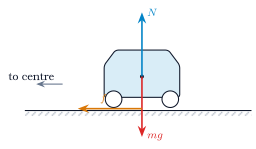
The figure shows the forces on a car of mass \(1000\) kg on a level curve of radius \(50\) m, seen from behind.
Which force provides the centripetal force? Write the two force equations.
Find the friction needed at \(10\) m/s.
With \(\mu = 0.4\), is this speed safe?
Answer(i) friction; \(N = mg\), \(f = \frac{mv^2}{r}\) (ii) \(2000\) N (iii) yes, \(4000\) N available
Dividing the second by the first: \(\tan\theta = \dfrac{v^2}{rg}\).
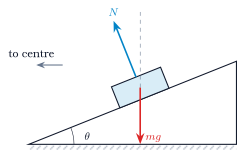
\(N\) is perpendicular to the road. Because the outer edge is higher, \(N\) tilts towards the inside of the curve, and its horizontal part supplies the centripetal force.
How did it go?
Q6
A curve of radius \(40\) m is banked at \(45^\circ\). Find the speed at which no friction is needed.
A railway curve of radius \(100\) m is to be taken at \(10\) m/s. The rails are \(1\) m apart. By how much should the outer rail be raised above the inner one?
Answer\(0.1\) m
Solution
\(\tan\theta = \dfrac{v^2}{rg} = \dfrac{100}{1000} = 0.1\). For a small angle the rise is \(h = d\tan\theta = 1 \times 0.1 = 0.1\) m.
How did it go?
Q8
An aircraft turns at \(100\) m/s with its wings banked at \(45^\circ\). The lift acts perpendicular to the wings. Find the radius of the turn.
Answer\(1000\) m
Solution
The lift plays the part of \(N\): \(\tan\theta = \dfrac{v^2}{rg}\), so \(r = \dfrac{v^2}{g\tan 45^\circ} = \dfrac{10000}{10} = 1000\) m.
How did it go?
Q9
A road is banked for a design speed \(v_0\). Describe what friction must do when a car goes (i) exactly at \(v_0\), (ii) faster, (iii) slower.
Answer(i) zero (ii) down the slope (iii) up the slope
Solution
At \(v_0\) the horizontal part of \(N\) is exactly the centripetal force; friction is zero.
Faster: more centripetal force is needed, so friction acts down the slope to add to it.
Slower: less is needed, and the car tends to slide down the bank, so friction acts up the slope.
How did it go?
Banked road with friction
Q10
With friction \(\mu\) the greatest speed on a banked road is \(v_{\max}^2 = rg\frac{\tan\theta + \mu}{1 - \mu\tan\theta}\). For \(r = 100\) m, \(\theta = 37^\circ\) and \(\mu = 0.25\), find \(v_{\max}\). Take \(\tan 37^\circ = 0.75\).
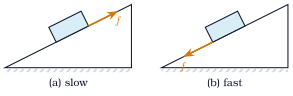
The figure shows the friction on a car on a banked road in two cases.
In (a) the car is slower than the design speed. Why does friction act up the slope?
In (b) the car is faster. Why does friction act down the slope?
At what speed is the friction zero?
Answer(i) car tends to slide down (ii) car tends to slide up (iii) \(\sqrt{rg\tan\theta}\)
Solution
Below the design speed the horizontal part of \(N\) is more than the car needs. The car tends to slip down the slope towards the centre, and friction opposes this by acting up the slope.
Above the design speed the car needs more centripetal force than \(N\) gives. It tends to slide up and out, so friction acts down the slope and adds an inward force.
At the design speed \(v_0 = \sqrt{rg\tan\theta}\).
How did it go?
Q12
The least speed on the same road is \(v_{\min}^2 = rg\frac{\tan\theta - \mu}{1 + \mu\tan\theta}\). Find \(v_{\min}\) for the road of Question 10.
Show that if \(\mu \ge \tan\theta\) a car can stand still on the banked road, so there is no least speed.
Answer\(mg\sin\theta \le \mu mg\cos\theta\)
Solution
A car at rest on the bank is a block on an incline. It stays if \(mg\sin\theta \le \mu mg\cos\theta\), that is, \(\mu \ge \tan\theta\). Then the formula for \(v_{\min}\) gives zero or a negative \(v_{\min}^2\): any speed down to zero is safe.
How did it go?
Conical pendulum
Q14
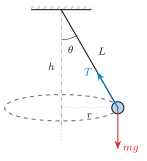
A bob on a string of length \(L\) moves on a horizontal circle, the string at angle \(\theta\) to the vertical.
Write the vertical and the horizontal force equations.
Show that \(\omega^2 = \frac{g}{L\cos\theta}\).
Show that the period is \(T = 2\pi\sqrt{\frac{h}{g}}\), where \(h = L\cos\theta\).
\(T\cos 37^\circ = mg\): \(T = \dfrac{2}{0.8} = 2.5\) N.
\(T\sin 37^\circ = \dfrac{mv^2}{r}\): \(1.5 = \dfrac{0.2v^2}{0.3}\), so \(v^2 = 2.25\) and \(v = 1.5\) m/s.
How did it go?
Q17
For a very small angle \(\theta\), compare the period of a conical pendulum with that of a simple pendulum of the same length.
Answerequal, \(2\pi\sqrt{L/g}\)
Solution
For small \(\theta\), \(\cos\theta \approx 1\), so the conical pendulum's period \(2\pi\sqrt{L\cos\theta/g}\) becomes \(2\pi\sqrt{L/g}\), the same as the simple pendulum's.
How did it go?
Q18
The bob of a conical pendulum moves in a circle whose centre is \(0.4\) m below the point of support. Find the period.
Answer\(0.4\pi \approx 1.3\) s
Solution
\(h = 0.4\) m: \(T = 2\pi\sqrt{\dfrac{0.4}{10}} = 2\pi \times 0.2 = 0.4\pi \approx 1.3\) s. The string length does not matter.
How did it go?
Q19
As the bob of a conical pendulum is made to go faster, what happens to \(\theta\) and to the tension? Can \(\theta\) reach \(90^\circ\)? Give the reason.
Answerboth increase; no, \(T \to \infty\)
Solution
\(\omega^2 = \dfrac{g}{L\cos\theta}\): a larger \(\omega\) needs a smaller \(\cos\theta\), so \(\theta\) increases. \(T = \dfrac{mg}{\cos\theta}\) increases too. At \(\theta = 90^\circ\), \(\cos\theta = 0\), which would need infinite \(\omega\) and infinite tension; the string can never be horizontal.
How did it go?
Small situations
Q20
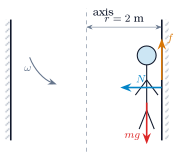
In a fairground rotor a person stands against the wall of a drum of radius \(2\) m. When the drum spins fast enough the floor is removed. \(\mu = 0.5\) between the person and the wall.
Which force provides the centripetal force? Write it in terms of \(\omega\).
Which force holds the person up? Write the condition for not slipping.
Find the least \(\omega\) and the corresponding speed.
Answer(i) \(N = m\omega^2r\) (ii) friction; \(\mu N \ge mg\) (iii) \(\sqrt{10} \approx 3.2\) rad/s; \(2\sqrt{10} \approx 6.3\) m/s
Solution
The normal force from the wall: \(N = m\omega^2r\).
Static friction along the wall balances the weight: \(f = mg\), and \(f \le \mu N\), so \(\mu m\omega^2r \ge mg\).
\(\omega^2 \ge \dfrac{g}{\mu r} = \dfrac{10}{0.5 \times 2} = 10\), so \(\omega_{\min} = \sqrt{10} \approx 3.2\) rad/s and \(v = \omega r = 2\sqrt{10} \approx 6.3\) m/s.
How did it go?
Q21
A coin lies \(0.1\) m from the centre of a turntable, with \(\mu = 0.4\). Find the greatest angular speed for which the coin does not slip, and the corresponding revolutions per minute.
The greatest safe speed on a level curve is \(20\) m/s. A car takes it at \(25\) m/s. By what factor is the required friction larger than the available friction?
Answer\(\frac{25}{16} \approx 1.6\)
Solution
The required friction is \(\dfrac{mv^2}{r} \propto v^2\). At \(25\) m/s it is \(\left(\dfrac{25}{20}\right)^2 = \dfrac{25}{16} \approx 1.6\) times the friction available at the limit, so the car skids.
How did it go?
Q23
A cyclist rides at \(10\) m/s round a curve of radius \(10\) m. Find the lean angle.
A curve of radius \(40\) m is banked at \(45^\circ\) for \(20\) m/s. A \(1000\) kg car takes it at \(10\) m/s. Find the friction needed, and state its direction. Take \(\sin 45^\circ = \cos 45^\circ = 0.71\).
Answer\(\approx 5.3 \times 10^{3}\) N up the slope
Solution
Needed centripetal force \(= \dfrac{1000 \times 100}{40} = 2500\) N. Along the slope, taking friction up the slope as positive: \(mg\sin\theta - f = \dfrac{mv^2}{r}\cos\theta\), so \(f = 10000 \times 0.71 - 2500 \times 0.71 \approx 5.3 \times 10^{3}\) N, up the slope. The car is well below the design speed and tends to slide down.