Questions on Work, Kinetic Energy and Power, the kind your examinations ask. Solve one on paper. Then tell the book how it went. The book believes you, and it uses your answer to plan your revision.
0%
Nothing marked yetMark honestly. Peek at the answer only after your own attempt.
Work by Constant, Variable and Internal Forces
24 questions · after Lesson 4, Work Done by Internal Forces
Constant force
Q1
A force of \(20\) N acts on a body that moves \(5\) m. Use \(W = Fs\cos\theta\) to find the work when the angle between the force and the displacement is
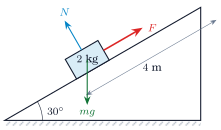
\(N\) is perpendicular to the slope and so to the displacement: \(W_N = 0\).
Steady speed along the slope: \(F = mg\sin 30^\circ = 10\) N. \(W_F = 10 \times 4 = 40\) J.
How did it go?
Q5
A \(4\) kg block is pushed \(5\) m along a floor with \(\mu = 0.2\). Find the work done by friction, by the normal force and by gravity.
Answer\(-40\) J; \(0\); \(0\)
Solution
Friction \(= \mu mg = 0.2 \times 40 = 8\) N, opposite to the motion: \(W_f = -8 \times 5 = -40\) J. The normal force and gravity are perpendicular to the displacement: both do zero work.
How did it go?
Q6
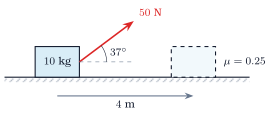
A \(10\) kg block on a floor with \(\mu = 0.25\) is pulled \(4\) m by a rope with \(50\) N at \(37^\circ\) above the horizontal. Take \(\sin 37^\circ = 0.6\), \(\cos 37^\circ = 0.8\).
Find the work done by the rope.
Find the normal force and the work done by friction.
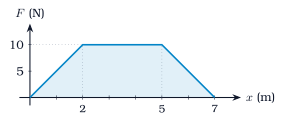
Triangle: \(\dfrac{1}{2} \times 2 \times 10 = 10\) J.
Rectangle: \(3 \times 10 = 30\) J. Triangle: \(\dfrac{1}{2} \times 2 \times 10 = 10\) J.
\(10 + 30 + 10 = 50\) J, the whole area.
How did it go?
Q9
A spring has \(k = 200\) N/m.
Find the work done by the person who stretches it from \(0\) to \(0.1\) m, and the work done by the spring.
Find the work done by the person in stretching it further, from \(0.1\) m to \(0.2\) m.
Answer(i) \(1\) J; \(-1\) J (ii) \(3\) J
Solution
Person: \(W = \dfrac{1}{2}kx^2 = \dfrac{1}{2} \times 200 \times 0.01 = 1\) J. The spring pulls back the whole way, so it does \(-1\) J.
\(W = \dfrac{1}{2}k(x_2^2 - x_1^2) = 100 \times (0.04 - 0.01) = 3\) J. The second \(0.1\) m costs three times as much, because the force is larger.
How did it go?
Q10
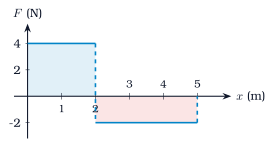
A force \(F = 4 - x\) acts along \(x\), in SI units. Find the work done from \(x = 0\) to \(4\) m, and from \(x = 0\) to \(8\) m. Explain the second result.
Answer\(8\) J; \(0\); negative work beyond \(4\) m
Two blocks are joined by a spring and pulled apart so that the spring stretches by \(x\). What is the total work done by the two spring forces on the blocks? Why is it not zero, even though the two forces are equal and opposite?
Answer\(-\frac{1}{2}kx^2\); displacements differ
Solution
Each block moves away from the other while the spring pulls it back, so both spring forces do negative work. Total \(= -\dfrac{1}{2}kx^2\), stored as elastic potential energy.
Equal and opposite forces cancel only if their points of application move by the same displacement. The two ends of the spring move apart, so the works do not cancel.
How did it go?
Q14
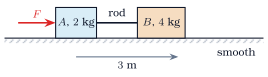
Blocks \(A\) (\(2\) kg) and \(B\) (\(4\) kg) are joined by a light rigid rod on a smooth floor. \(F = 12\) N pushes \(A\) and the pair moves \(3\) m.
Find the acceleration and the force in the rod.
Find the work done by the rod on \(B\) and on \(A\), and their sum.
Find the work done by \(F\). What does it equal?
Answer(i) \(2\) m/s\(^2\); \(8\) N (ii) \(+24\) J; \(-24\) J; \(0\) (iii) \(36\) J; gain in KE
Solution
\(a = \dfrac{12}{6} = 2\) m/s\(^2\). The rod pushes \(B\) with \(4 \times 2 = 8\) N and pushes back on \(A\) with \(8\) N.
On \(B\): \(+8 \times 3 = 24\) J. On \(A\): \(-8 \times 3 = -24\) J. Sum \(= 0\): a rigid rod's internal forces do no net work, because both ends move the same distance.
\(W_F = 12 \times 3 = 36\) J. This equals the kinetic energy gained by the pair: \(\dfrac{1}{2} \times 6 \times v^2\) with \(v^2 = 2 \times 2 \times 3 = 12\), that is, \(36\) J.
How did it go?
Q15
A block slides \(3\) m along a plank while the plank itself moves \(1\) m in the same direction. The kinetic friction between them is \(10\) N. Find the work done by friction on the block, on the plank, and in total.
Answer\(-30\) J; \(+10\) J; \(-20\) J
Solution
On the block friction acts backward over \(3\) m: \(-30\) J. On the plank friction acts forward over \(1\) m: \(+10\) J. Total \(= -20\) J \(= -f \times\) (relative sliding \(= 2\) m). Kinetic friction always removes energy equal to \(f\) times the sliding distance.
How did it go?
Q16
A person climbs a staircase. Why is the work done by the normal force of the stairs zero? Which force does the work that raises the person?
Answerno displacement at contact; muscles
Solution
The foot in contact with a step does not move while the normal force acts on it, so that force does no work. The work is done by the muscles of the legs, internal forces of the body, which convert chemical energy into potential energy.
How did it go?
Small situations
Q17
A porter carries a \(20\) kg load on his head and walks \(10\) m along a level platform at a steady speed. Find the work done by the force of his head on the load. Give the reason.
Answer\(0\), force perpendicular to motion
Solution
The head pushes the load vertically up with \(200\) N, but the displacement is horizontal: \(\theta = 90^\circ\), so \(W = 0\). (The porter still gets tired, but not from work on the load.)
How did it go?
Q18
Find the work done by the centripetal force in uniform circular motion, and by the tension on a swinging pendulum bob. Give the reason.
Answer\(0\); \(0\); perpendicular to velocity
Solution
Both are zero. The centripetal force points to the centre and the tension along the string. The velocity is along the tangent, so force and displacement are always perpendicular.
How did it go?
Q19
A \(5\) kg bucket is raised \(10\) m by a rope.
Find the work done by the rope at a steady speed.
Find it if the bucket accelerates upward at \(2\) m/s\(^2\).
Answer(i) \(500\) J (ii) \(600\) J
Solution
\(T = mg = 50\) N: \(W = 50 \times 10 = 500\) J.
\(T = m(g + a) = 60\) N: \(W = 600\) J. The extra \(100\) J appears as kinetic energy.
How did it go?
Q20
A \(0.5\) kg ball is thrown up and rises \(5\) m to its highest point. Find the work done by gravity on the way up, on the way down, and over the whole flight.
Answer\(-25\) J; \(+25\) J; \(0\)
Solution
\(mgh = 0.5 \times 10 \times 5 = 25\) J. Going up gravity opposes the motion: \(-25\) J. Coming down it helps: \(+25\) J. Over the whole flight: \(0\), because the ball returns to its starting height.
How did it go?
Q21
A spring of \(k = 100\) N/m is stretched by \(0.2\) m and released. Find the work done by the spring force as the spring returns to its natural length.
Answer\(+2\) J
Solution
The spring force points towards the natural length and the spring moves that way, so the work is positive: \(W = \dfrac{1}{2}kx^2 = \dfrac{1}{2} \times 100 \times 0.04 = 2\) J.
How did it go?
Q22
A \(2\) kg block slides \(5\) m down a \(37^\circ\) incline with \(\mu = 0.25\). Find the work done by gravity, by friction and by the normal force, and the net work.
Answer\(60\) J; \(-20\) J; \(0\); \(40\) J
Solution
Drop in height \(= 5\sin 37^\circ = 3\) m: \(W_g = 2 \times 10 \times 3 = 60\) J. \(N = mg\cos 37^\circ = 16\) N, friction \(= 4\) N: \(W_f = -4 \times 5 = -20\) J. \(W_N = 0\). Net \(= 40\) J.
How did it go?
Q23
A \(2\) kg block is pushed \(5\) m along a floor with \(\mu = 0.2\) and then pushed back to the start. Find the work done by friction over the round trip and the work done by gravity. What is the difference between the two forces?
Answer\(-40\) J; \(0\); friction non-conservative
Solution
Friction \(= 0.2 \times 20 = 4\) N and opposes the motion both ways: \(W_f = -4 \times 10 = -40\) J. Gravity is perpendicular to the motion throughout: \(0\). Friction's work depends on the path length (non-conservative); gravity's work depends only on the change in height (conservative).
How did it go?
Q24
A block of mass \(m\) slides a distance \(L\) down a smooth incline of angle \(\theta\). Show that the work done by gravity equals \(mgh\), where \(h\) is the drop in height.
Answer\(W = mg\sin\theta \cdot L = mgh\)
Solution
The component of gravity along the slope is \(mg\sin\theta\), in the direction of motion: \(W = mg\sin\theta \times L\). But \(L\sin\theta = h\), the vertical drop. So \(W = mgh\), whatever the angle of the incline.
How did it go?
Work-Energy Theorem and Power
24 questions · after Lesson 6, Power
Work-energy theorem
Q25
A \(2\) kg body speeds up from \(3\) m/s to \(5\) m/s. Find the change in its kinetic energy and hence the net work done on it.
Answer\(16\) J; \(16\) J
Solution
\(\Delta K = \dfrac{1}{2} \times 2 \times (25 - 9) = 16\) J. By the work-energy theorem the net work equals \(\Delta K\): \(16\) J.
How did it go?
Q26
A \(0.5\) kg ball is dropped from \(20\) m. Take \(g = 10\) m/s\(^2\) throughout this sheet. Find the work done by gravity and use the work-energy theorem to find the speed at the ground.
Answer\(100\) J; \(20\) m/s
Solution
\(W_g = mgh = 0.5 \times 10 \times 20 = 100\) J. \(\dfrac{1}{2}mv^2 = 100\), so \(v^2 = 400\) and \(v = 20\) m/s.
How did it go?
Q27
A \(4\) kg block sliding at \(6\) m/s on a floor with \(\mu = 0.3\) comes to rest.
Find the work done by friction.
Find the distance travelled.
Answer(i) \(-72\) J (ii) \(6\) m
Solution
The block loses all its kinetic energy: \(W_f = -\dfrac{1}{2} \times 4 \times 36 = -72\) J.
\(f = \mu mg = 12\) N. \(-12d = -72\), so \(d = 6\) m.
How did it go?
Q28
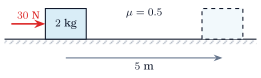
A \(2\) kg block at rest is pushed by \(30\) N through \(5\) m on a floor with \(\mu = 0.5\).
Find the work done by the push and by friction.
Find the net work and the final speed.
Check the speed with \(v^2 = 2as\).
Answer(i) \(150\) J; \(-50\) J (ii) \(100\) J; \(10\) m/s (iii) \(a = 10\), \(v^2 = 100\)
Solution
Push: \(30 \times 5 = 150\) J. Friction \(= 0.5 \times 20 = 10\) N: \(W_f = -50\) J.
Net \(= 100\) J \(= \dfrac{1}{2} \times 2 \times v^2\), so \(v = 10\) m/s.
Net force \(= 30 - 10 = 20\) N, \(a = 10\) m/s\(^2\): \(v^2 = 2 \times 10 \times 5 = 100\), \(v = 10\) m/s. Same.
How did it go?
Q29
A \(2\) kg block is projected up a \(37^\circ\) incline at \(8\) m/s. \(\mu = 0.25\); take \(\sin 37^\circ = 0.6\), \(\cos 37^\circ = 0.8\). Use the work-energy theorem to find how far it goes up the slope.
Answer\(4\) m
Solution
Let the block go \(d\) up the slope. Gravity: \(-mg\sin 37^\circ\,d = -12d\). Friction: \(-\mu mg\cos 37^\circ\,d = -4d\). Total \(-16d = 0 - \dfrac{1}{2} \times 2 \times 64 = -64\), so \(d = 4\) m.
How did it go?
Q30
A pendulum bob is released from rest \(20\) cm above its lowest point. Find its speed at the lowest point. Why does the tension not appear in the calculation?
Answer\(2\) m/s; tension does no work
Solution
Only gravity does work: \(mgh = \dfrac{1}{2}mv^2\), so \(v = \sqrt{2 \times 10 \times 0.2} = 2\) m/s. The tension is always perpendicular to the bob's velocity, so it does no work and drops out.
How did it go?
Q31
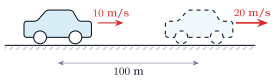
A \(1000\) kg car speeds up from \(10\) m/s to \(20\) m/s over \(100\) m of straight road.
Find the gain in kinetic energy.
Find the net force on the car, assumed constant.
The drag on the car is \(500\) N. Find the force from the engine.
Answer(i) \(1.5 \times 10^{5}\) J (ii) \(1500\) N (iii) \(2000\) N
Solution
\(\Delta K = \dfrac{1}{2} \times 1000 \times (400 - 100) = 1.5 \times 10^{5}\) J.
\(F_{\text{net}} \times 100 = 1.5 \times 10^{5}\), so \(F_{\text{net}} = 1500\) N.
\(F_{\text{engine}} - 500 = 1500\), so \(F_{\text{engine}} = 2000\) N.
How did it go?
Power
Q32
A machine does \(100\) J of work in \(5\) s.
Find its power.
How many joules is \(1\) kW h?
Answer(i) \(20\) W (ii) \(3.6 \times 10^{6}\) J
Solution
\(P = \dfrac{100}{5} = 20\) W.
\(1\) kW h \(= 1000\) W \(\times 3600\) s \(= 3.6 \times 10^{6}\) J.
How did it go?
Q33
A car moves at a steady \(20\) m/s against a drag of \(1000\) N. Find the power of its engine using \(P = Fv\).
Answer\(20\) kW
Solution
At steady speed the engine's force equals the drag: \(P = Fv = 1000 \times 20 = 20000\) W \(= 20\) kW.
How did it go?
Q34
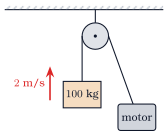
A motor lifts a \(100\) kg load at a steady \(2\) m/s.
Find the tension in the rope.
Find the useful power.
The motor is \(80\%\) efficient. Find the electrical power it draws.
Answer(i) \(1000\) N (ii) \(2000\) W (iii) \(2500\) W
Solution
Steady speed: \(T = mg = 1000\) N.
\(P = Tv = 1000 \times 2 = 2000\) W.
\(\dfrac{2000}{0.8} = 2500\) W. The missing \(500\) W becomes heat in the motor.
How did it go?
Q35
A pump lifts \(100\) kg of water every second through \(20\) m and delivers it at \(10\) m/s. Find the power needed.
Answer\(25\) kW
Solution
Each second: potential energy \(mgh = 100 \times 10 \times 20 = 20000\) J and kinetic energy \(\dfrac{1}{2} \times 100 \times 100 = 5000\) J. \(P = 25000\) W \(= 25\) kW.
How did it go?
Q36
A force \(\vec F = 6\hat i\) N acts on a body moving with velocity \(\vec v = 2\hat i + 3\hat j\) m/s. Find the instantaneous power.
Answer\(12\) W
Solution
\(P = \vec F\cdot\vec v = 6 \times 2 + 0 \times 3 = 12\) W.
How did it go?
Q37
A \(60\) kg person climbs \(3\) m of stairs in \(4\) s. Find the average power against gravity.
Answer\(450\) W
Solution
\(W = mgh = 60 \times 10 \times 3 = 1800\) J. \(P = \dfrac{1800}{4} = 450\) W.
How did it go?
Q38
A \(1000\) kg car has an engine of \(40\) kW and moves at \(20\) m/s against a drag of \(500\) N.
Find the engine's driving force.
Find the acceleration.
Answer(i) \(2000\) N (ii) \(1.5\) m/s\(^2\)
Solution
\(F = \dfrac{P}{v} = \dfrac{40000}{20} = 2000\) N.
Net force \(= 2000 - 500 = 1500\) N: \(a = \dfrac{1500}{1000} = 1.5\) m/s\(^2\).
How did it go?
Power and motion
Q39
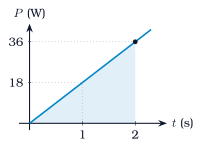
A \(2\) kg body moves with \(v = 3t\), in SI units. The figure shows the power of the net force against time.
Find the net force and show that \(P = 18t\).
Find the work done in the first \(2\) s from the area.
Check it against the kinetic energy at \(t = 2\) s.
\(a = 3\) m/s\(^2\), so \(F = 6\) N. \(P = Fv = 6 \times 3t = 18t\) W.
Area of the triangle \(= \dfrac{1}{2} \times 2 \times 36 = 36\) J.
At \(t = 2\) s, \(v = 6\) m/s: \(K = \dfrac{1}{2} \times 2 \times 36 = 36\) J. The work done equals the kinetic energy gained.
How did it go?
Q40
A constant power of \(100\) W acts on a \(2\) kg body at rest on a smooth floor for \(4\) s. Find its kinetic energy and its speed at the end.
Answer\(400\) J; \(20\) m/s
Solution
\(W = Pt = 400\) J, all of it kinetic energy: \(\dfrac{1}{2} \times 2 \times v^2 = 400\), so \(v = 20\) m/s.
How did it go?
Q41
A rope pulls a block along a rough floor at a steady \(2\) m/s with a tension of \(50\) N. Find the power delivered by the rope. Where does this energy go?
Answer\(100\) W; into heat by friction
Solution
\(P = Tv = 50 \times 2 = 100\) W. The block's kinetic energy does not change, so friction removes energy at \(100\) W, turning it into heat at the surfaces.
How did it go?
Q42
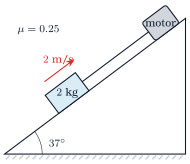
A motor pulls a \(2\) kg block up a \(37^\circ\) incline with \(\mu = 0.25\) at a steady \(2\) m/s.
Find the friction and the tension in the rope.
Find the power of the motor.
How much of this power goes against gravity, and how much against friction?
Answer(i) \(4\) N; \(16\) N (ii) \(32\) W (iii) \(24\) W; \(8\) W
Solution
\(N = mg\cos 37^\circ = 16\) N, friction \(= 0.25 \times 16 = 4\) N down the slope. Steady speed: \(T = mg\sin 37^\circ + f = 12 + 4 = 16\) N.
\(P = Tv = 16 \times 2 = 32\) W.
Against gravity: \(12 \times 2 = 24\) W. Against friction: \(4 \times 2 = 8\) W.
How did it go?
Small situations
Q43
A \(1000\) kg car climbs \(100\) m of height at a steady speed. Find the work done against gravity, and the time taken if the engine delivers \(50\) kW to this task.
Show that \(K = \frac{p^2}{2m}\). Two bodies of masses \(1\) kg and \(4\) kg have the same momentum. Find the ratio of their kinetic energies.
Answer\(p = mv\); \(4 : 1\)
Solution
\(p = mv\), so \(v = \dfrac{p}{m}\) and \(K = \dfrac{1}{2}mv^2 = \dfrac{p^2}{2m}\). For equal \(p\), \(K \propto \dfrac{1}{m}\): \(\dfrac{K_1}{K_4} = \dfrac{4}{1}\). The lighter body has four times the kinetic energy.
How did it go?
Q45
A \(10\) g bullet moving at \(400\) m/s stops after going \(10\) cm into a block. Find the average resistive force.
Answer\(8000\) N
Solution
\(K = \dfrac{1}{2} \times 0.01 \times 160000 = 800\) J. \(Fd = 800\) with \(d = 0.1\) m: \(F = 8000\) N.
How did it go?
Q46
A \(1\) kg ball thrown up at \(20\) m/s rises only \(15\) m because of air resistance.
Find the work done by gravity.
Find the work done by air resistance.
Find the average air resistance.
Answer(i) \(-150\) J (ii) \(-50\) J (iii) \(\frac{10}{3} \approx 3.3\) N
Solution
\(W_g = -mgh = -1 \times 10 \times 15 = -150\) J.
\(\Delta K = 0 - 200 = -200\) J \(= W_g + W_{\text{air}}\), so \(W_{\text{air}} = -50\) J.
\(F \times 15 = 50\), so \(F = \dfrac{10}{3} \approx 3.3\) N.
How did it go?
Q47
One horsepower is \(746\) W. A \(2\) hp motor lifts a \(50\) kg load at a steady speed. Find the speed.
Start from \(F = m\frac{dv}{dt}\) and \(\frac{dv}{dt} = v\frac{dv}{dx}\). Show that \(\int F\,dx = \frac{1}{2}mv^2 - \frac{1}{2}mu^2\), and then show that \(P = Fv\).