Questions on Potential Energy and Conservation of Energy, the kind your examinations ask. Solve one on paper. Then tell the book how it went. The book believes you, and it uses your answer to plan your revision.
0%
Nothing marked yetMark honestly. Peek at the answer only after your own attempt.
Potential Energy, Equilibrium and Springs
24 questions · after Lesson 6, Energy Diagrams and Equilibrium
Potential energy and force
Q1
A \(2\) kg book lies on a shelf \(5\) m above the floor. Take \(g = 10\) m/s\(^2\) throughout this sheet.
Find its potential energy with the floor as reference.
Find it with the shelf as reference.
Which of the two has physical meaning: \(U\) or \(\Delta U\)?
Answer(i) \(100\) J (ii) \(0\) (iii) \(\Delta U\)
Solution
\(U = mgh = 2 \times 10 \times 5 = 100\) J.
\(h = 0\), so \(U = 0\).
Only changes in potential energy matter physically; the value of \(U\) depends on where we choose the zero. Both choices give the same \(\Delta U\) for any motion.
How did it go?
Q2
A spring has \(k = 200\) N/m. Find the energy stored when it is stretched by \(0.1\) m, and by \(0.2\) m. Why does doubling the stretch not double the energy?
Answer\(1\) J; \(4\) J; \(U \propto x^2\)
Solution
\(U = \dfrac{1}{2}kx^2\): \(\dfrac{1}{2} \times 200 \times 0.01 = 1\) J and \(\dfrac{1}{2} \times 200 \times 0.04 = 4\) J. The energy grows as \(x^2\), because the force itself grows with \(x\): the second \(0.1\) m needs more work than the first.
How did it go?
Q3
The potential energy of a particle is \(U = 2x^2 - 4x\), in SI units.
Find the force \(F = -\frac{dU}{dx}\).
Find the equilibrium position.
Is it stable? Find \(U\) there.
Answer(i) \(4 - 4x\) (ii) \(x = 1\) m (iii) stable; \(-2\) J
Solution
\(F = -\dfrac{dU}{dx} = -(4x - 4) = 4 - 4x\).
\(F = 0\) at \(x = 1\) m.
\(\dfrac{d^2U}{dx^2} = 4 > 0\): a minimum of \(U\), so stable. \(U(1) = 2 - 4 = -2\) J.
How did it go?
Q4
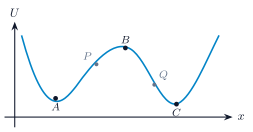
The figure shows the potential energy of a particle against \(x\).
Name the equilibrium points and say whether each is stable or unstable.
State the direction of the force at \(P\) and at \(Q\).
The particle is released from rest at \(P\). Towards which point does it move?
Equilibrium where the slope is zero: \(A\), \(B\), \(C\). \(A\) and \(C\) are minima, stable; \(B\) is a maximum, unstable.
\(F = -\dfrac{dU}{dx}\). At \(P\) the slope is positive, so the force points towards \(-x\) (downhill towards \(A\)). At \(Q\) the slope is negative, so the force points towards \(+x\) (towards \(C\)).
Released at \(P\) the particle is pushed down the slope to \(A\). It cannot climb over \(B\), because it has no energy to spare.
How did it go?
Q5
\(U = x^3 - 3x\), in SI units. Find the equilibrium positions and decide whether each is stable or unstable.
Answer\(x = 1\) stable; \(x = -1\) unstable
Solution
\(\dfrac{dU}{dx} = 3x^2 - 3 = 0\) at \(x = \pm 1\). \(\dfrac{d^2U}{dx^2} = 6x\): at \(x = 1\) it is \(+6\), a minimum (\(U = -2\)), stable. At \(x = -1\) it is \(-6\), a maximum (\(U = 2\)), unstable.
How did it go?
Q6
\(U = 3x + 4y\), in SI units. Find the force \(\vec F = -\frac{\partial U}{\partial x}\hat i - \frac{\partial U}{\partial y}\hat j\) and its magnitude.
Answer\(-3\hat i - 4\hat j\) N; \(5\) N
Solution
\(\dfrac{\partial U}{\partial x} = 3\) and \(\dfrac{\partial U}{\partial y} = 4\), so \(\vec F = -3\hat i - 4\hat j\) N, of magnitude \(5\) N. It is a constant force pointing down the slope of \(U\).
How did it go?
Conservation of mechanical energy
Q7
A \(1\) kg ball is dropped from \(20\) m. Use energy conservation to find its kinetic energy and its speed when it is \(5\) m above the ground.
Answer\(150\) J; \(10\sqrt{3} \approx 17\) m/s
Solution
Energy at the start: \(U = 1 \times 10 \times 20 = 200\) J, \(K = 0\). At \(5\) m: \(U = 50\) J, so \(K = 150\) J. \(\dfrac{1}{2} \times 1 \times v^2 = 150\) gives \(v = \sqrt{300} = 10\sqrt{3} \approx 17\) m/s.
How did it go?
Q8
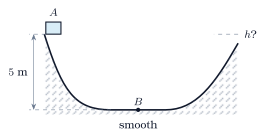
A block is released from rest at \(A\), \(5\) m above the flat part of a smooth track.
Find its speed at \(B\).
To what height \(h\) does it rise on the far slope?
Would the answer to (ii) change if the far slope were steeper? Give the reason.
Answer(i) \(10\) m/s (ii) \(5\) m (iii) no, energy depends on height only
Solution
No friction, and the normal force does no work: \(mgh = \dfrac{1}{2}mv^2\), \(v = \sqrt{2 \times 10 \times 5} = 10\) m/s.
All the kinetic energy turns back into potential energy: \(h = 5\) m, the same height it started from.
No. The height depends only on the energy, \(mgh\); the shape of the slope changes only the distance travelled along it.
How did it go?
Q9
A \(1\) kg pendulum bob on a \(1\) m string is released from rest with the string at \(60^\circ\) to the vertical.
Find the height it falls.
Find its speed at the lowest point.
Find the tension there.
Answer(i) \(0.5\) m (ii) \(\sqrt{10} \approx 3.2\) m/s (iii) \(20\) N
A spring gun has \(k = 250\) N/m. It is compressed by \(0.2\) m and fires a \(0.1\) kg ball horizontally. Find the speed of the ball.
Answer\(10\) m/s
Solution
\(\dfrac{1}{2}kx^2 = \dfrac{1}{2}mv^2\): \(250 \times 0.04 = 0.1v^2\), so \(v^2 = 100\) and \(v = 10\) m/s.
How did it go?
Q11
A \(2\) kg block is dropped from \(0.8\) m above the free end of a vertical spring with \(k = 1000\) N/m. Find the greatest compression of the spring.
Answer\(0.2\) m
Solution
Let the compression be \(x\). The block falls \(0.8 + x\): \(mg(0.8 + x) = \dfrac{1}{2}kx^2\), so \(20(0.8 + x) = 500x^2\), that is, \(25x^2 - x - 0.8 = 0\). \(x = \dfrac{1 + \sqrt{1 + 80}}{50} = \dfrac{10}{50} = 0.2\) m.
How did it go?
Q12
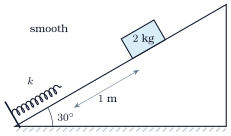
A spring with \(k = 400\) N/m is fixed at the bottom of a smooth \(30^\circ\) incline. A \(2\) kg block is released from rest \(1\) m along the slope above its free end.
Write the energy equation for a compression \(x\) of the spring.
Find the greatest compression.
Find the speed of the block when it first touches the spring.
Answer(i) \(10(1 + x) = 200x^2\) (ii) \(0.25\) m (iii) \(\sqrt{10} \approx 3.2\) m/s
Solution
The block slides \(1 + x\) down the slope, dropping \((1 + x)\sin 30^\circ\): \(mg\sin 30^\circ(1 + x) = \dfrac{1}{2}kx^2\), so \(10(1 + x) = 200x^2\).
\(20x^2 - x - 1 = 0\): \(x = \dfrac{1 + \sqrt{1 + 80}}{40} = \dfrac{10}{40} = 0.25\) m.
After \(1\) m: \(\dfrac{1}{2}mv^2 = mg\sin 30^\circ \times 1 = 10\) J, so \(v = \sqrt{10} \approx 3.2\) m/s.
How did it go?
Spring combinations and cutting
Q13
Two springs of \(200\) N/m each are joined (i) in series and (ii) in parallel. Find the effective stiffness of each combination and the energy stored when the combination is stretched by \(0.1\) m.
Answer(i) \(100\) N/m; \(0.5\) J (ii) \(400\) N/m; \(2\) J
A spring of \(k = 300\) N/m is cut into two pieces whose lengths are in the ratio \(1 : 3\). Find the stiffness of each piece.
Answer\(1200\) N/m; \(400\) N/m
Solution
Stiffness is inversely proportional to length. The pieces are \(\dfrac{1}{4}\) and \(\dfrac{3}{4}\) of the spring: \(k_1 = 4 \times 300 = 1200\) N/m and \(k_2 = \dfrac{4}{3} \times 300 = 400\) N/m. Check: in series \(\dfrac{1200 \times 400}{1600} = 300\) N/m.
How did it go?
Q15
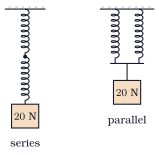
Two springs of \(200\) N/m hold a \(20\) N load, once in series and once in parallel.
Find the stretch of the series combination and the energy stored.
Find the stretch of the parallel combination and the energy stored.
Why does the series pair store more energy for the same load?
Answer(i) \(0.2\) m; \(2\) J (ii) \(0.05\) m; \(0.5\) J (iii) stretches more
Solution
\(k_s = 100\) N/m: \(x = \dfrac{20}{100} = 0.2\) m. \(U = \dfrac{1}{2} \times 100 \times 0.04 = 2\) J.
\(k_p = 400\) N/m: \(x = 0.05\) m. \(U = \dfrac{1}{2} \times 400 \times 0.0025 = 0.5\) J.
For a given force \(U = \dfrac{F^2}{2k}\): the softer combination stretches further, and the load moves further while doing work on it.
How did it go?
Q16
Springs \(k_1\) and \(k_2\) in series carry a force \(F\). Show that the total stored energy is \(\frac{F^2}{2k_1} + \frac{F^2}{2k_2}\), and that this equals \(\frac{F^2}{2k_s}\) with \(\frac{1}{k_s} = \frac{1}{k_1} + \frac{1}{k_2}\).
Answer\(U_i = \frac{1}{2}k_i x_i^2\) with \(x_i = F/k_i\)
Solution
In series each spring carries the full \(F\) and stretches by \(x_i = \dfrac{F}{k_i}\). Its energy is \(\dfrac{1}{2}k_ix_i^2 = \dfrac{F^2}{2k_i}\). Total \(= \dfrac{F^2}{2k_1} + \dfrac{F^2}{2k_2} = \dfrac{F^2}{2}\left(\dfrac{1}{k_1} + \dfrac{1}{k_2}\right) = \dfrac{F^2}{2k_s}\).
How did it go?
Q17
A spring of \(k = 100\) N/m stores \(0.5\) J when stretched by \(0.1\) m. It is cut in half. Find the energy stored in one half stretched by the same \(0.1\) m.
Answer\(1\) J
Solution
Half the spring has \(k = 200\) N/m. \(U = \dfrac{1}{2} \times 200 \times 0.01 = 1\) J, twice as much: the shorter spring needs twice the force for the same stretch.
How did it go?
Q18
A block on a smooth floor is joined to two walls by springs of \(100\) N/m and \(300\) N/m on opposite sides. Find the effective stiffness and the energy stored when the block is moved \(0.05\) m from its rest position.
Answer\(400\) N/m; \(0.5\) J
Solution
Moving the block stretches one spring and compresses the other; both push it back, so the stiffnesses add: \(k = 400\) N/m. \(U = \dfrac{1}{2} \times 400 \times 0.0025 = 0.5\) J.
How did it go?
Stability
Q19
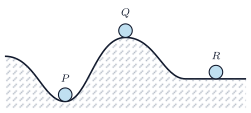
A ball rests at each of the three places shown.
Name the type of equilibrium at \(P\), \(Q\) and \(R\).
What happens to the potential energy for a small displacement in each case?
State the sign of \(\frac{d^2U}{dx^2}\) in each case.
\(P\): \(U\) rises either way, so the ball is pushed back. \(Q\): \(U\) falls either way, so the ball rolls off. \(R\): \(U\) stays the same and the ball stays wherever it is put.
Positive at \(P\) (a minimum), negative at \(Q\) (a maximum), zero at \(R\) (flat).
How did it go?
Q20
Explain, using \(F = -\frac{dU}{dx}\), why a free particle always tends to move towards lower potential energy.
Answer\(F\) points down the \(U\) slope
Solution
\(F = -\dfrac{dU}{dx}\): where \(U\) increases with \(x\) the force is negative, and where \(U\) decreases the force is positive. In both cases the force points towards decreasing \(U\), so a free particle accelerates that way, like a ball rolling downhill.
How did it go?
Q21
For \(U = \frac{1}{2}kx^2\) show that \(x = 0\) is a stable equilibrium. For \(U = -\frac{1}{2}kx^2\) show that it is unstable.
Answer\(U'' = k > 0\); \(U'' = -k < 0\)
Solution
\(U = \dfrac{1}{2}kx^2\): \(\dfrac{dU}{dx} = kx = 0\) at \(x = 0\) and \(\dfrac{d^2U}{dx^2} = k > 0\), a minimum: stable. \(U = -\dfrac{1}{2}kx^2\): again \(x = 0\) is an equilibrium, but \(\dfrac{d^2U}{dx^2} = -k < 0\), a maximum: unstable.
How did it go?
Small situations
Q22
Find the work needed to stretch a spring of \(k = 100\) N/m from \(0.1\) m to \(0.3\) m.
A \(0.5\) kg ball dropped from \(5\) m rebounds to \(3.2\) m. Find the mechanical energy lost in the bounce and the fraction of the initial energy it represents.
Answer\(9\) J; \(36\%\)
Solution
Initial energy \(= mgh = 0.5 \times 10 \times 5 = 25\) J. After the bounce \(= 0.5 \times 10 \times 3.2 = 16\) J. Lost \(= 9\) J, which is \(\dfrac{9}{25} = 36\%\).
How did it go?
Q24
A \(1\) kg bob on a \(2\) m string is pulled aside until the string is horizontal and released. Find the speed at the lowest point and the tension there.
Answer\(2\sqrt{10} \approx 6.3\) m/s; \(30\) N
Solution
The bob falls \(L = 2\) m: \(v = \sqrt{2gL} = \sqrt{40} = 2\sqrt{10} \approx 6.3\) m/s. At the bottom \(T = mg + \dfrac{mv^2}{L} = 10 + \dfrac{40}{2} = 30\) N, three times the weight.