Questions on Motion in a Vertical Circle, the kind your examinations ask. Solve one on paper. Then tell the book how it went. The book believes you, and it uses your answer to plan your revision.
0%
Nothing marked yetMark honestly. Peek at the answer only after your own attempt.
Vertical Circular Motion
24 questions · after Lesson 4, Rods, Tubes and Tracks
Tension at points of the circle
Q1
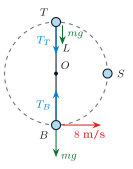
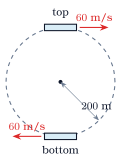
A \(1\) kg bob on a \(1\) m string moves in a vertical circle. At the bottom \(B\) its speed is \(8\) m/s. Take \(g = 10\) m/s\(^2\) throughout this sheet.
Write the force equation at \(B\) and find the tension \(T_B\).
Use energy conservation to find the speed at the top \(T\).
Find the tension at the top.
Answer(i) \(T_B - mg = \frac{mv^2}{L}\); \(74\) N (ii) \(2\sqrt{6} \approx 4.9\) m/s (iii) \(14\) N
Solution
At the bottom the centripetal direction is up: \(T_B - mg = \dfrac{mv_B^2}{L}\), so \(T_B = 10 + \dfrac{64}{1} = 74\) N.
The bob rises \(2L = 2\) m: \(\dfrac{1}{2}v_T^2 = \dfrac{1}{2} \times 64 - 10 \times 2\), so \(v_T^2 = 24\) and \(v_T = 2\sqrt{6} \approx 4.9\) m/s.
At the top the centripetal direction is down: \(T_T + mg = \dfrac{mv_T^2}{L}\), so \(T_T = 24 - 10 = 14\) N.
How did it go?
Q2
Show that for any speed the tensions at the bottom and the top of a vertical circle differ by \(6mg\). Check with Question 1.
For the bob of Question 1, find the speed at the side point \(S\) (string horizontal) and the tension there.
Answer\(2\sqrt{11} \approx 6.6\) m/s; \(44\) N
Solution
At \(S\) the bob has risen \(L = 1\) m: \(v_S^2 = 64 - 20 = 44\), \(v_S = 2\sqrt{11} \approx 6.6\) m/s. The string is horizontal, so gravity is perpendicular to it and the tension alone is centripetal: \(T = \dfrac{mv_S^2}{L} = 44\) N.
How did it go?
Q4
A bob on a string of length \(L\) just completes a vertical circle.
What is the tension at the top in this case? Show that the speed there is \(\sqrt{gL}\).
Show that the speed at the bottom is then \(\sqrt{5gL}\).
Find both speeds for \(L = 1\) m.
Answer(i) \(0\); \(mg = \frac{mv^2}{L}\) (ii) \(v_B^2 = gL + 4gL\) (iii) \(\sqrt{10} \approx 3.2\); \(\sqrt{50} \approx 7.1\) m/s
Solution
Just completing the circle means the string is about to go slack at the top: \(T = 0\). Then gravity alone is the centripetal force: \(mg = \dfrac{mv^2}{L}\), so \(v_{\text{top}} = \sqrt{gL}\).
Only gravity does work (the tension is perpendicular to the motion). Rising \(2L\): \(\dfrac{1}{2}mv_B^2 = \dfrac{1}{2}mv_T^2 + mg(2L)\), so \(v_T^2 = v_B^2 - 4gL\).
How did it go?
Q6
The bob of Question 1 is given only \(6\) m/s at the bottom.
Show that it cannot reach the top.
With \(\theta\) the angle of the string from the downward vertical, show that \(T = m(16 + 30\cos\theta)\) in newtons.
Completing the circle needs \(v_B \ge \sqrt{5gL} = \sqrt{50}\) m/s. \(36 < 50\), so the string goes slack before the top.
At angle \(\theta\) the bob has risen \(L(1 - \cos\theta)\): \(v^2 = 36 - 20(1 - \cos\theta) = 16 + 20\cos\theta\). Radial equation: \(T - mg\cos\theta = \dfrac{mv^2}{L}\), so \(T = m(16 + 20\cos\theta + 10\cos\theta) = m(16 + 30\cos\theta)\).
\(T = 0\) gives \(\cos\theta = -\dfrac{8}{15}\), an angle past the horizontal (\(\theta \approx 122^\circ\)). There the bob leaves the circle and moves as a projectile.
How did it go?
Rod versus string
Q7
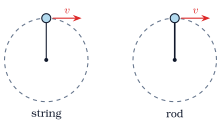
A bob on a light rigid rod of length \(1\) m moves in a vertical circle. Find the least speed at the top and the least speed at the bottom for it to complete the circle.
Answer\(0\); \(2\sqrt{10} \approx 6.3\) m/s
Solution
A rod can push, so the bob only needs to reach the top: least speed there is \(0\). Energy: \(v_B^2 = 0 + 4gL = 40\), so \(v_B = 2\sqrt{10} \approx 6.3\) m/s.
How did it go?
Q8
A bob is at the top of a vertical circle of radius \(1\) m, once on a string and once on a rod.
Why can the rod, but not the string, hold the bob at the top with very small speed?
Compare the least bottom speeds needed in the two cases.
Answer(i) rod can push (ii) string \(\sqrt{5gL}\); rod \(\sqrt{4gL}\)
Solution
A string can only pull towards the centre. At the top it needs at least \(mg\) of centripetal force from gravity alone, so \(v \ge \sqrt{gL}\). A rod can push the bob up, supporting it even at rest at the top.
A \(1\) kg bob on a \(1\) m rod passes the top at \(2\) m/s. Find the force in the rod and say whether it pushes or pulls.
Answer\(6\) N, pushes up
Solution
Needed centripetal force \(= \dfrac{mv^2}{L} = 4\) N, less than \(mg = 10\) N. So the rod must push up: \(mg - F = 4\), \(F = 6\) N, a push (compression).
How did it go?
Q10
A bucket of water is whirled in a vertical circle of radius \(1\) m. Find the least speed at the top for the water to stay in. Why does the water not fall out?
At the top the water needs a centripetal acceleration of at least \(g\), so \(v \ge \sqrt{gr} = \sqrt{10} \approx 3.2\) m/s. The water does not fall because gravity is fully used in curving its path; the bucket has to press on it to give any more.
How did it go?
Loops and tracks
Q11
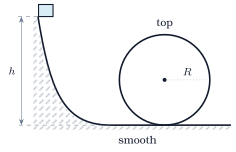
A block is released from rest at height \(h\) on a smooth track that leads into a vertical loop of radius \(R = 2\) m.
Write the least speed needed at the top of the loop.
Use energy conservation to show that the least \(h\) is \(\frac{5R}{2}\).
Find this \(h\).
Answer(i) \(\sqrt{gR}\) (ii) \(mgh = 2mgR + \frac{1}{2}mgR\) (iii) \(5\) m
Solution
\(v_{\text{top}} \ge \sqrt{gR}\), so that the track need not pull on the block.
Energy from the start to the top of the loop (height \(2R\)): \(mgh = mg(2R) + \dfrac{1}{2}mv_{\text{top}}^2 = 2mgR + \dfrac{1}{2}mgR\), so \(h = \dfrac{5R}{2}\).
\(h = 2.5 \times 2 = 5\) m.
How did it go?
Q12
For \(h = 5\) m and a \(1\) kg block, find the speed at the bottom of the loop and the normal force there.
For \(h = 5\) m, find the speed at the top of the loop and the normal force there.
Answer\(2\sqrt{5} \approx 4.5\) m/s; \(0\)
Solution
\(v^2 = 2g(h - 2R) = 2 \times 10 \times 1 = 20\), \(v = 2\sqrt{5} \approx 4.5\) m/s. \(N + mg = \dfrac{mv^2}{R} = 10\), so \(N = 0\): the block just makes it.
How did it go?
Q14
The block is released from \(h = 3\) m instead. It leaves the loop at a point where the radius makes angle \(\alpha\) with the upward vertical. Show that \(\cos\alpha = \frac{2(h - R)}{3R}\) and find the height of that point above the bottom.
Answer\(\cos\alpha = \frac{1}{3}\); \(\frac{8}{3} \approx 2.7\) m
Solution
At angle \(\alpha\) from the top the block is at height \(R + R\cos\alpha\), so \(v^2 = 2g(h - R - R\cos\alpha)\). Leaving means \(N = 0\): \(mg\cos\alpha = \dfrac{mv^2}{R} = 2mg\dfrac{h - R - R\cos\alpha}{R}\), so \(3R\cos\alpha = 2(h - R)\) and \(\cos\alpha = \dfrac{2(h - R)}{3R}\).
Top: \(N + mg = ma\), so \(N = 60(18 - 10) = 480\) N, pressing the pilot down into the seat (the seat is above the pilot).
Bottom: \(N - mg = ma\), so \(N = 60(18 + 10) = 1680\) N, almost three times the weight.
How did it go?
Q19
A string breaks when its tension exceeds \(50\) N. A \(1\) kg stone tied to \(1\) m of it is whirled in a vertical circle. Find the greatest speed allowed at the bottom.
Answer\(2\sqrt{10} \approx 6.3\) m/s
Solution
The tension is greatest at the bottom: \(T = mg + \dfrac{mv^2}{L} \le 50\), so \(v^2 \le 40\) and \(v_{\max} = 2\sqrt{10} \approx 6.3\) m/s.
How did it go?
Q20
A bucket holding \(1\) kg of water is whirled in a vertical circle of radius \(1\) m at \(2\) revolutions per second. Find the speed, and the force of the bucket on the water at the top.
Answer\(4\pi \approx 12.6\) m/s; \(16\pi^2 - 10 \approx 148\) N
Solution
\(\omega = 4\pi\) rad/s, \(v = \omega r = 4\pi \approx 12.6\) m/s. At the top: \(N + mg = \dfrac{mv^2}{r} = 16\pi^2 \approx 158\) N, so \(N \approx 148\) N. The bucket presses hard on the water; there is no danger of spilling.
How did it go?
Small situations
Q21
A \(2\) kg bob moves in a vertical circle on a string. Find the difference between the tensions at the bottom and the top. Does it depend on the speed?
Answer\(120\) N; no
Solution
\(T_B - T_T = 6mg = 6 \times 2 \times 10 = 120\) N, whatever the speed, as Question 2 showed.
How did it go?
Q22
In a vertical circle, where is the speed greatest and where least? Where is the tension greatest and where least? Give the reason.
Answerbottom; top; both
Solution
The speed is greatest at the bottom, where the potential energy is least, and least at the top. The tension is greatest at the bottom, where it must supply the centripetal force and also balance the weight. It is least at the top, where gravity helps.
How did it go?
Q23
A bob on a \(1\) m string passes the bottom at \(\sqrt{50}\) m/s. Find its speed and the tension at the point where the string makes \(60^\circ\) with the downward vertical. Take \(m = 1\) kg.
A bob of mass \(m\) is released from rest with the string horizontal. Show that when the string makes angle \(\theta\) with the horizontal, the tension is \(3mg\sin\theta\). Find it at \(\theta = 30^\circ\) for \(m = 1\) kg.
Answer\(v^2 = 2gL\sin\theta\); \(15\) N
Solution
From the horizontal the bob drops \(L\sin\theta\): \(v^2 = 2gL\sin\theta\). The weight's component along the string is \(mg\sin\theta\): \(T - mg\sin\theta = \dfrac{mv^2}{L} = 2mg\sin\theta\), so \(T = 3mg\sin\theta\). At \(30^\circ\): \(T = 3 \times 10 \times 0.5 = 15\) N.