Questions on Centre of Mass, the kind your examinations ask. Solve one on paper. Then tell the book how it went. The book believes you, and it uses your answer to plan your revision.
0%
Nothing marked yetMark honestly. Peek at the answer only after your own attempt.
Centre of Mass of Bodies and Cavities
24 questions · after Lesson 4, Bodies with Holes
Point masses
Q1
A \(2\) kg mass is at \(x = 0\) and a \(3\) kg mass at \(x = 5\) m. Find the position of the centre of mass.
Answer\(3\) m
Solution
\(x_{\text{cm}} = \dfrac{2 \times 0 + 3 \times 5}{5} = 3\) m, closer to the heavier mass.
How did it go?
Q2
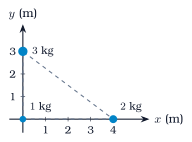
Three masses are placed as shown.
Find \(x_{\text{cm}}\).
Find \(y_{\text{cm}}\).
Is the centre of mass inside the triangle joining the masses?
Answer(i) \(\frac{4}{3}\) m (ii) \(1.5\) m (iii) yes
Yes: \(\left(\dfrac{4}{3}, 1.5\right)\) lies below the line from \((4, 0)\) to \((0, 3)\), whose equation is \(3x + 4y = 12\) (\(4 + 6 = 10 < 12\)).
How did it go?
Q3
Three equal masses sit at the corners of an equilateral triangle of side \(2\) m. Take one side along the \(x\)-axis from the origin. Find the centre of mass.
Answer\((1, \frac{1}{\sqrt{3}})\) m
Solution
Corners at \((0, 0)\), \((2, 0)\) and \((1, \sqrt{3})\). Equal masses give the average of the coordinates: \(x = \dfrac{0 + 2 + 1}{3} = 1\), \(y = \dfrac{\sqrt{3}}{3} = \dfrac{1}{\sqrt{3}} \approx 0.58\) m. This is the centroid.
How did it go?
Q4
Masses of \(1\) kg and \(3\) kg are \(4\) m apart. How far is the centre of mass from each?
Answer\(3\) m from \(1\) kg; \(1\) m from \(3\) kg
Solution
From the \(1\) kg mass: \(x = \dfrac{3 \times 4}{4} = 3\) m. So it is \(1\) m from the \(3\) kg mass. The centre of mass divides the distance in the inverse ratio of the masses.
How did it go?
Q5
A \(1\) kg mass is at \(x = 0\) and a \(3\) kg mass at \(x = 4\) m. Where must a \(2\) kg mass be placed so that the centre of mass of the three is at \(x = 2\) m?
Answer\(x = 0\)
Solution
\(\dfrac{1 \times 0 + 3 \times 4 + 2x}{6} = 2\) gives \(12 + 2x = 12\), so \(x = 0\): at the origin, with the \(1\) kg mass.
How did it go?
Continuous bodies
Q6
Use \(x_{\text{cm}} = \frac{1}{M}\int x\,dm\) with \(dm = \lambda\,dx\) to show that the centre of mass of a uniform rod of length \(L\) is at \(\frac{L}{2}\).
A rod of length \(3\) m has mass per unit length \(\lambda = kx\), measured from one end. Show that its centre of mass is at \(\frac{2L}{3}\) and find its position.
Answer\(\frac{\int kx^2 dx}{\int kx\,dx}\); \(2\) m
Solution
\(M = \int_0^L kx\,dx = \dfrac{kL^2}{2}\). \(x_{\text{cm}} = \dfrac{1}{M}\int_0^L x \cdot kx\,dx = \dfrac{kL^3/3}{kL^2/2} = \dfrac{2L}{3}\). For \(L = 3\) m: \(2\) m, nearer the heavy end.
How did it go?
Q8
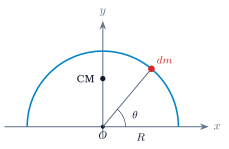
The centre of mass of a uniform semicircular ring of radius \(R\) lies on its axis of symmetry at \(y = \frac{2R}{\pi}\).
Why is \(x_{\text{cm}} = 0\)?
Find \(y_{\text{cm}}\) for \(R = 7\) cm. Take \(\pi = \frac{22}{7}\).
Is this point on the ring? Comment.
Answer(i) symmetry (ii) \(4.45\) cm (iii) no, in the empty space
Solution
The ring is symmetric about the \(y\)-axis: for every element at \(+x\) there is an equal one at \(-x\), so the contributions cancel.
No. The ring is at distance \(7\) cm from \(O\); the centre of mass at \(4.45\) cm is in the empty space inside. A centre of mass need not lie on the body.
How did it go?
Q9
The centre of mass of a uniform semicircular disc is at \(\frac{4R}{3\pi}\) from the centre. Find it for \(R = 7\) cm. Why is it lower than for the ring of the same radius?
Answer\(\approx 2.97\) cm; more mass near the centre
Solution
\(\dfrac{4 \times 7}{3 \times 22/7} = \dfrac{28 \times 7}{66} \approx 2.97\) cm. The disc has mass all the way in to the centre, which pulls the centre of mass down. The ring has all its mass at the rim.
How did it go?
Q10
Write the position of the centre of mass of each body, measured from its flat face.
A solid hemisphere of radius \(8\) cm.
A hollow hemisphere of radius \(8\) cm.
A solid cone of height \(12\) cm.
Answer(i) \(3\) cm (ii) \(4\) cm (iii) \(3\) cm
Solution
\(\dfrac{3R}{8} = 3\) cm.
\(\dfrac{R}{2} = 4\) cm.
\(\dfrac{h}{4} = 3\) cm.
How did it go?
Q11
For the semicircular ring in the figure, an element at angle \(\theta\) has mass \(dm = \frac{M}{\pi}d\theta\) and \(y = R\sin\theta\). Integrate from \(0\) to \(\pi\) to show that \(y_{\text{cm}} = \frac{2R}{\pi}\).
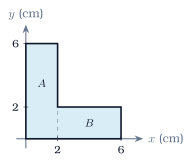
The lamina is uniform and of the same thickness everywhere, so mass is proportional to area and the ratio is what matters.
How did it go?
Q13
A uniform rod of mass \(2\) kg and length \(2\) m carries a small \(1\) kg ball fixed at one end. Find the centre of mass, measured from the ball.
Answer\(\frac{2}{3}\) m
Solution
The rod's own centre is \(1\) m from the ball. \(x_{\text{cm}} = \dfrac{1 \times 0 + 2 \times 1}{3} = \dfrac{2}{3}\) m from the ball.
How did it go?
Q14
Two uniform discs of the same thickness and material, of radii \(R\) and \(2R\), are placed touching each other on a table. Find the centre of mass, measured from the centre of the larger disc.
Answer\(0.6R\) towards the small disc
Solution
Mass \(\propto\) area \(\propto\) radius\(^2\): the masses are in the ratio \(1 : 4\). The centres are \(3R\) apart. From the larger disc's centre: \(x = \dfrac{1 \times 3R + 4 \times 0}{5} = 0.6R\), towards the small disc.
How did it go?
Q15
Two uniform cubes of the same material, of sides \(a\) and \(2a\), stand side by side on a table. Find the height of the centre of mass above the table.
Show that the centre of mass of two particles does not depend on the choice of origin. Shift the origin by \(d\) and see what happens to \(x_{\text{cm}}\).
Answer\(x_{\text{cm}}\) shifts by \(d\), same point
Solution
With the origin shifted by \(d\) every position becomes \(x_i' = x_i - d\). Then \(x_{\text{cm}}' = \dfrac{m_1(x_1 - d) + m_2(x_2 - d)}{m_1 + m_2} = x_{\text{cm}} - d\). The number changes by exactly the shift, so it describes the same physical point.
How did it go?
Cavities
Q17
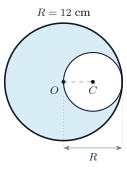
A circular hole of radius \(\frac{R}{2}\) is cut from a uniform disc of radius \(R = 12\) cm. The hole's centre \(C\) is \(\frac{R}{2}\) from the disc's centre \(O\).
Write the mass of the hole as a fraction of the full disc's mass.
Treat the hole as negative mass and find the shift of the centre of mass.
On which side of \(O\) does it lie?
Answer(i) \(\frac{1}{4}\) (ii) \(2\) cm (iii) opposite to the hole
Solution
Area \(\propto\) radius\(^2\): the hole is \(\left(\dfrac{1}{2}\right)^2 = \dfrac{1}{4}\) of the disc's mass \(M\).
Remaining mass \(\dfrac{3M}{4}\). Taking \(O\) as origin and \(C\) at \(+\dfrac{R}{2}\): \(x_{\text{cm}} = \dfrac{M \times 0 - \frac{M}{4} \times \frac{R}{2}}{3M/4} = -\dfrac{R}{6} = -2\) cm.
The minus sign puts it \(2\) cm from \(O\) on the side away from the hole, where more material remains.
How did it go?
Q18
A spherical cavity of radius \(\frac{R}{2}\) is made inside a uniform solid sphere of radius \(R = 14\) cm. The cavity's centre is \(\frac{R}{2}\) from the sphere's centre. Find the shift of the centre of mass.
Answer\(1\) cm, away from the cavity
Solution
Volume \(\propto\) radius\(^3\): the cavity is \(\dfrac{1}{8}\) of the mass. \(x_{\text{cm}} = \dfrac{-\frac{M}{8} \times \frac{R}{2}}{7M/8} = -\dfrac{R}{14} = -1\) cm: \(1\) cm from the centre, away from the cavity.
How did it go?
Q19
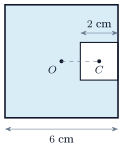
A square hole of side \(2\) cm is cut from a uniform square plate of side \(6\) cm. The hole's centre \(C\) is \(2\) cm to the right of the plate's centre \(O\).
Find the areas of the plate and of the hole.
Find the shift of the centre of mass and its direction.
Answer(i) \(36\); \(4\) cm\(^2\) (ii) \(0.25\) cm to the left
\(x_{\text{cm}} = \dfrac{36 \times 0 - 4 \times 2}{32} = -0.25\) cm: a quarter centimetre to the left of \(O\), away from the hole.
How did it go?
Q20
Explain why a hole can be treated as a body of negative mass when finding the centre of mass of what remains.
Answerplate \(=\) remainder \(+\) hole
Solution
The full plate is the remainder plus the piece cut out. So \(M\vec r_{\text{plate}} = m_{\text{rem}}\vec r_{\text{rem}} + m_{\text{hole}}\vec r_{\text{hole}}\). Solving for the remainder moves the hole's term to the other side with a minus sign. The hole enters exactly like a mass of \(-m_{\text{hole}}\) at its own centre.
How did it go?
Q21
A piece of length \(\frac{L}{4}\) is cut from one end of a uniform rod of length \(L\). Find the centre of mass of the remaining rod, measured from the cut end, in two ways: directly and by the negative-mass method.
Answer\(\frac{5L}{8}\)
Solution
Directly: what remains is a uniform rod of length \(\dfrac{3L}{4}\) that starts at \(\dfrac{L}{4}\); its centre is at \(\dfrac{L}{4} + \dfrac{3L}{8} = \dfrac{5L}{8}\).
Negative mass: full rod \(M\) at \(\dfrac{L}{2}\), removed piece \(\dfrac{M}{4}\) at \(\dfrac{L}{8}\). \(x = \dfrac{M \cdot L/2 - (M/4)(L/8)}{3M/4} = \dfrac{15L/32}{3/4} = \dfrac{5L}{8}\).
How did it go?
Small situations
Q22
A \(60\) kg man stands at one end of a \(90\) kg boat at rest on still water. He walks \(3\) m towards the other end. Ignoring the water's resistance, find how far the boat moves and in which direction.
Answer\(1.2\) m, opposite to the man
Solution
No external horizontal force acts, so the centre of mass stays put: \(60\,\Delta x_{\text{man}} = 90\,\Delta x_{\text{boat}}\) in magnitude, opposite in direction. With \(\Delta x_{\text{man}} + \Delta x_{\text{boat}} = 3\) m relative to each other: the boat moves \(\dfrac{60}{150} \times 3 = 1.2\) m backward and the man \(1.8\) m forward over the water.
How did it go?
Q23
The Earth is \(81\) times as massive as the Moon, and the centres are \(3.84 \times 10^{5}\) km apart. Find the distance of the centre of mass from the Earth's centre. Is it inside the Earth (radius \(6400\) km)?
Answer\(\approx 4.7 \times 10^{3}\) km; yes
Solution
From the Earth's centre: \(x = \dfrac{1 \times 3.84 \times 10^{5}}{81 + 1} \approx 4.7 \times 10^{3}\) km. This is less than \(6400\) km, so the centre of mass of the pair lies inside the Earth.
How did it go?
Q24
Must the centre of mass of a body lie inside the body? Give two examples in support of your answer.
Answerno; ring, L-shape
Solution
No. The centre of mass of a uniform ring is at its centre, where there is no material. That of an L-shaped plate can fall in the empty corner. It is a weighted average position, not a point of the body.