Questions on Momentum and Its Conservation, the kind your examinations ask. Solve one on paper. Then tell the book how it went. The book believes you, and it uses your answer to plan your revision.
0%
Nothing marked yetMark honestly. Peek at the answer only after your own attempt.
Conservation of Linear Momentum
24 questions · after Lesson 4, Momentum Along One Direction
Momentum of a system
Q1
Find the momentum of (i) a \(2\) kg ball at \(3\) m/s and (ii) a \(50\) g bullet at \(400\) m/s. Which is larger?
Answer(i) \(6\) kg m/s (ii) \(20\) kg m/s; bullet
Solution
(i) \(p = 2 \times 3 = 6\) kg m/s. (ii) \(p = 0.05 \times 400 = 20\) kg m/s. The light, fast bullet carries more momentum.
How did it go?
Q2
A \(2\) kg body moves at \(+3\) m/s and a \(3\) kg body at \(-2\) m/s along the same line. Find the total momentum and the velocity of the centre of mass.
Answer\(0\); \(0\)
Solution
\(P = 2 \times 3 + 3 \times (-2) = 0\). \(v_{\text{cm}} = \dfrac{P}{M} = 0\): the centre of mass is at rest even though both bodies move.
How did it go?
Q3
A \(1\) kg body moves at \(4\) m/s towards a \(3\) kg body at rest. Find the velocity of the centre of mass. Use \(\vec v_{\text{cm}} = \frac{\sum m_i\vec v_i}{\sum m_i}\).
Answer\(1\) m/s
Solution
\(v_{\text{cm}} = \dfrac{1 \times 4 + 3 \times 0}{4} = 1\) m/s, in the direction of the moving body.
How did it go?
Q4
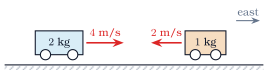
Two carts move towards each other on a smooth track, as shown.
Find the total momentum, taking east as positive.
Find the velocity of the centre of mass.
The carts collide and stick. Find their common velocity.
Answer(i) \(6\) kg m/s east (ii) \(2\) m/s east (iii) \(2\) m/s east
Solution
\(P = 2 \times 4 - 1 \times 2 = 6\) kg m/s, east.
\(v_{\text{cm}} = \dfrac{6}{3} = 2\) m/s east.
Momentum is conserved: \(6 = 3v\), \(v = 2\) m/s east, the same as \(v_{\text{cm}}\). After sticking, the carts move with the centre of mass.
How did it go?
Recoil and explosions
Q5
A \(5\) kg gun fires a \(10\) g bullet at \(500\) m/s. Find the recoil speed of the gun.
Answer\(1\) m/s
Solution
Before firing the total momentum is zero. After: \(5v + 0.01 \times 500 = 0\), so \(v = -1\) m/s: the gun recoils at \(1\) m/s.
How did it go?
Q6
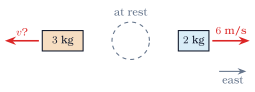
A \(5\) kg shell at rest bursts into two pieces. The \(2\) kg piece moves east at \(6\) m/s.
Find the velocity of the \(3\) kg piece.
Find the kinetic energy released by the explosion.
Which piece gets more kinetic energy? Give the reason.
Answer(i) \(4\) m/s west (ii) \(60\) J (iii) \(2\) kg, \(36\) J
Solution
\(2 \times 6 + 3v = 0\), so \(v = -4\) m/s: \(4\) m/s west.
\(K = \dfrac{1}{2} \times 2 \times 36 + \dfrac{1}{2} \times 3 \times 16 = 36 + 24 = 60\) J, all from the explosive.
The \(2\) kg piece gets \(36\) J, the \(3\) kg piece \(24\) J. Both have the same momentum \(12\) kg m/s, and \(K = \dfrac{p^2}{2m}\) is larger for the smaller mass.
How did it go?
Q7
A shell at rest bursts into three pieces. A \(1\) kg piece moves at \(4\) m/s along \(+x\) and another \(1\) kg piece at \(3\) m/s along \(+y\). Find the velocity of the third piece, of mass \(2\) kg.
Answer\(-2\hat i - 1.5\hat j\) m/s; \(2.5\) m/s
Solution
Total momentum stays zero: \(1 \times 4\hat i + 1 \times 3\hat j + 2\vec v = 0\), so \(\vec v = -2\hat i - 1.5\hat j\) m/s. Speed \(= \sqrt{4 + 2.25} = 2.5\) m/s.
How did it go?
Q8
A \(60\) kg skater at rest on ice throws a \(2\) kg ball horizontally at \(15\) m/s. Find the skater's recoil velocity.
Answer\(0.5\) m/s backward
Solution
\(60v + 2 \times 15 = 0\), so \(v = -0.5\) m/s: the skater slides backward at \(0.5\) m/s.
How did it go?
Q9
A \(1000\) kg car at \(20\) m/s runs into an identical car at rest and the two lock together.
Find the common velocity.
Find the kinetic energy lost.
Answer(i) \(10\) m/s (ii) \(10^{5}\) J
Solution
\(1000 \times 20 = 2000v\), so \(v = 10\) m/s.
Before: \(\dfrac{1}{2} \times 1000 \times 400 = 2 \times 10^{5}\) J. After: \(\dfrac{1}{2} \times 2000 \times 100 = 10^{5}\) J. Lost: \(10^{5}\) J, half of the original.
How did it go?
Q10
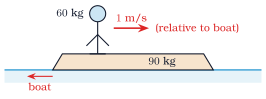
A \(60\) kg man walks along a \(90\) kg boat at \(1\) m/s relative to the boat. The boat is at rest to begin with and the water offers no resistance.
Let the boat move backward at \(u\). Write the man's velocity relative to the water.
Apply conservation of momentum and find \(u\).
Find the man's velocity relative to the water.
Answer(i) \(1 - u\) (ii) \(0.4\) m/s (iii) \(0.6\) m/s
Solution
Man relative to water \(=\) (man relative to boat) \(+\) (boat relative to water) \(= 1 - u\).
Total momentum stays zero: \(60(1 - u) - 90u = 0\), so \(60 = 150u\) and \(u = 0.4\) m/s.
Blocks of \(1\) kg and \(3\) kg on a smooth table are held with a compressed spring between them and then released. The \(1\) kg block moves off at \(6\) m/s. Find the velocity of the \(3\) kg block and the velocity of the centre of mass.
Answer\(2\) m/s opposite; \(0\)
Solution
The spring force is internal, so the total momentum stays zero: \(1 \times 6 + 3v = 0\), \(v = -2\) m/s, opposite to the \(1\) kg block. \(v_{\text{cm}} = 0\): the centre of mass stays where it was.
How did it go?
Q12
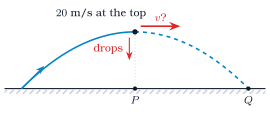
A \(4\) kg shell moving at \(20\) m/s at the top of its path bursts into two equal pieces. One piece drops from rest.
Find the velocity of the other piece just after the burst.
Where does the centre of mass of the two pieces land? Give the reason.
The first piece lands at \(P\), \(40\) m short of \(Q\). Where does the second piece land?
Answer(i) \(40\) m/s (ii) \(Q\), no external horizontal force (iii) \(40\) m beyond \(Q\)
Solution
\(4 \times 20 = 2 \times 0 + 2v\), so \(v = 40\) m/s horizontally.
The burst is internal and gravity acts on the centre of mass exactly as it did on the shell. So the centre of mass continues along the original parabola and lands at \(Q\).
The pieces are equal, so the centre of mass is midway between them. One piece lies \(40\) m before \(Q\), so the other lands \(40\) m beyond \(Q\).
How did it go?
Q13
Blocks of \(2\) kg and \(3\) kg lie on a smooth floor joined by a spring. A steady \(10\) N force pulls the \(3\) kg block. Find the acceleration of the centre of mass. Does it depend on how the spring stretches?
Answer\(2\) m/s\(^2\); no
Solution
\(a_{\text{cm}} = \dfrac{F_{\text{ext}}}{M} = \dfrac{10}{5} = 2\) m/s\(^2\). The spring's forces are internal and cancel in the sum, so the stretching of the spring does not affect the centre of mass.
How did it go?
Q14
A \(1\) kg ball is thrown up at \(20\) m/s while another \(1\) kg ball is dropped from rest at the same instant. Find the initial velocity and the acceleration of their centre of mass. Take \(g = 10\) m/s\(^2\).
Answer\(10\) m/s up; \(g\) down
Solution
\(v_{\text{cm}} = \dfrac{1 \times 20 + 1 \times 0}{2} = 10\) m/s upward. Both balls have acceleration \(g\) downward, so \(a_{\text{cm}} = g = 10\) m/s\(^2\) downward.
How did it go?
Q15
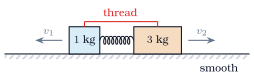
The thread holding the compressed spring between the blocks is cut. The spring stores \(24\) J.
Write the relation between \(v_1\) and \(v_2\).
Find \(v_1\) and \(v_2\).
Find the ratio of the kinetic energies of the two blocks.
Answer(i) \(v_1 = 3v_2\) (ii) \(6\) m/s; \(2\) m/s (iii) \(3 : 1\)
Energy: \(\dfrac{1}{2} \times 1 \times 9v_2^2 + \dfrac{1}{2} \times 3 \times v_2^2 = 24\), so \(6v_2^2 = 24\), \(v_2 = 2\) m/s and \(v_1 = 6\) m/s.
\(K_1 : K_2 = 18 : 6 = 3 : 1\), the inverse of the mass ratio.
How did it go?
External forces
Q16
Why is momentum conserved in every collision between two bodies, while kinetic energy often is not?
Answerinternal forces cancel; energy can go to heat, sound
Solution
During the collision the forces between the bodies are an action-reaction pair. Their impulses on the two bodies are equal and opposite, so the total momentum cannot change. Kinetic energy is not a vector and has no such pairing; part of it can be converted into heat, sound or deformation.
How did it go?
Q17
A \(0.5\) kg ball hits a wall at \(10\) m/s and rebounds at \(10\) m/s. The ball's momentum changes by \(10\) kg m/s. Is momentum conserved here? Where does the momentum go?
Answernot for the ball alone; to the wall and the Earth
Solution
The ball alone is not an isolated system: the wall pushes on it. Momentum is conserved for the ball plus the wall and the Earth. The wall gains \(10\) kg m/s, but its enormous mass makes its velocity change unnoticeable.
How did it go?
Q18
State whether the momentum of the system is conserved, with a reason.
Two skaters on ice push each other apart.
A ball falling freely.
Two cars during a brief collision on a rough road.
Answer(i) yes (ii) no, gravity (iii) nearly, impact force \(\gg\) friction
Solution
Yes: the ice is smooth, so no external horizontal force acts; the pushes are internal.
No: gravity is an external force on the ball and its momentum grows steadily.
Nearly: the collision force is far larger than friction, so over the brief impact friction's impulse is negligible.
How did it go?
Q19
A shell explodes in mid-air. Gravity is an external force. Why can momentum still be taken as conserved across the explosion?
Answerimpulse of gravity negligible in the short time
Solution
The explosion lasts a very short time \(\Delta t\). Gravity's impulse \(mg\,\Delta t\) in that time is tiny compared with the large internal impulses. So the momentum just after the explosion equals the momentum just before. Later, gravity changes the momentum in the usual way.
How did it go?
Small situations
Q20
An \(80\) kg astronaut floating at rest throws a \(4\) kg tool at \(10\) m/s. Find the astronaut's velocity and the time to drift \(10\) m.
Answer\(0.5\) m/s; \(20\) s
Solution
\(80v = 4 \times 10\), so \(v = 0.5\) m/s opposite to the throw. \(t = \dfrac{10}{0.5} = 20\) s.
How did it go?
Q21
A \(20\) g bullet at \(300\) m/s embeds itself in a \(2.98\) kg block on a smooth table. Find the velocity of the block with the bullet.
In the centre-of-mass frame the velocities are \(v_1 - v_{\text{cm}}\) and \(v_2 - v_{\text{cm}}\). Total momentum there: \(m_1(v_1 - v_{\text{cm}}) + m_2(v_2 - v_{\text{cm}}) = (m_1v_1 + m_2v_2) - (m_1 + m_2)v_{\text{cm}} = 0\), by the definition of \(v_{\text{cm}}\). So \(p_1' = -p_2'\).
How did it go?
Variable Mass Systems and Continuous Collisions
24 questions · after Lesson 6, Sand on a Belt and a Falling Chain
Thrust force
Q25
Write the thrust force on a body that ejects mass at a rate \(\frac{dm}{dt}\) with relative velocity \(v_{\text{rel}}\). A hose throws out \(2\) kg of water per second at \(20\) m/s. Find the force on the hose.
Answer\(F = v_{\text{rel}}\frac{dm}{dt}\); \(40\) N
Solution
\(F = v_{\text{rel}}\dfrac{dm}{dt}\), directed opposite to the ejected mass. For the hose: \(F = 20 \times 2 = 40\) N, pushing the hose backward.
How did it go?
Q26
A machine gun fires \(10\) bullets per second, each of mass \(20\) g at \(500\) m/s. Find the average force on the gun.
Answer\(100\) N
Solution
Mass leaving per second \(= 10 \times 0.02 = 0.2\) kg/s. \(F = 500 \times 0.2 = 100\) N.
How did it go?
Q27
Rain falls vertically at \(5\) m/s onto the flat roof of a stationary car at \(0.5\) kg per second and comes to rest there. Find the force on the roof.
Answer\(2.5\) N
Solution
Momentum arriving per second \(= 0.5 \times 5 = 2.5\) kg m/s each second, all destroyed at the roof. \(F = 2.5\) N downward.
How did it go?
Q28
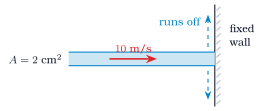
The jet strikes the wall and runs off along it. Take the density of water as \(1000\) kg/m\(^3\).
Find the mass of water hitting the wall per second.
Find the force on the wall.
Find the force if the water instead rebounds at \(10\) m/s.
Answer(i) \(2\) kg/s (ii) \(20\) N (iii) \(40\) N
Solution
\(\dfrac{dm}{dt} = \rho A v = 1000 \times 2 \times 10^{-4} \times 10 = 2\) kg/s.
The normal velocity \(10\) m/s is destroyed: \(F = v\dfrac{dm}{dt} = 10 \times 2 = 20\) N.
The normal velocity is reversed, so the change is \(20\) m/s per kg: \(F = 20 \times 2 = 40\) N.
How did it go?
Q29
Sand falls from a height of \(5\) m onto the pan of a balance at \(0.2\) kg per second. Take \(g = 10\) m/s\(^2\). Find the extra force on the pan at the instant the sand starts landing, before any sand collects.
Answer\(2\) N
Solution
Speed on arrival \(= \sqrt{2 \times 10 \times 5} = 10\) m/s. Extra force \(= v\dfrac{dm}{dt} = 10 \times 0.2 = 2\) N. Later the weight of the collected sand adds to it.
How did it go?
Q30
A stream of particles hits a wall and stops. Why is the force on the wall equal to the momentum arriving per second? Which form of Newton's second law is used?
Answer\(F = \frac{dp}{dt}\); momentum destroyed per second
Solution
Newton's second law in the form \(F = \dfrac{dp}{dt}\). In each second a mass \(\dfrac{dm}{dt}\) arrives with velocity \(v\) and is brought to rest, so momentum \(v\dfrac{dm}{dt}\) is destroyed per second. The wall must supply that rate of change of momentum as a force.
How did it go?
Conveyor belt
Q31
Sand falls gently onto a horizontal belt moving at \(3\) m/s at a rate of \(2\) kg per second.
Find the force needed to keep the belt moving.
Find the power of the motor.
Find the kinetic energy gained by the sand per second.
Answer(i) \(6\) N (ii) \(18\) W (iii) \(9\) W
Solution
\(F = v\dfrac{dm}{dt} = 3 \times 2 = 6\) N.
\(P = Fv = 6 \times 3 = 18\) W.
\(\dfrac{dK}{dt} = \dfrac{1}{2}\dfrac{dm}{dt}v^2 = \dfrac{1}{2} \times 2 \times 9 = 9\) W. The other \(9\) W is lost as heat while the sand slips to the belt speed.
How did it go?
Q32
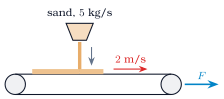
Sand falls onto the belt as shown. The belt runs on smooth rollers.
Find the force \(F\).
Find the power delivered by \(F\).
How much energy per second becomes heat?
Answer(i) \(10\) N (ii) \(20\) W (iii) \(10\) W
Solution
\(F = 2 \times 5 = 10\) N.
\(P = Fv = 10 \times 2 = 20\) W.
The sand gains \(\dfrac{1}{2} \times 5 \times 4 = 10\) J per second. The remaining \(10\) W becomes heat through friction between sand and belt.
How did it go?
Q33
Sand falls onto a belt moving at speed \(v\) at a rate \(\mu\). Show that exactly half the work done by the motor turns into heat.
Force \(F = \mu v\), so the motor's power is \(P = Fv = \mu v^2\). The sand's kinetic energy rises at \(\dfrac{1}{2}\mu v^2\) per second. The difference, \(\dfrac{1}{2}\mu v^2\), is half the motor's work, and it is dissipated as heat as each grain is dragged to the belt speed.
How did it go?
Q34
The motor in Q8 is switched off, but sand keeps falling onto the belt. The rollers are smooth. Why does the belt slow down?
Answermomentum is shared with the new sand
Solution
The belt and the sand on it have momentum. Each new grain arrives with no horizontal momentum and must be given some by the belt. With no motor, the total horizontal momentum stays fixed while the moving mass grows, so the speed falls.
How did it go?
Rockets
Q35
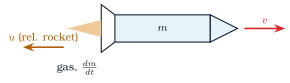
A rocket on its launch pad has mass \(5000\) kg. It ejects gas at \(50\) kg per second at \(2000\) m/s relative to the rocket. Take \(g = 10\) m/s\(^2\).
Find the thrust.
Find the initial acceleration.
Answer(i) \(10^{5}\) N (ii) \(10\) m/s\(^2\)
Solution
Thrust \(= u\dfrac{dm}{dt} = 2000 \times 50 = 10^{5}\) N.
Before: \(mv\). After: rocket \((m - dm)(v + dv)\) and gas \(dm\,(v - u)\), since the gas moves at \(u\) backward relative to the rocket.
No external force, so \(mv = (m - dm)(v + dv) + dm\,(v - u)\). Expanding and dropping \(dm\,dv\): \(0 = m\,dv - u\,dm\), so \(m\,dv = u\,dm\). Dividing by \(dt\): \(m\dfrac{dv}{dt} = u\dfrac{dm}{dt}\), so the thrust is \(u\dfrac{dm}{dt}\).
How did it go?
Q37
A rocket in free space starts from rest with exhaust speed \(u = 2000\) m/s. Use \(v = u\ln\frac{m_0}{m}\) and \(\ln 2 \approx 0.7\). Find its speed when its mass has fallen to (i) half (ii) a quarter of the initial mass.
Answer(i) \(1400\) m/s (ii) \(2800\) m/s
Solution
(i) \(v = 2000\ln 2 \approx 2000 \times 0.7 = 1400\) m/s. (ii) \(v = 2000\ln 4 = 2 \times 1400 = 2800\) m/s. Each halving of the mass adds the same \(1400\) m/s.
How did it go?
Q38
A \(4000\) kg rocket has exhaust speed \(2000\) m/s. Take \(g = 10\) m/s\(^2\). Find the minimum rate of gas ejection for the rocket to lift off.
Answer\(20\) kg/s
Solution
Thrust must at least equal the weight: \(u\dfrac{dm}{dt} = mg\), so \(\dfrac{dm}{dt} = \dfrac{4000 \times 10}{2000} = 20\) kg/s.
How did it go?
Q39
A \(1000\) kg rocket is launched vertically with \(u = 1000\) m/s, burning fuel at \(10\) kg per second for \(50\) s. Take \(g = 10\) m/s\(^2\) and \(\ln 2 \approx 0.7\). Use \(v = u\ln\frac{m_0}{m} - gt\) to find the speed at burnout.
Answer\(200\) m/s
Solution
Mass at burnout \(= 1000 - 10 \times 50 = 500\) kg. \(v = 1000\ln 2 - 10 \times 50 \approx 700 - 500 = 200\) m/s.
How did it go?
Q40
In free space the final speed of a rocket depends only on \(u\) and the ratio \(\frac{m_0}{m}\), not on how fast the fuel burns. Why? Why does the burn rate matter for a vertical launch?
Answerimpulse per kg of gas is fixed; gravity acts for less time
Solution
In free space each kilogram of gas ejected gives the rocket the same impulse, \(u\) per kilogram relative to the rocket, whenever it is ejected. So only the total mass ejected matters, through \(\ln(m_0/m)\). With gravity, the loss \(gt\) grows with the burn time, so a faster burn reaches a higher speed.
How did it go?
Chains and carts
Q41
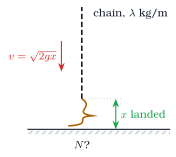
A uniform chain of \(\lambda = 1\) kg/m is held vertically with its lower end just touching a table and is released. Take \(g = 10\) m/s\(^2\). At the instant a length \(x = 0.5\) m has landed:
Find the speed of the falling part.
Find the mass landing per second.
Find the impact force on the table.
Find the total force on the table.
Answer(i) \(\sqrt{10} \approx 3.2\) m/s (ii) \(\sqrt{10}\) kg/s (iii) \(10\) N (iv) \(15\) N
Solution
The falling part is in free fall: \(v = \sqrt{2gx} = \sqrt{10} \approx 3.2\) m/s.
\(\dfrac{dm}{dt} = \lambda v = \sqrt{10} \approx 3.2\) kg/s.
Add the weight of the landed part, \(\lambda xg = 5\) N: total \(15\) N, three times the weight of the landed part.
How did it go?
Q42
A chain of \(\lambda = 2\) kg/m and length \(1\) m is released as in Q17. Find the force on the table just as the last link lands. Compare it with the weight of the chain.
Answer\(60\) N; three times the weight
Solution
Just before the last link lands, \(x = 1\) m and \(v^2 = 2g\). Force \(= \lambda xg + \lambda v^2 = 3\lambda xg = 3 \times 2 \times 1 \times 10 = 60\) N. The weight of the chain is \(20\) N, so the table feels three times the weight.
How did it go?
Q43
A chain of \(\lambda = 0.5\) kg/m lies in a heap on a smooth table. One end is pulled horizontally at a steady \(2\) m/s. Find the pulling force, the power of the pull and the kinetic energy gained per second.
Answer\(2\) N; \(4\) W; \(2\) W
Solution
Chain leaves the heap at \(\lambda v = 1\) kg/s and is brought from rest to \(2\) m/s. \(F = v\dfrac{dm}{dt} = \lambda v^2 = 0.5 \times 4 = 2\) N. Power \(= Fv = 4\) W. Kinetic energy gained per second \(= \dfrac{1}{2}(1)(4) = 2\) W. The other \(2\) W becomes heat in the jerks as each link starts moving.
How did it go?
Q44
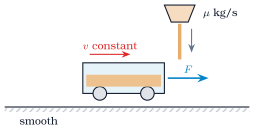
Sand pours vertically into the cart at \(\mu = 3\) kg/s. The cart moves at a constant \(2\) m/s on a smooth floor.
Find the force \(F\) needed.
The cart and its sand have mass \(30\) kg when \(F\) is removed. Find the speed after another \(10\) kg of sand has fallen in.
Answer(i) \(6\) N (ii) \(1.5\) m/s
Solution
Each second \(3\) kg of sand must be brought to \(2\) m/s: \(F = \mu v = 3 \times 2 = 6\) N.
With \(F\) removed, horizontal momentum is conserved: \(30 \times 2 = 40v\), so \(v = 1.5\) m/s.
How did it go?
Small situations
Q45
Sand leaks out through a hole in the floor of a cart moving on a smooth track. Does the cart speed up, slow down or keep its speed? Give the reason.
Answerkeeps its speed
Solution
The cart keeps its speed. The leaking sand leaves with the same horizontal velocity as the cart, so it carries away momentum in proportion to its mass. There is no relative velocity and hence no thrust on the cart.
How did it go?
Q46
Hailstones of \(10\) g each fall at \(20\) m/s onto a \(2\) m\(^2\) roof and come to rest. Each square metre receives \(500\) stones per second. Find the force and the pressure on the roof.
Answer\(200\) N; \(100\) Pa
Solution
Mass arriving per second \(= 0.01 \times 500 \times 2 = 10\) kg/s. \(F = 20 \times 10 = 200\) N. Pressure \(= \dfrac{200}{2} = 100\) Pa.
How did it go?
Q47
A jet engine takes in \(50\) kg of air per second at \(200\) m/s (the speed of the aircraft) and ejects it at \(500\) m/s. Ignore the fuel mass. Find the thrust.
Answer\(15\) kN
Solution
The engine raises the air's speed by \(500 - 200 = 300\) m/s. Thrust \(= \dfrac{dm}{dt}\,\Delta v = 50 \times 300 = 15000\) N \(= 15\) kN.
How did it go?
Q48
A pump throws out water at speed \(v\) at a mass rate \(\mu\) from rest. Show that the force needed is \(\mu v\) but the power needed is only \(\frac{1}{2}\mu v^2\). Where does the factor \(\frac{1}{2}\) come from?
Answer\(F = \mu v\); \(P = \frac{1}{2}\mu v^2\); work done on water \(\frac{1}{2}\mu v^2\) per second
Solution
Momentum given to the water per second is \(\mu v\), so the force is \(F = \mu v\). The kinetic energy given per second is \(\dfrac{1}{2}\mu v^2\), so that is the power. The product \(Fv = \mu v^2\) is not the power. The water does not move at \(v\) while the force acts on it. It is accelerated from rest, at an average speed of \(\dfrac{v}{2}\).