Questions on Collisions, the kind your examinations ask. Solve one on paper. Then tell the book how it went. The book believes you, and it uses your answer to plan your revision.
0%
Nothing marked yetMark honestly. Peek at the answer only after your own attempt.
Collisions in One Dimension
24 questions · after Lesson 4, The Coefficient of Restitution
Coefficient of restitution
Q1
Define the coefficient of restitution \(e\). Two balls approach at \(6\) m/s and separate at \(3\) m/s after the collision. Find \(e\).
\(e\) is the ratio of the speed of separation to the speed of approach along the line of impact. \(e = \dfrac{3}{6} = 0.5\).
How did it go?
Q2
A ball dropped from \(5\) m rebounds to \(3.2\) m. Take \(g = 10\) m/s\(^2\). Find the speed just before and just after the bounce, and \(e\).
Answer\(10\) m/s; \(8\) m/s; \(0.8\)
Solution
Before: \(v = \sqrt{2 \times 10 \times 5} = 10\) m/s. After: \(v' = \sqrt{2 \times 10 \times 3.2} = 8\) m/s. The floor does not move, so \(e = \dfrac{8}{10} = 0.8\). In general \(e = \sqrt{h'/h}\).
How did it go?
Q3
A ball hits the floor at \(8\) m/s and \(e = 0.5\). Find the rebound speed and the height it rises to.
Answer\(4\) m/s; \(0.8\) m
Solution
\(v' = eu = 0.5 \times 8 = 4\) m/s. Height \(= \dfrac{v'^2}{2g} = \dfrac{16}{20} = 0.8\) m.
How did it go?
Q4
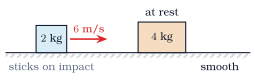
The blocks stick together on impact.
Find the common velocity after the collision.
Find the kinetic energy lost.
What is \(e\) for this collision?
Answer(i) \(2\) m/s (ii) \(24\) J (iii) \(0\)
Solution
\(2 \times 6 = 6v\), so \(v = 2\) m/s.
Before: \(\dfrac{1}{2} \times 2 \times 36 = 36\) J. After: \(\dfrac{1}{2} \times 6 \times 4 = 12\) J. Lost: \(24\) J.
The blocks do not separate, so the separation speed is zero and \(e = 0\).
How did it go?
Q5
For each value of \(e\) name the type of collision and state whether kinetic energy is conserved: (i) \(e = 1\) (ii) \(e = 0\) (iii) \(e = 0.4\).
Answer(i) elastic, yes (ii) perfectly inelastic, no (iii) inelastic, no
Solution
(i) Elastic: kinetic energy is conserved. (ii) Perfectly inelastic: the bodies move together and the maximum possible kinetic energy is lost. (iii) Inelastic: some kinetic energy is lost, but the bodies separate.
How did it go?
Elastic collisions
Q6
A ball at \(3\) m/s collides elastically head-on with an identical ball at rest. Find the velocity of each ball after the collision.
Answer\(0\); \(3\) m/s
Solution
Equal masses in an elastic head-on collision exchange velocities. The first ball stops and the second moves off at \(3\) m/s.
How did it go?
Q7
A \(2\) kg ball at \(6\) m/s collides elastically head-on with a \(4\) kg ball at rest.
Find the velocity of each ball after the collision. Use \(v_1 = \frac{m_1 - m_2}{m_1 + m_2}u_1\) and \(v_2 = \frac{2m_1}{m_1 + m_2}u_1\).
Verify that momentum and kinetic energy are both conserved.
Answer(i) \(-2\) m/s; \(4\) m/s (ii) \(12 = 12\) kg m/s; \(36 = 36\) J
Momentum: before \(12\), after \(2(-2) + 4(4) = 12\) kg m/s. Kinetic energy: before \(36\) J, after \(\dfrac{1}{2}(2)(4) + \dfrac{1}{2}(4)(16) = 4 + 32 = 36\) J.
How did it go?
Q8
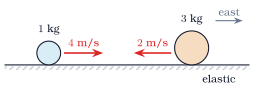
The two balls collide head-on and elastically. Take east as positive.
Write the momentum equation and the restitution equation with \(e = 1\).
Solve them for the two final velocities.
Answer(i) \(v_1 + 3v_2 = -2\); \(v_2 - v_1 = 6\) (ii) \(-5\) m/s; \(1\) m/s
Adding: \(4v_2 = 4\), \(v_2 = 1\) m/s east. Then \(v_1 = 1 - 6 = -5\) m/s, that is \(5\) m/s west. Check the energy: \(8 + 6 = 14\) J before, \(12.5 + 1.5 = 14\) J after.
How did it go?
Q9
Find the final velocities in an elastic head-on collision. (i) A very heavy ball at \(u\) hits a light ball at rest. (ii) A light ball at \(u\) hits a very heavy ball at rest.
Answer(i) \(u\); \(2u\) (ii) \(-u\); \(0\)
Solution
(i) With \(m_1 \gg m_2\): \(v_1 \approx u\) and \(v_2 \approx 2u\). The heavy ball is barely slowed and the light ball is thrown forward at twice the speed. (ii) With \(m_1 \ll m_2\): \(v_1 \approx -u\) and \(v_2 \approx 0\). The light ball rebounds with its speed unchanged, like a ball off a wall.
How did it go?
Q10
A ball of mass \(m_1\) at speed \(u\) hits a ball of mass \(m_2\) at rest, elastically. Show that the fraction of kinetic energy transferred is \(\frac{4m_1m_2}{(m_1 + m_2)^2}\). Evaluate it for \(m_2 = 3m_1\).
A neutron of mass \(m\) at speed \(u\) makes an elastic head-on collision with a deuteron of mass \(2m\) at rest. Find the neutron's final velocity and the fraction of its energy given to the deuteron.
Answer\(-\frac{u}{3}\); \(\frac{8}{9}\)
Solution
\(v_1 = \dfrac{m - 2m}{3m}u = -\dfrac{u}{3}\): the neutron rebounds at a third of its speed. Fraction transferred \(= \dfrac{4 \times m \times 2m}{9m^2} = \dfrac{8}{9}\). Check: the neutron keeps \(\dfrac{1}{9}\) of its energy, since \((1/3)^2 = 1/9\).
How did it go?
Inelastic collisions
Q12
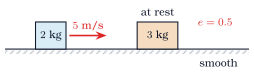
Use the figure.
Find the velocity of the centre of mass.
Find the velocity of each block after the collision.
Find the kinetic energy lost.
Answer(i) \(2\) m/s (ii) \(0.5\) m/s; \(3\) m/s (iii) \(11.25\) J
Before: \(\dfrac{1}{2} \times 2 \times 25 = 25\) J. After: \(\dfrac{1}{2}(2)(0.25) + \dfrac{1}{2}(3)(9) = 0.25 + 13.5 = 13.75\) J. Lost: \(11.25\) J.
How did it go?
Q13
A \(1\) kg ball at \(6\) m/s hits a \(2\) kg ball at rest and \(e = 0.5\). Find the kinetic energy lost using \(\Delta K = \frac{1}{2}\mu u_{\text{rel}}^2(1 - e^2)\), where \(\mu = \frac{m_1m_2}{m_1 + m_2}\).
A ball is dropped from \(5\) m onto a floor with \(e = 0.5\). Take \(g = 10\) m/s\(^2\).
Find the speed after the first bounce.
Find the height after the first bounce.
Find the time between the first and second bounces.
Answer(i) \(5\) m/s (ii) \(1.25\) m (iii) \(1\) s
Solution
Speed of impact \(= \sqrt{2 \times 10 \times 5} = 10\) m/s. After the bounce: \(0.5 \times 10 = 5\) m/s.
\(h_1 = \dfrac{25}{20} = 1.25\) m, which is \(e^2h = 0.25 \times 5\).
Time up and down at \(5\) m/s: \(t = \dfrac{2 \times 5}{10} = 1\) s.
How did it go?
Q15
A \(0.5\) kg ball at \(10\) m/s hits a fixed wall normally and \(e = 0.4\). Find the rebound speed, the magnitude of the change in momentum and the fraction of kinetic energy lost.
Answer\(4\) m/s; \(7\) kg m/s; \(0.84\)
Solution
Rebound speed \(= 0.4 \times 10 = 4\) m/s. \(|\Delta p| = 0.5(10 + 4) = 7\) kg m/s. Kinetic energy goes from \(25\) J to \(4\) J, so the fraction lost is \(1 - e^2 = 1 - 0.16 = 0.84\).
How did it go?
Q16
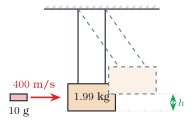
The bullet embeds in the hanging block. Take \(g = 10\) m/s\(^2\).
Find the velocity of the block just after the impact.
Find the height \(h\) the block rises to.
Find the kinetic energy lost in the impact.
Answer(i) \(2\) m/s (ii) \(0.2\) m (iii) \(796\) J
After the impact energy is conserved: \(\dfrac{1}{2} \times 2 \times 4 = 2 \times 10 \times h\), so \(h = 0.2\) m.
Before: \(\dfrac{1}{2} \times 0.01 \times 160000 = 800\) J. After: \(4\) J. Lost: \(796\) J, nearly all of it, as heat and deformation.
How did it go?
Spring-mass collisions
Q17
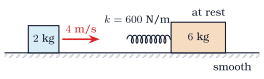
The \(2\) kg block runs into the spring attached to the \(6\) kg block.
Find the common velocity at the instant of maximum compression.
Find the maximum compression of the spring.
Answer(i) \(1\) m/s (ii) \(0.2\) m
Solution
At maximum compression both blocks move together: \(2 \times 4 = 8v\), \(v = 1\) m/s.
Energy: \(\dfrac{1}{2} \times 2 \times 16 = \dfrac{1}{2} \times 8 \times 1 + \dfrac{1}{2} \times 600 \times x^2\), so \(16 = 4 + 300x^2\) and \(x = 0.2\) m.
How did it go?
Q18
In Q17 the spring later returns to its natural length and the blocks separate. Find the velocity of each block after separation. Why is this collision elastic as a whole?
Answer\(-2\) m/s; \(2\) m/s; spring returns all its energy
Solution
The spring gives back all its stored energy, so both momentum and kinetic energy are conserved overall. Using the elastic formulae with \(m_1 = 2\), \(m_2 = 6\), \(u = 4\): \(v_1 = \dfrac{2 - 6}{8} \times 4 = -2\) m/s, \(v_2 = \dfrac{2 \times 2}{8} \times 4 = 2\) m/s. Check: \(-4 + 12 = 8\) kg m/s and \(4 + 12 = 16\) J.
How did it go?
Q19
A \(1\) kg block at \(6\) m/s hits a spring of \(k = 900\) N/m fixed to a wall. Find the maximum compression and the speed with which the block leaves the spring.
Answer\(0.2\) m; \(6\) m/s
Solution
\(\dfrac{1}{2} \times 1 \times 36 = \dfrac{1}{2} \times 900 \times x^2\), so \(x^2 = 0.04\) and \(x = 0.2\) m. The spring returns all the energy, so the block leaves at \(6\) m/s.
How did it go?
Q20
Two \(1\) kg blocks lie on a smooth table. One moves at \(4\) m/s towards the other, which is at rest and carries a spring of \(k = 200\) N/m. Find the maximum compression.
Answer\(0.2\) m
Solution
At maximum compression both move at \(v = \dfrac{1 \times 4}{2} = 2\) m/s. Energy: \(8 = \dfrac{1}{2} \times 2 \times 4 + \dfrac{1}{2} \times 200 \times x^2\), so \(4 = 100x^2\) and \(x = 0.2\) m.
How did it go?
Q21
Why is the compression of the spring greatest at the instant the two blocks have the same velocity?
Answerrelative velocity is zero there
Solution
While the first block is faster than the second, the gap between them is still closing and the spring is still being squeezed. Once the second block is faster, the spring is opening out. The compression is therefore greatest at the instant the relative velocity is zero.
How did it go?
Small situations
Q22
A \(2\) kg ball \(A\) at \(3\) m/s hits a \(1\) kg ball \(B\) at rest. After the collision \(A\) moves at \(1\) m/s in the same direction. Find the velocity of \(B\) and the value of \(e\). Is the collision elastic?
Answer\(4\) m/s; \(e = 1\); yes
Solution
Momentum: \(2 \times 3 = 2 \times 1 + 1 \times v_B\), so \(v_B = 4\) m/s. \(e = \dfrac{4 - 1}{3 - 0} = 1\). Kinetic energy: before \(9\) J, after \(1 + 8 = 9\) J. The collision is elastic.
How did it go?
Q23
A ball at \(6\) m/s hits an identical ball at rest with \(e = 0.5\). Find the velocity of each ball after the collision.
Answer\(1.5\) m/s; \(4.5\) m/s
Solution
Momentum: \(v_1 + v_2 = 6\). Restitution: \(v_2 - v_1 = 0.5 \times 6 = 3\). So \(v_2 = 4.5\) m/s and \(v_1 = 1.5\) m/s, both in the original direction.
How did it go?
Q24
A body of mass \(m\) at speed \(u\) hits a body of mass \(M\) at rest and the two stick. Show that the fraction of kinetic energy lost is \(\frac{M}{m + M}\).
24 questions · after Lesson 6, Right Angles, Floors and Discs
Ball on a smooth surface
Q25
A ball hits a smooth surface obliquely. Which component of its velocity stays the same, and which one changes? Where does \(e\) enter?
Answeralong the surface: same; normal: reversed and multiplied by \(e\)
Solution
The component along the surface is unchanged, because a smooth surface exerts no force along itself. The normal component reverses and its size is multiplied by \(e\): \(v_n' = e\,v_n\).
How did it go?
Q26
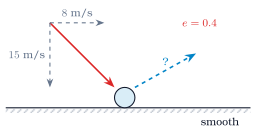
The ball hits the smooth floor with the components shown and \(e = 0.4\).
Find the two velocity components just after the bounce.
Find the speed after the bounce and the angle it makes with the floor.
The ball has mass \(0.1\) kg. Find the impulse from the floor.
Answer(i) \(8\) m/s along, \(6\) m/s up (ii) \(10\) m/s; \(37^\circ\) (iii) \(2.1\) N s, normal
Solution
Along the floor: \(8\) m/s, unchanged. Normal: \(0.4 \times 15 = 6\) m/s, now upward.
Speed \(= \sqrt{64 + 36} = 10\) m/s. \(\tan\alpha = \dfrac{6}{8}\), so \(\alpha = 37^\circ\) to the floor.
Only the normal momentum changes: \(J = 0.1 \times (15 + 6) = 2.1\) N s, normal to the floor.
How did it go?
Q27
A \(0.2\) kg ball at \(10\) m/s hits a smooth wall at \(37^\circ\) to the normal and rebounds elastically. Take \(\sin 37^\circ = 0.6\). Find the rebound velocity and the magnitude of the change in momentum.
Answer\(10\) m/s at \(37^\circ\) to the normal; \(3.2\) kg m/s
Solution
Normal component \(10\cos 37^\circ = 8\) m/s reverses; tangential \(6\) m/s stays. The ball leaves at \(10\) m/s at \(37^\circ\) to the normal, on the other side. \(|\Delta p| = 0.2 \times (8 + 8) = 3.2\) kg m/s.
How did it go?
Q28
In Q3 let \(e = 0.75\) instead. Find the speed after the bounce and the angle it makes with the normal.
Answer\(6\sqrt2 \approx 8.5\) m/s; \(45^\circ\)
Solution
Normal after: \(0.75 \times 8 = 6\) m/s. Tangential: \(6\) m/s. Speed \(= \sqrt{36 + 36} = 6\sqrt2 \approx 8.5\) m/s, at \(45^\circ\) to the normal.
How did it go?
Q29
A ball is thrown at \(20\) m/s at \(45^\circ\) on level ground with \(e = 0.5\). Take \(g = 10\) m/s\(^2\).
Find the range of the first hop.
Find the velocity just after the first bounce.
Find the range of the second hop.
Answer(i) \(40\) m (ii) \(10\sqrt2\) m/s along, \(5\sqrt2\) m/s up (iii) \(20\) m
Solution
\(R_1 = \dfrac{u^2\sin 90^\circ}{g} = \dfrac{400}{10} = 40\) m.
Just before landing: \(10\sqrt2\) m/s horizontal and \(10\sqrt2\) m/s down. After: horizontal \(10\sqrt2\) m/s, vertical \(0.5 \times 10\sqrt2 = 5\sqrt2\) m/s up.
\(R_2 = \dfrac{2u_xu_y}{g} = \dfrac{2 \times 10\sqrt2 \times 5\sqrt2}{10} = 20\) m, which is \(eR_1\).
How did it go?
Q30
Why does the velocity component along a smooth surface stay unchanged during the bounce?
Answerno friction, so no impulse along the surface
Solution
A smooth surface exerts only a normal force. During the bounce there is no force along the surface, so no impulse and no change of the tangential momentum.
How did it go?
Collisions between spheres
Q31
What is the line of impact for two colliding spheres? Along which direction does the coefficient of restitution apply?
Answerthe line joining the centres at contact; along it
Solution
The line of impact is the common normal at the point of contact, which for spheres is the line joining their centres. The impulsive force acts along it, so \(e\) applies to the velocity components along the line of impact. Components perpendicular to it do not change.
How did it go?
Q32
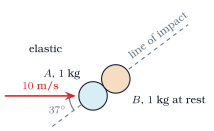
The balls are smooth and the collision is elastic. Take \(\cos 37^\circ = 0.8\).
Resolve \(A\)'s velocity along and perpendicular to the line of impact.
Find the velocity of each ball after the collision.
Find the angle between their final velocities.
Answer(i) \(8\) m/s; \(6\) m/s (ii) \(A\): \(6\) m/s perpendicular; \(B\): \(8\) m/s along (iii) \(90^\circ\)
Solution
Along the line: \(10\cos 37^\circ = 8\) m/s. Perpendicular: \(10\sin 37^\circ = 6\) m/s.
Along the line the collision is a 1D elastic collision of equal masses: they exchange the \(8\) m/s. \(B\) moves at \(8\) m/s along the line of impact. \(A\) keeps only its perpendicular \(6\) m/s.
\(A\) moves perpendicular to the line and \(B\) along it, so the angle between them is \(90^\circ\).
How did it go?
Q33
Two equal smooth spheres collide elastically, one of them at rest. Show that after the collision they move at right angles to each other.
Answer\(A\) keeps only the perpendicular part
Solution
Resolve the moving sphere's velocity into \(u\cos\theta\) along the line of impact and \(u\sin\theta\) perpendicular to it. Along the line, equal masses exchange velocities: the second sphere takes \(u\cos\theta\) and the first is left with zero. Perpendicular components do not change. So the first sphere moves perpendicular to the line and the second along it: at right angles.
How did it go?
Q34
Repeat Q8 with \(e = 0.5\). Find the velocity of each ball after the collision and the kinetic energy lost.
Along the line: \(v_A + v_B = 8\) and \(v_B - v_A = 0.5 \times 8 = 4\), so \(v_B = 6\) m/s, \(v_A = 2\) m/s. \(A\) has \(2\) m/s along and \(6\) m/s perpendicular, speed \(\sqrt{40} = 2\sqrt{10}\) m/s. Energy: before \(50\) J; after \(\dfrac{1}{2}(40) + \dfrac{1}{2}(36) = 38\) J. Lost: \(12\) J.
How did it go?
Q35
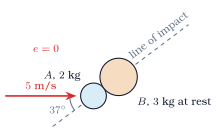
Here \(e = 0\) along the line of impact.
Find the velocity of \(B\) after the collision.
Find the speed of \(A\) after the collision.
Answer(i) \(1.6\) m/s along the line (ii) \(3.4\) m/s
Solution
Along the line \(A\) has \(5 \times 0.8 = 4\) m/s. With \(e = 0\) the two move together along the line: \(2 \times 4 = 5v\), \(v = 1.6\) m/s. \(B\) moves at \(1.6\) m/s along the line of impact.
\(A\) has \(1.6\) m/s along the line and its unchanged \(5 \times 0.6 = 3\) m/s perpendicular. Speed \(= \sqrt{2.56 + 9} = \sqrt{11.56} = 3.4\) m/s.
How did it go?
Q36
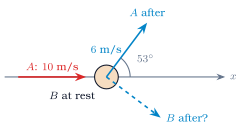
After the collision \(A\) moves at \(6\) m/s at \(53^\circ\) to the \(x\) axis. Take \(\cos 53^\circ = 0.6\).
Find the velocity of \(B\) after the collision.
Is the collision elastic? Check with the energies.
Answer(i) \(8\) m/s at \(37^\circ\) below \(x\) (ii) yes, \(50 = 18 + 32\)
Before: \(\dfrac{1}{2}(1)(100) = 50\) J. After: \(\dfrac{1}{2}(36) + \dfrac{1}{2}(64) = 18 + 32 = 50\) J. Elastic. The paths are at \(90^\circ\), as expected.
How did it go?
Q37
Two \(1\) kg balls moving at right angles, one at \(3\) m/s and the other at \(4\) m/s, collide and stick together. Find their common velocity and the kinetic energy lost.
Answer\(2.5\) m/s at \(53^\circ\) to the \(3\) m/s ball; \(6.25\) J
Solution
Momentum \((3, 4)\) kg m/s shared by \(2\) kg: \(v = (1.5, 2)\), speed \(2.5\) m/s at \(\tan^{-1}(2/1.5) = 53^\circ\) to the \(3\) m/s direction. Energy before \(\dfrac{1}{2}(9 + 16) = 12.5\) J, after \(\dfrac{1}{2}(2)(6.25) = 6.25\) J. Lost: \(6.25\) J.
How did it go?
Momentum in two dimensions
Q38
A \(2\) kg ball at \(3\) m/s along \(x\) collides with a \(1\) kg ball at \(6\) m/s along \(y\) and the two stick. Find the speed and direction of the combined ball.
Answer\(2\sqrt2\) m/s at \(45^\circ\) to \(x\)
Solution
Momentum \((6, 6)\) kg m/s shared by \(3\) kg: \(v = (2, 2)\) m/s, speed \(2\sqrt2 \approx 2.8\) m/s at \(45^\circ\) to \(x\).
How did it go?
Q39
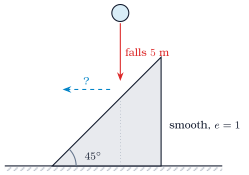
The ball falls \(5\) m from rest onto the smooth \(45^\circ\) incline. Take \(g = 10\) m/s\(^2\).
Find the speed just before impact.
Resolve this velocity along and normal to the incline.
Find the velocity just after the impact for \(e = 1\).
Answer(i) \(10\) m/s (ii) \(5\sqrt2\) m/s each (iii) \(10\) m/s horizontal, away from the incline
Along the incline: \(10\cos 45^\circ = 5\sqrt2\) m/s. Normal, into the surface: \(5\sqrt2\) m/s.
With \(e = 1\) the normal part reverses; the tangential part stays. Down-slope \(5\sqrt2\) plus outward-normal \(5\sqrt2\) add to \(10\) m/s horizontal, directed away from the incline.
How did it go?
Q40
A \(1\) kg ball at \(4\) m/s hits an identical ball at rest elastically. After the collision one ball moves at \(2.4\) m/s. Find the speed of the other and the angle between their paths.
Answer\(3.2\) m/s; \(90^\circ\)
Solution
Equal masses in an elastic collision with one at rest move at right angles, so \(u^2 = v_1^2 + v_2^2\): \(16 = 5.76 + v_2^2\), \(v_2 = 3.2\) m/s. The angle between the paths is \(90^\circ\).
How did it go?
Q41
A ball hits a smooth floor at angle \(\theta\) to the floor and rebounds at angle \(\theta'\). Show that \(\tan\theta' = e\tan\theta\).
In Q5 the ball keeps bouncing. Show that the total horizontal distance before it stops bouncing is \(\frac{R_1}{1 - e}\), and evaluate it.
Answer\(80\) m
Solution
Each bounce multiplies the vertical velocity by \(e\) and the range by \(e\): \(R_2 = eR_1\), \(R_3 = e^2R_1\), and so on. Total \(= R_1(1 + e + e^2 + \dots) = \dfrac{R_1}{1 - e}\). With \(R_1 = 40\) m and \(e = 0.5\): \(80\) m.
How did it go?
Q43
A ball strikes a smooth wall. Explain why the impulse from the wall is along the normal and why only the normal component of velocity changes.
Answersmooth: force only normal
Solution
A smooth wall cannot exert friction, so its force on the ball is purely normal. Impulse is force times time, hence along the normal too. Momentum along the wall is therefore unchanged, and only the normal component of the velocity changes.
How did it go?
Small situations
Q44
Two identical \(1\) kg balls, one at \(4\) m/s along \(x\) and the other at \(4\) m/s along \(y\), collide and stick. Find the velocity of the pair.
Answer\(2\sqrt2\) m/s at \(45^\circ\)
Solution
Momentum \((4, 4)\) kg m/s for \(2\) kg: \(v = (2, 2)\) m/s, that is \(2\sqrt2\) m/s at \(45^\circ\) to each original direction.
How did it go?
Q45
A \(1\) kg ball at \(5\) m/s hits an identical ball at rest. After the collision the first ball moves at \(3\) m/s at \(53^\circ\) to its original line. Find the velocity of the second ball. Take \(\cos 53^\circ = 0.6\).
Answer\(4\) m/s at \(37^\circ\) on the other side
Solution
First ball after: \((3 \times 0.6,\ 3 \times 0.8) = (1.8,\ 2.4)\) m/s. Second ball: \((5 - 1.8,\ -2.4) = (3.2,\ -2.4)\) m/s, speed \(4\) m/s at \(37^\circ\) on the other side of the line. Check: \(9 + 16 = 25\), elastic.
How did it go?
Q46
A cue ball at \(4\) m/s must send an equal object ball at \(60^\circ\) to the cue ball's line. The collision is elastic. Find the speed of each ball after the collision.
Answerobject \(2\) m/s; cue \(2\sqrt3 \approx 3.5\) m/s
Solution
The object ball leaves along the line of impact, so the line of impact is at \(60^\circ\) to the cue ball's velocity. Object ball: \(4\cos 60^\circ = 2\) m/s. Cue ball keeps the perpendicular part: \(4\sin 60^\circ = 2\sqrt3 \approx 3.5\) m/s, at \(90^\circ\) to the object ball.
How did it go?
Q47
A \(0.2\) kg ball at \(10\) m/s strikes a smooth floor at \(37^\circ\) to the floor and rebounds elastically. Find the impulse from the floor. Take \(\sin 37^\circ = 0.6\).
Answer\(2.4\) N s, normal to the floor
Solution
Normal component \(= 10\sin 37^\circ = 6\) m/s, reversed by the elastic bounce. \(J = 0.2 \times (6 + 6) = 2.4\) N s, normal to the floor.
How did it go?
Q48
A ball at speed \(u\) hits an equal ball at rest elastically. The line of impact makes angle \(\theta\) with \(u\). Show that the kinetic energies after the collision are in the ratio \(\sin^2\theta : \cos^2\theta\).
Along the line of impact the equal masses exchange velocities: \(B\) moves off at \(u\cos\theta\) and \(A\) keeps \(u\sin\theta\) perpendicular to the line. \(K_A = \dfrac{1}{2}mu^2\sin^2\theta\) and \(K_B = \dfrac{1}{2}mu^2\cos^2\theta\); their sum is the original energy.