Questions on Rigid Bodies and Moment of Inertia, the kind your examinations ask. Solve one on paper. Then tell the book how it went. The book believes you, and it uses your answer to plan your revision.
0%
Nothing marked yetMark honestly. Peek at the answer only after your own attempt.
Moment of Inertia and the Two Theorems
24 questions · after Lesson 6, The Perpendicular-Axis Theorem and Bodies with Holes
Point masses
Q1
Define the moment of inertia of a set of particles. Two \(2\) kg balls sit at the ends of a light rod of length \(1\) m. Find \(I\) about an axis through the centre and about an axis through one end, both perpendicular to the rod.
Answer\(I = \sum m_ir_i^2\); \(1\) kg m\(^2\); \(2\) kg m\(^2\)
Solution
\(I = \sum m_ir_i^2\), where \(r_i\) is the perpendicular distance of each particle from the axis. Centre: \(2(0.5)^2 + 2(0.5)^2 = 1\) kg m\(^2\). End: \(2(0)^2 + 2(1)^2 = 2\) kg m\(^2\).
How did it go?
Q2
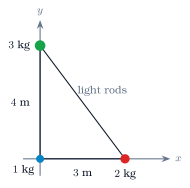
Three point masses are joined by light rods as shown. Distances are in metres.
Find \(I\) about the \(x\) axis.
Find \(I\) about the \(y\) axis.
Find \(I\) about the \(z\) axis through the origin. Check it with the perpendicular axis theorem.
Answer(i) \(48\) (ii) \(18\) (iii) \(66\) kg m\(^2\)
Solution
Only the \(3\) kg mass is off the \(x\) axis: \(I_x = 3 \times 4^2 = 48\) kg m\(^2\).
Only the \(2\) kg mass is off the \(y\) axis: \(I_y = 2 \times 3^2 = 18\) kg m\(^2\).
Four \(1\) kg masses sit at the corners of a square of side \(2\) m. Find \(I\) about (i) an axis through the centre perpendicular to the plane, (ii) one side, (iii) a diagonal.
Answer(i) \(8\) (ii) \(8\) (iii) \(4\) kg m\(^2\)
Solution
(i) Each mass is \(\sqrt2\) m from the centre: \(I = 4 \times 1 \times 2 = 8\) kg m\(^2\). (ii) Two masses on the side contribute nothing; the other two are \(2\) m away: \(I = 2 \times 4 = 8\) kg m\(^2\). (iii) Two masses lie on the diagonal; the other two are \(\sqrt2\) m from it: \(I = 2 \times 2 = 4\) kg m\(^2\).
How did it go?
Q4
Define the radius of gyration. A body of mass \(4\) kg has \(I = 8\) kg m\(^2\) about an axis. Find its radius of gyration about that axis.
Answer\(k = \sqrt{I/M}\); \(\sqrt2 \approx 1.4\) m
Solution
The radius of gyration \(k\) is the distance at which the whole mass, as a point, would give the same \(I\): \(I = Mk^2\). \(k = \sqrt{8/4} = \sqrt2 \approx 1.4\) m.
How did it go?
Q5
A \(2\) kg mass at \(3\) m from an axis and a \(6\) kg mass at \(1\) m from the same axis. Which has the larger moment of inertia? What does this say about the role of distance?
Answer\(2\) kg mass (\(18\) vs \(6\)); distance counts as \(r^2\)
Solution
\(2 \times 9 = 18\) kg m\(^2\) against \(6 \times 1 = 6\) kg m\(^2\). The lighter, farther mass wins because distance enters as \(r^2\). Moment of inertia is not just mass; it is mass weighted by the square of its distance from the axis.
How did it go?
Standard bodies
Q6
A ring has mass \(2\) kg and radius \(0.5\) m. Find \(I\) about its central axis and about a diameter.
Answer\(0.5\); \(0.25\) kg m\(^2\)
Solution
Central axis: \(I = MR^2 = 2 \times 0.25 = 0.5\) kg m\(^2\). Diameter: \(\dfrac{1}{2}MR^2 = 0.25\) kg m\(^2\).
How did it go?
Q7
A disc has mass \(4\) kg and radius \(0.5\) m. Find \(I\) about its central axis and about a diameter.
Answer\(0.5\); \(0.25\) kg m\(^2\)
Solution
Central axis: \(I = \dfrac{1}{2}MR^2 = \dfrac{1}{2} \times 4 \times 0.25 = 0.5\) kg m\(^2\). Diameter: \(\dfrac{1}{4}MR^2 = 0.25\) kg m\(^2\).
How did it go?
Q8
A uniform rod has mass \(3\) kg and length \(2\) m. Find \(I\) about a perpendicular axis through its centre and about a perpendicular axis through one end.
Answer\(1\); \(4\) kg m\(^2\)
Solution
Centre: \(\dfrac{ML^2}{12} = \dfrac{3 \times 4}{12} = 1\) kg m\(^2\). End: \(\dfrac{ML^2}{3} = 4\) kg m\(^2\).
How did it go?
Q9
A solid sphere and a hollow sphere each have mass \(5\) kg and radius \(0.3\) m. Find \(I\) of each about a diameter.
A solid cylinder and a thin hollow cylinder each have mass \(2\) kg and radius \(0.1\) m. Find \(I\) of each about the axis. Which one is harder to spin up?
Answer\(0.01\); \(0.02\) kg m\(^2\); hollow
Solution
Solid: \(\dfrac{1}{2}MR^2 = \dfrac{1}{2} \times 2 \times 0.01 = 0.01\) kg m\(^2\). Hollow: \(MR^2 = 0.02\) kg m\(^2\). The hollow cylinder has twice the moment of inertia and needs twice the torque for the same angular acceleration.
How did it go?
Q11
A ring and a disc have the same mass and radius. Find the ratio of their moments of inertia about the central axis. Explain the result in one sentence.
Answer\(2 : 1\); ring's mass is all at \(R\)
Solution
\(\dfrac{I_{\text{ring}}}{I_{\text{disc}}} = \dfrac{MR^2}{\frac{1}{2}MR^2} = 2\). All the ring's mass sits at the full radius \(R\), while much of the disc's mass lies closer to the axis.
How did it go?
Parallel axis theorem
Q12
State the parallel axis theorem. Use it to find \(I\) of the rod in Q8 about a perpendicular axis \(0.5\) m from its centre.
Answer\(I = I_{\text{cm}} + Md^2\); \(1.75\) kg m\(^2\)
Solution
\(I = I_{\text{cm}} + Md^2\), for any axis parallel to one through the centre of mass at distance \(d\). \(I = 1 + 3 \times 0.25 = 1.75\) kg m\(^2\).
How did it go?
Q13
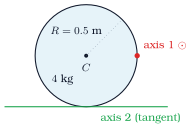
Use the disc shown.
Find \(I\) about axis 1, through a rim point and perpendicular to the plane.
Find \(I\) about axis 2, a tangent in the plane of the disc.
Two identical discs, each \(1\) kg and radius \(0.2\) m, are glued edge to edge in one plane. Find \(I\) about the axis through the centre of one disc, perpendicular to the plane.
Answer\(0.2\) kg m\(^2\)
Solution
First disc, about its own centre: \(\dfrac{1}{2}(1)(0.04) = 0.02\) kg m\(^2\). Second disc, centre \(0.4\) m away: \(0.02 + 1 \times 0.16 = 0.18\) kg m\(^2\). Total: \(0.2\) kg m\(^2\).
How did it go?
Q16
Using the parallel axis theorem, show that among all parallel axes, the one through the centre of mass gives the least moment of inertia.
Answer\(Md^2 \ge 0\)
Solution
For any axis parallel to the one through the centre of mass, \(I = I_{\text{cm}} + Md^2\). Since \(Md^2 \ge 0\), \(I \ge I_{\text{cm}}\), with equality only when \(d = 0\). So the axis through the centre of mass has the least \(I\) in its family of parallel axes.
How did it go?
Perpendicular axis theorem and composite bodies
Q17
State the perpendicular axis theorem. To which bodies does it apply? A square plate of mass \(2\) kg and side \(1\) m has \(I = \frac{Ma^2}{12}\) about a central axis parallel to a side. Find \(I\) about the central axis perpendicular to the plate.
Answer\(I_z = I_x + I_y\); plane laminas; \(\frac{1}{3}\) kg m\(^2\)
Solution
For a plane lamina, \(I_z = I_x + I_y\), where \(x\) and \(y\) lie in the plane and \(z\) is perpendicular to it through the same point. It applies only to flat bodies. For the square, \(I_x = I_y = \dfrac{Ma^2}{12} = \dfrac{2}{12} = \dfrac{1}{6}\), so \(I_z = \dfrac{1}{3}\) kg m\(^2\).
How did it go?
Q18
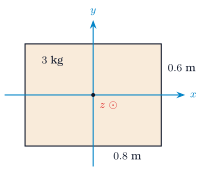
For the plate shown, use \(I = \frac{Mb^2}{12}\) for an axis in the plane, where \(b\) is the side perpendicular to that axis.
Find \(I_x\) and \(I_y\).
Find \(I_z\).
Answer(i) \(0.09\); \(0.16\) (ii) \(0.25\) kg m\(^2\)
\(I_z = I_x + I_y = 0.25\) kg m\(^2\), which is \(\dfrac{M(a^2 + b^2)}{12}\).
How did it go?
Q19
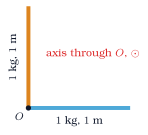
Two rods are joined at right angles at \(O\).
Find \(I\) about the axis through \(O\) perpendicular to the plane.
Find \(I\) about an axis along one of the rods.
Answer(i) \(\frac{2}{3}\) (ii) \(\frac{1}{3}\) kg m\(^2\)
Solution
Each rod turns about its end: \(\dfrac{ML^2}{3} = \dfrac{1}{3}\) each. Total \(\dfrac{2}{3}\) kg m\(^2\).
The rod on the axis contributes nothing (all its mass is on the axis). The other rod is perpendicular to the axis through its end: \(\dfrac{1}{3}\) kg m\(^2\).
How did it go?
Q20
A \(2\) kg rod of length \(1\) m carries a \(1\) kg ball at one end. Find \(I\) about a perpendicular axis through the other end.
Answer\(\frac{5}{3}\) kg m\(^2\)
Solution
Rod about its end: \(\dfrac{2 \times 1}{3} = \dfrac{2}{3}\). Ball at \(1\) m: \(1 \times 1 = 1\). Total \(\dfrac{5}{3}\) kg m\(^2\).
How did it go?
Q21
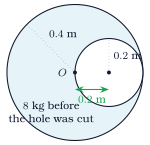
A hole is cut from the \(8\) kg disc as shown.
Find the mass removed.
Find \(I\) of the removed part about the axis through \(O\) perpendicular to the plane.
Find \(I\) of the remaining plate about that axis.
Answer(i) \(2\) kg (ii) \(0.12\) (iii) \(0.52\) kg m\(^2\)
Solution
Mass is proportional to area: \(8 \times \dfrac{0.2^2}{0.4^2} = 2\) kg.
About its own centre: \(\dfrac{1}{2}(2)(0.04) = 0.04\). Shift to \(O\), \(0.2\) m away: \(0.04 + 2 \times 0.04 = 0.12\) kg m\(^2\).
A solid sphere of mass \(2\) kg and radius \(0.1\) m is cut into two equal halves through a diameter. Find \(I\) of one half about that diameter.
Answer\(0.004\) kg m\(^2\)
Solution
Whole sphere: \(\dfrac{2}{5}(2)(0.01) = 0.008\) kg m\(^2\). The cut is symmetric, so each half has half of it: \(0.004\) kg m\(^2\).
How did it go?
Q23
A wire of mass \(M\) and length \(L\) is bent into a ring. Find \(I\) about the ring's central axis. Compare it with \(I\) of the straight wire about a perpendicular axis through its centre.
Answer\(\frac{ML^2}{4\pi^2}\); less than \(\frac{ML^2}{12}\)
Solution
\(2\pi R = L\), so \(R = \dfrac{L}{2\pi}\) and \(I = MR^2 = \dfrac{ML^2}{4\pi^2} \approx 0.025ML^2\). The straight rod has \(\dfrac{ML^2}{12} \approx 0.083ML^2\), more than three times as much, because its ends lie far from the axis.
How did it go?
Q24
Using the perpendicular axis theorem, show that \(I\) of a ring about a diameter is \(\frac{1}{2}MR^2\).
Answer\(2I_d = MR^2\)
Solution
Take the ring in the \(xy\) plane with \(z\) along its axis. By symmetry \(I_x = I_y = I_d\). The perpendicular axis theorem gives \(I_x + I_y = I_z = MR^2\), so \(2I_d = MR^2\) and \(I_d = \dfrac{1}{2}MR^2\).