Questions on Torque and Equilibrium, the kind your examinations ask. Solve one on paper. Then tell the book how it went. The book believes you, and it uses your answer to plan your revision.
0%
Nothing marked yetMark honestly. Peek at the answer only after your own attempt.
Torque and Toppling
24 questions · after Lesson 5, Toppling
Torque
Q1
Define torque as a cross product and give its magnitude. A \(10\) N force acts \(0.5\) m from a pivot. Find the torque when the force is perpendicular to the arm, and when it is at \(30^\circ\) to the arm.
Answer\(\vec\tau = \vec r \times \vec F\), \(\tau = rF\sin\theta\); \(5\) N m; \(2.5\) N m
Solution
\(\vec\tau = \vec r \times \vec F\), with magnitude \(rF\sin\theta\), where \(\theta\) is the angle between \(\vec r\) and \(\vec F\). Perpendicular: \(0.5 \times 10 = 5\) N m. At \(30^\circ\): \(0.5 \times 10 \times 0.5 = 2.5\) N m.
How did it go?
Q2
A force \(\vec F = 3\hat i + 4\hat j\) N acts at the point \(\vec r = 2\hat i\) m. Find the torque about the origin.
Answer\(8\hat k\) N m
Solution
\(\vec\tau = \vec r \times \vec F = (2\hat i) \times (3\hat i + 4\hat j) = 8\,\hat i \times \hat j = 8\hat k\) N m.
How did it go?
Q3
A force \(\vec F = 3\hat i + \hat j\) N acts at \(\vec r = \hat i + 2\hat j\) m. Find the torque about the origin and state its sense.
Answer\(-5\hat k\) N m; clockwise
Solution
\(\tau_z = xF_y - yF_x = 1 \times 1 - 2 \times 3 = -5\). \(\vec\tau = -5\hat k\) N m: clockwise when viewed from the \(+z\) side.
How did it go?
Q4
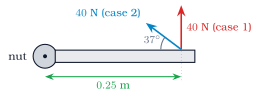
A \(40\) N force is applied to the spanner at \(0.25\) m from the nut. Take \(\sin 37^\circ = 0.6\).
Find the torque in case 1.
Find the torque in case 2.
Answer(i) \(10\) N m (ii) \(6\) N m
Solution
\(\tau = 0.25 \times 40 = 10\) N m.
Only the component perpendicular to the handle counts: \(\tau = 0.25 \times 40\sin 37^\circ = 0.25 \times 24 = 6\) N m.
How did it go?
Q5
A door is \(0.8\) m wide. A \(20\) N push acts on it. Find the torque about the hinges in each case. (i) Perpendicular to the door at the far edge. (ii) Perpendicular at the middle. (iii) Along the plane of the door at the far edge.
Answer(i) \(16\) (ii) \(8\) (iii) \(0\) N m
Solution
(i) \(0.8 \times 20 = 16\) N m. (ii) \(0.4 \times 20 = 8\) N m. (iii) The line of action passes through the hinge line, so the torque is \(0\).
How did it go?
Q6
Why does pushing a door close to its hinges hardly open it, even with a large force?
Answersmall lever arm, small torque
Solution
Torque is force times lever arm. Near the hinges the lever arm is tiny, so even a large push gives little torque about the hinge line.
How did it go?
Equilibrium and the shifting normal
Q7
A \(30\) kg child sits \(2\) m from the pivot of a seesaw. Where must a \(40\) kg child sit on the other side to balance it?
Answer\(1.5\) m
Solution
Balance the torques about the pivot: \(30g \times 2 = 40g \times x\), so \(x = 1.5\) m.
How did it go?
Q8
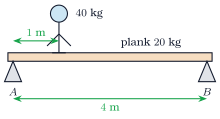
A \(40\) kg person stands on the uniform \(20\) kg plank. Take \(g = 10\) m/s\(^2\).
Take torques about \(A\) and find the force from support \(B\).
Find the force from support \(A\).
Answer(i) \(200\) N (ii) \(400\) N
Solution
About \(A\): \(N_B \times 4 = 200 \times 2 + 400 \times 1 = 800\), so \(N_B = 200\) N.
Vertical balance: \(N_A + N_B = 600\), so \(N_A = 400\) N. The support nearer the person carries more.
How did it go?
Q9
A uniform \(2\) kg rod of length \(1\) m is hinged at one end and held horizontal by a vertical string at the other end. Find the tension and the vertical force from the hinge.
Answer\(10\) N; \(10\) N up
Solution
About the hinge: \(T \times 1 = 20 \times 0.5\), so \(T = 10\) N. Vertical balance: hinge force \(= 20 - 10 = 10\) N upward.
How did it go?
Q10
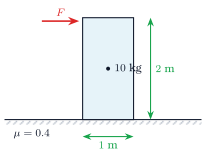
A block of width \(1\) m and height \(2\) m stands on a rough floor. When no horizontal force acts, where does the normal force act? When a horizontal force is applied at the top, why must the normal force shift?
Answerat the centre; to balance the torque of \(F\) and friction
Solution
With no horizontal force the normal acts through the centre of the base, directly under the centre of mass. When \(F\) acts at the top, friction at the base and \(F\) form a couple that would tip the block. The normal force shifts towards the far edge so that its torque with the weight balances that couple.
How did it go?
Q11
The block does not slide. Take \(g = 10\) m/s\(^2\).
For \(F = 20\) N, how far from the centre line does the normal force act?
Find the value of \(F\) at which the block begins to topple.
Does the block slide or topple first as \(F\) increases?
Answer(i) \(0.2\) m (ii) \(25\) N (iii) topples
Solution
Torques about the centre of mass: friction \(f = F = 20\) N acts \(1\) m below it, the normal \(N = 100\) N acts \(x\) to one side. \(100x = 20 \times 1\), so \(x = 0.2\) m.
Toppling begins when \(N\) reaches the edge, \(x = 0.5\) m: \(100 \times 0.5 = F \times 1\), so \(F = 25\) N. Equivalently, take torques about the bottom edge: \(F \times 2 = 100 \times 0.5\).
Sliding needs \(F > \mu N = 40\) N. Toppling needs only \(25\) N, so it topples first.
How did it go?
Q12
For the block of Q11, what condition on \(\mu\) makes it slide before it topples? Check it with \(\mu = 0.2\).
Answer\(\mu < 0.25\); slides at \(20\) N
Solution
Sliding comes first if \(\mu mg < \dfrac{mga}{2h}\), that is \(\mu < \dfrac{a}{2h} = \dfrac{1}{4} = 0.25\). With \(\mu = 0.2\): friction limit \(20\) N, less than the \(25\) N needed to topple, so it slides at \(20\) N.
How did it go?
Toppling on an incline
Q13
A block of width \(1\) m and height \(2\) m rests on an incline whose angle \(\theta\) is slowly raised. The friction is enough to prevent sliding. Find \(\tan\theta\) at which it topples.
Answer\(0.5\)
Solution
The block topples when the vertical through its centre of mass passes beyond the lower edge of the base. That happens when \(\tan\theta = \dfrac{a/2}{h/2} = \dfrac{a}{h} = \dfrac{1}{2}\).
How did it go?
Q14
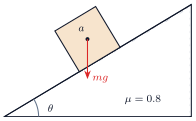
The angle of the incline is slowly increased.
Find \(\tan\theta\) at which the cube would topple.
Find \(\tan\theta\) at which the cube would slide.
Which happens first?
Answer(i) \(1\) (ii) \(0.8\) (iii) slides
Solution
For a cube \(a = h\), so it topples at \(\tan\theta = \dfrac{a}{h} = 1\), that is \(45^\circ\).
It slides when \(mg\sin\theta > \mu mg\cos\theta\), that is \(\tan\theta > 0.8\).
\(0.8 < 1\), so the cube slides before the tilt reaches the toppling value.
How did it go?
Q15
A solid cylinder of radius \(0.2\) m and height \(1\) m stands on its flat end on a very rough incline. Find \(\tan\theta\) at which it topples.
Answer\(0.4\)
Solution
Base width \(2R = 0.4\) m, height \(1\) m. \(\tan\theta = \dfrac{2R}{h} = 0.4\).
How did it go?
Q16
Why does a tall, narrow block topple at a smaller tilt than a short, wide one?
Answerweight's line leaves the base at a smaller tilt
Solution
Toppling begins when the vertical line through the centre of mass moves outside the base. For a tall, narrow block the centre of mass is high and the base is small. A small tilt is then enough to carry that line past the edge.
How did it go?
Q17
A \(20\) kg cupboard is \(0.6\) m deep and \(2\) m tall. A horizontal rope pulls it at a height of \(1.5\) m. Take \(g = 10\) m/s\(^2\).
Find the pull at which it starts to topple.
Find the least \(\mu\) for which it does not slide first.
Answer(i) \(40\) N (ii) \(0.2\)
Solution
Torques about the front bottom edge: \(F \times 1.5 = 200 \times 0.3\), so \(F = 40\) N.
It must not slide at \(40\) N: \(\mu \times 200 \ge 40\), so \(\mu \ge 0.2\).
How did it go?
Couples and small situations
Q18
Two \(5\) N forces, equal and opposite, act along parallel lines \(0.4\) m apart. Find the torque of this couple. Does it depend on the point about which torque is taken?
Answer\(2\) N m; no
Solution
Torque of a couple \(= F \times d = 5 \times 0.4 = 2\) N m. A couple has zero net force, so its torque is the same about every point.
How did it go?
Q19
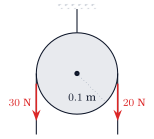
The two sides of the string pull on the pulley as shown.
Find the torque of each tension about the centre.
Find the net torque and the sense in which the pulley turns.
Answer(i) \(3\) N m; \(2\) N m (ii) \(1\) N m; anticlockwise
Solution
Each tension acts tangentially at the rim: \(30 \times 0.1 = 3\) N m and \(20 \times 0.1 = 2\) N m, in opposite senses.
Net torque \(= 3 - 2 = 1\) N m. The \(30\) N side wins: the left side moves down, so the pulley turns anticlockwise as drawn.
How did it go?
Q20
A wheel has radius \(0.5\) m. A \(20\) N force is applied (i) tangentially at the rim, (ii) tangentially at half the radius, (iii) radially at the rim. Find the torque about the axle in each case.
Answer(i) \(10\) (ii) \(5\) (iii) \(0\) N m
Solution
(i) \(20 \times 0.5 = 10\) N m. (ii) \(20 \times 0.25 = 5\) N m. (iii) A radial force passes through the axle: \(0\).
How did it go?
Q21
A string is wound round a disc of radius \(0.5\) m lying on a table. The string is pulled with \(10\) N along the table. Find the torque about the centre of the disc.
Answer\(5\) N m
Solution
The string leaves the rim tangentially, so its lever arm is the radius: \(\tau = 10 \times 0.5 = 5\) N m.
How did it go?
Q22
A \(40\) kg box is \(1\) m wide and \(1.5\) m tall. A horizontal force at a height of \(1\) m pushes it on a floor with \(\mu = 0.6\). Take \(g = 10\) m/s\(^2\). Find the force at which it topples and whether it slides first.
Answer\(200\) N; topples first
Solution
Toppling about the far bottom edge: \(F \times 1 = 400 \times 0.5\), so \(F = 200\) N. Sliding needs \(F > 0.6 \times 400 = 240\) N. \(200 < 240\), so the box topples first.
How did it go?
Q23
A uniform \(2\) kg rod of length \(1\) m is pivoted at one end and held at \(37^\circ\) to the vertical. Find the torque of its weight about the pivot. Take \(g = 10\) m/s\(^2\) and \(\sin 37^\circ = 0.6\).
Answer\(6\) N m
Solution
The weight acts at the centre, \(0.5\) m from the pivot, and its lever arm is \(0.5\sin 37^\circ = 0.3\) m. \(\tau = 20 \times 0.3 = 6\) N m.
How did it go?
Q24
A block of base \(a\) and height \(h\) is pushed horizontally at its top on a floor with friction coefficient \(\mu\). Show that it topples before it slides if \(\mu > \frac{a}{2h}\).
Toppling about the far bottom edge: \(Fh = mg\dfrac{a}{2}\), so \(F_{\text{topple}} = \dfrac{mga}{2h}\). Sliding: \(F_{\text{slide}} = \mu mg\). It topples first when \(F_{\text{topple}} < F_{\text{slide}}\): \(\dfrac{mga}{2h} < \mu mg\), that is \(\mu > \dfrac{a}{2h}\).
How did it go?
Static Equilibrium of Rigid Bodies
24 questions · after Lesson 6, Ladders and Hinges
Conditions for equilibrium
Q25
State the two conditions for a rigid body to be in equilibrium. Can a body with zero net force still fail to be in equilibrium? Give an example.
Answer\(\sum\vec F = 0\), \(\sum\vec\tau = 0\); yes, a couple
Solution
The net force must be zero (no linear acceleration) and the net torque about any point must be zero (no angular acceleration). Yes: two equal and opposite forces along different lines form a couple. The net force is zero but the torque is not, so the body starts to spin.
How did it go?
Q26
Two \(10\) N forces act on a plate along parallel lines \(0.3\) m apart, in opposite directions. Is the plate in equilibrium? What would be needed to make it so?
Answerno, torque \(3\) N m; an opposite couple of \(3\) N m
Solution
The forces cancel, but they form a couple of torque \(10 \times 0.3 = 3\) N m, so the plate is not in equilibrium. A second couple of \(3\) N m in the opposite sense is needed. A single extra force cannot do it, because it would spoil the force balance.
How did it go?
Q27
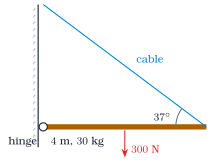
The beam is uniform. Take \(g = 10\) m/s\(^2\) and \(\sin 37^\circ = 0.6\).
Take torques about the hinge and find the cable tension.
Find the horizontal and vertical components of the hinge force.
Answer(i) \(250\) N (ii) \(200\) N towards the wall; \(150\) N up
Solution
About the hinge, the cable's lever arm is \(4\sin 37^\circ = 2.4\) m: \(T \times 2.4 = 300 \times 2\), so \(T = 250\) N.
Horizontal: \(H = T\cos 37^\circ = 200\) N, pushing the beam towards the wall. Vertical: \(V + T\sin 37^\circ = 300\), so \(V = 300 - 150 = 150\) N upward.
How did it go?
Q28
Why is it convenient to take torques about the hinge in Q3? What would change if torques were taken about the far end of the beam?
Answerhinge force has no torque there; hinge forces would enter
Solution
The unknown hinge force acts at the hinge and so has no torque about it. The torque equation then contains only \(T\) and the weight and gives \(T\) directly. About the far end, both hinge components would enter the torque equation and three equations would be needed together.
How did it go?
Q29
A uniform \(2\) m, \(10\) kg bar rests on a pivot \(0.5\) m from its left end. What mass hung from the left end keeps it horizontal?
Answer\(10\) kg
Solution
The bar's weight acts at its centre, \(1\) m from the left end and so \(0.5\) m from the pivot. \(mg \times 0.5 = 100 \times 0.5\), so \(m = 10\) kg.
How did it go?
Ladders
Q30
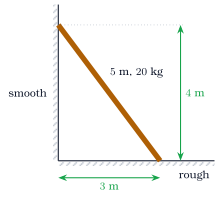
The wall is smooth and the floor is rough. Take \(g = 10\) m/s\(^2\).
Find the normal force from the floor.
Take torques about the base and find the force from the wall.
Find the friction at the base and the least \(\mu\) for the ladder to stay.
Answer(i) \(200\) N (ii) \(75\) N (iii) \(75\) N; \(0.375\)
Solution
Vertical forces: only the floor supports the ladder, so \(N = 200\) N.
About the base: the wall force \(N_w\) acts at height \(4\) m, the weight at horizontal distance \(1.5\) m. \(N_w \times 4 = 200 \times 1.5\), so \(N_w = 75\) N.
Horizontal balance: \(f = N_w = 75\) N. Need \(f \le \mu N\): \(\mu \ge \dfrac{75}{200} = 0.375\).
How did it go?
Q31
A \(40\) kg person stands at the top of the ladder of Q6. Find the force from the wall and the least \(\mu\) now.
Answer\(375\) N; \(0.625\)
Solution
The person's weight \(400\) N acts at horizontal distance \(3\) m from the base. \(N_w \times 4 = 200 \times 1.5 + 400 \times 3 = 1500\), so \(N_w = 375\) N. \(N = 600\) N, so \(\mu \ge \dfrac{375}{600} = 0.625\).
How did it go?
Q32
Why does the force from the wall grow as a person climbs the ladder, although the person's weight does not change?
Answerlever arm of the weight about the base grows
Solution
The wall force balances the torque of the weights about the base. As the person climbs, the horizontal distance of the person's weight from the base grows. Its torque grows, and a larger wall force is needed to balance it. The friction needed at the floor grows with it.
How did it go?
Q33
The floor under the ladder of Q6 has \(\mu = 0.6\). How far along the ladder can a \(60\) kg person climb before it slips?
Answer\(4.5\) m
Solution
\(N = 800\) N, so the largest friction and hence wall force is \(0.6 \times 800 = 480\) N. Let the person be at horizontal distance \(x\): \(480 \times 4 = 200 \times 1.5 + 600x\), so \(x = 2.7\) m. Along the ladder: \(\dfrac{2.7}{0.6} = 4.5\) m.
How did it go?
Q34
If the wall in Q6 were rough as well, in which direction would the wall's friction act on the ladder? Why?
Answerupward; opposes the top sliding down
Solution
If the ladder slips, its top slides down the wall. Friction at the wall opposes that motion, so it acts upward on the ladder, helping to support the weight.
How did it go?
Q35
A ladder of weight \(W\) leans on a smooth wall at angle \(\theta\) to the floor. Show that it stays only if \(\mu \ge \frac{1}{2\tan\theta}\). Check the result with Q6.
Floor: \(N = W\), \(f = N_w\). Torques about the base: \(N_wL\sin\theta = W\dfrac{L}{2}\cos\theta\), so \(N_w = \dfrac{W}{2\tan\theta}\). Friction: \(\dfrac{W}{2\tan\theta} \le \mu W\), so \(\mu \ge \dfrac{1}{2\tan\theta}\). In Q6, \(\tan\theta = \dfrac{4}{3}\): \(\mu \ge \dfrac{3}{8} = 0.375\).
How did it go?
Q36
For a floor with \(\mu = 0.25\), find the smallest \(\tan\theta\) at which the ladder of Q11 can lean on a smooth wall without slipping.
Answer\(2\)
Solution
\(\mu \ge \dfrac{1}{2\tan\theta}\) gives \(\tan\theta \ge \dfrac{1}{2\mu} = 2\). The ladder must be steeper than about \(63^\circ\).
How did it go?
Hinged rods, doors and wheels
Q37
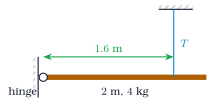
The uniform rod is held horizontal by the vertical string. Take \(g = 10\) m/s\(^2\).
Find the tension \(T\).
Find the vertical force from the hinge.
Answer(i) \(25\) N (ii) \(15\) N up
Solution
About the hinge: \(T \times 1.6 = 40 \times 1\), so \(T = 25\) N.
\(V + 25 = 40\), so \(V = 15\) N upward.
How did it go?
Q38
A uniform \(1\) m, \(5\) kg horizontal bar is hinged to a wall. A wire from its far end runs to the wall at \(45^\circ\). Take \(g = 10\) m/s\(^2\). Find the tension and the magnitude of the hinge force.
Answer\(25\sqrt2 \approx 35\) N; \(25\sqrt2 \approx 35\) N
Solution
About the hinge: \(T\sin 45^\circ \times 1 = 50 \times 0.5\), so \(T = \dfrac{25}{\sin 45^\circ} = 25\sqrt2 \approx 35\) N. Hinge: \(H = T\cos 45^\circ = 25\) N and \(V = 50 - 25 = 25\) N, magnitude \(25\sqrt2 \approx 35\) N at \(45^\circ\).
How did it go?
Q39
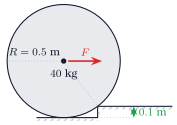
A horizontal force \(F\) at the axle just lifts the wheel over the step. Take \(g = 10\) m/s\(^2\).
Find the horizontal distance from the axle to the edge of the step.
Take torques about the edge and find \(F\).
Answer(i) \(0.3\) m (ii) \(300\) N
Solution
The axle is \(R - h = 0.4\) m above the edge. Horizontal distance \(= \sqrt{R^2 - (R - h)^2} = \sqrt{0.25 - 0.16} = 0.3\) m.
When the wheel just lifts, the ground no longer pushes. About the edge: \(F \times 0.4 = 400 \times 0.3\), so \(F = 300\) N.
How did it go?
Q40
Two people carry a uniform \(4\) m, \(60\) kg plank horizontally. One holds an end; the other holds it \(1\) m from the other end. Take \(g = 10\) m/s\(^2\). Find the force each exerts.
Answer\(200\) N (end); \(400\) N
Solution
Take torques about the end held by the first person: the second person is \(3\) m away and the weight \(2\) m away. \(F_2 \times 3 = 600 \times 2\), so \(F_2 = 400\) N and \(F_1 = 600 - 400 = 200\) N.
How did it go?
Q41
A \(4\) kg door, \(1.2\) m wide, hangs on two hinges \(1.5\) m apart, each carrying half the weight. Take \(g = 10\) m/s\(^2\). Find the vertical and horizontal force at each hinge.
Answer\(20\) N each; \(16\) N each, opposite
Solution
Vertical: \(20\) N at each hinge. The weight \(40\) N acts \(0.6\) m from the hinge line and tends to swing the door about the lower hinge. Torques about the lower hinge: \(H \times 1.5 = 40 \times 0.6\), so \(H = 16\) N. The upper hinge pulls the door towards the wall and the lower one pushes it away, each with \(16\) N.
How did it go?
Q42
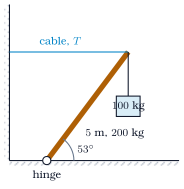
The uniform boom holds the load. Take \(g = 10\) m/s\(^2\), \(\cos 53^\circ = 0.6\).
Take torques about the hinge and find the cable tension \(T\).
Find the horizontal and vertical hinge forces.
Answer(i) \(1500\) N (ii) \(1500\) N away from the wall; \(3000\) N up
Solution
Tip: \(5\cos 53^\circ = 3\) m out, \(5\sin 53^\circ = 4\) m up; centre: \(1.5\) m out. \(T \times 4 = 2000 \times 1.5 + 1000 \times 3 = 6000\), so \(T = 1500\) N.
Horizontal: \(H = T = 1500\) N, directed away from the wall. Vertical: \(V = 2000 + 1000 = 3000\) N upward.
How did it go?
Q43
A rigid body is in equilibrium under three non-parallel forces. Show that their lines of action must pass through one point.
Answerelse the third has a torque about the meeting point of the other two
Solution
Two of the forces are not parallel, so their lines meet at some point \(P\). Both have zero torque about \(P\). For the net torque about \(P\) to vanish, the third force must also have zero torque about \(P\). So its line of action passes through \(P\) too.
How did it go?
Small situations
Q44
A uniform \(3\) m, \(30\) kg plank is supported at its ends \(A\) and \(B\). A \(60\) kg person stands \(1\) m from \(A\). Take \(g = 10\) m/s\(^2\). Find the force at each support.
Answer\(A\): \(550\) N; \(B\): \(350\) N
Solution
About \(A\): \(N_B \times 3 = 300 \times 1.5 + 600 \times 1 = 1050\), so \(N_B = 350\) N. \(N_A = 900 - 350 = 550\) N.
How did it go?
Q45
A wheelbarrow carries a \(60\) kg load whose weight acts \(0.5\) m behind the wheel axle. The handles are \(1.5\) m from the axle. Take \(g = 10\) m/s\(^2\). Find the lifting force at the handles.
Answer\(200\) N
Solution
Torques about the axle: \(F \times 1.5 = 600 \times 0.5\), so \(F = 200\) N. The wheel carries the remaining \(400\) N.
How did it go?
Q46
A \(1.5\) m crowbar rests on a fulcrum \(0.1\) m from the end under a rock. A \(100\) N push at the far end just lifts the rock. Find the force on the rock.
Answer\(1400\) N
Solution
Torques about the fulcrum: \(F_{\text{rock}} \times 0.1 = 100 \times 1.4\), so \(F_{\text{rock}} = 1400\) N. The bar multiplies the push \(14\) times.
How did it go?
Q47
A uniform \(3\) m, \(10\) kg beam rests on a pivot \(1\) m from its left end. Find the mass to hang at the left end so that it balances.
Answer\(5\) kg
Solution
The weight acts at \(1.5\) m from the left end, \(0.5\) m from the pivot. \(m \times 10 \times 1 = 100 \times 0.5\), so \(m = 5\) kg.
How did it go?
Q48
A ladder of length \(L\) and weight \(W\) leans on a smooth wall at angle \(\theta\). A person of weight \(W_p\) stands a distance \(d\) up the ladder. Show that \(\mu \ge \frac{W/2 + W_pd/L}{(W + W_p)\tan\theta}\).
Answertorques about the base: \(N_wL\sin\theta = W\frac{L}{2}\cos\theta + W_pd\cos\theta\)
Solution
Floor: \(N = W + W_p\) and \(f = N_w\). Torques about the base: \(N_wL\sin\theta = W\dfrac{L}{2}\cos\theta + W_pd\cos\theta\), so \(N_w = \dfrac{W/2 + W_pd/L}{\tan\theta}\). Friction \(f = N_w \le \mu N\) gives \(\mu \ge \dfrac{W/2 + W_pd/L}{(W + W_p)\tan\theta}\).