Questions on Dynamics of Rotation, the kind your examinations ask. Solve one on paper. Then tell the book how it went. The book believes you, and it uses your answer to plan your revision.
0%
Nothing marked yetMark honestly. Peek at the answer only after your own attempt.
Rotational Dynamics, Hinge Forces, Work and Power
24 questions · after Lesson 5, Energy Conservation with Rotation
Torque and angular acceleration
Q1
A wheel of \(I = 2\) kg m\(^2\) is acted on by a steady torque of \(4\) N m from rest. Find its angular acceleration and its angular velocity after \(5\) s.
A string wound round a disc of mass \(4\) kg and radius \(0.5\) m is pulled with \(10\) N. The disc turns freely about its axle. Find the angular acceleration and the angle turned in \(2\) s.
Answer\(10\) rad/s\(^2\); \(20\) rad
Solution
\(I = \dfrac{1}{2}(4)(0.25) = 0.5\) kg m\(^2\). \(\tau = 10 \times 0.5 = 5\) N m, so \(\alpha = 10\) rad/s\(^2\). \(\theta = \dfrac{1}{2}\alpha t^2 = \dfrac{1}{2}(10)(4) = 20\) rad, about \(3.2\) revolutions.
How did it go?
Q3
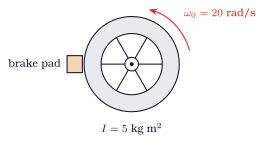
The brake pad stops the flywheel in \(10\) s.
Find the angular deceleration.
Find the friction torque.
How many revolutions does the wheel make while stopping?
Answer(i) \(2\) rad/s\(^2\) (ii) \(10\) N m (iii) \(100\) rad \(\approx 16\) rev
Solution
\(\alpha = \dfrac{0 - 20}{10} = -2\) rad/s\(^2\).
\(\tau = I\alpha = 5 \times 2 = 10\) N m, opposing the spin.
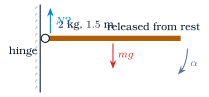
A uniform rod of length \(1.5\) m is hinged at one end and released from rest in the horizontal position. Take \(g = 10\) m/s\(^2\). Find the angular acceleration just after release and the linear acceleration of the free end.
Answer\(10\) rad/s\(^2\); \(15\) m/s\(^2\)
Solution
Torque of the weight about the hinge: \(mg\dfrac{L}{2}\). \(I = \dfrac{mL^2}{3}\). \(\alpha = \dfrac{mgL/2}{mL^2/3} = \dfrac{3g}{2L} = \dfrac{30}{3} = 10\) rad/s\(^2\). Free end: \(a = \alpha L = 15\) m/s\(^2\).
How did it go?
Q5
In Q4 the free end starts with an acceleration greater than \(g\). How is this possible for a body acted on only by gravity and the hinge?
Answerhinge pulls the near end up, so the far end goes down faster
Solution
The rod is not in free fall: the hinge pushes up on the near end. That upward push keeps the centre of mass slower than \(g\), and the rotation it causes drives the far end faster than \(g\). Only the centre of mass is limited to \(g\) when the net force is the weight alone.
How did it go?
Q6
The rod of Q4 is instead released from rest at \(60^\circ\) below the horizontal. Find the angular acceleration just after release.
Answer\(5\) rad/s\(^2\)
Solution
The lever arm of the weight is \(\dfrac{L}{2}\cos 60^\circ\): \(\alpha = \dfrac{3g\cos 60^\circ}{2L} = 10 \times 0.5 = 5\) rad/s\(^2\).
How did it go?
Pulleys with mass
Q7
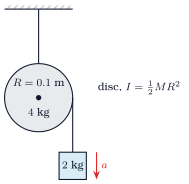
The string does not slip on the disc. Take \(g = 10\) m/s\(^2\).
Write Newton's law for the block and the torque equation for the disc.
Find the acceleration of the block and the tension.
Find the angular acceleration of the disc.
Answer(i) \(mg - T = ma\); \(TR = \frac{1}{2}MR^2\alpha\) (ii) \(5\) m/s\(^2\); \(10\) N (iii) \(50\) rad/s\(^2\)
Solution
Block: \(mg - T = ma\). Disc: \(TR = I\alpha = \dfrac{1}{2}MR^2\alpha\) with \(a = \alpha R\), so \(T = \dfrac{1}{2}Ma\).
\(mg = ma + \dfrac{1}{2}Ma\), so \(a = \dfrac{mg}{m + M/2} = \dfrac{20}{2 + 2} = 5\) m/s\(^2\). \(T = m(g - a) = 2 \times 5 = 10\) N.
Masses of \(3\) kg and \(1\) kg hang from a string over a disc pulley of mass \(2\) kg and radius \(0.1\) m. Take \(g = 10\) m/s\(^2\). Find the acceleration, the two tensions and the angular acceleration of the pulley.
Why are the tensions on the two sides of the pulley in Q8 different, when they were equal for a light pulley?
Answernet torque needed to spin the pulley
Solution
A pulley with mass has moment of inertia, so it needs a net torque to gain angular velocity. That torque comes from the difference \(T_1 - T_2\) times the radius. A light pulley needs no torque, so the tensions are equal.
How did it go?
Q10
A solid cylinder of mass \(3\) kg has a string wound round it. The string's upper end is held fixed and the cylinder falls, unwinding the string. Take \(g = 10\) m/s\(^2\). Find its acceleration and the tension.
Answer\(\frac{20}{3} \approx 6.7\) m/s\(^2\); \(10\) N
Solution
\(mg - T = ma\) and \(TR = \dfrac{1}{2}mR^2\alpha\) with \(a = \alpha R\), so \(T = \dfrac{1}{2}ma\). Then \(mg = \dfrac{3}{2}ma\), \(a = \dfrac{2g}{3} = \dfrac{20}{3}\) m/s\(^2\) and \(T = \dfrac{mg}{3} = 10\) N.
How did it go?
Q11
A wheel of \(I = 0.5\) kg m\(^2\) starts from rest and reaches \(10\) rad/s in \(5\) s under a constant torque. Find the torque, the angle turned and the work done.
Answer\(1\) N m; \(25\) rad; \(25\) J
Solution
\(\alpha = \dfrac{10}{5} = 2\) rad/s\(^2\), \(\tau = I\alpha = 1\) N m. \(\theta = \dfrac{1}{2}(2)(25) = 25\) rad. \(W = \tau\theta = 25\) J, which equals \(\dfrac{1}{2}I\omega^2 = \dfrac{1}{2}(0.5)(100) = 25\) J.
How did it go?
Hinge forces
Q12
The rod is released from rest in the horizontal position. Take \(g = 10\) m/s\(^2\).
Find the acceleration of the centre of mass just after release.
Find the vertical force from the hinge at that instant.
Why is the horizontal hinge force zero at that instant?
Answer(i) \(7.5\) m/s\(^2\) down (ii) \(5\) N up (iii) no horizontal acceleration yet
Solution
\(\alpha = \dfrac{3g}{2L} = 10\) rad/s\(^2\). The centre is at \(\dfrac{L}{2} = 0.75\) m: \(a_{\text{cm}} = 10 \times 0.75 = 7.5\) m/s\(^2\) downward.
\(mg - N = ma_{\text{cm}}\): \(20 - N = 2 \times 7.5 = 15\), so \(N = 5\) N upward.
The rod is at rest, so \(\omega = 0\) and there is no centripetal acceleration along the rod. The centre of mass accelerates only downward, so the horizontal hinge force must be zero.
How did it go?
Q13
The rod of Q12 swings down to the vertical. Find its angular velocity there, the acceleration of its centre of mass and the force from the hinge.
Answer\(2\sqrt5 \approx 4.5\) rad/s; \(15\) m/s\(^2\) up; \(50\) N up
Solution
Energy: \(mg\dfrac{L}{2} = \dfrac{1}{2}\cdot\dfrac{mL^2}{3}\omega^2\), so \(\omega^2 = \dfrac{3g}{L} = 20\) and \(\omega = 2\sqrt5\) rad/s. At the bottom \(\alpha = 0\) (no torque), so \(a_{\text{cm}} = \omega^2\dfrac{L}{2} = 20 \times 0.75 = 15\) m/s\(^2\) upward. \(N - mg = ma_{\text{cm}}\): \(N = 20 + 30 = 50\) N upward.
How did it go?
Q14
A \(2\) kg rod of length \(1\) m turns in a horizontal plane about a vertical axis through one end at a steady \(4\) rad/s. Find the horizontal force exerted by the hinge.
Answer\(16\) N, towards the axis
Solution
The centre of mass moves in a circle of radius \(0.5\) m: it needs \(m\omega^2r = 2 \times 16 \times 0.5 = 16\) N towards the axis. Only the hinge can supply it.
How did it go?
Q15
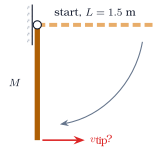
The rod of length \(1.5\) m swings from rest at the horizontal to the vertical. Take \(g = 10\) m/s\(^2\).
Use energy conservation to find the angular velocity at the bottom.
Find the speed of the tip.
Answer(i) \(2\sqrt5\) rad/s (ii) \(3\sqrt5 \approx 6.7\) m/s
Solution
The centre falls \(\dfrac{L}{2}\): \(Mg\dfrac{L}{2} = \dfrac{1}{2}\cdot\dfrac{ML^2}{3}\omega^2\), so \(\omega = \sqrt{\dfrac{3g}{L}} = \sqrt{20} = 2\sqrt5\) rad/s.
Just after release the hinge force on the rod is less than its weight, but at the bottom of the swing it is more. Explain both in one sentence each.
Answercentre of mass accelerates down; needs centripetal force up
Solution
Just after release the centre of mass accelerates downward, so the net force is downward and the hinge supports less than the weight. At the bottom the centre of mass moves in a circle and needs an upward centripetal force. The hinge must then pull up with more than the weight.
How did it go?
Work, energy and power
Q17
Find the rotational kinetic energy of a disc of mass \(4\) kg and radius \(0.5\) m spinning at \(10\) rad/s about its axis.
Answer\(25\) J
Solution
\(I = \dfrac{1}{2}(4)(0.25) = 0.5\) kg m\(^2\). \(K = \dfrac{1}{2}I\omega^2 = \dfrac{1}{2}(0.5)(100) = 25\) J.
How did it go?
Q18
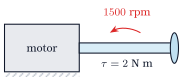
The motor drives the shaft at \(1500\) rpm with a torque of \(2\) N m.
Find \(\omega\) in rad/s.
Find the power delivered.
Answer(i) \(50\pi \approx 157\) rad/s (ii) \(100\pi \approx 314\) W
A torque takes a wheel of \(I = 2\) kg m\(^2\) from rest to \(20\) rad/s in \(4\) s. Find the work done, the torque and the average power.
Answer\(400\) J; \(10\) N m; \(100\) W
Solution
\(W = \dfrac{1}{2}I\omega^2 = \dfrac{1}{2}(2)(400) = 400\) J. \(\alpha = \dfrac{20}{4} = 5\) rad/s\(^2\), \(\tau = 10\) N m. Average power \(= \dfrac{400}{4} = 100\) W. Check: \(\theta = \dfrac{1}{2}(5)(16) = 40\) rad and \(\tau\theta = 400\) J.
How did it go?
Q21
In Q7 the block falls \(2\) m from rest. Use energy conservation to find its speed, and check it against the acceleration found there.
A grinding wheel turns at \(30\) rad/s. A tool pressed against its rim, \(0.1\) m from the axis, exerts a friction force of \(10\) N. Find the power the motor must supply to keep the speed steady.
Answer\(30\) W
Solution
Friction torque \(= 10 \times 0.1 = 1\) N m. To hold the speed the motor supplies \(P = \tau\omega = 1 \times 30 = 30\) W, all of it turning into heat at the tool.
How did it go?
Q23
A flywheel of \(I = 0.2\) kg m\(^2\) stores \(1000\) J of rotational kinetic energy. Find its angular velocity and its rpm.