Questions on Angular Momentum, the kind your examinations ask. Solve one on paper. Then tell the book how it went. The book believes you, and it uses your answer to plan your revision.
0%
Nothing marked yetMark honestly. Peek at the answer only after your own attempt.
Angular Momentum and Its Conservation
24 questions · after Lesson 5, Collisions with Pivoted Bodies
Angular momentum of a particle and a body
Q1
Define the angular momentum of a particle about a point. A \(2\) kg particle at \(\vec r = 3\hat i\) m moves with \(\vec v = 4\hat j\) m/s. Find \(\vec L\) about the origin.
Answer\(\vec L = \vec r \times \vec p\); \(24\hat k\) kg m\(^2\)/s
Solution
\(\vec L = \vec r \times \vec p = \vec r \times m\vec v = 3\hat i \times (2 \times 4)\hat j = 24\hat k\) kg m\(^2\)/s.
How did it go?
Q2
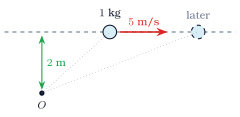
The particle moves along the dashed line at a steady \(5\) m/s.
Find its angular momentum about \(O\).
Does \(L\) change as the particle moves on? Give the reason.
Answer(i) \(10\) kg m\(^2\)/s (ii) no, \(mv \times\) (perpendicular distance) is fixed
Solution
\(L = mv \times d = 1 \times 5 \times 2 = 10\) kg m\(^2\)/s, where \(d\) is the perpendicular distance from \(O\) to the line.
No. \(L = mvd\) and \(m\), \(v\) and \(d\) all stay the same as the particle moves along the line. No force acts, so no torque acts and \(L\) is constant.
How did it go?
Q3
Find \(L\) in each case. (i) A disc of \(I = 0.5\) kg m\(^2\) at \(20\) rad/s. (ii) A ring of mass \(2\) kg and radius \(0.5\) m at \(4\) rad/s about its axis.
Answer(i) \(10\) (ii) \(2\) kg m\(^2\)/s
Solution
(i) \(L = I\omega = 0.5 \times 20 = 10\) kg m\(^2\)/s. (ii) \(I = MR^2 = 2 \times 0.25 = 0.5\), so \(L = 0.5 \times 4 = 2\) kg m\(^2\)/s.
How did it go?
Q4
Starting from \(L = \sum m_ir_iv_i\) for the particles of a rigid body turning about a fixed axis, show that \(L = I\omega\).
Answer\(v_i = r_i\omega\), so \(L = \omega\sum m_ir_i^2\)
Solution
Each particle moves in a circle of radius \(r_i\) about the axis with speed \(v_i = r_i\omega\), and \(\vec r_i \perp \vec v_i\). So \(L = \sum m_ir_iv_i = \sum m_ir_i^2\omega = \omega\sum m_ir_i^2 = I\omega\).
How did it go?
Q5
A \(0.5\) kg particle moves in a circle of radius \(2\) m at \(3\) m/s. Find the magnitude of its angular momentum about the centre and state its direction.
Answer\(3\) kg m\(^2\)/s; perpendicular to the plane
Solution
\(L = mvr = 0.5 \times 3 \times 2 = 3\) kg m\(^2\)/s. \(\vec L\) is perpendicular to the plane of the circle, in the sense given by the right-hand rule.
How did it go?
Conservation with changing moment of inertia
Q6
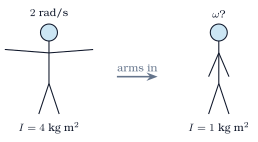
The skater pulls the arms in. No external torque acts about the vertical axis.
Find the new angular velocity.
Find the kinetic energy before and after.
Where does the extra energy come from?
Answer(i) \(8\) rad/s (ii) \(8\) J; \(32\) J (iii) work by the arm muscles
Before: \(\dfrac{1}{2}(4)(4) = 8\) J. After: \(\dfrac{1}{2}(1)(64) = 32\) J.
The skater's muscles do work pulling the arms inward against the outward pull needed to keep them moving in smaller circles. That work becomes the extra kinetic energy.
How did it go?
Q7
A disc of \(I = 2\) kg m\(^2\) spins freely at \(10\) rad/s. A \(0.5\) kg lump of clay is dropped onto it and sticks at \(2\) m from the axis. Find the new angular velocity and the kinetic energy lost.
Answer\(5\) rad/s; \(50\) J
Solution
\(I_2 = 2 + 0.5 \times 4 = 4\) kg m\(^2\). \(2 \times 10 = 4\omega\), so \(\omega = 5\) rad/s. Energy: \(\dfrac{1}{2}(2)(100) = 100\) J before, \(\dfrac{1}{2}(4)(25) = 50\) J after: \(50\) J lost as heat when the clay is dragged up to speed.
How did it go?
Q8
A turntable of \(I = 300\) kg m\(^2\) and radius \(2\) m turns at \(1\) rad/s with a \(60\) kg man standing at its rim. Treat the man as a particle. The man walks to the centre. Find the new angular velocity.
Answer\(1.8\) rad/s
Solution
At the rim: \(I = 300 + 60 \times 4 = 540\) kg m\(^2\). At the centre the man adds nothing: \(I = 300\). \(540 \times 1 = 300\,\omega\), so \(\omega = 1.8\) rad/s.
How did it go?
Q9
A star of rotation period \(20\) days collapses to half its radius, keeping its mass and shape. Find its new period.
Answer\(5\) days
Solution
\(I \propto R^2\), so \(I\) falls to a quarter and \(\omega\) rises four times. The period falls to a quarter: \(5\) days.
How did it go?
Q10
Disc \(A\) has \(I = 2\) kg m\(^2\) and spins at \(6\) rad/s. It is dropped onto disc \(B\), \(I = 4\) kg m\(^2\) and at rest, on the same axle. They then turn together. Find the common angular velocity and the kinetic energy lost.
In Q10 kinetic energy is lost but angular momentum is not. Explain both facts.
Answerfriction between discs is internal; it heats them
Solution
The friction between the discs is an internal force. The torque it exerts on \(A\) is equal and opposite to that on \(B\), so the total angular momentum cannot change. But friction does negative net work as the discs slip on each other, turning kinetic energy into heat.
How did it go?
Angular impulse
Q12
State the angular impulse-momentum theorem. A torque of \(5\) N m acts for \(4\) s on a wheel of \(I = 2\) kg m\(^2\) at rest. Find the final angular velocity.
Answer\(\int\tau\,dt = \Delta L\); \(10\) rad/s
Solution
The angular impulse of the net torque equals the change of angular momentum: \(\int\tau\,dt = L_2 - L_1\). Here \(5 \times 4 = 2\omega\), so \(\omega = 10\) rad/s.
How did it go?
Q13
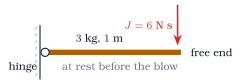
A hammer blow gives the free end an impulse of \(6\) N s.
Find the angular impulse about the hinge.
Find the angular velocity just after the blow.
Answer(i) \(6\) N m s (ii) \(6\) rad/s
Solution
Angular impulse \(= J \times L = 6 \times 1 = 6\) N m s.
\(I = \dfrac{ML^2}{3} = \dfrac{3 \times 1}{3} = 1\) kg m\(^2\). \(I\omega = 6\), so \(\omega = 6\) rad/s.
How did it go?
Q14
A disc of \(I = 0.5\) kg m\(^2\) is at rest on its axle. A tangential impulse of \(4\) N s is delivered at \(0.5\) m from the axis. Find the angular velocity produced.
Answer\(4\) rad/s
Solution
Angular impulse \(= 4 \times 0.5 = 2\) N m s. \(\omega = \dfrac{2}{0.5} = 4\) rad/s.
How did it go?
Q15
In Q13 the hinge also exerts a large impulsive force during the blow. Why does it not appear in the angular impulse equation about the hinge?
Answerzero lever arm about the hinge
Solution
The hinge force acts at the hinge, so its lever arm about the hinge is zero. Its torque, and therefore its angular impulse about the hinge, is zero however large it is. That is why torques are taken about the hinge.
How did it go?
Particles hitting hinged and free bodies
Q16
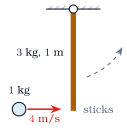
The putty sticks to the lower end of the hanging rod. Take \(g = 10\) m/s\(^2\).
Find the angular momentum of the putty about the hinge just before impact.
Find the angular velocity just after impact.
Find \(\cos\theta\) for the maximum angle \(\theta\) the rod swings to.
Answer(i) \(4\) kg m\(^2\)/s (ii) \(2\) rad/s (iii) \(0.84\)
Kinetic energy after impact: \(\dfrac{1}{2}(2)(4) = 4\) J. Rise in potential energy at angle \(\theta\): the rod's centre rises \(\dfrac{L}{2}(1 - \cos\theta)\) and the putty rises \(L(1 - \cos\theta)\). \(30 \times 0.5(1 - \cos\theta) + 10 \times 1(1 - \cos\theta) = 25(1 - \cos\theta) = 4\), so \(\cos\theta = 0.84\).
How did it go?
Q17
In Q16 linear momentum is not conserved during the impact but angular momentum about the hinge is. Explain.
Answerhinge impulse has no torque about the hinge
Solution
During the impact the hinge exerts a large impulsive force on the rod, an external force, so the linear momentum of rod plus putty changes. That force acts at the hinge and has no torque about it, and gravity's impulse is negligible in the short time. So angular momentum about the hinge is conserved across the impact.
How did it go?
Q18
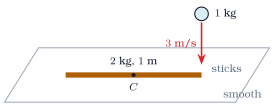
The rod is free on a smooth table and the particle sticks to its end.
Find the velocity of the centre of mass of the system after impact.
Locate the centre of mass of rod plus particle.
Find the angular velocity after impact, using angular momentum about that centre of mass.
Answer(i) \(1\) m/s (ii) \(\frac{1}{6}\) m from \(C\) towards the particle (iii) \(3\) rad/s
Solution
No external horizontal force: \(1 \times 3 = 3v_{\text{cm}}\), so \(v_{\text{cm}} = 1\) m/s.
Take \(C\) as origin, the struck end at \(0.5\) m: \(x_{\text{cm}} = \dfrac{2 \times 0 + 1 \times 0.5}{3} = \dfrac{1}{6}\) m from \(C\) towards the particle.
The particle is \(\dfrac{1}{3}\) m from the centre of mass: \(L = 1 \times 3 \times \dfrac{1}{3} = 1\) kg m\(^2\)/s. \(I\) about the centre of mass: rod \(\dfrac{2}{12} + 2\left(\dfrac{1}{6}\right)^2 = \dfrac{2}{9}\), particle \(1 \times \dfrac{1}{9}\); total \(\dfrac{1}{3}\). \(\omega = \dfrac{1}{1/3} = 3\) rad/s.
How did it go?
Q19
In Q18 suppose the particle had hit the centre \(C\) of the rod instead. Find the motion after impact and compare it with Q18.
Answer\(1\) m/s, no rotation
Solution
The blow now passes through the centre of mass of rod plus particle, which is at \(C\). So there is no angular momentum about it. The system slides at \(v_{\text{cm}} = 1\) m/s without rotating. The linear motion is the same as in Q18; only the rotation is missing.
How did it go?
Q20
A \(2\) kg, \(1\) m rod lies at rest on a smooth table. An impulse of \(4\) N s is applied at one end, perpendicular to the rod. Find the velocity of the centre, the angular velocity, and the velocity of each end just after.
Answer\(2\) m/s; \(12\) rad/s; \(8\) m/s; \(-4\) m/s
In Q20, which point of the rod is momentarily at rest just after the blow?
Answer\(\frac{1}{6}\) m from the centre, away from the blow
Solution
Velocity of a point at distance \(x\) from the centre, on the far side: \(2 - 12x\). It vanishes at \(x = \dfrac{1}{6}\) m from the centre, away from the blow. That point is the instantaneous centre of rotation.
How did it go?
Small situations
Q22
A planet's farthest distance from the Sun is three times its nearest. Its speed at the nearest point is \(30\) km/s. Find its speed at the farthest point.
Answer\(10\) km/s
Solution
Gravity is central, so \(L = mvr\) is conserved: \(v_{\text{far}}r_{\text{far}} = v_{\text{near}}r_{\text{near}}\). \(v_{\text{far}} = \dfrac{30}{3} = 10\) km/s.
How did it go?
Q23
A merry-go-round of \(I = 60\) kg m\(^2\) and radius \(2\) m is at rest. A \(30\) kg child runs at \(3\) m/s along a tangent and jumps onto its rim. Find the angular velocity afterwards.
Answer\(1\) rad/s
Solution
Angular momentum of the child about the axis: \(mvR = 30 \times 3 \times 2 = 180\) kg m\(^2\)/s. After: \(I = 60 + 30 \times 4 = 180\) kg m\(^2\). \(\omega = \dfrac{180}{180} = 1\) rad/s.
How did it go?
Q24
A particle moves with constant velocity along a straight line. Show that its angular momentum about any fixed point is constant.
Answer\(\frac{d\vec L}{dt} = \vec v \times m\vec v + \vec r \times 0 = 0\)
Solution
\(\vec L = \vec r \times m\vec v\). \(\dfrac{d\vec L}{dt} = \dfrac{d\vec r}{dt} \times m\vec v + \vec r \times m\dfrac{d\vec v}{dt} = \vec v \times m\vec v + \vec r \times 0 = 0\), since \(\vec v \times \vec v = 0\) and \(\vec v\) is constant. So \(\vec L\) is constant. Equivalently, \(L = mvd\) with \(d\) the fixed perpendicular distance.