Questions on Dynamics of Rolling, the kind your examinations ask. Solve one on paper. Then tell the book how it went. The book believes you, and it uses your answer to plan your revision.
0%
Nothing marked yetMark honestly. Peek at the answer only after your own attempt.
Rolling and the Instantaneous Axis
24 questions · after Lesson 4, Rolling with Slipping
Kinematics of rolling
Q1
State the condition for rolling without slipping. A wheel of radius \(0.5\) m rolls with its centre moving at \(4\) m/s. Find its angular velocity.
Answer\(v_{\text{cm}} = R\omega\); \(8\) rad/s
Solution
Rolling without slipping: the contact point is at rest, which needs \(v_{\text{cm}} = R\omega\). \(\omega = \dfrac{4}{0.5} = 8\) rad/s.
How did it go?
Q2
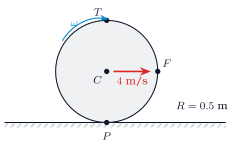
The wheel rolls without slipping at \(4\) m/s.
Find the velocities of \(T\), \(C\) and \(P\).
Find the velocity of \(F\), in magnitude and direction.
Answer(i) \(8\); \(4\); \(0\) m/s (ii) \(4\sqrt2 \approx 5.7\) m/s at \(45^\circ\) below the horizontal
Solution
Each point has \(v_{\text{cm}}\) plus \(\omega r\) from the spin. \(T\): \(4 + 4 = 8\) m/s forward. \(C\): \(4\) m/s. \(P\): \(4 - 4 = 0\).
At \(F\) the spin velocity \(\omega R = 4\) m/s points straight down. Adding \(4\) m/s forward: speed \(4\sqrt2 \approx 5.7\) m/s at \(45^\circ\) below the horizontal.
How did it go?
Q3
Why is the point of contact of a rolling wheel momentarily at rest, even though the wheel is moving?
Answer\(v_{\text{cm}}\) forward and \(\omega R\) backward cancel there
Solution
The contact point has the forward velocity \(v_{\text{cm}}\) of the centre and the backward velocity \(\omega R\) from the spin. In pure rolling these are equal, so they cancel and the point is instantaneously at rest. A moment later a different point of the rim is in contact.
How did it go?
Q4
A wheel of radius \(0.5\) m rolls without slipping through \(10\) revolutions. How far does its centre move?
Answer\(10\pi \approx 31.4\) m
Solution
Each revolution moves the centre by one circumference: \(10 \times 2\pi \times 0.5 = 10\pi \approx 31.4\) m.
How did it go?
Q5
A ball of radius \(0.5\) m moves with \(v_{\text{cm}} = 3\) m/s and spins at \(4\) rad/s in the rolling sense. Is it rolling without slipping? Find the velocity of the contact point and the direction of friction.
Answerno; \(1\) m/s forward; friction backward
Solution
\(\omega R = 4 \times 0.5 = 2\) m/s, less than \(v_{\text{cm}} = 3\) m/s, so it is not pure rolling. The contact point moves forward at \(3 - 2 = 1\) m/s. Kinetic friction opposes this slip, so it acts backward on the ball.
How did it go?
Q6
A bicycle wheel of radius \(0.3\) m rolls at \(6\) m/s. Find \(\omega\), the speed of the top of the wheel, and the acceleration of a rim point relative to the centre.
Answer\(20\) rad/s; \(12\) m/s; \(120\) m/s\(^2\) towards the centre
Solution
\(\omega = \dfrac{6}{0.3} = 20\) rad/s. Top: \(2v = 12\) m/s. Relative to the centre every rim point moves in a circle at \(\omega R\), so its acceleration is \(\omega^2R = 400 \times 0.3 = 120\) m/s\(^2\) towards the centre.
How did it go?
Instantaneous axis
Q7
What is the instantaneous axis of rotation (IAOR) of a body moving in a plane? Where is it for a wheel rolling without slipping?
Answerthe point of zero velocity; the contact point
Solution
The instantaneous axis is the line perpendicular to the plane of motion through the point of zero velocity. That point may lie on the body or on its extension. The body's motion is then pure rotation about that axis. For rolling without slipping the contact point is at rest, so it is the instantaneous axis.
How did it go?
Q8
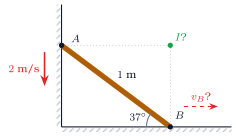
End \(A\) slides down the wall at \(2\) m/s while end \(B\) slides along the floor. Take \(\sin 37^\circ = 0.6\).
Locate the instantaneous axis \(I\).
Find the angular velocity of the rod.
Find the velocity of \(B\).
Answer(i) \(0.8\) m from the wall, \(0.6\) m above the floor (ii) \(2.5\) rad/s (iii) \(1.5\) m/s along the floor
Solution
\(I\) lies on the perpendicular to each velocity through its point. \(A\) moves vertically, so \(I\) is on the horizontal through \(A\); \(B\) moves horizontally, so \(I\) is on the vertical through \(B\). \(A\) is \(1 \times 0.6 = 0.6\) m up the wall and \(B\) is \(1 \times 0.8 = 0.8\) m along the floor. So \(I\) is \(0.8\) m from the wall and \(0.6\) m above the floor.
\(IB = 0.6\) m. \(v_B = \omega \times IB = 2.5 \times 0.6 = 1.5\) m/s, along the floor away from the wall.
How did it go?
Q9
In Q8 find the speed of the midpoint of the rod.
Answer\(1.25\) m/s
Solution
\(I\), \(A\), \(B\) and the corner form a rectangle, and the midpoint \(M\) of the rod is its centre. So \(M\) is \(\dfrac{L}{2} = 0.5\) m from \(I\). \(v_M = 2.5 \times 0.5 = 1.25\) m/s, perpendicular to \(IM\).
How did it go?
Q10
A disc rolls without slipping. Show that its kinetic energy computed as pure rotation about the contact point equals \(\frac{1}{2}Mv^2 + \frac{1}{2}I_{\text{cm}}\omega^2\).
Answer\(I_P = I_{\text{cm}} + MR^2\) and \(v = R\omega\)
Solution
About the contact point \(P\): \(K = \dfrac{1}{2}I_P\omega^2\) with \(I_P = I_{\text{cm}} + MR^2\) (parallel axis). So \(K = \dfrac{1}{2}I_{\text{cm}}\omega^2 + \dfrac{1}{2}MR^2\omega^2 = \dfrac{1}{2}I_{\text{cm}}\omega^2 + \dfrac{1}{2}Mv^2\), using \(v = R\omega\).
How did it go?
Q11
Use the instantaneous axis to find the speed of point \(F\) of Q2, and check your earlier answer.
Answer\(IF = R\sqrt2\); \(4\sqrt2\) m/s
Solution
\(F\) is at distance \(\sqrt{R^2 + R^2} = R\sqrt2\) from the contact point \(P\). Speed \(= \omega \times R\sqrt2 = 8 \times 0.5\sqrt2 = 4\sqrt2\) m/s, perpendicular to \(PF\), that is at \(45^\circ\) below the horizontal. This matches Q2.
How did it go?
Energy of rolling
Q12
A disc of mass \(2\) kg and radius \(0.5\) m rolls at \(4\) m/s. Find its translational, rotational and total kinetic energy. What fraction is rotational?
Translational: \(\dfrac{1}{2}(2)(16) = 16\) J. \(I = \dfrac{1}{2}(2)(0.25) = 0.25\), \(\omega = 8\): rotational \(\dfrac{1}{2}(0.25)(64) = 8\) J. Total \(24\) J; rotational fraction \(\dfrac{8}{24} = \dfrac{1}{3}\).
How did it go?
Q13
Find the fraction of the total kinetic energy that is rotational for a rolling (i) ring, (ii) disc, (iii) solid sphere.
Answer(i) \(\frac{1}{2}\) (ii) \(\frac{1}{3}\) (iii) \(\frac{2}{7}\)
Solution
\(K_{\text{rot}} = \dfrac{1}{2}Mk^2\omega^2 = \dfrac{k^2}{R^2}\cdot\dfrac{1}{2}Mv^2\), so the fraction is \(\dfrac{k^2/R^2}{1 + k^2/R^2}\). Ring (\(k^2/R^2 = 1\)): \(\dfrac{1}{2}\). Disc (\(\dfrac{1}{2}\)): \(\dfrac{1}{3}\). Sphere (\(\dfrac{2}{5}\)): \(\dfrac{2}{7}\).
How did it go?
Q14
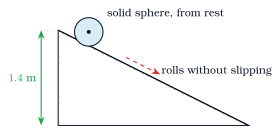
The solid sphere rolls down without slipping. Take \(g = 10\) m/s\(^2\).
Find its speed at the bottom.
A ring and a disc are released alongside it. Which reaches the bottom first? Give the reason.
Answer(i) \(2\sqrt5 \approx 4.5\) m/s (ii) sphere; smallest \(k^2/R^2\)
Solution
Friction does no work in pure rolling: \(mgh = \dfrac{1}{2}mv^2\left(1 + \dfrac{2}{5}\right)\), so \(v^2 = \dfrac{2gh}{1.4} = \dfrac{28}{1.4} = 20\) and \(v = 2\sqrt5 \approx 4.5\) m/s.
The sphere. Its \(k^2/R^2 = \dfrac{2}{5}\) is the smallest, so the least share of the energy goes into spin and its acceleration is the largest. The ring, with \(k^2/R^2 = 1\), is last.
How did it go?
Q15
Use \(a = \frac{g\sin\theta}{1 + k^2/R^2}\) to find the acceleration of a solid sphere, a disc and a ring rolling down a \(37^\circ\) incline. Take \(g = 10\) m/s\(^2\).
A \(3\) kg disc rolls down a \(37^\circ\) incline without slipping. Take \(g = 10\) m/s\(^2\). Find the friction force and the least \(\mu\) that allows pure rolling.
Answer\(6\) N; \(0.25\)
Solution
Along the incline: \(mg\sin\theta - f = ma\) with \(a = 4\) m/s\(^2\): \(f = 3 \times 6 - 3 \times 4 = 6\) N. Normal force \(= 3 \times 10 \times 0.8 = 24\) N. \(\mu_{\min} = \dfrac{6}{24} = 0.25\). In general \(f = \dfrac{mg\sin\theta}{1 + R^2/k^2}\).
How did it go?
Slipping to rolling
Q17
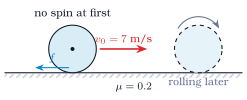
A solid ball is thrown along the floor at \(7\) m/s with no spin. Take \(g = 10\) m/s\(^2\).
Find the linear and angular accelerations while it slips (\(I = \frac{2}{5}mR^2\)).
Find the time when pure rolling begins and the speed then.
How far has it travelled by then?
Answer(i) \(2\) m/s\(^2\) backward; \(5\mu g/(2R)\) (ii) \(1\) s; \(5\) m/s (iii) \(6\) m
Solution
Friction \(\mu mg\) backward: \(a = -\mu g = -2\) m/s\(^2\). Torque about the centre \(\mu mgR = \dfrac{2}{5}mR^2\alpha\), so \(\alpha = \dfrac{5\mu g}{2R}\), spinning it up in the rolling sense.
\(v = 7 - 2t\) and \(\omega R = \alpha Rt = \dfrac{5\mu g}{2}t = 5t\). Pure rolling when \(v = \omega R\): \(7 - 2t = 5t\), \(t = 1\) s. Then \(v = 5\) m/s, which is \(\dfrac{5}{7}v_0\).
\(s = 7 \times 1 - \dfrac{1}{2}(2)(1) = 6\) m.
How did it go?
Q18
A ring is thrown along a rough floor at speed \(v_0\) with no spin. Show that it rolls without slipping once its speed has fallen to \(\frac{v_0}{2}\).
Answer\(v = v_0 - \mu gt\), \(\omega R = \mu gt\)
Solution
For a ring \(I = mR^2\): \(a = -\mu g\) and \(\alpha = \dfrac{\mu mgR}{mR^2} = \dfrac{\mu g}{R}\). So \(v = v_0 - \mu gt\) and \(\omega R = \mu gt\). Setting \(v = \omega R\): \(v_0 - \mu gt = \mu gt\), so \(\mu gt = \dfrac{v_0}{2}\) and \(v = v_0 - \dfrac{v_0}{2} = \dfrac{v_0}{2}\).
How did it go?
Q19
In Q17 friction acts backward on the ball while it slips. Why does friction stop acting once pure rolling begins on a level floor?
Answercontact point at rest; no tendency to slip
Solution
Kinetic friction acts only while the surfaces slip. Once the contact point is at rest there is no slipping and no kinetic friction. On a level floor nothing tries to change \(v\) or \(\omega\), so no static friction is needed either. The ball rolls on at constant speed.
How did it go?
Q20
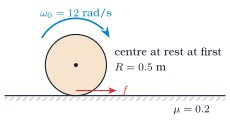
The spinning disc is placed on the floor with its centre at rest. Take \(g = 10\) m/s\(^2\).
Write \(v\) and \(\omega\) as functions of time while it slips.
Find the speed of the centre when pure rolling begins, and the time taken.
Answer(i) \(v = \mu gt\); \(\omega = \omega_0 - \frac{2\mu g}{R}t\) (ii) \(2\) m/s; \(1\) s
Solution
The bottom moves backward, so friction \(\mu mg\) acts forward: \(v = \mu gt\). Its torque slows the spin: \(\alpha = \dfrac{\mu mgR}{\frac{1}{2}mR^2} = \dfrac{2\mu g}{R}\), so \(\omega = \omega_0 - \dfrac{2\mu g}{R}t\).
Pure rolling when \(v = \omega R\): \(\mu gt = \omega_0R - 2\mu gt\), so \(\mu gt = \dfrac{\omega_0R}{3}\). \(v = \dfrac{12 \times 0.5}{3} = 2\) m/s, and \(t = \dfrac{2}{\mu g} = \dfrac{2}{2} = 1\) s.
How did it go?
Q21
Explain why the angular momentum of the ball in Q17 about the point of contact stays constant while it slips.
Answerfriction and normal pass through the contact point; gravity's torque cancels the normal's
Solution
Friction and the normal force act at the contact point, so they have no torque about it. Gravity acts at the centre, directly above the contact point, so its torque about that point is zero too. With no torque about the contact point, the angular momentum about it stays constant.
How did it go?
Small situations
Q22
A car moves at \(15\) m/s on wheels of radius \(0.3\) m. Find the angular velocity of the wheels in rad/s and in rpm.
A \(2\) kg solid cylinder rolls at \(3\) m/s. Find its total kinetic energy.
Answer\(13.5\) J
Solution
For a solid cylinder \(k^2/R^2 = \dfrac{1}{2}\): \(K = \dfrac{1}{2}mv^2\left(1 + \dfrac{1}{2}\right) = \dfrac{3}{4}(2)(9) = 13.5\) J.
How did it go?
Q24
Use conservation of angular momentum about the contact point to show that the ball of Q17 ends up rolling at \(\frac{5}{7}v_0\).
Answer\(mv_0R = \frac{7}{5}mvR\)
Solution
About the contact point the angular momentum is constant (Q21). At first: \(L = mv_0R\) (the ball has no spin). When rolling at speed \(v\): \(L = mvR + I\omega = mvR + \dfrac{2}{5}mR^2\cdot\dfrac{v}{R} = \dfrac{7}{5}mvR\). Equating: \(v = \dfrac{5}{7}v_0\), the same as Q17.