Questions on Gravitational Force and Field, the kind your examinations ask. Solve one on paper. Then tell the book how it went. The book believes you, and it uses your answer to plan your revision.
0%
Nothing marked yetMark honestly. Peek at the answer only after your own attempt.
Variation of g and the Shell Theorems
24 questions · after Lesson 5, The Acceleration Due to Gravity and How It Varies
Newton's law and the shell theorems
Q1
State Newton's law of gravitation. Find the force between a \(2\) kg and a \(3\) kg mass \(1\) m apart. Take \(G = 6.67 \times 10^{-11}\) N m\(^2\)/kg\(^2\).
Answer\(F = \frac{Gm_1m_2}{r^2}\); \(4 \times 10^{-10}\) N
Solution
Every two point masses attract along the line joining them with \(F = \dfrac{Gm_1m_2}{r^2}\). \(F = 6.67 \times 10^{-11} \times \dfrac{2 \times 3}{1} = 4 \times 10^{-10}\) N.
How did it go?
Q2
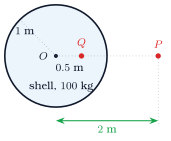
State the two shell theorems. For the shell shown, take \(G = 6.67 \times 10^{-11}\) SI units.
Find the field at \(P\).
Find the field at \(Q\).
Answeroutside: as a point mass at the centre; inside: zero; (i) \(1.7 \times 10^{-9}\) N/kg (ii) \(0\)
Solution
Outside a uniform shell the field is the same as that of a point mass at the centre. Inside, the field is zero everywhere. (i) \(g_P = \dfrac{GM}{r^2} = \dfrac{6.67 \times 10^{-11} \times 100}{4} = 1.7 \times 10^{-9}\) N/kg. (ii) \(Q\) is inside: \(g_Q = 0\).
How did it go?
Q3
Explain in words why the gravitational field inside a uniform thin shell is zero at every point.
Answerpulls from opposite cones cancel: area \(\propto r^2\), force \(\propto \frac{1}{r^2}\)
Solution
From any inside point draw a narrow double cone. It cuts the shell in two patches on opposite sides. The area of each patch grows as the square of its distance, while the pull per unit mass falls as the inverse square. So the two patches pull equally in opposite directions. Adding all such pairs of patches gives zero.
How did it go?
Q4
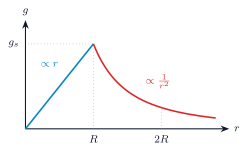
The graph shows \(g\) against \(r\) for a uniform solid sphere of radius \(R\).
Write \(g(r)\) for \(r < R\) and for \(r > R\).
Where is \(g\) largest? Find \(g\) at \(r = \frac{R}{2}\) and at \(r = 2R\) in terms of \(g_s\).
Answer(i) \(\frac{GMr}{R^3}\); \(\frac{GM}{r^2}\) (ii) at the surface; \(\frac{g_s}{2}\); \(\frac{g_s}{4}\)
The two curves meet at the surface, where \(g = g_s = \dfrac{GM}{R^2}\) is largest. At \(\dfrac{R}{2}\): \(\dfrac{g_s}{2}\). At \(2R\): \(\dfrac{g_s}{4}\).
How did it go?
Q5
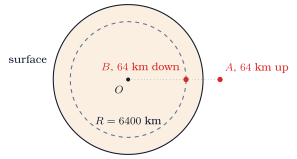
Treat the Earth as a uniform sphere of radius \(R\). Write \(g\) at a depth \(d\) and at a height \(h\) in terms of the surface value \(g\).
\(B\). Going up, the inverse square counts the fraction twice; going down, only the mass inside counts, which drops the fraction once.
How did it go?
Q11
A \(60\) kg person weighs \(600\) N on the surface. Find the weight at a height \(R\) above the surface and at a height \(2R\).
Answer\(150\) N; \(66.7\) N
Solution
At \(h = R\): \(\dfrac{600}{4} = 150\) N. At \(h = 2R\), \(r = 3R\): \(\dfrac{600}{9} \approx 66.7\) N.
How did it go?
Q12
Find \(g\) at a depth of \(\frac{R}{2}\), taking \(g = 10\) m/s\(^2\) at the surface. What is \(g\) at the centre?
Answer\(5\) m/s\(^2\); \(0\)
Solution
\(g_d = g\left(1 - \dfrac{1}{2}\right) = 5\) m/s\(^2\). At the centre, \(d = R\) and \(g = 0\): the pulls from all sides cancel.
How did it go?
Q13
Starting from \(g_h = \frac{GM}{(R + h)^2}\), show that for \(h \ll R\), \(g_h \approx g\left(1 - \frac{2h}{R}\right)\).
Answer\((1 + h/R)^{-2} \approx 1 - 2h/R\)
Solution
\(g_h = \dfrac{GM}{R^2}\left(1 + \dfrac{h}{R}\right)^{-2} = g\left(1 + \dfrac{h}{R}\right)^{-2}\). For \(\dfrac{h}{R} \ll 1\) the binomial expansion gives \((1 + x)^{-2} \approx 1 - 2x\), so \(g_h \approx g\left(1 - \dfrac{2h}{R}\right)\).
How did it go?
Rotation and shape
Q14
Write the effective \(g\) at latitude \(\lambda\) on the rotating Earth. Find the reduction at the equator. Take \(\omega = 7.3 \times 10^{-5}\) rad/s and \(R = 6.4 \times 10^{6}\) m.
Answer\(g' = g - \omega^2R\cos^2\lambda\); \(0.034\) m/s\(^2\)
Solution
\(g' = g - \omega^2R\cos^2\lambda\). At the equator, \(\cos\lambda = 1\): reduction \(= \omega^2R = (7.3 \times 10^{-5})^2 \times 6.4 \times 10^{6} \approx 0.034\) m/s\(^2\), about a third of a percent of \(g\).
How did it go?
Q15
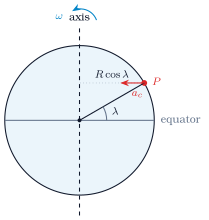
Point \(P\) at latitude \(\lambda\) moves in a circle of radius \(R\cos\lambda\) about the axis, with \(a_c = \omega^2R\cos\lambda\).
Why is the reduction in \(g\) only \(\omega^2R\cos^2\lambda\) and not \(\omega^2R\cos\lambda\)?
Find the reduction at \(\lambda = 60^\circ\), using \(\omega^2R \approx 0.034\) m/s\(^2\).
Where is the reduction zero?
Answer(i) only the component along \(g\) counts (ii) \(0.0085\) m/s\(^2\) (iii) poles
Solution
The centripetal acceleration \(\omega^2R\cos\lambda\) points towards the axis, not towards the centre. Only its component along the radius, \(\omega^2R\cos\lambda \times \cos\lambda\), subtracts from \(g\); the rest slightly tilts the plumb line.
At the poles, where \(\cos\lambda = 0\): a point on the axis does not move in a circle.
How did it go?
Q16
How fast would the Earth have to spin for objects at the equator to become weightless? Give \(\omega\) and the length of the day. Take \(g = 10\) m/s\(^2\) and \(R = 6.4 \times 10^{6}\) m.
Answer\(1.25 \times 10^{-3}\) rad/s; \(\approx 84\) min
Solution
Weightless when \(\omega^2R = g\): \(\omega = \sqrt{\dfrac{10}{6.4 \times 10^{6}}} = 1.25 \times 10^{-3}\) rad/s. \(T = \dfrac{2\pi}{\omega} \approx 5000\) s \(\approx 84\) min, about \(17\) times faster than the present spin.
How did it go?
Q17
Give two reasons why \(g\) is slightly larger at the poles than at the equator.
Answerno rotation effect; poles nearer the centre
Solution
First, the poles lie on the axis, so the rotation subtracts nothing there, while at the equator it subtracts \(\omega^2R\). Second, the Earth bulges at the equator, so the poles are about \(21\) km closer to the centre and the inverse-square pull is stronger.
How did it go?
Q18
The Earth's equatorial radius exceeds the polar radius by about \(21\) km. Estimate how much larger \(g\) is at the poles because of this alone. Take \(g = 10\) m/s\(^2\) and \(R = 6400\) km.
Answer\(\approx 0.07\) m/s\(^2\)
Solution
\(g \propto \dfrac{1}{R^2}\), so \(\dfrac{\Delta g}{g} \approx \dfrac{2\Delta R}{R} = \dfrac{2 \times 21}{6400} \approx 0.0066\). \(\Delta g \approx 0.066\) m/s\(^2\), about \(0.07\) m/s\(^2\), of the same order as the rotation effect.
How did it go?
Small situations
Q19
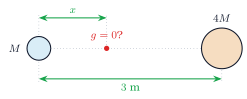
Find the point between the spheres where the net field is zero.
Answer\(1\) m from \(M\)
Solution
At distance \(x\) from \(M\) the fields balance: \(\dfrac{GM}{x^2} = \dfrac{G \cdot 4M}{(3 - x)^2}\), so \(3 - x = 2x\) and \(x = 1\) m. The null point is nearer the smaller mass.
How did it go?
Q20
Two identical solid spheres of mass \(M\) and radius \(R\) touch each other. Find the force between them. If both were made of the same material with twice the radius, how many times larger would the force be?
Answer\(\frac{GM^2}{4R^2}\); \(16\)
Solution
Each sphere acts as a point mass at its centre, and the centres are \(2R\) apart: \(F = \dfrac{GM^2}{(2R)^2} = \dfrac{GM^2}{4R^2}\). Same material: \(M \propto R^3\), so \(F \propto \dfrac{R^6}{R^2} = R^4\). Doubling \(R\) multiplies \(F\) by \(16\).
How did it go?
Q21
Find the mass of the Earth from \(g = 10\) m/s\(^2\), \(R = 6.4 \times 10^{6}\) m and \(G = 6.67 \times 10^{-11}\) SI units.
Answer\(6.1 \times 10^{24}\) kg
Solution
\(g = \dfrac{GM}{R^2}\), so \(M = \dfrac{gR^2}{G} = \dfrac{10 \times (6.4 \times 10^{6})^2}{6.67 \times 10^{-11}} \approx 6.1 \times 10^{24}\) kg.
How did it go?
Q22
A planet has twice the Earth's mass and twice its radius. Find \(g\) on its surface. Take \(g = 10\) m/s\(^2\) on Earth.
Answer\(5\) m/s\(^2\)
Solution
\(g \propto \dfrac{M}{R^2}\): \(\dfrac{2}{4} = \dfrac{1}{2}\) of the Earth's value, \(5\) m/s\(^2\).
How did it go?
Q23
A planet has the same density as the Earth but half the radius. Find \(g\) on its surface, taking \(g = 10\) m/s\(^2\) on Earth.
Answer\(5\) m/s\(^2\)
Solution
\(M = \dfrac{4}{3}\pi R^3\rho\), so \(g = \dfrac{GM}{R^2} = \dfrac{4}{3}\pi G\rho R \propto \rho R\). Same \(\rho\), half \(R\): \(g = 5\) m/s\(^2\).
How did it go?
Q24
Use the shell theorems to show that inside a uniform solid sphere \(g(r) = \frac{GMr}{R^3}\).
Answerinner mass \(M\frac{r^3}{R^3}\) acts at the centre; outer shells give zero
Solution
Split the sphere into thin shells. At distance \(r\) from the centre, the shells outside \(r\) give zero field (second theorem). The shells inside form a sphere of radius \(r\) with mass \(M' = M\dfrac{r^3}{R^3}\) (uniform density), which acts as a point mass at the centre (first theorem). So \(g = \dfrac{GM'}{r^2} = \dfrac{GMr}{R^3}\).