Questions on Gravitational Energy and Orbits, the kind your examinations ask. Solve one on paper. Then tell the book how it went. The book believes you, and it uses your answer to plan your revision.
0%
Nothing marked yetMark honestly. Peek at the answer only after your own attempt.
Gravitational Potential and Self-Energy
24 questions · after Lesson 3, Gravitational Potential
Potential and potential energy
Q1
Define gravitational potential and give its unit. Find the potential at the Earth's surface using \(V = -\frac{GM}{R} = -gR\), with \(g = 10\) m/s\(^2\) and \(R = 6.4 \times 10^{6}\) m.
Answerwork per unit mass from infinity; J/kg; \(-6.4 \times 10^{7}\) J/kg
Solution
The potential at a point is the work done per unit mass in bringing a small mass slowly from infinity to that point. The work is that of an external agent. Unit: J/kg. At the surface \(V = -gR = -10 \times 6.4 \times 10^{6} = -6.4 \times 10^{7}\) J/kg.
How did it go?
Q2
Write the potential energy of two point masses. Find it for \(2\) kg and \(3\) kg placed \(1\) m apart, and the work needed to separate them to infinity. Take \(G = 6.67 \times 10^{-11}\) SI units.
\(U = -\dfrac{Gm_1m_2}{r} = -\dfrac{6.67 \times 10^{-11} \times 6}{1} = -4 \times 10^{-10}\) J. To separate them to infinity (\(U = 0\)) an agent must supply \(+4 \times 10^{-10}\) J.
How did it go?
Q3
Write the relation between field and potential. Starting from \(V = -\frac{GM}{r}\), obtain the field and state its direction.
Answer\(g = -\frac{dV}{dr}\); \(\frac{GM}{r^2}\), towards the mass
Solution
\(g = -\dfrac{dV}{dr}\). With \(V = -\dfrac{GM}{r}\): \(\dfrac{dV}{dr} = \dfrac{GM}{r^2}\), so \(g = -\dfrac{GM}{r^2}\): magnitude \(\dfrac{GM}{r^2}\), directed towards decreasing \(r\), that is towards the mass.
How did it go?
Q4
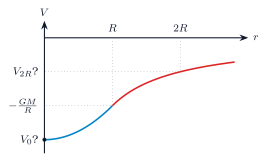
The graph shows \(V(r)\) for a uniform solid sphere of mass \(M\) and radius \(R\).
Find \(V_{2R}\) in terms of \(\frac{GM}{R}\).
Find \(V_0\), the potential at the centre, using \(V(r) = -\frac{GM(3R^2 - r^2)}{2R^3}\) inside.
Why is the curve smooth at \(r = R\)?
Answer(i) \(-\frac{GM}{2R}\) (ii) \(-\frac{3GM}{2R}\) (iii) field is continuous there
Solution
Outside, \(V = -\dfrac{GM}{r}\): \(V_{2R} = -\dfrac{GM}{2R}\), half the surface value in size.
The slope of \(V\) is \(-g\), and \(g\) is continuous at the surface (both formulas give \(\dfrac{GM}{R^2}\)). Equal slopes on both sides make the curve smooth there.
How did it go?
Q5
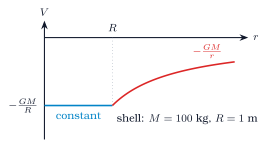
The shell has \(M = 100\) kg and \(R = 1\) m. Take \(G = 6.67 \times 10^{-11}\) SI units.
Find \(V\) at the centre.
Find \(V\) at \(r = 2\) m.
Answer(i) \(-6.7 \times 10^{-9}\) J/kg (ii) \(-3.3 \times 10^{-9}\) J/kg
Why is the potential the same at every point inside a thin shell?
Answerfield zero inside, so no change of \(V\)
Solution
The field inside a shell is zero, so no work is done in moving a mass between any two inside points. The potential therefore cannot change inside; it stays at the value on the shell, \(-\dfrac{GM}{R}\).
How did it go?
Potential of spheres
Q7
For a uniform solid sphere, find \(V\) at \(r = \frac{R}{2}\) in terms of \(\frac{GM}{R}\).
Treat the Earth as uniform. Find the work an external agent does to move a \(1\) kg mass slowly from the surface to the centre. Use \(gR = 6.4 \times 10^{7}\) J/kg. Explain the sign.
Answer\(-3.2 \times 10^{7}\) J; the mass falls in on its own
Solution
\(W = m(V_0 - V_s) = 1 \times \left(-\dfrac{3}{2}gR + gR\right) = -\dfrac{gR}{2} = -3.2 \times 10^{7}\) J. The work is negative: the potential falls towards the centre, so gravity pulls the mass inward and the agent must hold it back.
How did it go?
Q9
Find the work needed to lift a \(1\) kg mass from the surface to a height \(R\). Why is it not \(mgR\)?
Answer\(3.2 \times 10^{7}\) J; \(g\) falls with height
Solution
\(W = m(V_{2R} - V_R) = 1 \times \left(-\dfrac{gR}{2} + gR\right) = \dfrac{gR}{2} = 3.2 \times 10^{7}\) J. \(mgR = 6.4 \times 10^{7}\) J would be right only if \(g\) stayed \(10\) m/s\(^2\) all the way up; in fact it falls to \(\dfrac{g}{4}\) at the top.
How did it go?
Q10
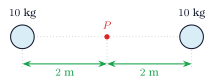
\(P\) is midway between the two masses. Take \(G = 6.67 \times 10^{-11}\) SI units.
Find the field at \(P\).
Find the potential at \(P\).
Find the work needed to bring a \(1\) kg mass from infinity to \(P\).
\(W = mV = -6.7 \times 10^{-10}\) J. It is negative although the field at \(P\) is zero: work is decided by the potential, not by the field at the final point.
How did it go?
Q11
Four \(1\) kg masses sit at the corners of a square whose centre is \(1\) m from each corner. Find the potential at the centre. Take \(G = 6.67 \times 10^{-11}\) SI units.
Answer\(-2.7 \times 10^{-10}\) J/kg
Solution
\(V = -4 \times \dfrac{G \times 1}{1} = -4G = -2.7 \times 10^{-10}\) J/kg. The field at the centre is zero by symmetry, but the potential is not.
How did it go?
Q12
Show that the potential at the centre of a uniform solid sphere is \(\frac{3}{2}\) times the potential at its surface.
Inside, \(V(r) = -\dfrac{GM(3R^2 - r^2)}{2R^3}\). At \(r = 0\): \(V_0 = -\dfrac{3GM}{2R}\). At \(r = R\): \(V_s = -\dfrac{GM \times 2R^2}{2R^3} = -\dfrac{GM}{R}\). So \(V_0 = \dfrac{3}{2}V_s\).
How did it go?
Self-energy
Q13
What is the self-energy of a body? Show that the self-energy of a thin shell of mass \(M\) and radius \(R\) is \(-\frac{GM^2}{2R}\).
Answerwork to assemble from infinity; \(\int_0^M -\frac{Gm\,dm}{R}\)
Solution
The self-energy is the work done by an external agent in assembling the body from matter spread out at infinity. Build the shell layer by layer. When it has mass \(m\), its potential is \(-\dfrac{Gm}{R}\), so bringing the next \(dm\) takes \(dW = -\dfrac{Gm\,dm}{R}\). \(U = \int_0^M -\dfrac{Gm\,dm}{R} = -\dfrac{GM^2}{2R}\).
How did it go?
Q14
Write the self-energy of a uniform solid sphere. Find the ratio of the self-energies of a shell and a solid sphere of the same mass and radius.
Answer\(-\frac{3GM^2}{5R}\); \(\frac{5}{6}\)
Solution
Solid sphere: \(U = -\dfrac{3GM^2}{5R}\). Ratio \(\dfrac{U_{\text{shell}}}{U_{\text{sphere}}} = \dfrac{1/2}{3/5} = \dfrac{5}{6}\). The sphere is more tightly bound because its mass sits closer together.
How did it go?
Q15
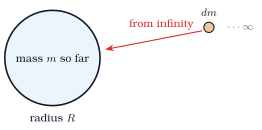
A shell of radius \(R\) is being assembled; it has mass \(m\) so far.
Find the work done by the external agent in bringing the next \(dm\) from infinity.
Integrate from \(m = 0\) to \(M\) and obtain the self-energy.
Answer(i) \(-\frac{Gm\,dm}{R}\) (ii) \(-\frac{GM^2}{2R}\)
Solution
The potential at the shell is \(-\dfrac{Gm}{R}\), so \(dW = V\,dm = -\dfrac{Gm\,dm}{R}\).
How much energy would be needed to scatter all the Earth's matter to infinity? Explain using Q16.
Answer\(2.3 \times 10^{32}\) J
Solution
To scatter the matter to infinity the self-energy must be raised from \(-2.3 \times 10^{32}\) J to zero, so about \(2.3 \times 10^{32}\) J must be supplied. This is the Earth's gravitational binding energy.
How did it go?
Q18
Why is the self-energy negative? What does a more negative self-energy mean physically?
Answergravity does positive work while assembling; more tightly bound
Solution
As the pieces are brought together, gravity pulls them in and does positive work, so the agent does negative work. The assembled body has less energy than the scattered matter. A more negative self-energy means the body is more tightly bound and needs more energy to pull apart.
How did it go?
Small situations
Q19
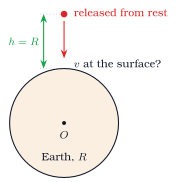
The body is released from rest at a height \(R\). Use \(gR = 6.4 \times 10^{7}\) J/kg.
Find the change in potential per kilogram between the two positions.
Find the speed at the surface.
Answer(i) \(-3.2 \times 10^{7}\) J/kg (ii) \(8\) km/s
\(\dfrac{1}{2}v^2 = 3.2 \times 10^{7}\), so \(v^2 = 6.4 \times 10^{7} = gR\) and \(v = 8000\) m/s \(= 8\) km/s.
How did it go?
Q20
Two \(1\) kg particles are released from rest \(1\) m apart in free space. Find the total kinetic energy when they are \(0.5\) m apart, and the speed of each. Take \(G = 6.67 \times 10^{-11}\) SI units.
Answer\(6.7 \times 10^{-11}\) J; \(8.2 \times 10^{-6}\) m/s
Solution
Energy: \(K = U_1 - U_2 = -\dfrac{G}{1} + \dfrac{G}{0.5} = G = 6.7 \times 10^{-11}\) J in total. Momentum is conserved and the masses are equal, so each has \(\dfrac{G}{2}\): \(\dfrac{1}{2}v^2 = 3.3 \times 10^{-11}\), \(v \approx 8.2 \times 10^{-6}\) m/s.
How did it go?
Q21
On the Moon \(g = 1.6\) m/s\(^2\) and \(R = 1.7 \times 10^{6}\) m. Find the potential difference between the Moon's surface and infinity.
Find the least speed with which a body must be thrown up from the Earth's surface to reach a height \(R\). Why does it equal the answer to Q19?
Answer\(8\) km/s; same energy change, reversed
Solution
It must supply \(\dfrac{gR}{2}\) per kilogram: \(\dfrac{1}{2}v^2 = \dfrac{gR}{2}\), so \(v = \sqrt{gR} = 8\) km/s. Going up from the surface to \(R\) is the time reverse of falling from \(R\) to the surface. The same energy change gives the same speed.
How did it go?
Q23
Find the energy needed just to lift a \(1000\) kg satellite from the surface to a height \(R\), ignoring any orbital speed. Use \(gR = 6.4 \times 10^{7}\) J/kg.
Answer\(3.2 \times 10^{10}\) J
Solution
\(W = m\,\Delta V = 1000 \times \dfrac{gR}{2} = 1000 \times 3.2 \times 10^{7} = 3.2 \times 10^{10}\) J.
How did it go?
Q24
Show that the work done in lifting a mass \(m\) from the surface to a height \(h\) is \(\frac{mghR}{R + h}\). Show that it reduces to \(mgh\) for \(h \ll R\).
\(W = m\left[V(R + h) - V(R)\right] = GMm\left(\dfrac{1}{R} - \dfrac{1}{R + h}\right) = \dfrac{GMmh}{R(R + h)}\). With \(GM = gR^2\): \(W = \dfrac{mghR}{R + h}\). For \(h \ll R\), \(R + h \approx R\) and \(W \approx mgh\).
How did it go?
Satellites: Orbital Speed, Period and Geostationary Orbit
24 questions · after Lesson 5, Satellites in Orbit
Orbital speed
Q25
A satellite of mass \(m\) moves in a circle of radius \(r\) about a planet of mass \(M\). Derive its orbital speed by balancing the gravitational force against the centripetal requirement.
Gravity is the only force and it must supply the centripetal force: \(\dfrac{GMm}{r^2} = \dfrac{mv^2}{r}\). So \(v^2 = \dfrac{GM}{r}\) and \(v = \sqrt{\dfrac{GM}{r}}\).
How did it go?
Q26
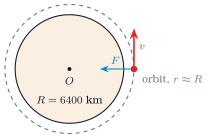
The satellite orbits just above the surface. Take \(g = 10\) m/s\(^2\) and \(R = 6400\) km.
Show that \(v = \sqrt{gR}\) and evaluate it.
Find the period.
Answer(i) \(GM = gR^2\); \(8\) km/s (ii) \(\approx 5000\) s \(\approx 84\) min
\(T = \dfrac{2\pi R}{v} = \dfrac{2\pi \times 6.4 \times 10^{6}}{8000} \approx 5000\) s, about \(84\) min.
How did it go?
Q27
A satellite orbits at a height \(R\) above the surface. Find its speed and period. Take \(g = 10\) m/s\(^2\) and \(R = 6400\) km.
Answer\(4\sqrt2 \approx 5.7\) km/s; \(\approx 1.4 \times 10^{4}\) s \(\approx 4\) h
Solution
\(r = 2R\): \(v = \sqrt{\dfrac{gR^2}{2R}} = \sqrt{\dfrac{gR}{2}} = \dfrac{8}{\sqrt2} = 4\sqrt2 \approx 5.7\) km/s. \(T = \dfrac{2\pi \times 2R}{v} = \dfrac{4\pi \times 6.4 \times 10^{6}}{5657} \approx 1.4 \times 10^{4}\) s, about \(4\) h. Check: \(T \propto r^{3/2}\), and \(2^{3/2} \times 84\) min \(\approx 238\) min.
How did it go?
Q28
Does the orbital speed depend on the mass of the satellite? Explain in one sentence.
Answerno; \(m\) cancels
Solution
No. The satellite's mass appears on both sides of \(\dfrac{GMm}{r^2} = \dfrac{mv^2}{r}\) and cancels; the speed is fixed by \(M\) and \(r\) alone.
How did it go?
Q29
A satellite is in free fall all the time. Why does it never reach the ground?
Answerthe ground curves away as fast as it falls
Solution
It falls towards the Earth continuously, but it also moves sideways very fast. In the time it falls a little, the ground has curved away by the same amount. The fall never closes the gap, so the path stays a circle.
How did it go?
Q30
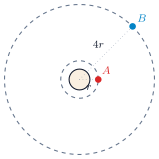
How does the orbital speed change if the orbital radius is made four times larger?
Answerhalved
Solution
\(v \propto \dfrac{1}{\sqrt r}\). Four times the radius gives half the speed.
How did it go?
Period
Q31
Derive \(T = 2\pi\sqrt{\frac{r^3}{GM}}\) and state how \(T^2\) depends on \(r\).
Two satellites of different masses move in the same circular orbit. Compare their speeds and periods, with a reason.
Answersame; \(m\) cancels
Solution
Both have the same speed \(\sqrt{GM/r}\) and the same period \(2\pi\sqrt{r^3/GM}\), because the satellite's mass cancels in the force equation. Only their energies and momenta differ.
How did it go?
Geostationary orbit
Q37
List the conditions a satellite must satisfy to appear fixed in the sky from the ground.
Answer\(T = 24\) h, equatorial plane, west to east, circular
Solution
Its period must equal the Earth's rotation period, \(24\) h. It must orbit in the equatorial plane, in the same sense as the Earth turns, west to east. The orbit must be circular so that its angular speed is uniform.
How did it go?
Q38
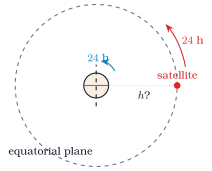
Use \(GM = 4 \times 10^{14}\) m\(^3\)/s\(^2\), \(T = 86400\) s and \(4\pi^2 \approx 40\).
Find the orbital radius.
Find the height \(h\) above the surface (\(R = 6400\) km).
Answer(i) \(\approx 4.2 \times 10^{7}\) m (ii) \(\approx 36000\) km
Why can a geostationary satellite not be placed so that it stays directly above Delhi (latitude \(28^\circ\) N)?
Answerorbit plane must pass through the centre; only the equatorial plane works
Solution
The centre of every orbit is the centre of the Earth, so the orbit plane passes through the centre. A circle above latitude \(28^\circ\) would be centred on the axis, not on the Earth's centre, and gravity cannot hold a satellite on it. Only the equatorial plane both contains the centre and turns with the ground.
How did it go?
Q41
How many geostationary satellites are needed to cover almost the whole Earth for communication? Which regions are left out?
Answerthree, \(120^\circ\) apart; the polar regions
Solution
Three satellites spaced \(120^\circ\) apart around the geostationary ring can see almost the whole surface between them. The regions near the poles are left out: from there a geostationary satellite sits below the horizon.
How did it go?
Q42
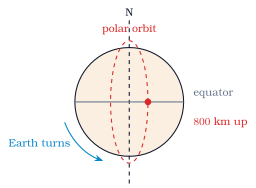
The satellite is in a circular polar orbit \(800\) km up. Use \(GM = 4 \times 10^{14}\) m\(^3\)/s\(^2\) and \(R = 6400\) km.
Find its period.
Why can such a satellite photograph every part of the Earth?
Answer(i) \(\approx 6100\) s \(\approx 100\) min (ii) Earth turns under the fixed orbit plane
Solution
\(r = 7200\) km \(= 7.2 \times 10^{6}\) m. \(T = 2\pi\sqrt{\dfrac{r^3}{GM}} = 2\pi\sqrt{\dfrac{3.73 \times 10^{20}}{4 \times 10^{14}}} = 2\pi \times 966 \approx 6100\) s, about \(100\) min.
The orbit plane stays fixed in space while the Earth turns beneath it. On successive passes the satellite flies over strips of ground further and further west, so it sweeps the whole globe.
How did it go?
Small situations
Q43
A satellite orbits at \(r = 2R\). Take \(g = 10\) m/s\(^2\). Find \(g\) at the orbit and the satellite's centripetal acceleration.
Answer\(2.5\) m/s\(^2\); \(2.5\) m/s\(^2\)
Solution
\(g' = \dfrac{g}{4} = 2.5\) m/s\(^2\). In a circular orbit gravity is the only force, so the centripetal acceleration equals \(g'\): \(2.5\) m/s\(^2\).
How did it go?
Q44
Why do astronauts in an orbiting station feel weightless, although gravity there is nearly \(9\) m/s\(^2\)?
Answerfree fall, no normal force
Solution
The station and everyone in it fall freely with the same acceleration \(g'\). The floor does not push on the astronauts, so there is no normal force. Weightlessness is the absence of that push, not the absence of gravity.
How did it go?
Q45
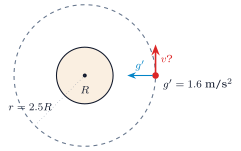
At the orbit, \(r = 2.5R = 1.6 \times 10^{7}\) m and the field is \(g' = 1.6\) m/s\(^2\).
Show that \(v = \sqrt{g'r}\).
Find \(v\).
Answer(i) \(g' = \frac{v^2}{r}\) (ii) \(\approx 5.1\) km/s
Solution
At the orbit gravity per unit mass is \(g'\), and it must equal the centripetal acceleration: \(g' = \dfrac{v^2}{r}\), so \(v = \sqrt{g'r}\).
Two satellites in the same orbit have masses \(m\) and \(2m\). Find the ratio of their kinetic energies and of their periods.
Answer\(1 : 2\); \(1 : 1\)
Solution
Same orbit, same speed. \(K = \dfrac{1}{2}mv^2 \propto m\): ratio \(1 : 2\). The period does not depend on mass: ratio \(1 : 1\).
How did it go?
Q48
Using \(GM = gR^2\), show that the period of a satellite at radius \(r\) is \(T = 2\pi\sqrt{\frac{r^3}{gR^2}}\). Check that it gives \(2\pi\sqrt{R/g}\) for \(r = R\).
Answer\(T = 2\pi\sqrt{r^3/GM}\) with \(GM = gR^2\)
Solution
\(T = 2\pi\sqrt{\dfrac{r^3}{GM}}\) with \(GM = gR^2\) gives \(T = 2\pi\sqrt{\dfrac{r^3}{gR^2}}\). For \(r = R\): \(T = 2\pi\sqrt{\dfrac{R^3}{gR^2}} = 2\pi\sqrt{\dfrac{R}{g}}\), the period found in Q2.
How did it go?
Satellite Energy, Binding Energy and Escape
24 questions · after Lesson 6, The Energy of a Satellite
Energies of a satellite
Q49
A satellite of mass \(m\) orbits at radius \(r\) about a planet of mass \(M\). Write its kinetic, potential and total energy, and show that \(E = -K = \frac{U}{2}\).
\(v^2 = \dfrac{GM}{r}\), so \(K = \dfrac{1}{2}mv^2 = \dfrac{GMm}{2r}\). \(U = -\dfrac{GMm}{r}\). \(E = K + U = -\dfrac{GMm}{2r}\). Comparing: \(E = -K\) and \(E = \dfrac{U}{2}\).
How did it go?
Q50
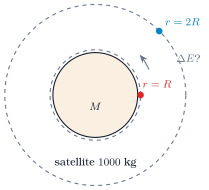
A \(1000\) kg satellite orbits at \(r = 2R\). Use \(GM = gR^2\) with \(gR = 6.4 \times 10^{7}\) J/kg.
Find \(K\), \(U\) and \(E\).
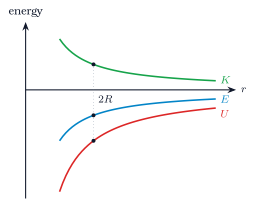
Which curve is which on the graph? Give the reason.
Answer(i) \(1.6 \times 10^{10}\); \(-3.2 \times 10^{10}\); \(-1.6 \times 10^{10}\) J (ii) \(K > 0\), \(U\) lowest, \(E\) between
Solution
\(\dfrac{GMm}{r} = \dfrac{mgR^2}{2R} = \dfrac{mgR}{2} = 1000 \times 3.2 \times 10^{7} = 3.2 \times 10^{10}\) J. So \(U = -3.2 \times 10^{10}\) J, \(K = 1.6 \times 10^{10}\) J and \(E = -1.6 \times 10^{10}\) J.
\(K\) is the only positive curve. \(U\) is the lowest, twice as far below the axis as \(E\), and \(E\) lies exactly midway between \(U\) and the axis. All three shrink towards zero as \(r\) grows.
How did it go?
Q51
Why is the total energy of a satellite negative? What would a positive total energy mean?
\(E < 0\) means the kinetic energy is less than the energy needed to climb to infinity, where \(U = 0\). The satellite is bound; it cannot get away. A positive total energy would mean it reaches infinity with kinetic energy to spare: it escapes.
How did it go?
Q52
Find the kinetic and total energy of a \(1000\) kg satellite skimming the Earth's surface. Use \(gR = 6.4 \times 10^{7}\) J/kg.
\(r = R\): \(K = \dfrac{mgR}{2} = 3.2 \times 10^{10}\) J and \(E = -K = -3.2 \times 10^{10}\) J.
How did it go?
Q53
Define the binding energy of a satellite. Find it for the satellite of Q2.
Answerenergy to remove it to infinity, \(-E\); \(1.6 \times 10^{10}\) J
Solution
The binding energy is the least energy that must be supplied to carry the satellite to infinity and leave it at rest there: \(B = 0 - E = \dfrac{GMm}{2r}\). For Q2: \(1.6 \times 10^{10}\) J.
How did it go?
Q54
Find the energy needed to put the \(1000\) kg satellite from rest on the surface into the orbit at \(r = 2R\). Ignore the Earth's rotation.
Answer\(4.8 \times 10^{10}\) J
Solution
On the surface at rest: \(E_1 = -\dfrac{GMm}{R} = -mgR = -6.4 \times 10^{10}\) J. In orbit: \(E_2 = -1.6 \times 10^{10}\) J. Energy needed \(= E_2 - E_1 = 4.8 \times 10^{10}\) J, which is \(\dfrac{3}{4}mgR\).
How did it go?
Changing orbits
Q55
A satellite is moved from an orbit of radius \(r\) to one of radius \(2r\). State whether \(K\), \(U\) and \(E\) increase or decrease, and find the work needed in terms of \(\frac{GMm}{r}\).
Answer\(K\) decreases; \(U\) and \(E\) increase; \(\frac{GMm}{4r}\)
Solution
\(K = \dfrac{GMm}{2r}\) halves, so it decreases. \(U = -\dfrac{GMm}{r}\) goes from \(-\dfrac{GMm}{r}\) to \(-\dfrac{GMm}{2r}\): it increases. \(E = -\dfrac{GMm}{2r}\) goes to \(-\dfrac{GMm}{4r}\): it increases. Work \(= \Delta E = \dfrac{GMm}{2r} - \dfrac{GMm}{4r} = \dfrac{GMm}{4r}\).
How did it go?
Q56
The \(1000\) kg satellite is raised from the skimming orbit to \(r = 2R\). Use \(gR = 6.4 \times 10^{7}\) J/kg.
At \(R\): \(E = -\dfrac{mgR}{2} = -3.2 \times 10^{10}\) J. At \(2R\): \(E = -\dfrac{mgR}{4} = -1.6 \times 10^{10}\) J.
\(\Delta E = -1.6 \times 10^{10} + 3.2 \times 10^{10} = 1.6 \times 10^{10}\) J.
How did it go?
Q57
To raise its orbit a satellite fires its engine forward, gaining speed. Yet in the higher orbit it moves more slowly. Explain.
Answergravity slows it as it climbs; \(v \propto r^{-1/2}\)
Solution
The burn adds kinetic energy, so the total energy rises and the satellite climbs to a larger orbit. While climbing, gravity does negative work and takes back more kinetic energy than the burn gave. In the new orbit \(v = \sqrt{GM/r}\) is smaller, though \(E\) is larger.
How did it go?
Q58
Air drag slowly removes energy from a low satellite. Explain why its speed increases as it spirals down.
Answer\(E\) falls, so \(r\) falls and \(K = -E\) rises
Solution
Drag lowers \(E\), so \(E = -\dfrac{GMm}{2r}\) becomes more negative and \(r\) shrinks. Since \(K = -E\), the kinetic energy grows as \(E\) falls. Gravity does positive work on the way in, more than drag removes, and the satellite speeds up.
How did it go?
Q59
Two \(1000\) kg satellites orbit at \(R\) and \(2R\). Find the ratio of their binding energies and of their speeds.
Answer\(2 : 1\); \(\sqrt2 : 1\)
Solution
\(B \propto \dfrac{1}{r}\): ratio \(\dfrac{B_R}{B_{2R}} = 2 : 1\). \(v \propto \dfrac{1}{\sqrt r}\): ratio \(\sqrt2 : 1\).
How did it go?
Escape speed
Q60
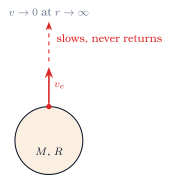
Derive the escape speed \(v_e = \sqrt{\frac{2GM}{R}} = \sqrt{2gR}\) from energy conservation, and evaluate it for the Earth. Use \(gR = 6.4 \times 10^{7}\) J/kg.
To just reach infinity with zero speed, the total energy must be zero: \(\dfrac{1}{2}mv_e^2 - \dfrac{GMm}{R} = 0\), so \(v_e = \sqrt{\dfrac{2GM}{R}} = \sqrt{2gR} = \sqrt{1.28 \times 10^{8}} \approx 11.3 \times 10^{3}\) m/s.
How did it go?
Q61
A body leaves the surface at exactly \(v_e\).
What are its speed and total energy when it is very far away?
Show that \(v_e = \sqrt2\,v_o\), where \(v_o\) is the speed of a skimming orbit.
Answer(i) zero; zero (ii) \(v_e^2 = 2gR = 2v_o^2\)
Solution
Very far away \(U \to 0\), and the total energy is zero, so the kinetic energy and the speed also go to zero. \(E = 0\) throughout.
\(v_e^2 = 2gR\) and \(v_o^2 = gR\), so \(v_e^2 = 2v_o^2\) and \(v_e = \sqrt2\,v_o\).
How did it go?
Q62
Find the escape speed from the Moon: \(g = 1.6\) m/s\(^2\), \(R = 1.7 \times 10^{6}\) m.
A planet has twice the Earth's mass and twice its radius. Find its escape speed.
Answer\(11.3\) km/s, same as Earth
Solution
\(v_e = \sqrt{\dfrac{2GM}{R}} \propto \sqrt{\dfrac{M}{R}}\). Doubling both leaves the ratio unchanged, so \(v_e = 11.3\) km/s, the same as for the Earth.
How did it go?
Q64
A body is thrown up from the Earth at \(2v_o\), twice the skimming orbital speed. Show that it escapes, and find its speed when very far away. Take \(v_o = 8\) km/s.
\(E = \dfrac{1}{2}m(2v_o)^2 - \dfrac{GMm}{R} = 2mv_o^2 - mv_o^2 = mv_o^2 > 0\), so it escapes. Far away all of \(E\) is kinetic: \(\dfrac{1}{2}mv_\infty^2 = mv_o^2\), so \(v_\infty = \sqrt2\,v_o \approx 11.3\) km/s.
How did it go?
Q65
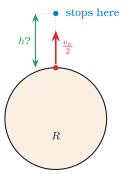
A body is thrown up at \(\frac{v_e}{2}\).
Write the energy equation between the surface and the highest point.
Find the height \(h\) in terms of \(R\).
Answer(i) \(\frac{1}{2}\cdot\frac{v_e^2}{4} - gR = -\frac{gR^2}{R + h}\) (ii) \(\frac{R}{3}\)
Solution
Per unit mass: \(\dfrac{1}{2}\left(\dfrac{v_e}{2}\right)^2 - \dfrac{GM}{R} = 0 - \dfrac{GM}{R + h}\). With \(v_e^2 = 2gR\) and \(GM = gR^2\): \(\dfrac{gR}{4} - gR = -\dfrac{gR^2}{R + h}\).
\(-\dfrac{3gR}{4} = -\dfrac{gR^2}{R + h}\), so \(R + h = \dfrac{4R}{3}\) and \(h = \dfrac{R}{3}\).
How did it go?
Q66
Does the escape speed depend on the direction in which the body is thrown? Ignore air and the Earth's rotation. Explain.
Answerno; energy is a scalar
Solution
No. The escape condition is \(E \ge 0\), and both \(\dfrac{1}{2}mv^2\) and \(U\) are scalars that do not depend on direction. Any direction that does not hit the ground works. Rotation and air would change the practical answer, which is why rockets launch eastward.
How did it go?
Atmospheres and small situations
Q67
The rms speed of hydrogen molecules at \(300\) K is about \(1.9\) km/s. Explain why the Moon (\(v_e \approx 2.3\) km/s) has no atmosphere, while the Earth keeps oxygen.
Answerfast molecules exceed \(v_e\) on the Moon; \(0.5\) km/s \(\ll 11.3\) km/s on Earth
Solution
The rms speed is only an average; a good fraction of the molecules move much faster. On the Moon, \(1.9\) km/s is close to \(v_e = 2.3\) km/s, so the fast tail keeps escaping and over ages the gas is lost. On the Earth, oxygen at about \(0.5\) km/s is far below \(11.3\) km/s, so almost none escapes.
How did it go?
Q68
Find the rms speed of oxygen at \(300\) K, using \(v_{\text{rms}} = \sqrt{\frac{3RT}{M}}\) with \(R = 8.3\) J/mol K and \(M = 0.032\) kg/mol. Compare it with the Earth's escape speed.
Answer\(\approx 0.48\) km/s; far below \(11.3\) km/s
Solution
\(v_{\text{rms}} = \sqrt{\dfrac{3 \times 8.3 \times 300}{0.032}} = \sqrt{2.33 \times 10^{5}} \approx 480\) m/s \(\approx 0.48\) km/s, about \(\dfrac{1}{24}\) of the escape speed. The Earth keeps its oxygen.
How did it go?
Q69
At what temperature would the rms speed of hydrogen (\(M = 0.002\) kg/mol) equal the Earth's escape speed of \(11.3\) km/s?
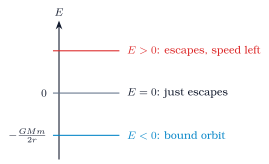
A body is given total energy \(E\) near a planet. Describe its motion for \(E < 0\), \(E = 0\) and \(E > 0\).
Answerbound orbit; just escapes; escapes with speed left
Solution
\(E < 0\): the body is bound and moves in a closed orbit (circle or ellipse); it never reaches infinity. \(E = 0\): it just escapes, arriving at infinity with zero speed. \(E > 0\): it escapes and still has kinetic energy \(E\) when far away.
How did it go?
Q71
The \(1000\) kg satellite of Q2 orbits at \(r = 2R\). How much extra energy must it be given to escape from the Earth?
Answer\(1.6 \times 10^{10}\) J
Solution
It must be given its binding energy, \(-E = \dfrac{GMm}{2r} = 1.6 \times 10^{10}\) J. Its total energy then becomes zero and it can just reach infinity.
How did it go?
Q72
Show that the minimum extra speed a skimming satellite needs in order to escape is \((\sqrt2 - 1)v_o\), and evaluate it for \(v_o = 8\) km/s.
Answer\(\approx 3.3\) km/s
Solution
The satellite already moves at \(v_o\). To escape from radius \(R\) it needs \(v_e = \sqrt2\,v_o\) in the same direction, so the extra speed is \(\sqrt2\,v_o - v_o = (\sqrt2 - 1)v_o \approx 0.414 \times 8 \approx 3.3\) km/s.
How did it go?
Kepler's Laws, Binary Stars and the Two-Body Problem
24 questions · after Lesson 7, Kepler's Laws and Binary Stars
Kepler's laws
Q73
State Kepler's three laws of planetary motion.
Answerellipses with the Sun at a focus; equal areas in equal times; \(T^2 \propto a^3\)
Solution
First: each planet moves on an ellipse with the Sun at one focus. Second: the line from the Sun to the planet sweeps equal areas in equal times. Third: the square of the period is proportional to the cube of the semi-major axis, \(T^2 \propto a^3\).
How did it go?
Q74
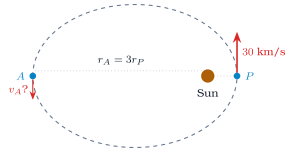
The planet's speed at perihelion \(P\) is \(30\) km/s and \(r_A = 3r_P\).
Which quantity is conserved between \(P\) and \(A\)? Why?
Find the speed at aphelion \(A\).
Answer(i) angular momentum; gravity is central (ii) \(10\) km/s
Solution
Angular momentum about the Sun. The Sun's pull is along the line to the Sun, so it has no torque about the Sun and cannot change \(L\).
At \(P\) and \(A\) the velocity is perpendicular to the radius: \(mv_Pr_P = mv_Ar_A\), so \(v_A = v_P\dfrac{r_P}{r_A} = \dfrac{30}{3} = 10\) km/s.
How did it go?
Q75
The Earth (\(m = 6 \times 10^{24}\) kg) has orbital angular momentum \(2.7 \times 10^{40}\) kg m\(^2\)/s about the Sun. Find its areal velocity.
Show that the areal velocity of a planet is \(\frac{dA}{dt} = \frac{L}{2m}\), and hence that Kepler's second law follows from conservation of angular momentum.
In time \(dt\) the radius vector turns through a small angle and sweeps a thin triangle of area \(dA = \dfrac{1}{2}r\,(v_\perp dt)\). Here \(v_\perp\) is the velocity component perpendicular to \(\vec r\). So \(\dfrac{dA}{dt} = \dfrac{1}{2}rv_\perp = \dfrac{L}{2m}\), since \(L = mrv_\perp\). Gravity is central, so \(L\) is constant and so is the areal velocity: Kepler's second law.
How did it go?
Q77
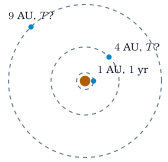
Use Kepler's third law with the Earth (\(1\) AU, \(1\) yr) as reference.
Find \(T\) for \(a = 4\) AU.
Find \(T\) for \(a = 9\) AU.
Answer(i) \(8\) yr (ii) \(27\) yr
Solution
\(T = a^{3/2}\) in years when \(a\) is in AU: \(4^{3/2} = 8\) yr.
\(9^{3/2} = 27\) yr.
How did it go?
Q78
A comet has a period of \(27\) years and a perihelion distance of \(1\) AU. Find its semi-major axis and its aphelion distance.
For an elliptical orbit of semi-major axis \(a\), write the total energy and the speed at distance \(r\). Show that at \(r = a\) the speed equals that of a circular orbit of radius \(a\).
\(E = -\dfrac{GMm}{2a}\). Energy conservation gives \(\dfrac{1}{2}mv^2 - \dfrac{GMm}{r} = -\dfrac{GMm}{2a}\), so \(v^2 = GM\left(\dfrac{2}{r} - \dfrac{1}{a}\right)\). At \(r = a\): \(v^2 = \dfrac{GM}{a}\), exactly the circular-orbit speed at radius \(a\).
How did it go?
Q80
Show that for any elliptical orbit \(\frac{v_P}{v_A} = \frac{r_A}{r_P}\). Where is the kinetic energy of the planet largest, and where is the potential energy largest?
Answer\(mv_Pr_P = mv_Ar_A\); \(K\) at \(P\); \(U\) at \(A\)
Solution
At \(P\) and \(A\) the velocity is perpendicular to \(\vec r\), so \(L = mv_Pr_P = mv_Ar_A\) and \(\dfrac{v_P}{v_A} = \dfrac{r_A}{r_P}\). Kinetic energy is largest at \(P\) (largest speed). Potential energy \(-\dfrac{GMm}{r}\) is largest, that is least negative, at \(A\) where \(r\) is largest.
How did it go?
Q81
Halley's comet has \(r_P = 0.6\) AU and \(r_A = 35\) AU. Find its semi-major axis and estimate its period.
Answer\(17.8\) AU; \(\approx 75\) yr
Solution
\(a = \dfrac{0.6 + 35}{2} = 17.8\) AU. \(T = a^{3/2} = 17.8^{1.5} \approx 75\) yr, which matches its observed return every \(75\) to \(76\) years.
How did it go?
Q82
Give two different physical reasons why a planet moves fastest at perihelion.
Answer\(L\) conserved with smallest \(r\); gravity did positive work on the way in
Solution
Angular momentum: \(L = mrv_\perp\) is fixed, so the smallest \(r\) goes with the largest speed. Energy: on the way in from aphelion, gravity pulls the planet inward along its motion and does positive work, turning potential energy into kinetic energy.
How did it go?
Binary stars
Q83
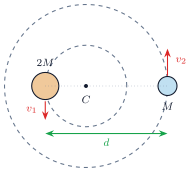
The two stars circle their common centre of mass \(C\) with separation \(d\).
Find the distance of each star from \(C\).
Why must both stars have the same period?
Find \(\frac{v_1}{v_2}\).
Answer(i) \(\frac{d}{3}\); \(\frac{2d}{3}\) (ii) they stay opposite \(C\) (iii) \(\frac{1}{2}\)
Solution
\(C\) divides \(d\) in the inverse ratio of the masses. The \(2M\) star is \(\dfrac{M}{3M}d = \dfrac{d}{3}\) from \(C\) and the \(M\) star is \(\dfrac{2d}{3}\) from \(C\).
The force on each star points at the other, through \(C\). Both stars must always lie on a line through \(C\), on opposite sides. So they turn through equal angles in equal times: same period, same \(\omega\).
\(v = \omega r\) with the same \(\omega\): \(\dfrac{v_1}{v_2} = \dfrac{d/3}{2d/3} = \dfrac{1}{2}\). The heavier star moves more slowly.
How did it go?
Q84
For the binary of Q11, apply \(F = m\omega^2r\) to either star and show that \(\omega^2 = \frac{G(m_1 + m_2)}{d^3}\).
For star 1: \(\dfrac{Gm_1m_2}{d^2} = m_1\omega^2r_1\) with \(r_1 = \dfrac{m_2d}{m_1 + m_2}\). So \(\dfrac{Gm_2}{d^2} = \omega^2\dfrac{m_2d}{m_1 + m_2}\), giving \(\omega^2 = \dfrac{G(m_1 + m_2)}{d^3}\). Star 2 gives the same result.
How did it go?
Q85
Two stars of \(2 \times 10^{30}\) kg each are \(2 \times 10^{11}\) m apart in circular orbits. Find their common period. Take \(G = 6.67 \times 10^{-11}\) SI units.
Answer\(\approx 3.4 \times 10^{7}\) s \(\approx 1.1\) yr
Equal masses, so each is \(\dfrac{d}{2} = 10^{11}\) m from \(C\). \(v = \dfrac{2\pi \times 10^{11}}{3.4 \times 10^{7}} \approx 1.8 \times 10^{4}\) m/s \(\approx 18\) km/s.
How did it go?
Q87
Define the reduced mass of a two-body system. Find it for masses \(2M\) and \(M\), and for two equal masses \(M\).
\(\mu = \dfrac{m_1m_2}{m_1 + m_2}\). For \(2M\) and \(M\): \(\dfrac{2M^2}{3M} = \dfrac{2M}{3}\). For \(M\) and \(M\): \(\dfrac{M^2}{2M} = \dfrac{M}{2}\).
How did it go?
Q88
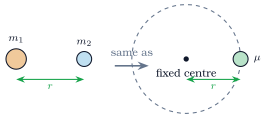
Two bodies attract each other with force \(F = \frac{Gm_1m_2}{r^2}\).
Write the accelerations of the two bodies and hence the relative acceleration.
Show that the relative motion obeys \(\mu\,a_{\text{rel}} = F\), with \(\mu\) the reduced mass.
Each body accelerates towards the other: \(a_1 = \dfrac{F}{m_1}\) and \(a_2 = \dfrac{F}{m_2}\), in opposite directions. The separation therefore shrinks at the rate \(a_{\text{rel}} = a_1 + a_2 = F\left(\dfrac{1}{m_1} + \dfrac{1}{m_2}\right)\).
\(\dfrac{1}{m_1} + \dfrac{1}{m_2} = \dfrac{m_1 + m_2}{m_1m_2} = \dfrac{1}{\mu}\), so \(a_{\text{rel}} = \dfrac{F}{\mu}\), that is \(\mu\,a_{\text{rel}} = F\). The relative motion is that of a single body of mass \(\mu\) pulled by \(F\) towards a fixed centre.
How did it go?
Q89
Write the total energy of a binary star in circular orbits with separation \(d\). Evaluate it for the binary of Q13.
\(E = -\dfrac{Gm_1m_2}{2d}\), the same form as for a satellite with \(d\) as the separation. \(E = -\dfrac{6.67 \times 10^{-11} \times 4 \times 10^{60}}{2 \times 2 \times 10^{11}} \approx -6.7 \times 10^{38}\) J.
How did it go?
Q90
Using the reduced mass, show that the total kinetic energy of the binary of Q13 is \(\frac{Gm_1m_2}{2d}\).
The total kinetic energy about \(C\) equals \(\dfrac{1}{2}\mu v_{\text{rel}}^2\), where \(v_{\text{rel}} = \omega d\) is the relative speed. Using \(\omega^2 = \dfrac{G(m_1 + m_2)}{d^3}\): \(v_{\text{rel}}^2 = \dfrac{G(m_1 + m_2)}{d}\), so \(K = \dfrac{1}{2}\cdot\dfrac{m_1m_2}{m_1 + m_2}\cdot\dfrac{G(m_1 + m_2)}{d} = \dfrac{Gm_1m_2}{2d}\). Then \(E = K + U = \dfrac{Gm_1m_2}{2d} - \dfrac{Gm_1m_2}{d} = -\dfrac{Gm_1m_2}{2d}\), as in Q17.
How did it go?
Small situations
Q91
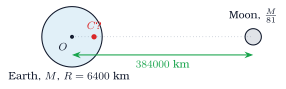
Locate the centre of mass \(C\) of the Earth-Moon system. Is it inside the Earth?
Answer\(\approx 4700\) km from the Earth's centre; yes
Solution
From the Earth's centre: \(x = \dfrac{m_{\text{moon}}d}{M + m_{\text{moon}}} = \dfrac{384000}{82} \approx 4700\) km. This is less than the Earth's radius of \(6400\) km, so \(C\) lies inside the Earth, about \(1700\) km below the surface.
How did it go?
Q92
What does the Earth actually do while the Moon "orbits the Earth"? Describe the motion of both bodies about \(C\).
Answerboth circle \(C\) with the same period; Earth on a small circle
Solution
Both bodies circle \(C\) with the same period of \(27.3\) days, always on opposite sides of it. The Moon moves on a circle of radius about \(379000\) km. The Earth's centre moves on a small circle of radius \(4700\) km, a wobble that shows up in the Earth's motion about the Sun.
How did it go?
Q93
A satellite has \(r_P = 2R\) and \(r_A = 6R\) about the Earth. Find the semi-major axis, the ratio \(\frac{v_P}{v_A}\), and the total energy in terms of \(\frac{GMm}{R}\).
If the Sun's mass were doubled, what would be the period of a planet in a circular orbit of the present Earth's radius?
Answer\(\frac{1}{\sqrt2}\) yr \(\approx 258\) days
Solution
\(T = 2\pi\sqrt{\dfrac{r^3}{GM}} \propto \dfrac{1}{\sqrt M}\). Doubling \(M\) divides the period by \(\sqrt2\): \(T = \dfrac{1}{\sqrt2}\) yr \(\approx 0.71\) yr \(\approx 258\) days.
How did it go?
Q96
Starting from \(\omega^2 = \frac{G(m_1 + m_2)}{d^3}\), show that the period of a binary is \(T = 2\pi\sqrt{\frac{d^3}{G(m_1 + m_2)}}\). What does this reduce to when \(m_2 \ll m_1\)?
\(T = \dfrac{2\pi}{\omega} = 2\pi\sqrt{\dfrac{d^3}{G(m_1 + m_2)}}\). When \(m_2 \ll m_1\), \(m_1 + m_2 \approx m_1\) and \(T \approx 2\pi\sqrt{\dfrac{d^3}{Gm_1}}\), the ordinary satellite formula with the heavy body fixed at the centre.