Questions on Temperature and Thermal Expansion, the kind your examinations ask. Solve one on paper. Then tell the book how it went. The book believes you, and it uses your answer to plan your revision.
0%
Nothing marked yetMark honestly. Peek at the answer only after your own attempt.
Temperature Scales and Thermometers
22 questions · after Lesson 3, How Thermometers Work
Scales and conversions
Q1
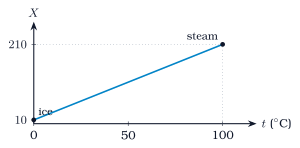
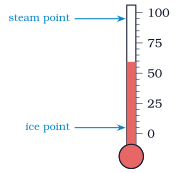
The ice point and the steam point are \(0^\circ\)C and \(100^\circ\)C, \(32^\circ\)F and \(212^\circ\)F. Take the ice point as \(273\) K throughout this sheet.
Write the relation between a Celsius reading \(C\), a Fahrenheit reading \(F\) and a Kelvin reading \(T\).
Convert \(40^\circ\)C to \(^\circ\)F and to K.
Convert \(77^\circ\)F to \(^\circ\)C.
Answer(i) \(\frac{C}{100} = \frac{F - 32}{180} = \frac{T - 273}{100}\) (ii) \(104^\circ\)F; \(313\) K (iii) \(25^\circ\)C
Solution
Each scale is linear between the two fixed points. So the fraction of the way from the ice point to the steam point is the same on every scale.
The temperature of a room rises by \(20^\circ\)C. Write this rise in kelvin and in Fahrenheit degrees. Why is a temperature difference the same number in \(^\circ\)C and in K?
Answer\(20\) K; \(36^\circ\)F; same size of degree
Solution
A Celsius degree and a kelvin are the same size: both are \(\dfrac{1}{100}\) of the interval between the ice point and the steam point. So a rise of \(20^\circ\)C is a rise of \(20\) K.
The same interval is \(180\) Fahrenheit degrees, so one Celsius degree is \(1.8\) Fahrenheit degrees. The rise is \(20 \times 1.8 = 36^\circ\)F.
The two scales differ only in where zero is placed. A difference does not depend on the zero.
How did it go?
Q3
Find the temperature at which the Celsius and Fahrenheit readings are equal. Find the Celsius temperature at which the Fahrenheit reading is twice the Celsius reading.
Put \(F = C\) in \(F = \dfrac{9}{5}C + 32\): \(C = \dfrac{9}{5}C + 32\), so \(-\dfrac{4}{5}C = 32\) and \(C = -40\). The scales agree at \(-40^\circ\).
Put \(F = 2C\): \(2C = \dfrac{9}{5}C + 32\), so \(\dfrac{1}{5}C = 32\) and \(C = 160^\circ\)C. Check: \(160^\circ\)C is \(320^\circ\)F.
How did it go?
Q4
Absolute zero is \(-273.15^\circ\)C. Write absolute zero in \(^\circ\)F. Why does the Kelvin scale have no negative temperatures?
Answer\(-459.67^\circ\)F; no thermal motion below \(0\) K
Let the reading equal the true temperature \(t\): \(t = 5 + 0.9t\), so \(0.1t = 5\) and \(t = 50^\circ\)C.
How did it go?
Q9
Another faulty thermometer reads \(-2^\circ\)C in melting ice and \(103^\circ\)C in steam.
Find its reading when the true temperature is \(60^\circ\)C.
At which true temperature does it read correctly?
Answer(i) \(61^\circ\)C (ii) \(40^\circ\)C
Solution
There are \(105\) divisions between the fixed points. Reading \(= -2 + \dfrac{60}{100} \times 105 = -2 + 63 = 61^\circ\)C.
\(t = -2 + 1.05t\), so \(0.05t = 2\) and \(t = 40^\circ\)C.
How did it go?
Q10
Scale \(A\) has fixed points \(30^\circ\)A and \(90^\circ\)A. Scale \(B\) has fixed points \(-10^\circ\)B and \(110^\circ\)B. Write \(B\) in terms of \(A\). Find the reading on \(B\) when \(A\) reads \(60^\circ\)A.
In a constant-volume gas thermometer, which quantity is kept fixed and which is measured? Write the relation between the temperature \(T\) and the pressure \(P\). The pressure is \(60\) cm of mercury at the ice point and \(80\) cm of mercury in a hot bath. Find the bath temperature in K and in \(^\circ\)C.
Answervolume; pressure; \(T = 273\,\frac{P}{P_0}\); \(364\) K \(= 91^\circ\)C
Solution
The volume of the gas is kept fixed and the pressure is measured. For a gas at constant volume the pressure is proportional to the absolute temperature: \(\dfrac{T}{273} = \dfrac{P}{P_0}\), where \(P_0\) is the pressure at the ice point.
\(T = 273 \times \dfrac{80}{60} = 364\) K, which is \(364 - 273 = 91^\circ\)C.
How did it go?
Q13
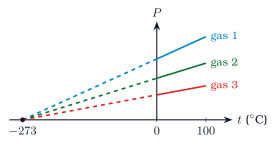
The graph shows the pressure of a fixed volume of gas against temperature for three different gases.
What do the three lines have in common? What is the temperature at this point called?
The pressure of one gas is \(P_0\) at \(0^\circ\)C and \(1.366P_0\) at \(100^\circ\)C. Use these values to find the temperature at which the pressure would fall to zero.
Answer(i) meet at \(-273^\circ\)C; absolute zero (ii) \(-273^\circ\)C
Solution
All three lines, when extended, cut the temperature axis at the same point, \(-273^\circ\)C. There the pressure of every gas would be zero. This temperature is absolute zero.
The pressure rises linearly: \(P = P_0(1 + \beta t)\) with \(\beta = \dfrac{1.366 - 1}{100} = 0.00366\) per \(^\circ\)C. \(P = 0\) when \(t = -\dfrac{1}{\beta} = -\dfrac{100}{0.366} = -273^\circ\)C.
How did it go?
Q14
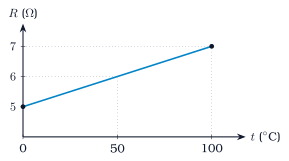
The resistance of a platinum wire is \(10\ \Omega\) at the ice point and \(14\ \Omega\) at the steam point.
Write the formula that gives the temperature \(t\) from the resistance \(R_t\).
Find the temperature when the resistance is \(12.4\ \Omega\).
Find the temperature coefficient of resistance \(\alpha\), defined by \(R_t = R_0(1 + \alpha t)\).
Answer(i) \(t = \frac{R_t - R_0}{R_{100} - R_0} \times 100\) (ii) \(60^\circ\)C (iii) \(0.004\) per \(^\circ\)C
Solution
The resistance rises linearly with temperature, so \(t = \dfrac{R_t - R_0}{R_{100} - R_0} \times 100\).
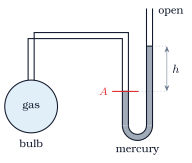
The figure shows a constant-volume gas thermometer. The right limb of the manometer is open to the air at pressure \(P_0\).
How is the volume of the gas kept constant when the bulb is heated?
Write the pressure of the gas in terms of \(P_0\), the height \(h\) and the density \(\rho\) of mercury.
Why is the gas thermometer chosen as the standard thermometer?
Answer(i) mercury brought back to \(A\) (ii) \(P_0 + h\rho g\) (iii) all gases agree; wide range
Solution
When the gas is heated it pushes the mercury in the left limb down. The right limb is raised (or mercury is added) until the left level is back at the mark \(A\). The gas then fills the same volume as before.
The mercury in the right limb stands \(h\) higher, so \(P = P_0 + h\rho g\).
At low pressure all gases give the same reading, so the scale does not depend on the gas chosen. A gas thermometer also works over a very wide range, from about \(-270^\circ\)C to over \(1000^\circ\)C.
How did it go?
Q17
The modern scale uses one fixed point, the triple point of water at \(273.16\) K, and \(T = 273.16\,\frac{P}{P_{tr}}\). The pressure in a gas thermometer is twice its triple-point value. Find \(T\). Why is the triple point a better fixed point than the ice point?
Answer\(546.32\) K; single, reproducible
Solution
\(T = 273.16 \times 2 = 546.32\) K.
The triple point is one exact state: ice, water and vapour together at one fixed pressure. It is easy to reproduce anywhere. The ice point depends on the air pressure and on dissolved air in the water, so it varies slightly.
How did it go?
Q18
Name the thermometric property used in each thermometer.
mercury-in-glass,
constant-volume gas,
platinum resistance,
thermocouple.
What must be true of a property before it can be used to measure temperature?
Answer(i) length (ii) pressure (iii) resistance (iv) emf; changes steadily with \(T\)
Solution
(i) The length of the mercury column. (ii) The pressure of the gas. (iii) The electrical resistance of the platinum wire. (iv) The emf across the junctions.
The property must change steadily with temperature, and one value of the property must correspond to one temperature only.
How did it go?
Small situations
Q19
In a mercury thermometer the mercury column is \(2\) cm long in melting ice and \(22\) cm long in steam. Find the temperature when the column is \(8\) cm long. Find the length of the column at \(45^\circ\)C.
Answer\(30^\circ\)C; \(11\) cm
Solution
The length \(l\) is the thermometric property: \(t = \dfrac{l - l_0}{l_{100} - l_0} \times 100 = \dfrac{8 - 2}{22 - 2} \times 100 = 30^\circ\)C.
At \(45^\circ\)C, \(l = 2 + \dfrac{45}{100} \times 20 = 11\) cm.
How did it go?
Q20
Write \(27^\circ\)C and \(-73^\circ\)C in kelvin and find the ratio of the two absolute temperatures. Is the ratio of the two Celsius readings meaningful? Give the reason.
Answer\(300\) K; \(200\) K; \(1.5\); no
Solution
\(27 + 273 = 300\) K and \(-73 + 273 = 200\) K. Ratio \(= \dfrac{300}{200} = 1.5\).
The Celsius ratio \(\dfrac{27}{-73}\) means nothing. The Celsius zero is an arbitrary point, so a Celsius reading is not proportional to how hot a body is. Only absolute temperatures can be compared as ratios.
How did it go?
Q21
An oven is heated from \(20^\circ\)C to \(200^\circ\)C. Find the rise in temperature in K and in \(^\circ\)F. Find the final temperature in \(^\circ\)F.
Final temperature \(= \dfrac{9}{5} \times 200 + 32 = 392^\circ\)F.
How did it go?
Q22
Mercury freezes at \(-39^\circ\)C and boils at \(357^\circ\)C. Why can a mercury thermometer measure neither \(-50^\circ\)C nor \(400^\circ\)C? Suggest one thermometer for each of these temperatures.
Answersolid; gas; alcohol; platinum or gas
Solution
At \(-50^\circ\)C mercury is solid, so the column cannot move. At \(400^\circ\)C mercury is a vapour, so there is no column.
For \(-50^\circ\)C use an alcohol thermometer (alcohol freezes at \(-115^\circ\)C). For \(400^\circ\)C use a platinum resistance thermometer or a gas thermometer.
How did it go?
Linear, Areal and Volume Expansion
22 questions · after Lesson 5, Liquids, Density and the Strange Case of Water
Linear expansion
Q23
Define the coefficient of linear expansion \(\alpha\) and write the formula for the change in length \(\Delta L\) of a rod. A steel rod (\(\alpha = 1.2 \times 10^{-5}\) per \(^\circ\)C) is \(2\) m long at \(20^\circ\)C. Find its change in length when it is heated to \(70^\circ\)C. Write the unit and the dimensions of \(\alpha\).
Answer\(\Delta L = \alpha L\Delta T\); \(1.2\) mm; per \(^\circ\)C, \([\mathrm{K}^{-1}]\)
Solution
\(\alpha\) is the fractional increase in length per degree rise in temperature: \(\alpha = \dfrac{\Delta L}{L\,\Delta T}\), so \(\Delta L = \alpha L\Delta T\).
\(\Delta L = 1.2 \times 10^{-5} \times 2 \times 50 = 1.2 \times 10^{-3}\) m \(= 1.2\) mm.
\(\alpha\) has the unit per \(^\circ\)C (the same as per kelvin) and the dimensions \([\mathrm{K}^{-1}]\), because \(\Delta L / L\) is a pure number.
How did it go?
Q24
Railway rails are \(20\) m long and are laid at \(10^\circ\)C. The temperature can rise to \(50^\circ\)C. Find the gap that must be left between two rails. Take \(\alpha = 1.2 \times 10^{-5}\) per \(^\circ\)C. What happens if no gap is left?
Answer\(9.6\) mm; rails buckle
Solution
\(\Delta L = \alpha L\Delta T = 1.2 \times 10^{-5} \times 20 \times 40 = 9.6 \times 10^{-3}\) m \(= 9.6\) mm. The gap must be at least \(9.6\) mm.
Without a gap the rails push against each other as they expand. The thermal stress bends them sideways and the track buckles.
How did it go?
Q25
A brass rod (\(\alpha = 2 \times 10^{-5}\) per \(^\circ\)C) is heated by \(100^\circ\)C. Find the fractional change in its length and express it as a percentage. Does this fraction depend on the length of the rod?
Answer\(2 \times 10^{-3} = 0.2\%\); no
Solution
\(\dfrac{\Delta L}{L} = \alpha\Delta T = 2 \times 10^{-5} \times 100 = 2 \times 10^{-3}\), that is \(0.2\%\).
The fraction depends only on \(\alpha\) and \(\Delta T\), not on the length. A long rod and a short rod expand by the same percentage.
How did it go?
Q26
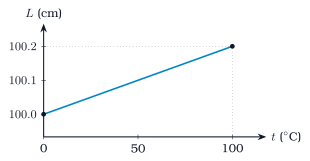
The graph shows the length \(L\) of a metal rod against its temperature \(t\).
Read the length at \(0^\circ\)C and at \(100^\circ\)C.
Find \(\alpha\) for the metal.
Find the length of the rod at \(250^\circ\)C.
Answer(i) \(100.0\) cm; \(100.2\) cm (ii) \(2 \times 10^{-5}\) per \(^\circ\)C (iii) \(100.5\) cm
Solution
\(L_0 = 100.0\) cm at \(0^\circ\)C and \(L = 100.2\) cm at \(100^\circ\)C.
The line is straight, so \(\Delta L = 2 \times 10^{-5} \times 100 \times 250 = 0.5\) cm and \(L = 100.5\) cm.
How did it go?
Q27
A steel rod (\(\alpha = 1.2 \times 10^{-5}\) per \(^\circ\)C) is longer than a brass rod (\(\alpha = 1.8 \times 10^{-5}\) per \(^\circ\)C) by \(10\) cm at every temperature. Find the length of each rod.
Answersteel \(30\) cm; brass \(20\) cm
Solution
The difference stays the same only if both rods expand by the same amount: \(\alpha_s L_s\Delta T = \alpha_b L_b\Delta T\).
\(1.2 L_s = 1.8 L_b\), so \(L_s = 1.5 L_b\). With \(L_s - L_b = 10\) cm, \(0.5 L_b = 10\) cm. So \(L_b = 20\) cm and \(L_s = 30\) cm.
How did it go?
Areal and volume expansion
Q28
A square plate of side \(a\) is heated by \(\Delta T\). Show that the coefficient of areal expansion is \(\beta = 2\alpha\). State the corresponding result for the coefficient of volume expansion \(\gamma\) of a cube.
Answer\(\beta = 2\alpha\); \(\gamma = 3\alpha\)
Solution
Each side becomes \(a(1 + \alpha\Delta T)\). The area becomes \(a^2(1 + \alpha\Delta T)^2 = a^2(1 + 2\alpha\Delta T + \alpha^2\Delta T^2)\).
\(\alpha\Delta T\) is very small, so its square can be dropped: \(A' = A(1 + 2\alpha\Delta T)\). Comparing with \(A' = A(1 + \beta\Delta T)\) gives \(\beta = 2\alpha\).
For a cube the volume is \(a^3(1 + \alpha\Delta T)^3 \approx a^3(1 + 3\alpha\Delta T)\), so \(\gamma = 3\alpha\).
How did it go?
Q29
A brass plate (\(\alpha = 2 \times 10^{-5}\) per \(^\circ\)C) has an area of \(0.5\) m\(^2\). Find the increase in its area when it is heated by \(100^\circ\)C. Give the answer in cm\(^2\).
A metal cube (\(\alpha = 2.5 \times 10^{-5}\) per \(^\circ\)C) has sides of \(10\) cm. It is heated by \(200^\circ\)C. Find the increase in its volume and its new volume.
\(\Delta V = \gamma V\Delta T = 7.5 \times 10^{-5} \times 1000 \times 200 = 15\) cm\(^3\). New volume \(= 1015\) cm\(^3\).
How did it go?
Q31
A crystal expands differently along its three axes, with coefficients \(\alpha_x\), \(\alpha_y\) and \(\alpha_z\).
Show that its coefficient of volume expansion is \(\gamma = \alpha_x + \alpha_y + \alpha_z\).
For \(\alpha_x = 1 \times 10^{-5}\), \(\alpha_y = 2 \times 10^{-5}\) and \(\alpha_z = 3 \times 10^{-5}\) per \(^\circ\)C, find \(\gamma\) and the areal coefficient \(\beta\) of the face in the \(xy\) plane.
Answer(i) \(\gamma = \alpha_x + \alpha_y + \alpha_z\) (ii) \(6 \times 10^{-5}\); \(3 \times 10^{-5}\) per \(^\circ\)C
Solution
\(V' = x(1 + \alpha_x\Delta T)\,y(1 + \alpha_y\Delta T)\,z(1 + \alpha_z\Delta T)\). Multiplying and dropping products of small terms: \(V' = V[1 + (\alpha_x + \alpha_y + \alpha_z)\Delta T]\). So \(\gamma = \alpha_x + \alpha_y + \alpha_z\).
\(\gamma = (1 + 2 + 3) \times 10^{-5} = 6 \times 10^{-5}\) per \(^\circ\)C. The \(xy\) face has \(\beta = \alpha_x + \alpha_y = 3 \times 10^{-5}\) per \(^\circ\)C.
How did it go?
Cavities
Q32
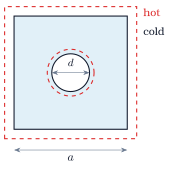
A square brass plate of side \(a = 10\) cm has a circular hole of diameter \(d = 2\) cm. The plate is heated by \(100^\circ\)C. Take \(\alpha = 2 \times 10^{-5}\) per \(^\circ\)C.
Does the hole become larger or smaller? Give the reason.
Find the change in the diameter of the hole, in mm.
Find the percentage change in the area of the hole.
Answer(i) larger (ii) \(0.04\) mm (iii) \(0.4\%\)
Solution
Larger. Every distance in the plate grows by the same fraction, including the distance across the hole. The hole expands exactly as a brass disc filling it would.
\(\Delta d = \alpha d\Delta T = 2 \times 10^{-5} \times 2 \times 100 = 4 \times 10^{-3}\) cm \(= 0.04\) mm.
\(\dfrac{\Delta A}{A} = \beta\Delta T = 2\alpha\Delta T = 4 \times 10^{-3} = 0.4\%\).
How did it go?
Q33
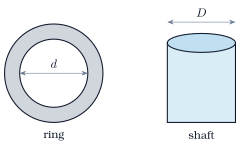
An iron ring (\(\alpha = 1.25 \times 10^{-5}\) per \(^\circ\)C) has an inner diameter \(d = 10.00\) cm at \(20^\circ\)C. It must be fitted over a shaft of diameter \(D = 10.01\) cm.
By how much must the inner diameter grow?
Find the temperature to which the ring must be heated.
What happens when the ring cools on the shaft?
Answer(i) \(0.01\) cm (ii) \(100^\circ\)C (iii) grips the shaft
Solution
\(\Delta d = 10.01 - 10.00 = 0.01\) cm.
\(\Delta T = \dfrac{\Delta d}{\alpha d} = \dfrac{0.01}{1.25 \times 10^{-5} \times 10} = 80^\circ\)C. The ring must be heated to \(20 + 80 = 100^\circ\)C.
As the ring cools it tries to shrink back to \(10.00\) cm. The shaft stops it, so the ring grips the shaft tightly. This is how iron tyres are fitted on cart wheels.
How did it go?
Q34
A glass flask (\(\alpha = 8 \times 10^{-6}\) per \(^\circ\)C) holds exactly \(1000\) cm\(^3\) at \(0^\circ\)C. Does the cavity expand like solid glass when the flask is heated? Find the volume of the flask at \(100^\circ\)C.
Answeryes; \(1002.4\) cm\(^3\)
Solution
Yes. The glass around the cavity expands outward in every direction, so the cavity grows as if it were filled with glass.
\(\gamma = 3\alpha = 2.4 \times 10^{-5}\) per \(^\circ\)C. \(\Delta V = 2.4 \times 10^{-5} \times 1000 \times 100 = 2.4\) cm\(^3\). Volume at \(100^\circ\)C \(= 1002.4\) cm\(^3\).
How did it go?
Density
Q35
A body of density \(\rho\) and volume expansion coefficient \(\gamma\) is heated by \(\Delta T\). Show that its new density is \(\rho' = \frac{\rho}{1 + \gamma\Delta T} \approx \rho(1 - \gamma\Delta T)\). A liquid of density \(1000\) kg/m\(^3\) and \(\gamma = 5 \times 10^{-4}\) per \(^\circ\)C is heated by \(20^\circ\)C. Find its new density.
The mass does not change. \(\rho' = \dfrac{m}{V'} = \dfrac{m}{V(1 + \gamma\Delta T)} = \dfrac{\rho}{1 + \gamma\Delta T}\).
For small \(x\), \(\dfrac{1}{1 + x} \approx 1 - x\), so \(\rho' \approx \rho(1 - \gamma\Delta T)\).
\(\gamma\Delta T = 5 \times 10^{-4} \times 20 = 0.01\). \(\rho' = \dfrac{1000}{1.01} = 990\) kg/m\(^3\) (the approximate form also gives \(990\)).
How did it go?
Anomalous expansion of water
Q36
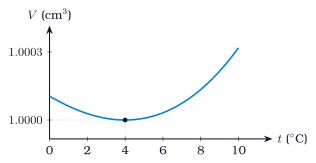
The graph shows the volume of \(1\) g of water between \(0^\circ\)C and \(10^\circ\)C.
At which temperature is the volume least? At which temperature is the density greatest?
Between \(0^\circ\)C and \(4^\circ\)C, does water expand or contract when heated? What is the sign of \(\gamma\) there?
Read the density of water at \(4^\circ\)C from the graph.
Answer(i) \(4^\circ\)C; \(4^\circ\)C (ii) contracts; negative (iii) \(1\) g/cm\(^3\)
Solution
The volume is least at \(4^\circ\)C. The same mass in the least volume means the density is greatest at \(4^\circ\)C.
From \(0^\circ\)C to \(4^\circ\)C the volume falls as the temperature rises, so water contracts on heating. \(\gamma = \dfrac{\Delta V}{V\Delta T}\) is negative there.
\(1\) g fills \(1.0000\) cm\(^3\) at \(4^\circ\)C, so the density is \(1\) g/cm\(^3 = 1000\) kg/m\(^3\).
How did it go?
Q37
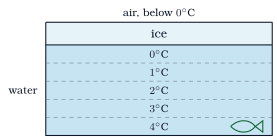
The figure shows a lake in winter.
Why is the water at the bottom at \(4^\circ\)C and not colder?
Why does the lake freeze from the top and not from the bottom?
Why does the ice float on the water?
Answer(i) densest water sinks (ii) coldest water floats (iii) ice less dense
Solution
As the lake cools, the water at \(4^\circ\)C is the densest and sinks to the bottom. Water colder than \(4^\circ\)C is lighter and stays above it. So the bottom layer stays at \(4^\circ\)C.
The coldest water, at \(0^\circ\)C, is the least dense and floats at the top. It freezes first, so ice forms at the surface.
Water expands when it freezes, so ice is less dense than water (about \(0.92\) g/cm\(^3\)). The lighter ice floats. The ice layer also insulates the water below, so the lake does not freeze solid.
How did it go?
Q38
A thermometer is made with water instead of mercury. Why would its readings between \(0^\circ\)C and \(8^\circ\)C be useless?
Answertwo temperatures, one volume
Solution
Between \(0^\circ\)C and \(8^\circ\)C the volume of water first falls and then rises. Two different temperatures, such as \(2^\circ\)C and \(6^\circ\)C, give the same volume, so one reading could mean either temperature. A thermometric property must change in one direction only.
How did it go?
Q39
A sealed steel bottle is completely full of water at \(4^\circ\)C. It is cooled to \(0^\circ\)C. What happens to the water and to the bottle? Give the reason.
Answerwater expands; bottle may burst
Solution
Below \(4^\circ\)C water expands on cooling. The water needs more room, but the steel bottle contracts slightly on cooling. The water presses hard on the walls and the bottle may burst. This is why water pipes crack in a hard frost.
How did it go?
Small situations
Q40
A steel metre scale (\(\alpha = 1.2 \times 10^{-5}\) per \(^\circ\)C) is correct at \(20^\circ\)C. At \(40^\circ\)C it reads \(100\) cm for a rod. Is the true length of the rod more or less than \(100\) cm? Find the true length.
Answermore; \(100.024\) cm
Solution
At \(40^\circ\)C every division of the scale is longer than \(1\) mm, so the scale reads too few divisions. The true length is more than \(100\) cm.
A steel tank (\(\alpha = 1.2 \times 10^{-5}\) per \(^\circ\)C) has a volume of \(2\) m\(^3\) at \(20^\circ\)C. Find the increase in its volume, in litres, when it is heated to \(70^\circ\)C.
A copper wire (\(\alpha = 1.7 \times 10^{-5}\) per \(^\circ\)C) is \(5\) m long on a hot day at \(40^\circ\)C. Find its length on a cold night at \(0^\circ\)C.
Answer\(4.9966\) m, shorter by \(3.4\) mm
Solution
\(\Delta L = \alpha L\Delta T = 1.7 \times 10^{-5} \times 5 \times (-40) = -3.4 \times 10^{-3}\) m. The wire contracts by \(3.4\) mm, to \(4.9966\) m.
How did it go?
Q43
Two rods have lengths in the ratio \(1 : 2\) and coefficients of linear expansion in the ratio \(2 : 1\). Both are heated by the same \(\Delta T\). Find the ratio of their increases in length.
Answer\(1 : 1\)
Solution
\(\Delta L = \alpha L\Delta T\), so \(\dfrac{\Delta L_1}{\Delta L_2} = \dfrac{\alpha_1 L_1}{\alpha_2 L_2} = \dfrac{2 \times 1}{1 \times 2} = 1\). The ratio is \(1 : 1\).
How did it go?
Q44
A glass jar (\(\alpha = 8 \times 10^{-6}\) per \(^\circ\)C) has a tight aluminium lid (\(\alpha = 2.4 \times 10^{-5}\) per \(^\circ\)C). Both are warmed in hot water. Does the lid become looser or tighter? Give the reason.
Answerlooser
Solution
Looser. Both the lid and the mouth of the jar expand, but \(\alpha\) for aluminium is three times that of glass. The lid grows more than the jar, so the grip loosens. This is why a stuck lid is run under hot water.
How did it go?
Expansion of Liquids and Mechanical Applications
22 questions · after Lesson 6, Expansion at Work
Apparent expansion of liquids
Q45
A liquid is heated in a vessel. Define its real expansion and its apparent expansion. Write the relation between \(\gamma_{real}\), \(\gamma_{app}\) and \(\gamma_{vessel}\). Why is the apparent expansion smaller than the real expansion?
Answerreal: true volume rise; apparent: rise of level; \(\gamma_{app} = \gamma_{real} - \gamma_{vessel}\); vessel expands too
Solution
The real expansion is the true increase in the volume of the liquid. The apparent expansion is the increase in the level seen in the vessel.
The vessel expands as well, so part of the real expansion only fills the extra space in the vessel. Hence \(\gamma_{app} = \gamma_{real} - \gamma_{vessel}\), and the apparent expansion is smaller than the real one.
How did it go?
Q46
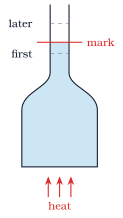
A glass flask is filled with a liquid up to a mark on its neck and heated from below. The level first falls below the mark and then rises above it.
Why does the level fall at first?
Why does the level rise later?
What would be seen if the liquid and the glass had the same \(\gamma\)?
Answer(i) glass expands first (ii) liquid expands more (iii) no change
Solution
The heat reaches the glass first. The flask expands before the liquid has warmed, so the same liquid fills a larger flask and the level dips.
Once the liquid is heated it expands too. Its \(\gamma\) is much larger than that of glass, so the liquid soon fills the extra space and rises above the mark.
After the first dip the level would return to the mark and stay there. The liquid and the flask would expand by the same fraction.
How did it go?
Q47
For mercury \(\gamma = 1.8 \times 10^{-4}\) per \(^\circ\)C, and for glass \(\alpha = 8 \times 10^{-6}\) per \(^\circ\)C.
Find \(\gamma\) for glass.
Find the apparent expansion coefficient of mercury in glass.
A glass flask is full of \(500\) cm\(^3\) of mercury. Find the volume that overflows when the flask is heated by \(100^\circ\)C.
Answer(i) \(2.4 \times 10^{-5}\) (ii) \(1.56 \times 10^{-4}\) per \(^\circ\)C (iii) \(7.8\) cm\(^3\)
Solution
\(\gamma = 3\alpha = 2.4 \times 10^{-5}\) per \(^\circ\)C.
Overflow \(= \gamma_{app}V\Delta T = 1.56 \times 10^{-4} \times 500 \times 100 = 7.8\) cm\(^3\). (The mercury expands by \(9\) cm\(^3\) and the flask by \(1.2\) cm\(^3\).)
How did it go?
Q48
A glass vessel (\(\gamma = 2.4 \times 10^{-5}\) per \(^\circ\)C) is full of \(1000\) cm\(^3\) of a liquid. When the vessel is heated by \(20^\circ\)C, \(3.52\) cm\(^3\) of the liquid overflows. Find the apparent and the real expansion coefficients of the liquid.
Answer\(1.76 \times 10^{-4}\); \(2.0 \times 10^{-4}\) per \(^\circ\)C
A liquid with \(\gamma = 7.5 \times 10^{-5}\) per \(^\circ\)C fills a metal vessel with \(\alpha = 2.5 \times 10^{-5}\) per \(^\circ\)C. What is seen when the vessel is heated? Give the reason.
Answerlevel unchanged; \(\gamma_l = 3\alpha_v\)
Solution
\(\gamma_{vessel} = 3\alpha = 7.5 \times 10^{-5}\) per \(^\circ\)C, the same as \(\gamma\) of the liquid. So \(\gamma_{app} = 0\): the liquid and the vessel expand by the same fraction, and the level does not move.
How did it go?
Q50
A glass vessel (\(\gamma_v = 2.4 \times 10^{-5}\) per \(^\circ\)C) of volume \(1000\) cm\(^3\) is partly filled with a liquid (\(\gamma_l = 2.4 \times 10^{-4}\) per \(^\circ\)C). Find the volume of liquid for which the empty space above the liquid stays the same at every temperature.
Answer\(100\) cm\(^3\)
Solution
The empty space stays the same if the liquid expands by exactly the same volume as the vessel: \(\gamma_l V_l\Delta T = \gamma_v V\Delta T\).
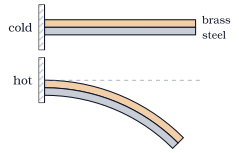
The figure shows a strip of brass (\(\alpha = 2 \times 10^{-5}\) per \(^\circ\)C) fixed to a strip of steel (\(\alpha = 1.2 \times 10^{-5}\) per \(^\circ\)C).
When the strip is heated, which metal lies on the outside of the bend? Give the reason.
Which way does the strip bend when it is cooled below room temperature?
Name two uses of a bimetallic strip.
Answer(i) brass (ii) other way (iii) thermostat; fire alarm
Solution
Brass. It has the larger \(\alpha\), so it becomes longer than the steel. The longer strip must lie on the outside of the curve, where the arc is longer.
On cooling the brass contracts more and becomes the shorter strip. The strip bends the other way, with brass on the inside.
A thermostat in an iron, a geyser or a refrigerator; a fire alarm; a bimetallic thermometer.
How did it go?
Q52
Two strips, each of thickness \(d\), are joined to make a bimetallic strip. When heated by \(\Delta T\) it bends into an arc of radius \(R\) and angle \(\theta\). Show that \(R = \frac{d}{(\alpha_1 - \alpha_2)\Delta T}\). Take the arc lengths of the two centre lines as \((R + \frac{d}{2})\theta\) and \((R - \frac{d}{2})\theta\).
For small quantities the left side is \(1 + (\alpha_1 - \alpha_2)\Delta T\) and the right side is \(1 + \dfrac{d}{R}\). So \(R = \dfrac{d}{(\alpha_1 - \alpha_2)\Delta T}\).
How did it go?
Q53
The strip of Question 7 has \(d = 1\) mm and is heated by \(100^\circ\)C. Find the radius of the bend. What is the radius if the rise in temperature is doubled?
\(R \propto \dfrac{1}{\Delta T}\), so doubling the rise halves the radius: \(R = 0.625\) m. The strip bends more sharply.
How did it go?
Q54
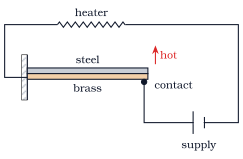
The figure shows a thermostat. The strip, steel above brass, rests on a contact and completes the heater circuit.
Which way does the strip bend when the room becomes hot? Give the reason.
What happens to the heater?
What happens when the room cools again?
Answer(i) upward (ii) circuit breaks (iii) contact remade
Solution
Upward. Brass expands more than steel, so the brass side becomes longer and must lie on the outside of the bend. With brass below, the free end lifts.
The free end leaves the contact, the circuit breaks and the heater stops.
The strip straightens, the free end rests on the contact again and the heater works again. The room temperature stays close to the set value.
How did it go?
Pendulum clock
Q55
The time period of a simple pendulum is \(T = 2\pi\sqrt{L/g}\). The rod of length \(L\) has a coefficient of expansion \(\alpha\). Show that a temperature rise \(\Delta\theta\) changes the period by the fraction \(\frac{\Delta T}{T} = \frac{1}{2}\alpha\,\Delta\theta\).
A pendulum clock with a brass rod (\(\alpha = 2 \times 10^{-5}\) per \(^\circ\)C) keeps correct time at \(20^\circ\)C. Find the fractional change in its period at \(30^\circ\)C. Does the clock run fast or slow at \(30^\circ\)C? Find the time it gains or loses in a day.
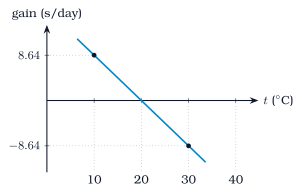
The graph shows the daily gain of a pendulum clock against temperature. A negative gain is a loss.
At which temperature does the clock keep correct time?
Find the loss per day at \(40^\circ\)C.
Find \(\alpha\) for the pendulum rod.
Answer(i) \(20^\circ\)C (ii) \(17.28\) s (iii) \(2 \times 10^{-5}\) per \(^\circ\)C
Solution
The line crosses zero gain at \(20^\circ\)C. The clock is correct there.
The line is straight: \(8.64\) s per \(10^\circ\)C. At \(40^\circ\)C, \(20^\circ\)C above the correct temperature, the loss is \(2 \times 8.64 = 17.28\) s per day.
Per \(10^\circ\)C the fractional change is \(\dfrac{8.64}{86400} = 10^{-4} = \dfrac{1}{2}\alpha \times 10\), so \(\alpha = 2 \times 10^{-5}\) per \(^\circ\)C.
How did it go?
Density and buoyancy
Q60
Show that a body of density \(\rho\) heated by \(\Delta T\) has a new density \(\rho' \approx \rho(1 - \gamma\Delta T)\). A solid with \(\alpha = 10^{-5}\) per \(^\circ\)C is heated by \(100^\circ\)C. Find the percentage change in its density.
Answer\(-0.3\%\)
Solution
The mass is fixed and the volume becomes \(V(1 + \gamma\Delta T)\). So \(\rho' = \dfrac{\rho}{1 + \gamma\Delta T} \approx \rho(1 - \gamma\Delta T)\), using \(\dfrac{1}{1 + x} \approx 1 - x\).
\(\gamma = 3\alpha = 3 \times 10^{-5}\) per \(^\circ\)C. \(\dfrac{\Delta\rho}{\rho} = -\gamma\Delta T = -3 \times 10^{-3}\), a fall of \(0.3\%\).
How did it go?
Q61
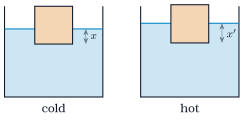
A block of density \(\rho_s\) floats in a liquid of density \(\rho_l\) with a fraction \(f\) of its volume below the surface. Their expansion coefficients are \(\gamma_s\) and \(\gamma_l\).
Write \(f\) in terms of the densities. Show that after a rise \(\Delta T\) the fraction is \(f' = f\,\frac{1 + \gamma_l\Delta T}{1 + \gamma_s\Delta T}\).
When does the block sink deeper on heating?
For \(f = 0.8\), \(\gamma_l = 5 \times 10^{-4}\), \(\gamma_s = 5 \times 10^{-5}\) per \(^\circ\)C and \(\Delta T = 100^\circ\)C, find \(f'\).
Answer(i) \(f = \rho_s/\rho_l\) (ii) \(\gamma_l > \gamma_s\) (iii) \(0.836\)
Solution
Floating: weight \(=\) buoyancy, so \(\rho_s V g = \rho_l (fV) g\) and \(f = \dfrac{\rho_s}{\rho_l}\).
After heating, \(\rho_s' = \dfrac{\rho_s}{1 + \gamma_s\Delta T}\) and \(\rho_l' = \dfrac{\rho_l}{1 + \gamma_l\Delta T}\). So \(f' = \dfrac{\rho_s'}{\rho_l'} = f\,\dfrac{1 + \gamma_l\Delta T}{1 + \gamma_s\Delta T}\).
\(f' > f\) when \(\gamma_l > \gamma_s\). The liquid becomes lighter faster than the block, so the block must displace more liquid and sinks deeper. Liquids usually expand more than solids, so this is the common case.
\(f' = 0.8 \times \dfrac{1 + 0.05}{1 + 0.005} = 0.8 \times \dfrac{1.05}{1.005} = 0.836\). About \(84\%\) of the block is now below the surface.
How did it go?
Q62
A body is fully submerged in a liquid, with \(\gamma_l = 3 \times 10^{-4}\) and \(\gamma_s = 3 \times 10^{-5}\) per \(^\circ\)C. Both are heated by \(100^\circ\)C. Find the percentage change in the buoyant force on the body.
Answer\(-2.7\%\)
Solution
Buoyant force \(F = V\rho_l g\). After heating, \(V' = V(1 + \gamma_s\Delta T)\) and \(\rho_l' = \dfrac{\rho_l}{1 + \gamma_l\Delta T}\).
A small glass ball has exactly the density of water at \(4^\circ\)C and floats just below the surface. The water is warmed to \(20^\circ\)C. Does the ball rise or sink? Give the reason.
Answersinks; water less dense
Solution
Sinks. Water is densest at \(4^\circ\)C, so at \(20^\circ\)C the water is less dense than before. The glass ball expands very little, so its density is almost unchanged and is now greater than that of the water.
How did it go?
Q65
A solid has density \(8000\) kg/m\(^3\) at \(0^\circ\)C and \(\alpha = 1.25 \times 10^{-5}\) per \(^\circ\)C. Find its density at \(100^\circ\)C.
Answer\(7970\) kg/m\(^3\)
Solution
\(\gamma = 3\alpha = 3.75 \times 10^{-5}\) per \(^\circ\)C. \(\gamma\Delta T = 3.75 \times 10^{-3}\).
\(\rho' = \dfrac{8000}{1.00375} = 7970\) kg/m\(^3\). The approximate form \(8000(1 - 0.00375) = 7970\) agrees.
How did it go?
Q66
In a mercury thermometer the glass bore expands along with the mercury. Why does the mercury column still rise when the thermometer is heated? Which coefficient, real or apparent, does the scale actually measure?
Answermercury expands \(7.5\) times more; apparent
Solution
For mercury \(\gamma = 1.8 \times 10^{-4}\) per \(^\circ\)C, for glass only \(2.4 \times 10^{-5}\) per \(^\circ\)C. Mercury expands about \(7.5\) times more than the bore, so the extra volume must move up the bore.
The scale reads the rise of the column, which is the apparent expansion, \(\gamma_{app} = 1.56 \times 10^{-4}\) per \(^\circ\)C. The bore's own expansion is already allowed for when the scale is marked.