Questions on Calorimetry and Change of State, the kind your examinations ask. Solve one on paper. Then tell the book how it went. The book believes you, and it uses your answer to plan your revision.
0%
Nothing marked yetMark honestly. Peek at the answer only after your own attempt.
Specific Heat, Latent Heat and Heating Curves
22 questions · after Lesson 3, Reading a Heating Curve
Specific heat
Q1
Define the specific heat capacity \(s\) of a substance. Write the formula for the heat \(Q\) needed to warm a mass \(m\) by \(\Delta T\), and give the SI unit of \(s\). Find the heat needed to warm \(2\) kg of water from \(20^\circ\)C to \(30^\circ\)C. Throughout this sheet take \(s = 4200\) J/kg K for water, \(2100\) J/kg K for ice, \(L = 3.36 \times 10^5\) J/kg for ice and \(2.26 \times 10^6\) J/kg for steam.
Answer\(Q = ms\Delta T\); J/kg K; \(84\) kJ
Solution
The specific heat capacity is the heat needed to warm \(1\) kg of the substance by \(1\) K: \(Q = ms\Delta T\). Its SI unit is J/kg K.
Define the heat capacity \(C\) of a body and give its unit. A copper block of mass \(0.5\) kg has \(s = 400\) J/kg K. Find its heat capacity and the heat needed to warm it by \(50\) K.
Answer\(C = ms\); J/K; \(200\) J/K; \(10\) kJ
Solution
The heat capacity is the heat needed to warm the whole body by \(1\) K: \(C = ms\), in J/K.
The molar heat capacity is the heat needed to warm one mole by \(1\) K. Write it in terms of \(s\) and the molar mass \(M\). Find the molar heat capacity of water (\(M = 18\) g) and of aluminium (\(s = 900\) J/kg K, \(M = 27\) g).
Answer\(Ms\); \(75.6\); \(24.3\) J/mol K
Solution
One mole has mass \(M\), so the molar heat capacity is \(C_m = Ms\).
Water: \(0.018 \times 4200 = 75.6\) J/mol K. Aluminium: \(0.027 \times 900 = 24.3\) J/mol K.
How did it go?
Q5
Define the water equivalent of a calorimeter. A copper calorimeter (\(s = 400\) J/kg K) has mass \(0.2\) kg. Find its water equivalent. Find the heat needed to warm the calorimeter and \(0.1\) kg of water in it by \(10^\circ\)C.
Answerwater needing the same heat, \(W = ms/s_{w}\); \(20\) g; \(5040\) J
Solution
The water equivalent \(W\) is the mass of water that needs the same heat as the calorimeter for the same rise in temperature. So \(W s_{water} = m s\).
\(W = \dfrac{0.2 \times 400}{4200} = 0.019\) kg \(\approx 20\) g.
Treat the calorimeter as \(20\) g of extra water: \(Q = (0.1 + 0.02) \times 4200 \times 10 = 5040\) J.
How did it go?
Q6
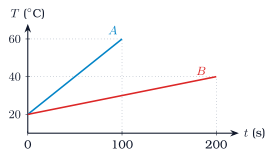
Equal masses of two liquids \(A\) and \(B\) are heated by identical heaters. The graph shows their temperatures.
Which liquid has the smaller specific heat? Give the reason.
Find the ratio \(s_A : s_B\).
Find the ratio if instead the mass of \(B\) were twice the mass of \(A\).
\(A\). The same heat is supplied each second to the same mass, and \(A\) warms faster. A smaller \(s\) means less heat per degree, so a faster rise.
Rate of rise \(= \dfrac{P}{ms}\), so \(s \propto \dfrac{1}{\text{rate}}\). \(A\) rises \(40^\circ\)C in \(100\) s (\(0.4^\circ\)C/s) and \(B\) rises \(20^\circ\)C in \(200\) s (\(0.1^\circ\)C/s). \(s_A : s_B = 0.1 : 0.4 = 1 : 4\).
Define the latent heat \(L\) of a substance and write the formula \(Q = mL\). Why does the temperature stay constant while ice melts? Find the heat needed to melt \(0.5\) kg of ice at \(0^\circ\)C.
Answerheat per kg to change state, \(Q = mL\); bonds break, KE unchanged; \(168\) kJ
Solution
The latent heat is the heat needed to change the state of \(1\) kg of the substance at constant temperature. So \(Q = mL\), with \(L\) in J/kg.
During melting the heat goes into breaking the bonds that hold the molecules in the solid, not into making them move faster. So the temperature does not rise.
Find the heat needed to turn \(2\) kg of water at \(100^\circ\)C into steam. Compare it with the heat needed to warm the same water from \(0^\circ\)C to \(100^\circ\)C.
Answer\(4.52\) MJ; \(840\) kJ, \(5.4\) times
Solution
\(Q = mL = 2 \times 2.26 \times 10^6 = 4.52 \times 10^6\) J \(= 4.52\) MJ.
Warming: \(Q = 2 \times 4200 \times 100 = 8.4 \times 10^5\) J \(= 840\) kJ. Boiling away the water takes \(\dfrac{4520}{840} \approx 5.4\) times as much heat as bringing it to the boil.
How did it go?
Q9
Find the total heat needed to turn \(1\) kg of ice at \(-10^\circ\)C into water at \(20^\circ\)C. Show the three steps separately.
Steam of mass \(0.1\) kg at \(100^\circ\)C condenses and cools to \(50^\circ\)C. Find the heat given out. Why does steam at \(100^\circ\)C cause a worse burn than water at \(100^\circ\)C?
Answer\(247\) kJ; \(2260\) J/g of latent heat given first
Steam first gives out its latent heat, \(226\) kJ per \(0.1\) kg, before it even begins to cool. Water at \(100^\circ\)C gives out only the \(21\) kJ of cooling. So steam delivers more than ten times the heat to the skin.
How did it go?
Q11
A \(336\) W heater is placed in ice at \(0^\circ\)C. Find the mass of ice melted per second. How long does the heater take to melt \(300\) g of ice?
Answer\(1\) g/s; \(300\) s
Solution
Each second the heater supplies \(336\) J. Mass melted per second \(= \dfrac{336}{3.36 \times 10^5} = 10^{-3}\) kg \(= 1\) g.
Time for \(300\) g \(= 300\) s \(= 5\) minutes.
How did it go?
Q12
One gram of sweat evaporates from the skin. Take \(L = 2.26 \times 10^6\) J/kg. Find the heat taken from the body. Find the mass of water that this much heat would cool by \(1^\circ\)C.
Answer\(2260\) J; \(538\) g
Solution
\(Q = mL = 10^{-3} \times 2.26 \times 10^6 = 2260\) J.
\(m = \dfrac{Q}{s\Delta T} = \dfrac{2260}{4200 \times 1} = 0.538\) kg \(= 538\) g. One gram of sweat cools more than half a kilogram of the body by a degree, which is why sweating works.
How did it go?
Heating curves
Q13
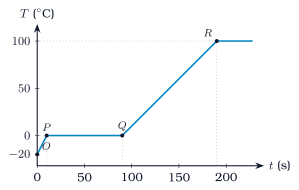
The graph shows the temperature of \(100\) g of ice, at first at \(-20^\circ\)C, heated by a \(420\) W heater.
Which parts of the graph show a change of state? Name the change in each.
Use the part \(PQ\) to find the latent heat of fusion of ice.
Use the parts \(OP\) and \(QR\) to find the specific heats of ice and of water.
Answer(i) \(PQ\) melting; after \(R\) boiling (ii) \(3.36 \times 10^5\) J/kg (iii) \(2100\); \(4200\) J/kg K
Solution
\(PQ\) is flat at \(0^\circ\)C: the ice is melting. The flat part after \(R\) at \(100^\circ\)C: the water is boiling.
\(PQ\) lasts from \(10\) s to \(90\) s, that is \(80\) s. Heat \(= 420 \times 80 = 33600\) J for \(0.1\) kg. \(L = \dfrac{33600}{0.1} = 3.36 \times 10^5\) J/kg.
\(OP\): \(20^\circ\)C rise in \(10\) s, heat \(= 4200\) J. \(s_{ice} = \dfrac{4200}{0.1 \times 20} = 2100\) J/kg K.
\(QR\): \(100^\circ\)C rise in \(100\) s, heat \(= 42000\) J. \(s_{water} = \dfrac{42000}{0.1 \times 100} = 4200\) J/kg K. Ice warms twice as fast as water because its specific heat is half.
How did it go?
Q14
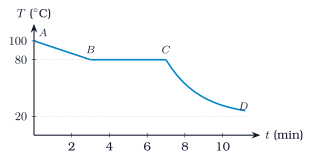
Molten naphthalene is left to cool in a room at \(20^\circ\)C. The graph shows its temperature.
Read the freezing point of naphthalene.
Why does the temperature stay constant from \(B\) to \(C\) although heat is still leaving?
In which state is the naphthalene along \(AB\), and along \(CD\)?
Answer(i) \(80^\circ\)C (ii) latent heat released (iii) liquid; solid
Solution
The flat part is at \(80^\circ\)C, so naphthalene freezes (and melts) at \(80^\circ\)C.
From \(B\) to \(C\) the liquid is turning into solid. The latent heat released as the molecules lock into place exactly replaces the heat lost to the room, so the temperature does not fall.
Along \(AB\) it is all liquid, cooling. Along \(CD\) it is all solid, cooling. \(CD\) flattens out because the temperature difference from the room shrinks, so heat leaves more slowly.
How did it go?
Q15
A \(100\) W heater warms \(0.1\) kg of a solid. The temperature rises from \(0^\circ\)C to \(40^\circ\)C in \(20\) s. It stays at \(40^\circ\)C for \(60\) s, then rises to \(100^\circ\)C in \(120\) s. Find the specific heat of the solid, the latent heat of fusion and the specific heat of the liquid.
Answer\(500\) J/kg K; \(60\) kJ/kg; \(2000\) J/kg K
Solution
Solid: heat \(= 100 \times 20 = 2000\) J for \(40^\circ\)C. \(s = \dfrac{2000}{0.1 \times 40} = 500\) J/kg K.
Liquid: heat \(= 100 \times 120 = 12000\) J for \(60^\circ\)C. \(s = \dfrac{12000}{0.1 \times 60} = 2000\) J/kg K.
How did it go?
Q16
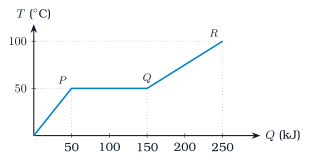
The graph shows the temperature of \(1\) kg of a substance against the heat supplied.
Read the melting point.
Find the latent heat of fusion.
Find the specific heat of the solid and of the liquid.
Answer(i) \(50^\circ\)C (ii) \(100\) kJ/kg (iii) \(1000\); \(2000\) J/kg K
Solution
The flat part \(PQ\) is at \(50^\circ\)C, the melting point.
\(PQ\) runs from \(50\) kJ to \(150\) kJ: \(100\) kJ melts \(1\) kg, so \(L = 100\) kJ/kg.
Solid (\(OP\)): \(50\) kJ for \(50^\circ\)C, \(s = \dfrac{50000}{1 \times 50} = 1000\) J/kg K. Liquid (\(QR\)): \(100\) kJ for \(50^\circ\)C, \(s = 2000\) J/kg K. The liquid line is less steep because the liquid needs more heat per degree.
How did it go?
Q17
Water is heated at a steady rate from ice at \(0^\circ\)C until all of it has boiled away. Which is longer, the melting plateau or the boiling plateau? Find the ratio of the two times.
Answerboiling; \(6.7\)
Solution
At a steady rate the time is proportional to the heat: \(t \propto mL\). The boiling plateau is longer because \(L_v > L_f\).
During melting the heat supplied does not raise the temperature. Where does this energy go?
Answerpotential energy of molecules
Solution
Temperature measures the average kinetic energy of the molecules. During melting the heat goes into pulling the molecules apart against the forces that hold the solid together. It raises their potential energy, not their kinetic energy, so the temperature stays the same.
How did it go?
Small situations
Q19
A \(2\) kW kettle holds \(1\) kg of water at \(20^\circ\)C. Find the time to bring the water to \(100^\circ\)C, and the further time to boil away \(0.5\) kg of it. Neglect heat losses.
Answer\(168\) s; \(565\) s
Solution
Heat to warm: \(1 \times 4200 \times 80 = 336000\) J. \(t = \dfrac{336000}{2000} = 168\) s.
Heat to boil away \(0.5\) kg: \(0.5 \times 2.26 \times 10^6 = 1.13 \times 10^6\) J. \(t = \dfrac{1.13 \times 10^6}{2000} = 565\) s.
How did it go?
Q20
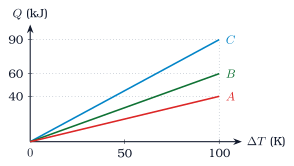
The graph shows the heat supplied to \(1\) kg of each of three metals against the rise in temperature.
Which metal has the largest specific heat? How do you know?
Find the specific heat of each metal.
Find the heat needed to warm \(2\) kg of \(A\) by \(25\) K.
Answer(i) \(C\) (ii) \(400\); \(600\); \(900\) J/kg K (iii) \(20\) kJ
Solution
\(C\). For the same rise it needs the most heat, so its line is the steepest. The slope of each line is the heat capacity \(ms\) with \(m = 1\) kg.
\(s = \dfrac{Q}{m\Delta T}\) at \(\Delta T = 100\) K: \(A\): \(\dfrac{40000}{100} = 400\); \(B\): \(\dfrac{60000}{100} = 600\); \(C\): \(\dfrac{90000}{100} = 900\) J/kg K.
A block of ice at \(0^\circ\)C absorbs sunlight at \(336\) W. Find the mass of ice that melts in one hour.
Answer\(3.6\) kg
Solution
Heat in one hour \(= 336 \times 3600 = 1.21 \times 10^6\) J. \(m = \dfrac{336 \times 3600}{3.36 \times 10^5} = 3.6\) kg.
How did it go?
Q22
One calorie is \(4.2\) J. The specific heat of water is \(1\) cal/g \(^\circ\)C, and the latent heats of ice and steam are \(80\) cal/g and \(540\) cal/g. Convert these three values to SI units.
22 questions · after Lesson 5, Mixing Ice, Water and Steam
The principle
Q23
State the principle of calorimetry and the two conditions under which it holds. \(100\) g of water at \(80^\circ\)C is mixed with \(100\) g of water at \(20^\circ\)C. Find the final temperature. Throughout this sheet take \(s = 1\) cal/g \(^\circ\)C for water, \(0.5\) cal/g \(^\circ\)C for ice, \(L = 80\) cal/g for ice and \(540\) cal/g for steam.
Answerheat lost \(=\) heat gained; no loss, no reaction; \(50^\circ\)C
Solution
When hot and cold bodies are mixed, the heat lost by the hot bodies equals the heat gained by the cold bodies. This holds if no heat leaves or enters the system, and if no chemical change or change of state produces or absorbs heat unexpectedly.
\(100(80 - T) = 100(T - 20)\), so \(80 - T = T - 20\) and \(T = 50^\circ\)C. Equal masses of the same liquid meet at the mean temperature.
How did it go?
Q24
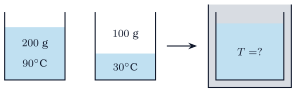
The two beakers of water in the figure are poured into an insulated vessel.
Write the heat lost by the hot water and the heat gained by the cold water in terms of the final temperature \(T\).
Find \(T\).
Answer(i) \(200(90 - T)\); \(100(T - 30)\) cal (ii) \(70^\circ\)C
A copper block of mass \(100\) g (\(s = 0.1\) cal/g \(^\circ\)C) at \(100^\circ\)C is dropped into \(90\) g of water at \(20^\circ\)C. Find the final temperature.
Answer\(28^\circ\)C
Solution
Heat lost by copper \(= 100 \times 0.1 \times (100 - T) = 10(100 - T)\). Heat gained by water \(= 90(T - 20)\).
\(1000 - 10T = 90T - 1800\), so \(100T = 2800\) and \(T = 28^\circ\)C. The copper counts as only \(10\) g of water, which is why the rise is small.
How did it go?
Q26
A calorimeter of water equivalent \(10\) g holds \(90\) g of water at \(20^\circ\)C. A metal block of mass \(200\) g at \(140^\circ\)C is dropped in. The final temperature is \(40^\circ\)C. Find the specific heat of the metal.
Answer\(0.1\) cal/g \(^\circ\)C
Solution
Heat gained by water and calorimeter \(= (90 + 10) \times 1 \times (40 - 20) = 2000\) cal.
Heat lost by metal \(= 200 \times s \times (140 - 40) = 20000\,s\). So \(20000\,s = 2000\) and \(s = 0.1\) cal/g \(^\circ\)C.
How did it go?
Q27
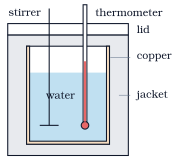
The figure shows a calorimeter.
Why is the vessel made of thin copper?
What are the jacket and the lid for?
Why is the water stirred before the thermometer is read?
Answer(i) quick heat transfer (ii) stop heat loss (iii) uniform temperature
Solution
Copper conducts heat well, so the vessel and the water reach the same temperature quickly. A thin vessel has a small heat capacity, so it takes little heat itself.
The jacket is a poor conductor and the lid stops evaporation and convection. Together they keep heat from leaking to the room, so that heat lost equals heat gained.
Stirring mixes the water so that all of it is at one temperature. Otherwise the thermometer reads only the layer around its bulb.
How did it go?
Ice and water
Q28
\(20\) g of ice at \(0^\circ\)C is put into \(80\) g of water at \(30^\circ\)C. Show that all the ice melts, and find the final temperature.
Answer\(2400\) cal available \(> 1600\) cal needed; \(8^\circ\)C
Solution
Heat needed to melt all the ice \(= 20 \times 80 = 1600\) cal. Heat available if the water cools to \(0^\circ\)C \(= 80 \times 30 = 2400\) cal. This is more than \(1600\) cal, so all the ice melts.
\(50\) g of ice at \(0^\circ\)C is put into \(50\) g of water at \(40^\circ\)C. Find the mass of ice that melts, the final temperature and the final contents of the vessel.
Answer\(25\) g; \(0^\circ\)C; \(25\) g ice \(+ 75\) g water
Solution
Heat needed to melt all the ice \(= 50 \times 80 = 4000\) cal. Heat available from the water cooling to \(0^\circ\)C \(= 50 \times 40 = 2000\) cal. This is less than \(4000\) cal, so only part of the ice melts and the final temperature is \(0^\circ\)C.
Mass melted \(= \dfrac{2000}{80} = 25\) g. The vessel holds \(25\) g of ice and \(50 + 25 = 75\) g of water, all at \(0^\circ\)C.
How did it go?
Q30
\(10\) g of ice at \(-20^\circ\)C is put into \(100\) g of water at \(20^\circ\)C. Find the final temperature.
Answer\(10^\circ\)C
Solution
Warm the ice to \(0^\circ\)C: \(10 \times 0.5 \times 20 = 100\) cal. Melt it: \(10 \times 80 = 800\) cal. Total \(900\) cal, which the water can supply (\(100 \times 20 = 2000\) cal available).
\(900 + 10T = 100(20 - T)\), so \(110T = 1100\) and \(T = 10^\circ\)C.
How did it go?
Q31
Steam at \(100^\circ\)C is passed into \(100\) g of water at \(46^\circ\)C until the water just begins to boil. Find the mass of steam condensed.
Answer\(10\) g
Solution
Heat gained by water \(= 100 \times (100 - 46) = 5400\) cal.
The final temperature is \(100^\circ\)C, so the condensed steam does not cool at all. Each gram gives only its latent heat, \(540\) cal: \(540m = 5400\) and \(m = 10\) g.
How did it go?
Q32
\(10\) g of steam at \(100^\circ\)C is passed into \(50\) g of ice at \(0^\circ\)C in an insulated vessel. Show that all the ice melts, and find the final temperature.
Answer\(6400\) cal available \(> 4000\) cal needed; \(40^\circ\)C
Solution
Heat the steam can give while condensing and cooling to \(0^\circ\)C \(= 10 \times 540 + 10 \times 100 = 6400\) cal. Heat needed to melt all the ice \(= 50 \times 80 = 4000\) cal. So all the ice melts and the final temperature is above \(0^\circ\)C.
Heat lost by steam \(= 5400 + 10(100 - T)\). Heat gained by ice \(= 4000 + 50T\).
\(6400 - 10T = 4000 + 50T\), so \(60T = 2400\) and \(T = 40^\circ\)C.
How did it go?
Q33
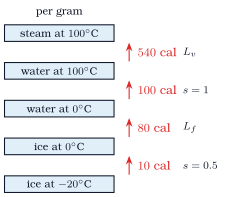
The figure shows the heat needed for each step for \(1\) g of water. Use it to find the following.
The heat needed to turn \(1\) g of ice at \(-20^\circ\)C into steam at \(100^\circ\)C.
The heat given out when \(1\) g of steam at \(100^\circ\)C becomes water at \(0^\circ\)C.
The heat needed to turn \(5\) g of ice at \(-20^\circ\)C into water at \(0^\circ\)C.
Answer(i) \(730\) cal (ii) \(640\) cal (iii) \(450\) cal
Solution
Add the four steps: \(10 + 80 + 100 + 540 = 730\) cal.
Down two steps: \(540 + 100 = 640\) cal.
Two steps up for each gram: \(10 + 80 = 90\) cal. For \(5\) g: \(450\) cal.
How did it go?
Method of mixtures
Q34
Liquid \(A\) has \(s = 0.5\) cal/g \(^\circ\)C and liquid \(B\) has \(s = 0.25\) cal/g \(^\circ\)C. \(100\) g of \(A\) at \(60^\circ\)C is mixed with \(200\) g of \(B\) at \(20^\circ\)C. Find the final temperature.
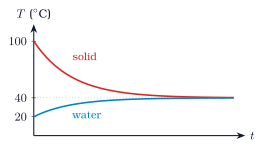
The solid starts at \(100^\circ\)C, the water at \(20^\circ\)C. Both curves meet at \(40^\circ\)C.
Equal masses \(m\): \(m\,s\,(100 - 40) = m \times 1 \times (40 - 20)\), so \(60s = 20\) and \(s = \dfrac{1}{3}\) cal/g \(^\circ\)C.
The same heat flows out of the solid and into the water each second. Water has the larger specific heat, so the same heat changes its temperature less.
How did it go?
Q37
A glass holds \(300\) g of a drink (\(s = 1\) cal/g \(^\circ\)C) at \(30^\circ\)C. \(30\) g of ice at \(0^\circ\)C is added. Find the final temperature.
Answer\(20^\circ\)C
Solution
Melting the ice needs \(30 \times 80 = 2400\) cal; the drink can supply \(300 \times 30 = 9000\) cal, so all the ice melts.
\(2400 + 30T = 300(30 - T)\), so \(330T = 6600\) and \(T = 20^\circ\)C.
How did it go?
Q38
A calorimeter of water equivalent \(20\) g holds \(80\) g of water at \(20^\circ\)C. \(100\) g of water at \(70^\circ\)C is poured in. Find the final temperature.
Answer\(45^\circ\)C
Solution
The calorimeter and its water count as \(80 + 20 = 100\) g of water at \(20^\circ\)C.
Two balls of equal mass are heated to \(100^\circ\)C. One is copper (\(s = 0.1\) cal/g \(^\circ\)C) and one is aluminium (\(s = 0.2\) cal/g \(^\circ\)C). Each is dropped into its own beaker of water at \(20^\circ\)C. Which beaker warms more? Give the reason.
Answeraluminium; twice the heat
Solution
The aluminium beaker. For the same mass and the same fall in temperature, the heat given out is \(ms\Delta T\). Aluminium has twice the \(s\) of copper. The aluminium ball gives out about twice as much heat, so its water warms more.
How did it go?
Q40
Equal masses of two different liquids at \(20^\circ\)C and \(60^\circ\)C are mixed. The final temperature is exactly \(40^\circ\)C. What does this tell you about their specific heats?
Answerequal
Solution
With equal masses, \(m s_1 (60 - 40) = m s_2 (40 - 20)\), so \(s_1 = s_2\). The final temperature is the mean only when the heat capacities are equal.
How did it go?
Small situations
Q41
\(100\) g of ice at \(0^\circ\)C is put into \(100\) g of water at \(80^\circ\)C. Find the final temperature and the final contents.
Answer\(0^\circ\)C; \(200\) g water
Solution
Heat needed to melt all the ice \(= 100 \times 80 = 8000\) cal. Heat available from the water cooling to \(0^\circ\)C \(= 100 \times 80 = 8000\) cal. The two are exactly equal.
So all the ice just melts and the final temperature is \(0^\circ\)C. The vessel holds \(200\) g of water at \(0^\circ\)C.
How did it go?
Q42
A vessel holds \(100\) g of ice and \(100\) g of water, both at \(0^\circ\)C. \(2\) g of steam at \(100^\circ\)C is passed in. Find the mass of ice that melts and the final contents.
Answer\(16\) g; \(84\) g ice \(+ 118\) g water
Solution
Each gram of steam gives \(540\) cal on condensing and \(100\) cal on cooling to \(0^\circ\)C: \(640\) cal. So \(2\) g gives \(1280\) cal.
Ice melted \(= \dfrac{1280}{80} = 16\) g. The vessel holds \(100 - 16 = 84\) g of ice and \(100 + 16 + 2 = 118\) g of water, all at \(0^\circ\)C.
How did it go?
Q43
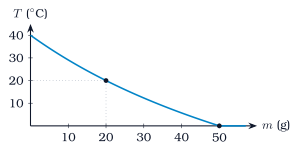
Ice at \(0^\circ\)C is added to \(100\) g of water at \(40^\circ\)C. The graph shows the final temperature against the mass of ice.
Read the mass of ice that gives a final temperature of \(20^\circ\)C. Check it by calculation.
Read the mass of ice beyond which the final temperature stays at \(0^\circ\)C. Check it by calculation.
What is in the vessel when \(60\) g of ice has been added?
Answer(i) \(20\) g (ii) \(50\) g (iii) \(10\) g ice \(+ 150\) g water at \(0^\circ\)C
Solution
The curve passes through \(T = 20^\circ\)C at \(m = 20\) g. Check: \(80 \times 20 + 20 \times 20 = 2000\) cal gained, and \(100 \times (40 - 20) = 2000\) cal lost.
The curve reaches \(0^\circ\)C at \(m = 50\) g. Check: the water can give \(100 \times 40 = 4000\) cal, which melts \(\dfrac{4000}{80} = 50\) g.
Only \(50\) g melts. The vessel holds \(10\) g of ice and \(150\) g of water, all at \(0^\circ\)C.
How did it go?
Q44
Steam at \(100^\circ\)C is passed into \(100\) g of ice at \(0^\circ\)C. Find the mass of steam for which the ice just melts, with everything at \(0^\circ\)C.
Answer\(12.5\) g
Solution
Each gram of steam gives \(540 + 100 = 640\) cal in becoming water at \(0^\circ\)C. Melting \(100\) g of ice needs \(8000\) cal.