Questions on Kinetic Theory of Gases, the kind your examinations ask. Solve one on paper. Then tell the book how it went. The book believes you, and it uses your answer to plan your revision.
0%
Nothing marked yetMark honestly. Peek at the answer only after your own attempt.
Ideal Gas Equation and the Gas Laws
22 questions · after Lesson 1, The Gas Laws and the Ideal Gas Equation
The gas laws
Q1
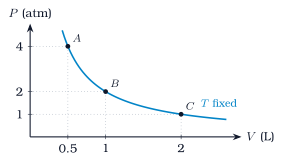
The graph shows the pressure of a fixed mass of gas against its volume at constant temperature.
State Boyle's law and write it as an equation.
Read \(P\) and \(V\) at \(A\), \(B\) and \(C\) and show that they obey the law.
Find the pressure when the gas is compressed to \(0.25\) L.
Answer(i) \(PV = \) const (ii) \(PV = 2\) atm L at each (iii) \(8\) atm
Solution
At constant temperature the pressure of a fixed mass of gas is inversely proportional to its volume: \(PV = \) constant.
\(A\): \(4 \times 0.5 = 2\). \(B\): \(2 \times 1 = 2\). \(C\): \(1 \times 2 = 2\) atm L. The product is the same at all three points.
\(P = \dfrac{2}{0.25} = 8\) atm.
How did it go?
Q2
State Charles's law. A gas occupies \(600\) mL at \(300\) K. Find its volume at \(400\) K at the same pressure. Why does the calculation fail if the temperatures are written as \(27^\circ\)C and \(127^\circ\)C?
Answer\(800\) mL; \(T\) must be absolute
Solution
At constant pressure the volume of a fixed mass of gas is proportional to its absolute temperature: \(\dfrac{V}{T} = \) constant.
Volume is proportional to the absolute temperature, not to the Celsius reading. \(\dfrac{127}{27}\) would give \(2822\) mL, which is wrong. Only the Kelvin scale starts from the point where \(V\) would be zero.
How did it go?
Q3
State the pressure law (Gay-Lussac's law). The air in a car tyre is at \(2\) atm at \(27^\circ\)C. Find its pressure after a long drive warms it to \(87^\circ\)C. Take the volume as fixed.
Answer\(P \propto T\) at fixed \(V\); \(2.4\) atm
Solution
At constant volume the pressure of a fixed mass of gas is proportional to its absolute temperature: \(\dfrac{P}{T} = \) constant.
\(P_2 = 2 \times \dfrac{360}{300} = 2.4\) atm.
How did it go?
Q4
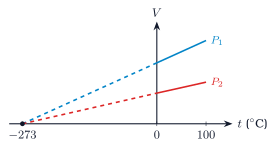
The graph shows the volume of a fixed mass of gas against temperature at two constant pressures \(P_1\) and \(P_2\).
Why are the lines straight, and why do both pass through \(-273^\circ\)C?
Which pressure is larger, \(P_1\) or \(P_2\)? Give the reason.
Answer(i) \(V \propto T\); \(V = 0\) at \(0\) K (ii) \(P_2\)
Solution
At constant pressure \(V \propto T\), so \(V\) is a linear function of \(t\): \(V = V_0(1 + t/273)\). Every such line reaches \(V = 0\) at \(t = -273^\circ\)C, which is absolute zero.
\(P_2\). At any temperature the red line gives the smaller volume. By Boyle's law a smaller volume at the same temperature means a larger pressure.
How did it go?
Q5
Write the combined gas law for a fixed mass of gas. A gas at \(1\) atm and \(300\) K occupies \(6\) L. Find its volume at \(2\) atm and \(400\) K.
Answer\(\frac{P_1V_1}{T_1} = \frac{P_2V_2}{T_2}\); \(4\) L
Solution
\(\dfrac{P_1V_1}{T_1} = \dfrac{P_2V_2}{T_2}\), so \(V_2 = V_1\dfrac{P_1}{P_2}\dfrac{T_2}{T_1} = 6 \times \dfrac{1}{2} \times \dfrac{400}{300} = 4\) L.
How did it go?
Q6
State Avogadro's law. One mole of any gas occupies \(22.4\) L at STP (\(0^\circ\)C, \(1\) atm). Find the number of molecules in \(5.6\) L of oxygen at STP and their total mass. Take \(N_A = 6 \times 10^{23}\) per mol and \(M = 32\) g/mol for oxygen.
Answer\(1.5 \times 10^{23}\); \(8\) g
Solution
Equal volumes of all gases at the same temperature and pressure contain equal numbers of molecules.
\(5.6\) L is \(\dfrac{5.6}{22.4} = 0.25\) mol. Molecules \(= 0.25 \times 6 \times 10^{23} = 1.5 \times 10^{23}\). Mass \(= 0.25 \times 32 = 8\) g.
How did it go?
The ideal gas equation
Q7
Write the ideal gas equation \(PV = nRT\) and name each symbol with its SI unit. Find the volume of \(1\) mol of an ideal gas at \(300\) K and \(10^5\) Pa. Take \(R = 8.3\) J/mol K throughout this sheet.
\(P\) is the pressure (Pa), \(V\) the volume (m\(^3\)) and \(n\) the number of moles. \(T\) is the absolute temperature (K) and \(R = 8.3\) J/mol K is the gas constant.
Show that the density of an ideal gas is \(\rho = \frac{PM}{RT}\), where \(M\) is the molar mass. Find the density of air (\(M = 29\) g/mol) at \(300\) K and \(10^5\) Pa.
Write the ideal gas equation in the form \(PV = NkT\), where \(N\) is the number of molecules. Write \(k\) in terms of \(R\) and \(N_A\) and find its value.
Answer\(k = R/N_A = 1.38 \times 10^{-23}\) J/K
Solution
\(n = \dfrac{N}{N_A}\), so \(PV = \dfrac{N}{N_A}RT = NkT\) with \(k = \dfrac{R}{N_A}\), the Boltzmann constant.
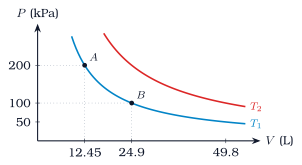
The graph shows two isotherms of \(1\) mol of an ideal gas.
Find the product \(PV\) at \(A\) and at \(B\), in kPa L, and explain why the two values are equal.
Find \(T_1\).
The upper isotherm has \(PV = 4980\) kPa L. Find \(T_2\).
Answer(i) \(2490\) kPa L (ii) \(300\) K (iii) \(600\) K
Solution
\(A\): \(200 \times 12.45 = 2490\) kPa L. \(B\): \(100 \times 24.9 = 2490\) kPa L. Both points lie on one isotherm, so \(PV = nRT\) has the same value.
\(PV = 2490\) kPa L \(= 2490\) J. \(T_1 = \dfrac{PV}{nR} = \dfrac{2490}{1 \times 8.3} = 300\) K.
\(T_2 = \dfrac{4980}{8.3} = 600\) K. Twice the \(PV\) product means twice the temperature.
How did it go?
Q12
State Dalton's law of partial pressures. A vessel of volume \(24.9\) L at \(300\) K holds \(2\) mol of hydrogen and \(1\) mol of oxygen. Find the partial pressure of each gas and the total pressure.
Answer\(2 \times 10^5\); \(10^5\); \(3 \times 10^5\) Pa
Solution
In a mixture of gases that do not react, each gas exerts the pressure it would exert alone in the same vessel. The total pressure is the sum of these partial pressures.
\(p = \dfrac{nRT}{V}\) with \(\dfrac{RT}{V} = \dfrac{8.3 \times 300}{0.0249} = 10^5\) Pa per mole. Hydrogen: \(2 \times 10^5\) Pa. Oxygen: \(10^5\) Pa. Total: \(3 \times 10^5\) Pa.
How did it go?
Small situations
Q13
A gas in a sealed rigid vessel is at \(27^\circ\)C. To what temperature must it be heated so that its pressure doubles? Give the answer in K and in \(^\circ\)C.
Answer\(600\) K \(= 327^\circ\)C
Solution
At constant volume \(P \propto T\). Doubling \(P\) doubles \(T\): \(T = 2 \times 300 = 600\) K \(= 327^\circ\)C.
How did it go?
Q14
A balloon holds \(2\) L of air at \(27^\circ\)C. It is left in the sun and warms to \(57^\circ\)C at the same pressure. Find its new volume.
Answer\(2.2\) L
Solution
At constant pressure \(V \propto T\). \(V = 2 \times \dfrac{330}{300} = 2.2\) L.
How did it go?
Q15
An air bubble of volume \(1\) cm\(^3\) forms at a depth where the pressure is \(4\) atm. It rises to the surface, where the pressure is \(1\) atm. The temperature does not change. Find its volume at the surface.
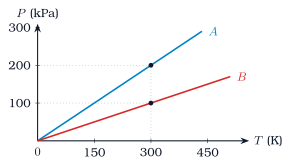
One mole of gas is sealed in each of two rigid vessels \(A\) and \(B\). The graph shows the pressure in each against temperature.
Why is each graph a straight line through the origin?
Which vessel has the larger volume? Find the ratio \(V_A : V_B\).
Find \(V_A\).
Answer(i) \(P = (nR/V)T\) (ii) \(B\); \(1 : 2\) (iii) \(12.45\) L
Solution
\(P = \dfrac{nR}{V}T\). With \(n\) and \(V\) fixed, \(P\) is proportional to \(T\), so the graph is a straight line through the origin with slope \(\dfrac{nR}{V}\).
The slope is \(\dfrac{nR}{V}\), so the less steep line has the larger volume: \(B\). At \(300\) K, \(P_A = 200\) kPa and \(P_B = 100\) kPa, so \(\dfrac{V_A}{V_B} = \dfrac{P_B}{P_A} = \dfrac{1}{2}\).
A gas cylinder at \(27^\circ\)C is at \(20\) atm. Some gas leaks out and the pressure falls to \(15\) atm at the same temperature. Find the fraction of the gas that has escaped.
Answer\(\frac{1}{4}\)
Solution
At fixed \(V\) and \(T\), \(P \propto n\). The moles left are \(\dfrac{15}{20} = \dfrac{3}{4}\) of the original, so \(\dfrac{1}{4}\) of the gas has escaped.
How did it go?
Q18
Vessel \(A\) (volume \(2\) L) holds gas at \(3\) atm. Vessel \(B\) (volume \(4\) L) holds the same gas at \(1.5\) atm and the same temperature. They are connected by a narrow tube. Find the final pressure.
Answer\(2\) atm
Solution
The total number of moles is fixed: \(\dfrac{P_AV_A + P_BV_B}{RT} = \dfrac{P(V_A + V_B)}{RT}\).
Find the density of oxygen (\(M = 32\) g/mol) at STP, in g/L and in kg/m\(^3\).
Answer\(1.43\) g/L \(= 1.43\) kg/m\(^3\)
Solution
One mole, \(32\) g, fills \(22.4\) L: \(\rho = \dfrac{32}{22.4} = 1.43\) g/L. Since \(1\) g/L \(= 1\) kg/m\(^3\), this is \(1.43\) kg/m\(^3\).
How did it go?
Q20
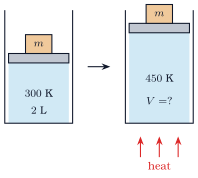
A gas is trapped under a frictionless piston carrying a fixed load. The gas is heated from \(300\) K to \(450\) K.
Why does the pressure of the gas stay the same?
Which gas law applies? Find the new volume.
Answer(i) same load (ii) Charles; \(3\) L
Solution
The piston is free to move. It settles where the gas pressure balances the load and the air above: \(P = P_0 + \dfrac{mg}{A}\). The load does not change, so \(P\) does not change.
Charles's law, at constant pressure. \(V = 2 \times \dfrac{450}{300} = 3\) L.
How did it go?
Q21
State three assumptions of the kinetic theory that make a gas ideal.
Answerpoint molecules; no forces; elastic collisions
Solution
The molecules are points: their own volume is negligible compared with the volume of the container. They exert no forces on each other except during collisions. Collisions with each other and with the walls are perfectly elastic and take negligible time.
How did it go?
Q22
Find the number of molecules per cubic metre of an ideal gas at \(300\) K and \(10^5\) Pa. Take \(k = 1.38 \times 10^{-23}\) J/K.
Answer\(2.4 \times 10^{25}\) per m\(^3\)
Solution
\(PV = NkT\), so \(\dfrac{N}{V} = \dfrac{P}{kT} = \dfrac{10^5}{1.38 \times 10^{-23} \times 300} = 2.4 \times 10^{25}\) per m\(^3\).
How did it go?
Pressure of a Gas and Molecular Speeds
22 questions · after Lesson 3, Temperature and Molecular Speeds
Pressure of a gas
Q23
Write the kinetic-theory formula for the pressure of a gas, \(P = \frac{1}{3}\rho\,v_{rms}^2\), and name each symbol. Write the same formula in terms of the number of molecules \(N\), the mass \(m\) of one molecule and the volume \(V\). Take \(R = 8.3\) J/mol K, \(k = 1.38 \times 10^{-23}\) J/K and \(N_A = 6 \times 10^{23}\) per mol throughout this sheet.
\(P\) is the pressure, \(\rho\) the density of the gas and \(v_{rms}\) the root mean square speed of its molecules, \(v_{rms} = \sqrt{\overline{v^2}}\).
\(\rho = \dfrac{Nm}{V}\), so \(P = \dfrac{1}{3}\dfrac{Nm}{V}\overline{v^2} = \dfrac{Nm\overline{v^2}}{3V}\).
How did it go?
Q24
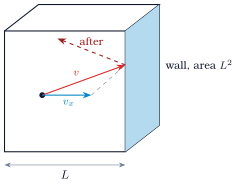
A molecule of mass \(m\) moves in a cubical box of side \(L\). Its velocity component towards the shaded wall is \(v_x\).
Find the change in momentum of the molecule in one collision with the shaded wall.
Find the time between two collisions with the shaded wall, and hence the average force on the wall from this molecule.
For \(N\) molecules the average of \(v_x^2\) is \(\frac{1}{3}\overline{v^2}\). Show that \(P = \frac{Nm\overline{v^2}}{3L^3}\).
Answer(i) \(2mv_x\) (ii) \(\frac{2L}{v_x}\); \(\frac{mv_x^2}{L}\) (iii) \(P = \frac{Nm\overline{v^2}}{3L^3}\)
Solution
The collision is elastic, so \(v_x\) reverses and the other components do not change. Change in momentum \(= mv_x - (-mv_x) = 2mv_x\).
After a collision the molecule crosses the box and comes back, a distance \(2L\) at speed \(v_x\): time \(= \dfrac{2L}{v_x}\). Average force \(= \dfrac{\text{momentum per collision}}{\text{time between collisions}} = \dfrac{2mv_x}{2L/v_x} = \dfrac{mv_x^2}{L}\).
Total force on the wall \(= \sum \dfrac{mv_x^2}{L} = \dfrac{Nm\overline{v_x^2}}{L} = \dfrac{Nm\overline{v^2}}{3L}\). Pressure \(= \dfrac{\text{force}}{L^2} = \dfrac{Nm\overline{v^2}}{3L^3}\).
How did it go?
Q25
Air at \(10^5\) Pa has density \(1.2\) kg/m\(^3\). Find the rms speed of its molecules.
Use \(P = \frac{1}{3}\rho v_{rms}^2\) and \(PV = nRT\) to show that \(v_{rms} = \sqrt{\frac{3RT}{M}} = \sqrt{\frac{3kT}{m}}\). Find \(v_{rms}\) for oxygen (\(M = 32\) g/mol) at \(300\) K.
Answer\(v_{rms} = \sqrt{\frac{3RT}{M}} = \sqrt{\frac{3kT}{m}}\); \(483\) m/s
Solution
\(P = \dfrac{1}{3}\dfrac{m_{gas}}{V}v_{rms}^2\), so \(PV = \dfrac{1}{3}m_{gas}v_{rms}^2\). With \(PV = nRT\) and \(m_{gas} = nM\): \(\dfrac{1}{3}nMv_{rms}^2 = nRT\), so \(v_{rms} = \sqrt{\dfrac{3RT}{M}}\).
Dividing \(R\) and \(M\) by \(N_A\): \(v_{rms} = \sqrt{\dfrac{3kT}{m}}\).
Find the ratio of the rms speeds of hydrogen (\(M = 2\) g/mol) and oxygen (\(M = 32\) g/mol) at the same temperature. Hence find \(v_{rms}\) for hydrogen at \(300\) K.
Answer\(4 : 1\); \(1930\) m/s
Solution
At the same \(T\), \(v_{rms} \propto \dfrac{1}{\sqrt{M}}\). \(\dfrac{v_H}{v_O} = \sqrt{\dfrac{32}{2}} = 4\), so the ratio is \(4 : 1\).
At what temperature is the rms speed of oxygen molecules equal to the rms speed of hydrogen molecules at \(300\) K?
Answer\(4800\) K
Solution
\(\sqrt{\dfrac{3RT_O}{32}} = \sqrt{\dfrac{3R \times 300}{2}}\), so \(\dfrac{T_O}{32} = \dfrac{300}{2}\) and \(T_O = 16 \times 300 = 4800\) K.
How did it go?
Q29
A gas is at \(27^\circ\)C. To what temperature must it be heated so that the rms speed of its molecules doubles?
Answer\(1200\) K \(= 927^\circ\)C
Solution
\(v_{rms} \propto \sqrt{T}\). Doubling \(v_{rms}\) needs four times the absolute temperature: \(T = 4 \times 300 = 1200\) K \(= 927^\circ\)C.
How did it go?
Kinetic energy and temperature
Q30
Write the average translational kinetic energy of one molecule in terms of \(k\) and \(T\). Find it at \(300\) K. Find the total translational kinetic energy of one mole of gas at \(300\) K.
One mole: \(N_A \times \dfrac{3}{2}kT = \dfrac{3}{2}RT = 1.5 \times 8.3 \times 300 = 3735\) J.
How did it go?
Q31
Hydrogen and oxygen are at the same temperature. Compare the average kinetic energy of their molecules and the rms speed of their molecules. Give the reason for each answer.
Answersame KE; \(v_{rms}\) of H\(_2\) four times
Solution
The average kinetic energy is \(\dfrac{3}{2}kT\) and depends only on the temperature, so it is the same for both gases.
The rms speed is \(\sqrt{3kT/m}\). A hydrogen molecule is \(16\) times lighter, so for the same kinetic energy it moves \(\sqrt{16} = 4\) times faster.
How did it go?
Maxwell distribution
Q32
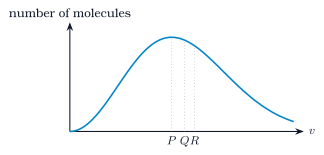
The graph shows the Maxwell distribution of molecular speeds at one temperature. Three speeds \(P\), \(Q\) and \(R\) are marked.
Name the three speeds \(P\), \(Q\) and \(R\).
Write the formula for each in terms of \(R\), \(T\) and \(M\).
What does the area under the curve represent?
Answer(i) \(v_p\); \(v_{avg}\); \(v_{rms}\) (ii) \(\sqrt{\frac{2RT}{M}}\); \(\sqrt{\frac{8RT}{\pi M}}\); \(\sqrt{\frac{3RT}{M}}\) (iii) total number
Solution
\(P\) is at the peak: the most probable speed \(v_p\). \(Q\) is the average speed \(v_{avg}\) and \(R\) is the rms speed \(v_{rms}\). They come in that order: \(v_p < v_{avg} < v_{rms}\).
The height of the curve at \(v\) gives the number of molecules with speeds near \(v\). The area under the whole curve is the total number of molecules.
How did it go?
Q33
Show that \(v_p : v_{avg} : v_{rms} = \sqrt{2} : \sqrt{8/\pi} : \sqrt{3}\) and write this ratio as decimals. Which of the three is always the largest?
Answer\(1 : 1.13 : 1.22\); \(v_{rms}\)
Solution
All three have the common factor \(\sqrt{RT/M}\), so the ratio is \(\sqrt{2} : \sqrt{8/\pi} : \sqrt{3} = 1.414 : 1.596 : 1.732\).
Dividing by \(1.414\): \(1 : 1.13 : 1.22\). The rms speed is always the largest, because squaring gives more weight to the fast molecules.
How did it go?
Q34
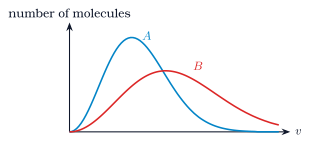
The graph shows the speed distribution of the same gas at two temperatures.
Which curve is at the higher temperature? Give the reason.
What happens to the height of the peak when the gas is heated? Why?
What is the same for both curves?
Answer(i) \(B\) (ii) falls (iii) area
Solution
\(B\). Its peak is at a higher speed, and \(v_p = \sqrt{2RT/M}\) grows with \(T\).
The peak falls. The molecules spread over a wider range of speeds, and the total number is fixed, so fewer molecules share any one speed.
The area under each curve: it is the total number of molecules, which does not change on heating.
How did it go?
Q35
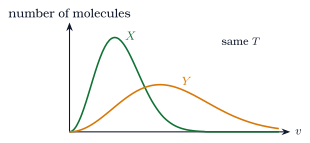
The graph shows the speed distributions of two gases \(X\) and \(Y\) at the same temperature. The peak of \(Y\) is at twice the speed of the peak of \(X\).
Which gas has the lighter molecules? Give the reason.
Find the ratio of their molar masses \(M_X : M_Y\).
If \(Y\) is helium (\(M = 4\) g/mol), find \(M_X\).
Answer(i) \(Y\), faster at the same KE (ii) \(4 : 1\) (iii) \(16\) g/mol
Solution
\(Y\). At the same temperature all molecules have the same average kinetic energy. So the lighter molecules move faster and their peak lies further to the right.
Five molecules have speeds \(1\), \(2\), \(3\), \(4\) and \(5\) km/s. Find their average speed and their rms speed. Which is larger? Is this always so?
The rms speed is larger. It is always at least as large as the average, because squaring weights the larger speeds more. The two are equal only if all the speeds are equal.
How did it go?
Q37
The rms speed of the molecules of a gas is \(500\) m/s. Find their average speed and their most probable speed.
Hydrogen at STP has density \(0.09\) kg/m\(^3\) and rms speed \(1840\) m/s. Find the pressure predicted by kinetic theory and compare it with \(1\) atm \(= 1.01 \times 10^5\) Pa.
This is \(1\) atm within \(1\%\). The kinetic theory gives the right pressure from the measured density and speed.
How did it go?
Q39
The absolute temperature of a gas in a rigid vessel is doubled. By what factor do the pressure and the rms speed change? Explain the change in pressure in terms of molecular collisions.
Answer\(P \times 2\); \(v_{rms} \times \sqrt{2}\)
Solution
At fixed \(V\), \(P \propto T\), so the pressure doubles. \(v_{rms} \propto \sqrt{T}\), so the rms speed becomes \(\sqrt{2}\) times, about \(1.41\) times.
Faster molecules hit the walls harder, with \(\sqrt{2}\) times the momentum, and more often, \(\sqrt{2}\) times as frequently. The two factors together double the force on the walls.
How did it go?
Q40
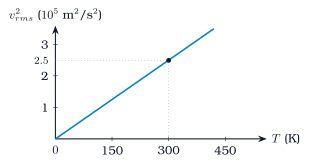
The graph shows \(v_{rms}^2\) against temperature for a gas.
Why is the graph a straight line through the origin?
Use the slope to find the molar mass of the gas.
Find \(v_{rms}\) at \(600\) K.
Answer(i) \(v_{rms}^2 = \frac{3R}{M}T\) (ii) \(30\) g/mol (iii) \(707\) m/s
Solution
\(v_{rms}^2 = \dfrac{3RT}{M}\) is proportional to \(T\), with slope \(\dfrac{3R}{M}\) and zero intercept.
Put \(\dfrac{1}{2}m\overline{v^2} = \dfrac{3}{2}kT\): \(P = \dfrac{2}{3}\dfrac{N}{V} \times \dfrac{3}{2}kT = \dfrac{NkT}{V}\), so \(PV = NkT\).
How did it go?
Q44
A gas is heated in a rigid vessel. Explain, using the motion of the molecules, why its pressure rises.
Answerfaster, harder and more frequent hits
Solution
Heating raises the average kinetic energy, so the molecules move faster. Each collision with a wall now transfers more momentum, and the collisions come more often because the molecules cross the vessel more quickly. Both effects increase the force on the walls, so the pressure rises.
How did it go?
Degrees of Freedom, Equipartition and Molar Heat Capacities
22 questions · after Lesson 5, Molar Heat Capacities of Gases
Degrees of freedom and equipartition
Q45
What is meant by the degrees of freedom \(f\) of a molecule? Write \(f\) for a monatomic gas, a rigid diatomic gas and a non-linear triatomic gas. Why is rotation about the bond axis of a diatomic molecule not counted?
Answer\(3\); \(5\); \(6\); no energy in that rotation
Solution
The degrees of freedom are the number of independent ways a molecule can store energy. This is the number of independent coordinates needed to describe its motion.
Monatomic: \(3\) (translation along \(x\), \(y\), \(z\)). Rigid diatomic: \(3 + 2 = 5\) (two rotations about axes perpendicular to the bond). Non-linear triatomic: \(3 + 3 = 6\).
The atoms are almost points on the bond axis, so the moment of inertia about that axis is negligible. Rotation about it stores no energy and is not counted.
How did it go?
Q46
State the law of equipartition of energy. Find the average energy of one molecule of a diatomic gas at \(300\) K. Take \(k = 1.38 \times 10^{-23}\) J/K and \(R = 8.3\) J/mol K throughout this sheet.
Answer\(\frac{1}{2}kT\) per degree; \(1.04 \times 10^{-20}\) J
Solution
In thermal equilibrium the energy is shared equally among all degrees of freedom: each has an average energy \(\dfrac{1}{2}kT\) per molecule.
Diatomic, \(f = 5\): energy \(= \dfrac{5}{2}kT = 2.5 \times 1.38 \times 10^{-23} \times 300 = 1.04 \times 10^{-20}\) J.
How did it go?
Q47
Write the internal energy \(U\) of \(n\) moles of an ideal gas in terms of \(f\) and \(T\). Find \(U\) for \(2\) mol of helium at \(300\) K and for \(2\) mol of nitrogen at \(300\) K.
Starting from \(U = \frac{f}{2}nRT\), show that \(C_V = \frac{f}{2}R\). Then use the first law at constant pressure to show that \(C_P - C_V = R\).
Answer\(C_V = \frac{f}{2}R\); \(C_P - C_V = R\)
Solution
At constant volume no work is done, so all the heat goes into \(U\): \(nC_V\Delta T = \Delta U = \dfrac{f}{2}nR\Delta T\), giving \(C_V = \dfrac{f}{2}R\).
At constant pressure the gas also expands: \(Q = \Delta U + P\Delta V\). From \(PV = nRT\) at constant \(P\), \(P\Delta V = nR\Delta T\). So \(nC_P\Delta T = nC_V\Delta T + nR\Delta T\), giving \(C_P - C_V = R\).
How did it go?
Q49
Show that \(\gamma = \frac{C_P}{C_V} = 1 + \frac{2}{f}\). Find \(\gamma\) for \(f = 3\), \(5\) and \(6\).
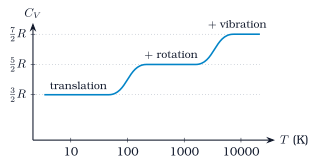
The graph shows \(C_V\) of hydrogen against temperature.
Which motion alone contributes to \(C_V\) below about \(100\) K?
Which motion is added near \(100\) K, and which near \(2000\) K?
Write \(f\) for each of the three flat parts.
Answer(i) translation (ii) rotation; vibration (iii) \(3\); \(5\); \(7\)
Solution
Translation only: \(C_V = \dfrac{3}{2}R\), so \(f = 3\). At such low temperatures the molecules do not have enough energy to rotate.
Near \(100\) K rotation begins and \(C_V\) rises to \(\dfrac{5}{2}R\). Near \(2000\) K the atoms begin to vibrate along the bond and \(C_V\) rises to \(\dfrac{7}{2}R\).
\(f = 3\), \(5\) and \(7\). Vibration adds two degrees of freedom, one for kinetic and one for potential energy.
How did it go?
Q52
A gas has \(\gamma = 1.4\). Find \(f\) and \(C_V\). What kind of molecule does the gas have?
Answer\(5\); \(20.75\) J/mol K; diatomic
Solution
\(\gamma = 1 + \dfrac{2}{f} = 1.4\), so \(\dfrac{2}{f} = 0.4\) and \(f = 5\). \(C_V = \dfrac{5}{2}R = 20.75\) J/mol K. The gas is diatomic, such as nitrogen or oxygen.
How did it go?
Q53
\(2\) mol of oxygen is heated by \(10\) K. Find the heat needed at constant volume and at constant pressure. Where does the difference go?
Answer\(415\) J; \(581\) J; work done
Solution
Oxygen is diatomic: \(C_V = 20.75\) and \(C_P = 29.05\) J/mol K.
Constant volume: \(Q = nC_V\Delta T = 2 \times 20.75 \times 10 = 415\) J. Constant pressure: \(Q = nC_P\Delta T = 2 \times 29.05 \times 10 = 581\) J.
The extra \(166\) J \(= nR\Delta T\) is the work done by the gas as it pushes back the surroundings while it expands.
How did it go?
Q54
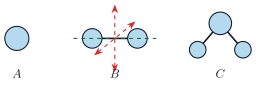
The figure shows three kinds of molecule. For each, write the number of translational, rotational and total degrees of freedom, and the value of \(\gamma\).
\(A\), a single atom: \(3\) translational, \(0\) rotational, \(f = 3\), \(\gamma = \dfrac{5}{3}\).
\(B\), a rigid dumbbell: \(3\) translational, \(2\) rotational (the two dashed axes), \(f = 5\), \(\gamma = \dfrac{7}{5}\).
\(C\), a bent molecule: \(3\) translational, \(3\) rotational, \(f = 6\), \(\gamma = \dfrac{4}{3}\).
How did it go?
Mixtures
Q55
\(1\) mol of helium is mixed with \(1\) mol of oxygen. Find \(C_V\), \(C_P\) and \(\gamma\) of the mixture. Write the answers as multiples of \(R\).
Answer\(2R\); \(3R\); \(1.5\)
Solution
\(C_V\) of a mixture is the total heat capacity divided by the total moles: \(C_V = \dfrac{n_1C_{V1} + n_2C_{V2}}{n_1 + n_2} = \dfrac{1 \times \frac{3}{2}R + 1 \times \frac{5}{2}R}{2} = 2R\).
The specific heat per kilogram is \(c_V = C_V/M\). Find \(c_V\) for helium (\(M = 4\) g/mol) and for nitrogen (\(M = 28\) g/mol). Why is the value for helium so much larger?
Answer\(3112\); \(741\) J/kg K; more molecules per kg
Solution
Helium: \(c_V = \dfrac{12.45}{0.004} = 3112\) J/kg K. Nitrogen: \(c_V = \dfrac{20.75}{0.028} = 741\) J/kg K.
One kilogram of helium contains seven times as many molecules as one kilogram of nitrogen. Each molecule needs its share of energy, so the light gas needs far more heat per kilogram.
How did it go?
Q59
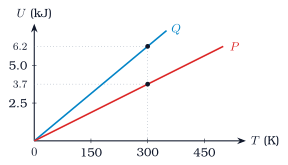
The graph shows the internal energy of \(1\) mol of each of two ideal gases \(P\) and \(Q\).
Find the slope of each line and express it as a multiple of \(R\).
\(P\): slope \(= \dfrac{3700}{300} = 12.3\) J/K \(\approx \dfrac{3}{2}R\). \(Q\): slope \(= \dfrac{6200}{300} = 20.7\) J/K \(\approx \dfrac{5}{2}R\). The slope of \(U\) against \(T\) for \(1\) mol is \(C_V\).
\(Q\). Its \(C_V = \dfrac{5}{2}R\) means \(f = 5\), the value for a rigid diatomic molecule. \(P\) with \(f = 3\) is monatomic.
\(U \propto f\) at the same \(T\) and \(n\), so \(U_Q : U_P = 5 : 3\).
How did it go?
Q60
For a certain gas, measurements give \(C_P = 29.1\) J/mol K and \(C_V = 20.8\) J/mol K. Check Mayer's relation. Find \(\gamma\) and say whether the gas is monatomic or diatomic.
Answer\(8.3\) J/mol K \(= R\); \(1.4\); diatomic
Solution
\(C_P - C_V = 29.1 - 20.8 = 8.3\) J/mol K \(= R\), as Mayer's relation requires.
\(\gamma = \dfrac{29.1}{20.8} = 1.4 = \dfrac{7}{5}\), so \(f = 5\) and the gas is diatomic.
How did it go?
Q61
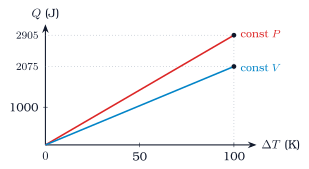
The graph shows the heat supplied to \(1\) mol of a gas against its rise in temperature, at constant volume and at constant pressure.
Read \(C_V\) and \(C_P\) from the graph.
Find \(f\) for the gas.
Find the work done by the gas in the constant-pressure process for \(\Delta T = 100\) K.
Answer(i) \(20.75\); \(29.05\) J/mol K (ii) \(5\) (iii) \(830\) J
Solution
The slopes are the molar heat capacities. \(C_V = \dfrac{2075}{100} = 20.75\) J/mol K and \(C_P = \dfrac{2905}{100} = 29.05\) J/mol K.
\(W = Q_P - Q_V = 2905 - 2075 = 830\) J, which is \(nR\Delta T = 1 \times 8.3 \times 100\).
How did it go?
Q62
At a very high temperature the atoms of a diatomic molecule also vibrate, which adds two degrees of freedom. Find \(f\), \(C_V\) and \(\gamma\) for such a gas.
The average translational kinetic energy of one molecule is \(\frac{3}{2}kT\). Show that the internal energy of \(n\) moles of a monatomic gas is \(U = \frac{3}{2}nRT\).
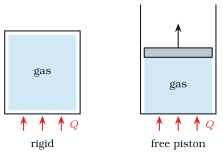
Equal amounts of the same diatomic gas are given the same heat \(Q\), one in a rigid vessel and one under a free piston.
Which gas rises more in temperature? Give the reason.
Find the ratio of the two rises in temperature.
Answer(i) rigid (ii) \(1.4 : 1\)
Solution
The gas in the rigid vessel. It does no work, so all of \(Q\) raises its internal energy. Under the piston part of \(Q\) is spent pushing the piston up.
\(Q = nC_V\Delta T_V = nC_P\Delta T_P\), so \(\dfrac{\Delta T_V}{\Delta T_P} = \dfrac{C_P}{C_V} = \gamma = 1.4\) for a diatomic gas.
How did it go?
Q65
\(1\) mol of helium is heated from \(300\) K to \(400\) K. Find the heat needed at constant pressure and at constant volume.
Answer\(2075\) J; \(1245\) J
Solution
Helium is monatomic. Constant pressure: \(Q = nC_P\Delta T = 1 \times 20.75 \times 100 = 2075\) J. Constant volume: \(Q = nC_V\Delta T = 1 \times 12.45 \times 100 = 1245\) J.
How did it go?
Q66
A diatomic gas is heated at constant pressure. What fraction of the heat supplied becomes internal energy, and what fraction becomes work done by the gas?
Answer\(\frac{5}{7}\); \(\frac{2}{7}\)
Solution
\(Q = nC_P\Delta T\) and \(\Delta U = nC_V\Delta T\), so \(\dfrac{\Delta U}{Q} = \dfrac{C_V}{C_P} = \dfrac{5}{7}\). The rest, \(\dfrac{R}{C_P} = \dfrac{2}{7}\), is work done by the gas.
How did it go?
Mean Free Path, Real Gases and the Barometric Formula
22 questions · after Lesson 6, Mean Free Path, Real Gases and the Atmosphere
Mean free path
Q67
Define the mean free path \(\lambda\) of a gas molecule. Write the formula \(\lambda = \frac{1}{\sqrt{2}\,\pi d^2 n}\) and name \(d\) and \(n\). How does \(\lambda\) change if \(n\) is doubled? If \(d\) is doubled? Take \(k = 1.38 \times 10^{-23}\) J/K, \(R = 8.3\) J/mol K and \(g = 10\) m/s\(^2\) throughout this sheet.
Answermean distance between collisions; halves; quarter
Solution
The mean free path is the average distance a molecule travels between two successive collisions. \(d\) is the diameter of a molecule and \(n\) is the number of molecules per unit volume.
\(\lambda \propto \dfrac{1}{n}\), so doubling \(n\) halves \(\lambda\). \(\lambda \propto \dfrac{1}{d^2}\), so doubling \(d\) reduces \(\lambda\) to a quarter.
How did it go?
Q68
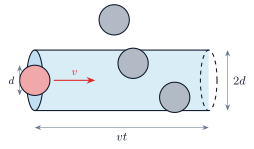
A molecule of diameter \(d\) moves at speed \(v\) through a gas with \(n\) molecules per unit volume. Treat the other molecules as at rest.
Find the volume of the cylinder it sweeps out in time \(t\).
Find the number of collisions in time \(t\), and hence show that \(\lambda = \frac{1}{\pi d^2 n}\).
Why does the exact formula have an extra \(\sqrt{2}\) in the denominator?
Answer(i) \(\pi d^2 vt\) (ii) \(n\pi d^2 vt\) (iii) other molecules also move
Solution
The molecule hits any molecule whose centre lies within \(d\) of its own path. It sweeps a cylinder of radius \(d\) and length \(vt\): volume \(= \pi d^2 vt\).
Collisions \(= n \times \pi d^2 vt\). The distance travelled is \(vt\), so \(\lambda = \dfrac{vt}{n\pi d^2 vt} = \dfrac{1}{\pi d^2 n}\).
The other molecules are not at rest. Their relative speed is on average \(\sqrt{2}\) times \(v\), so collisions happen \(\sqrt{2}\) times as often and \(\lambda\) is \(\sqrt{2}\) times shorter.
How did it go?
Q69
Air molecules have \(d = 3 \times 10^{-10}\) m, and at room conditions \(n = 2.5 \times 10^{25}\) per m\(^3\). Find \(\lambda\). How many molecular diameters is this?
Answer\(10^{-7}\) m \(= 100\) nm; about \(330\,d\)
Solution
\(\pi d^2 = \pi \times 9 \times 10^{-20} = 2.83 \times 10^{-19}\) m\(^2\). \(\sqrt{2}\pi d^2 n = 1.414 \times 2.83 \times 10^{-19} \times 2.5 \times 10^{25} = 10^7\) per m.
\(\lambda = 10^{-7}\) m \(= 100\) nm. This is \(\dfrac{10^{-7}}{3 \times 10^{-10}} \approx 330\) molecular diameters: a gas is mostly empty space.
How did it go?
Q70
Use \(n = \frac{P}{kT}\) to write \(\lambda\) in terms of \(P\) and \(T\). By what factor does \(\lambda\) change when the pressure is doubled at fixed temperature? When the temperature is doubled at fixed pressure?
\(\lambda \propto \dfrac{1}{P}\): doubling \(P\) halves \(\lambda\). \(\lambda \propto T\): doubling \(T\) at fixed \(P\) doubles \(\lambda\), because the gas expands and the molecules are further apart.
How did it go?
Q71
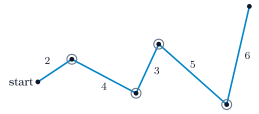
The figure shows the path of one molecule through five collisions. The lengths of the free paths are marked in units of \(25\) nm. Find the mean free path in nm.
Answer\(100\) nm
Solution
Mean of the five free paths \(= \dfrac{2 + 4 + 3 + 5 + 6}{5} = 4\) units \(= 4 \times 25 = 100\) nm.
How did it go?
Q72
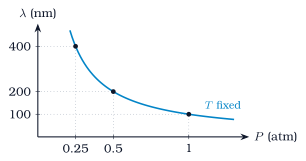
The graph shows the mean free path of air molecules against pressure at room temperature.
Read \(\lambda\) at \(0.5\) atm and at \(0.25\) atm. What is the shape of the graph?
Find \(\lambda\) in a vacuum chamber at \(10^{-3}\) atm.
Answer(i) \(200\) nm; \(400\) nm; hyperbola (ii) \(10^5\) nm \(= 0.1\) mm
Solution
\(200\) nm at \(0.5\) atm and \(400\) nm at \(0.25\) atm. \(\lambda \propto \dfrac{1}{P}\), so the graph is a hyperbola.
\(\lambda = 100 \text{ nm} \times \dfrac{1}{10^{-3}} = 10^5\) nm \(= 0.1\) mm. In a good vacuum the free path can exceed the size of the chamber.
How did it go?
Q73
Air molecules have average speed \(500\) m/s and \(\lambda = 100\) nm. Find the number of collisions one molecule makes per second, and the average time between collisions.
Answer\(5 \times 10^9\) per s; \(2 \times 10^{-10}\) s
Solution
Collision frequency \(= \dfrac{v}{\lambda} = \dfrac{500}{10^{-7}} = 5 \times 10^9\) per second.
Time between collisions \(= \dfrac{\lambda}{v} = \dfrac{10^{-7}}{500} = 2 \times 10^{-10}\) s.
How did it go?
Q74
Molecules move at about \(500\) m/s, yet the smell of perfume takes minutes to cross a room. Explain.
Answerzigzag path, \(10^9\) collisions per second
Solution
A molecule travels only about \(100\) nm before it collides and changes direction. It makes billions of collisions per second, so its path is a random zigzag. Its net progress across the room is a tiny fraction of the distance it actually travels, and diffusion is slow.
How did it go?
Real gases
Q75
Which two assumptions of the kinetic theory fail for a real gas at high pressure? State the correction van der Waals made for each.
Answerno size; no forces
Solution
At high pressure the molecules are close together. The assumption that they occupy no volume fails: van der Waals replaced \(V\) by \(V - nb\), the space actually free for motion.
The assumption that they exert no forces on each other also fails. The attraction between molecules reduces the pressure on the walls, so he added \(\dfrac{an^2}{V^2}\) to the measured pressure.
How did it go?
Q76
Write the van der Waals equation for \(n\) moles of gas. What do the constants \(a\) and \(b\) measure? Why is the pressure term added and the volume term subtracted?
\(a\) measures the strength of the attraction between molecules; \(b\) measures the volume excluded by the molecules themselves per mole.
A molecule about to hit the wall is pulled back by the others, so the measured \(P\) is less than the ideal value. The term is added to correct it. The molecules cannot enter the volume taken up by other molecules, so \(nb\) is subtracted from \(V\).
How did it go?
Q77
Find the SI units of \(a\) and of \(b\).
AnswerPa m\(^6\)/mol\(^2\); m\(^3\)/mol
Solution
\(\dfrac{an^2}{V^2}\) is a pressure, so \(a = \dfrac{\text{Pa} \times \text{m}^6}{\text{mol}^2}\): Pa m\(^6\)/mol\(^2\).
\(nb\) is a volume, so \(b\) is in m\(^3\)/mol.
How did it go?
Q78
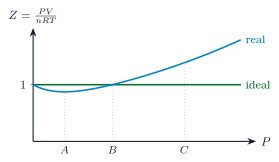
The graph shows \(Z = \frac{PV}{nRT}\) against pressure for an ideal gas and for a real gas.
What is \(Z\) for an ideal gas at every pressure?
At \(A\) the real gas has \(Z < 1\). Which correction is responsible?
At \(C\) the real gas has \(Z > 1\). Which correction is responsible? What happens at \(B\)?
Answer(i) \(1\) (ii) attraction, \(a\) (iii) size, \(b\); they cancel
Solution
\(PV = nRT\), so \(Z = 1\) at every pressure: the green line.
Attraction between molecules. It lowers the pressure below the ideal value, so \(PV\) is less than \(nRT\). This is the \(a\) correction.
The finite size of the molecules. The free volume \(V - nb\) is less than \(V\), so the measured \(V\) is more than the ideal value and \(Z > 1\). This is the \(b\) correction. At \(B\) the two corrections cancel and the gas happens to obey \(PV = nRT\).
How did it go?
Q79
The constant \(b\) is about four times the total volume of the molecules in one mole. For molecules of radius \(1.5 \times 10^{-10}\) m, estimate \(b\) in cm\(^3\)/mol. Take \(N_A = 6 \times 10^{23}\) per mol.
Answer\(34\) cm\(^3\)/mol
Solution
Volume of one molecule \(= \dfrac{4}{3}\pi r^3 = \dfrac{4}{3}\pi(1.5 \times 10^{-10})^3 = 1.41 \times 10^{-29}\) m\(^3\).
\(b \approx 4 \times 6 \times 10^{23} \times 1.41 \times 10^{-29} = 3.4 \times 10^{-5}\) m\(^3\)/mol \(= 34\) cm\(^3\)/mol. Real values are of this size: \(27\) cm\(^3\)/mol for hydrogen, \(43\) for carbon dioxide.
How did it go?
Q80
\(1\) mol of a gas with \(a = 0.1\) Pa m\(^6\)/mol\(^2\) and \(b = 3 \times 10^{-5}\) m\(^3\)/mol fills \(24.9\) L at \(300\) K. Find the pressure from the ideal gas equation and from the van der Waals equation. Compare the two.
The two differ by \(0.04\%\). The size correction raises \(P\) by \(120\) Pa and the attraction lowers it by \(161\) Pa. Both are tiny at ordinary pressure, so the gas is almost ideal.
How did it go?
Q81
Under what conditions of pressure and temperature does a real gas behave almost ideally? Give the reason for each condition.
Answerlow \(P\): molecules far apart; high \(T\): KE \(\gg\) attraction
Solution
Low pressure: the molecules are far apart, so their own volume is negligible and the attraction between them is weak.
High temperature: the molecules move fast, so their kinetic energy is much larger than the potential energy of attraction. The attraction hardly affects their motion.
How did it go?
Barometric formula
Q82
The pressure in an isothermal atmosphere falls with height. Start from \(dP = -\rho g\,dh\) and \(\rho = \frac{PM}{RT}\), and show that \(P = P_0\,e^{-Mgh/RT}\).
Answer\(P = P_0\,e^{-Mgh/RT}\)
Solution
A layer of air of thickness \(dh\) has weight \(\rho g\,dh\) per unit area, so the pressure falls by that much going up: \(dP = -\rho g\,dh\).
Put \(\rho = \dfrac{PM}{RT}\): \(\dfrac{dP}{P} = -\dfrac{Mg}{RT}dh\).
With \(T\) constant, integrate from \(0\) to \(h\): \(\ln\dfrac{P}{P_0} = -\dfrac{Mgh}{RT}\), so \(P = P_0\,e^{-Mgh/RT}\).
How did it go?
Q83
The scale height is \(H = \frac{RT}{Mg}\). Find \(H\) for air (\(M = 29\) g/mol) at \(290\) K. What does \(H\) mean physically?
Answer\(8.3\) km; height for fall to \(P_0/e\)
Solution
\(H = \dfrac{RT}{Mg} = \dfrac{8.3 \times 290}{0.029 \times 10} = 8300\) m \(= 8.3\) km.
\(H\) is the height over which the pressure falls by a factor \(e\). It is also the height the whole atmosphere would have if its density stayed at the sea-level value.
How did it go?
Q84
Using \(H = 8.3\) km, find the pressure at heights \(H\) and \(2H\) as fractions of \(P_0\). Find the height at which the pressure is half of \(P_0\).
\(P = \dfrac{P_0}{2}\) when \(e^{-h/H} = \dfrac{1}{2}\), so \(h = H\ln 2 = 8.3 \times 0.693 = 5.75\) km.
How did it go?
Q85
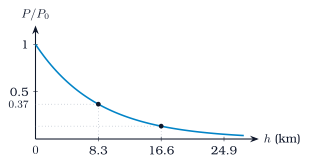
The graph shows \(P/P_0\) against height for an isothermal atmosphere.
Read \(P/P_0\) at \(8.3\) km and at \(16.6\) km.
Find \(P/P_0\) at \(24.9\) km.
By what factor does the pressure fall for every \(8.3\) km of climb?
Answer(i) \(0.37\); \(0.135\) (ii) \(0.05\) (iii) \(e = 2.72\)
Solution
At \(8.3\) km, \(P/P_0 = 0.37\); at \(16.6\) km, \(0.135\).
\(24.9\) km is \(3H\): \(P/P_0 = e^{-3} = 0.05\).
Each \(8.3\) km divides the pressure by \(e = 2.72\). An exponential falls by the same factor for every equal step.
How did it go?
Q86
Show that the density of the air obeys the same law, \(\rho = \rho_0\,e^{-h/H}\). The density at sea level is \(1.2\) kg/m\(^3\). Find the density at \(8.3\) km.
Answer\(\rho \propto P\) at fixed \(T\); \(0.44\) kg/m\(^3\)
Solution
\(\rho = \dfrac{PM}{RT}\) with \(T\) constant, so \(\rho \propto P\) and \(\rho = \rho_0\,e^{-h/H}\).
Give two reasons why the barometric formula is only approximate for the real atmosphere.
Answer\(T\) falls with height; \(g\) varies
Solution
The atmosphere is not isothermal: the temperature falls by about \(6^\circ\)C per kilometre in the lower atmosphere, so \(H\) is smaller at height. Also \(g\) and the composition of the air change slowly with height. The formula is a fair guide for the first \(10\) km only.
How did it go?
Q88
The summit of Mount Everest is at \(8.8\) km. Estimate the pressure there as a fraction of sea-level pressure. Why do climbers carry oxygen?
Answer\(0.35\); a third of the oxygen per breath
Solution
\(\dfrac{P}{P_0} = e^{-8.8/8.3} = e^{-1.06} = 0.35\). The measured value is about \(0.33\).
The air is a third as dense, so each breath brings in only a third of the oxygen. The body cannot get enough oxygen from the thin air.