Questions on The First Law and Thermodynamic Processes, the kind your examinations ask. Solve one on paper. Then tell the book how it went. The book believes you, and it uses your answer to plan your revision.
0%
Nothing marked yetMark honestly. Peek at the answer only after your own attempt.
First Law, Work Done and Indicator Diagrams
22 questions · after Lesson 4, Isochoric, Isobaric and Isothermal Processes
Zeroth and first law
Q1
State the zeroth law of thermodynamics. Which physical quantity does it define? How does a thermometer make use of it?
Answertwo bodies in equilibrium with a third are in equilibrium; temperature; reaches equilibrium with the body
Solution
If two bodies are each in thermal equilibrium with a third body, they are in thermal equilibrium with each other.
The law defines temperature: bodies in thermal equilibrium have the same temperature. A thermometer is the third body. When it reaches equilibrium with a patient, its reading is the patient's temperature.
How did it go?
Q2
State the first law of thermodynamics as an equation. State the sign convention for the heat \(Q\) and the work \(W\). Take \(R = 8.3\) J/mol K throughout this sheet.
Answer\(Q = \Delta U + W\); \(Q\) in \(+\); \(W\) by gas \(+\)
Solution
\(Q = \Delta U + W\): the heat given to a system raises its internal energy and does work.
\(Q\) is positive when heat enters the system. \(W\) is positive when the system does work on its surroundings, as in an expansion. Heat leaving and work done on the gas are negative.
How did it go?
Q3
Find the change in internal energy of a gas in each case.
The gas absorbs \(500\) J of heat and does \(200\) J of work.
The gas gives out \(300\) J of heat while \(100\) J of work is done on it.
Answer(i) \(300\) J (ii) \(-200\) J
Solution
\(\Delta U = Q - W = 500 - 200 = 300\) J.
\(Q = -300\) J and \(W = -100\) J (work done on the gas). \(\Delta U = -300 - (-100) = -200\) J.
How did it go?
Q4
Internal energy is a state function, but heat and work are not. Explain what this means. A gas is taken from state \(A\) to state \(B\) by two different paths. What is the same for both paths, and what may differ?
Answersame \(\Delta U\); \(Q\) and \(W\) differ
Solution
A state function has a definite value in each state, so its change depends only on the initial and final states. \(U\) depends only on the state of the gas.
Heat and work depend on the path: they are energy in transit, not properties of a state. For two paths from \(A\) to \(B\), \(\Delta U\) is the same but \(Q\) and \(W\) can differ. Only their difference \(Q - W\) is fixed.
How did it go?
Q5
Write the work done by a gas that expands at constant pressure \(P\) from \(V_1\) to \(V_2\). A gas at \(10^5\) Pa expands from \(2\) L to \(3\) L. Find the work done by the gas.
Answer\(W = P(V_2 - V_1)\); \(100\) J
Solution
\(W = P(V_2 - V_1)\), the area of a rectangle under the horizontal line on the \(P\)-\(V\) diagram.
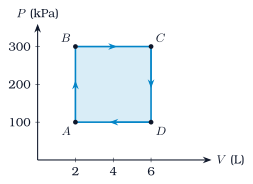
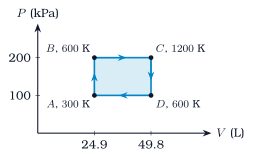
\(W_{net} = 0 + 1200 + 0 - 400 = 800\) J, which is the area of the rectangle, \(200\) kPa \(\times 4\) L.
In a cycle \(\Delta U = 0\), so \(Q_{net} = W_{net} = 800\) J. Run anticlockwise, every \(W\) changes sign: \(W_{net} = -800\) J, and the gas gives out \(800\) J of heat.
How did it go?
Q8
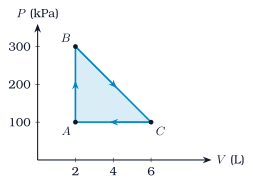
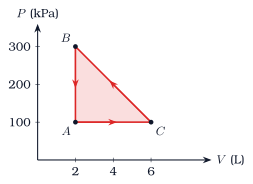
The figure shows the cycle \(ABCA\).
Find the work done in each step \(AB\), \(BC\) and \(CA\).
Find the net work done by the gas in the cycle.
Answer(i) \(0\); \(800\) J; \(-400\) J (ii) \(400\) J
Solution
\(AB\): \(V\) constant, \(W = 0\). \(BC\): area of the trapezium under \(BC\), \(\dfrac{300 + 100}{2} \times 4 = 800\) J. \(CA\): \(W = 100 \times (2 - 6) = -400\) J.
\(W_{net} = 0 + 800 - 400 = 400\) J, the area of the triangle: \(\dfrac{1}{2} \times 4 \times 200 = 400\) J.
How did it go?
Q9
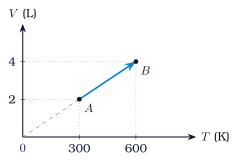
The figure shows a process \(AB\) on a \(V\)-\(T\) diagram. The line passes through the origin.
Which quantity stays constant in this process? Give the reason.
The pressure is \(100\) kPa. Find the work done by the gas.
Sketch the same process on a \(P\)-\(V\) diagram.
Answer(i) \(P\) (ii) \(200\) J (iii) horizontal line
Solution
\(V \propto T\) along a line through the origin. From \(PV = nRT\), \(\dfrac{V}{T} = \dfrac{nR}{P}\) is constant, so \(P\) is constant. The process is isobaric.
\(W = P\Delta V = 100 \times (4 - 2) = 200\) kPa L \(= 200\) J.
A horizontal line at \(P = 100\) kPa from \(V = 2\) L to \(V = 4\) L, with the arrow towards larger \(V\).
How did it go?
Q10
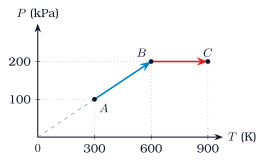
The figure shows two processes on a \(P\)-\(T\) diagram.
Name the process \(AB\) and the process \(BC\). Give the reason for each.
In which process is no work done?
The gas is \(1\) mol. Find the work done in \(BC\).
Answer(i) \(AB\) isochoric; \(BC\) isobaric (ii) \(AB\) (iii) \(2490\) J
Solution
\(AB\): \(P \propto T\) through the origin, so \(\dfrac{P}{T} = \dfrac{nR}{V}\) is constant and \(V\) is constant. \(AB\) is isochoric. \(BC\): \(P\) is constant, so \(BC\) is isobaric.
\(AB\): the volume does not change, so \(W = 0\).
\(BC\): \(W = P\Delta V = nR\Delta T = 1 \times 8.3 \times (900 - 600) = 2490\) J.
How did it go?
Q11
The work done in an isothermal expansion is \(W = nRT\ln\frac{V_2}{V_1}\). Find the work done when \(1\) mol of gas at \(300\) K expands from \(10\) L to \(20\) L. Take \(\ln 2 = 0.693\).
A gas is compressed at a constant pressure of \(2 \times 10^5\) Pa from \(5\) L to \(2\) L, and \(400\) J of heat leaves it. Find the work done on the gas and the change in its internal energy.
Answer\(600\) J on gas; \(\Delta U = +200\) J
Solution
\(W = P\Delta V = 2 \times 10^5 \times (2 - 5) \times 10^{-3} = -600\) J. So \(600\) J of work is done on the gas.
\(Q = -400\) J. \(\Delta U = Q - W = -400 - (-600) = +200\) J. The internal energy rises, so the gas becomes hotter.
How did it go?
Q13
\(1\) mol of a diatomic gas (\(C_V = 20.75\) J/mol K) is heated from \(300\) K to \(400\) K at constant volume. Find \(W\), \(\Delta U\) and \(Q\).
Answer\(0\); \(2075\) J; \(2075\) J
Solution
At constant volume \(W = 0\). \(\Delta U = nC_V\Delta T = 1 \times 20.75 \times 100 = 2075\) J. \(Q = \Delta U + W = 2075\) J.
How did it go?
Q14
In one cycle an engine absorbs \(1000\) J of heat and rejects \(600\) J. Find the net work done and the change in internal energy in the cycle. What fraction of the heat absorbed becomes work?
Answer\(400\) J; \(0\); \(40\%\)
Solution
\(W_{net} = Q_{in} - Q_{out} = 1000 - 600 = 400\) J. In a full cycle the gas returns to its starting state, so \(\Delta U = 0\).
Fraction \(= \dfrac{400}{1000} = 0.4\), that is \(40\%\). This is the efficiency of the engine.
How did it go?
Q15
State the sign of \(W\), \(\Delta U\) and \(Q\) for each process.
an adiabatic expansion,
an isothermal compression.
Answer(i) \(W +\), \(\Delta U -\), \(Q = 0\) (ii) \(W -\), \(\Delta U = 0\), \(Q -\)
Solution
Expansion: \(W\) positive. Adiabatic: \(Q = 0\). Then \(\Delta U = -W\) is negative: the gas cools.
Compression: \(W\) negative. Isothermal: \(T\) constant, so \(\Delta U = 0\). Then \(Q = W\) is negative: the gas gives out heat.
How did it go?
Q16
Show that for any cyclic process the net heat absorbed equals the net work done.
Answer\(\Delta U = 0\) in a cycle, so \(Q_{net} = W_{net}\)
Solution
Internal energy is a state function. After a complete cycle the gas is back in its initial state, so \(\Delta U = 0\).
The first law, \(Q = \Delta U + W\), then gives \(Q_{net} = W_{net}\).
How did it go?
Q17
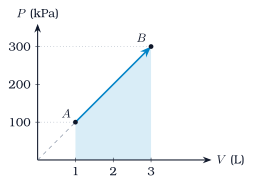
A gas expands from \(1\) L to \(3\) L. Its pressure falls linearly from \(150\) kPa to \(50\) kPa. Find the work done by the gas.
Answer\(200\) J
Solution
The \(P\)-\(V\) graph is a straight line, so the area under it is a trapezium: \(W = \dfrac{150 + 50}{2} \times (3 - 1) = 100 \times 2 = 200\) kPa L \(= 200\) J.
How did it go?
Q18
A piston of area \(0.01\) m\(^2\) moves out by \(0.1\) m against a constant outside pressure of \(10^5\) Pa. Find the work done by the gas from force times distance, and check it against \(P\Delta V\).
Answer\(100\) J
Solution
Force on the piston \(= PA = 10^5 \times 0.01 = 1000\) N. Work \(= F \times d = 1000 \times 0.1 = 100\) J.
\(\Delta V = A \times d = 0.01 \times 0.1 = 10^{-3}\) m\(^3\), and \(P\Delta V = 10^5 \times 10^{-3} = 100\) J. The two agree.
How did it go?
Q19
A gas goes from \(A\) to \(B\) by path 1, absorbing \(800\) J of heat and doing \(500\) J of work. By path 2 it does only \(300\) J of work. Find the heat absorbed along path 2.
Answer\(600\) J
Solution
Path 1: \(\Delta U = Q - W = 800 - 500 = 300\) J. \(\Delta U\) is the same for every path from \(A\) to \(B\).
Path 2: \(Q = \Delta U + W = 300 + 300 = 600\) J.
How did it go?
Q20
Why is \(\Delta U = nC_V\Delta T\) true for an ideal gas in every process, not only at constant volume?
Answer\(U\) depends only on \(T\)
Solution
The internal energy of an ideal gas depends only on its temperature, \(U = \dfrac{f}{2}nRT\). So \(\Delta U\) is fixed by \(\Delta T\) alone. At constant volume \(Q = \Delta U = nC_V\Delta T\), and the same \(\Delta U\) goes with the same \(\Delta T\) in any other process.
How did it go?
Q21
The internal energy of \(2\) mol of an ideal monatomic gas at \(300\) K is \(U = \frac{3}{2}nRT\). Find \(U\). The gas is compressed isothermally to half its volume. Find \(\Delta U\).
Isothermal: \(T\) does not change, so \(\Delta U = 0\). The work done on the gas leaves as heat.
How did it go?
Q22
A bicycle pump becomes warm when the tyre is pumped quickly. Explain using the first law.
Answerwork on air, \(Q \approx 0\), \(U\) rises
Solution
The air is compressed quickly, so there is no time for heat to leave: \(Q \approx 0\). Work is done on the air, so \(W\) is negative and \(\Delta U = -W\) is positive. The internal energy and temperature of the air rise, and the pump becomes warm.
How did it go?
Isothermal, Adiabatic, Isobaric and Isochoric Processes
22 questions · after Lesson 5, Adiabatic Processes
The four processes
Q23
For each process write what stays constant, the equation of state, the work done by the gas and the heat absorbed. Take \(R = 8.3\) J/mol K and \(\ln 2 = 0.693\) throughout this sheet.
\(2\) mol of an ideal gas at \(300\) K expands isothermally to twice its volume. Find the work done by the gas, the change in internal energy and the heat absorbed.
\(T\) is constant, so \(\Delta U = 0\) and \(Q = W = 3452\) J. All the heat absorbed becomes work.
How did it go?
Q25
\(1\) mol of gas at \(300\) K is compressed isothermally from \(1\) atm to \(4\) atm. Find the work done on the gas and the heat given out. Take \(\ln 4 = 1.386\).
Answer\(3452\) J; \(3452\) J
Solution
At constant \(T\), \(\dfrac{V_2}{V_1} = \dfrac{P_1}{P_2} = \dfrac{1}{4}\). \(W = nRT\ln\dfrac{1}{4} = -2490 \times 1.386 = -3452\) J. So \(3452\) J of work is done on the gas.
\(\Delta U = 0\), so \(Q = W = -3452\) J: the gas gives out \(3452\) J of heat.
How did it go?
Adiabatic
Q26
Write the three forms of the adiabatic equation, in \(P\) and \(V\), in \(T\) and \(V\), and in \(P\) and \(T\). Starting from \(PV^\gamma = \) constant and \(PV = nRT\), show that \(TV^{\gamma - 1} = \) constant.
From \(PV = nRT\), \(P = \dfrac{nRT}{V}\). Put this in \(PV^\gamma = \) constant: \(\dfrac{nRT}{V}V^\gamma = nRTV^{\gamma - 1} = \) constant. Since \(nR\) is fixed, \(TV^{\gamma - 1} = \) constant.
How did it go?
Q27
Helium (\(\gamma = \frac{5}{3}\)) at \(300\) K and pressure \(P_1\) is compressed adiabatically to one eighth of its volume. Find its final temperature and its final pressure in terms of \(P_1\).
Write the work done in an adiabatic process in terms of \(P_1\), \(V_1\), \(P_2\), \(V_2\) and \(\gamma\). Write it also in terms of \(n\), \(R\), \(T_1\) and \(T_2\). For \(1\) mol of the helium in Question 5, find the work done on the gas and the change in its internal energy.
\(W = \dfrac{1 \times 8.3 \times (300 - 1200)}{2/3} = -11205\) J. So \(11205\) J of work is done on the gas.
\(Q = 0\), so \(\Delta U = -W = +11205\) J. Check: \(nC_V\Delta T = 12.45 \times 900 = 11205\) J.
How did it go?
Q29
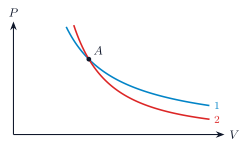
The figure shows two curves through the same state \(A\) on a \(P\)-\(V\) diagram.
Which curve is the adiabat and which the isotherm? Give the reason.
Find the ratio of the slopes of the two curves at \(A\) for a diatomic gas.
Answer(i) \(2\) adiabat, steeper (ii) \(1.4\)
Solution
Curve \(2\) is the adiabat: it is steeper. In an adiabatic expansion the gas cools as well as spreads out, so its pressure falls faster than along the isotherm.
Slope of adiabat \(= \gamma \times\) slope of isotherm, so the ratio is \(\gamma = 1.4\).
How did it go?
Q30
Show that at any point the slope of an adiabat is \(\gamma\) times the slope of the isotherm through that point.
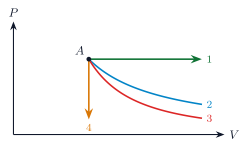
\(1\), horizontal: isobaric. \(2\), the gentler curve: isothermal. \(3\), the steeper curve: adiabatic. \(4\), vertical: isochoric.
Path \(1\). The work is the area under the curve, and the isobaric line stays highest over the whole expansion. The adiabat does the least.
How did it go?
Q34
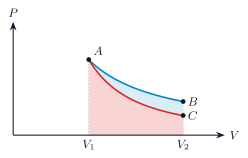
A gas at \(A\) expands to the same final volume \(V_2\), once isothermally to \(B\) and once adiabatically to \(C\).
Which path does more work? What does the shaded gap between the curves represent?
Which final state has the lower temperature? Give the reason.
Which path absorbs heat, and which absorbs none?
Answer(i) isothermal; extra work (ii) \(C\) (iii) \(AB\); \(AC\)
Solution
The isothermal path \(AB\): the area under it is larger. The shaded gap is the extra work done along \(AB\) compared with \(AC\).
\(C\). Along \(AC\) no heat enters, so the work is paid for by the internal energy and the gas cools. Along \(AB\) the temperature stays at its original value.
\(AB\) absorbs heat equal to the work done. \(AC\) absorbs none.
How did it go?
Q35
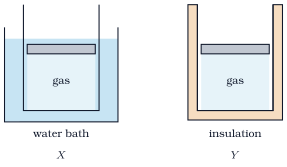
Cylinder \(X\) has thin conducting walls and stands in a large water bath. Cylinder \(Y\) has thick insulated walls. In each the piston is pushed in.
Which cylinder gives an isothermal process and which an adiabatic one?
Why must the piston in \(X\) move slowly, and why may the piston in \(Y\) move fast?
In which cylinder does the gas become hotter?
Answer(i) \(X\) isothermal; \(Y\) adiabatic (ii) time for heat flow (iii) \(Y\)
Solution
\(X\): heat flows freely to the bath, so the gas stays at the bath temperature. Isothermal. \(Y\): no heat can leave. Adiabatic.
Heat flow takes time. In \(X\) the piston must move slowly so that the heat produced by compression has time to leave and \(T\) stays constant. In \(Y\) no heat is meant to leave, so moving fast does no harm and in practice helps.
\(Y\). The work done on the gas cannot escape as heat, so it raises the internal energy and the temperature.
How did it go?
Q36
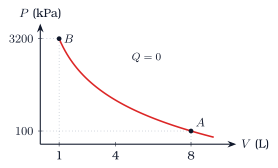
The figure shows an adiabatic compression of helium from \(A\) to \(B\).
Read \(P\) and \(V\) at \(A\) and at \(B\).
Show that \(PV^\gamma\) is the same at \(A\) and at \(B\) for \(\gamma = \frac{5}{3}\).
The temperature at \(A\) is \(300\) K. Find the temperature at \(B\).
Answer(i) \(8\) L, \(100\) kPa; \(1\) L, \(3200\) kPa (ii) \(3200\) each (iii) \(1200\) K
The bulk modulus of a gas is \(B = -V\frac{dP}{dV}\). Show that \(B = P\) for an isothermal change and \(B = \gamma P\) for an adiabatic change. Find both for air (\(\gamma = 1.4\)) at \(10^5\) Pa. Which one governs the speed of sound?
Isothermal: \(\dfrac{dP}{dV} = -\dfrac{P}{V}\), so \(B = -V\left(-\dfrac{P}{V}\right) = P\). Adiabatic: \(\dfrac{dP}{dV} = -\gamma\dfrac{P}{V}\), so \(B = \gamma P\).
Air: \(B_{iso} = 10^5\) Pa and \(B_{adi} = 1.4 \times 10^5\) Pa. Sound compresses the air too fast for heat to flow, so the adiabatic modulus governs the speed of sound (Laplace's correction).
How did it go?
Q39
Why must an isothermal process be slow and an adiabatic process fast? Give one everyday example of each.
Answerheat must flow; heat must not flow
Solution
Isothermal: the temperature stays constant only if the heat produced or needed has time to flow in or out. So the change must be slow. Example: the slow leak of air from a balloon over hours.
Adiabatic: no heat must flow, so the change must be over before heat can move. Example: the compression stroke of a diesel engine, or a bicycle pump.
How did it go?
Q40
Show that the work done by \(n\) moles of ideal gas in an isobaric process is \(W = nR\Delta T\). Find the work when \(3\) mol is heated by \(50\) K at constant pressure.
Answer\(W = P\Delta V = nR\Delta T\); \(1245\) J
Solution
\(W = P(V_2 - V_1)\). With \(PV = nRT\) at constant \(P\), \(PV_2 - PV_1 = nRT_2 - nRT_1\), so \(W = nR\Delta T\).
\(W = 3 \times 8.3 \times 50 = 1245\) J.
How did it go?
Q41
A gas obeys \(PV^{1.4} = \) constant in an adiabatic process. Find its degrees of freedom and its \(C_V\) and \(C_P\).
Answer\(5\); \(20.75\); \(29.05\) J/mol K
Solution
\(\gamma = 1.4 = 1 + \dfrac{2}{f}\), so \(f = 5\): a diatomic gas.
\(C_V = \dfrac{5}{2}R = 20.75\) J/mol K and \(C_P = C_V + R = 29.05\) J/mol K.
How did it go?
Q42
A gas expands isothermally and absorbs \(1000\) J of heat. Find the work it does. It is then compressed adiabatically back to its original volume. Is the final temperature higher or lower than the original? Give the reason.
Answer\(1000\) J; higher
Solution
Isothermal: \(\Delta U = 0\), so \(W = Q = 1000\) J.
The adiabatic compression does work on the gas with no heat leaving, so \(\Delta U\) is positive and the gas warms above its original temperature. The isothermal expansion had left \(T\) unchanged, so the final temperature is higher.
How did it go?
Q43
Find \(\Delta U\) in each case.
Isochoric: \(500\) J of heat is absorbed.
Isobaric: \(700\) J of heat is absorbed and \(200\) J of work is done by the gas.
\(T\) constant, so \(\Delta U = 0\). The \(400\) J leaves as work.
\(Q = 0\), so \(\Delta U = -W = -300\) J.
How did it go?
Q44
Air rushing out of a punctured tyre feels cold. Explain.
Answeradiabatic expansion cools
Solution
The air expands quickly as it escapes, with no time to take in heat: an adiabatic expansion. It does work pushing the outside air aside, and this work comes from its internal energy. Its temperature falls, so the jet feels cold.
How did it go?
Polytropic Processes, Free Expansion and Cycles
22 questions · after Lesson 6, Polytropic Processes, Free Expansion and Cycles
Polytropic processes
Q45
A polytropic process obeys \(PV^x = \) constant, where \(x\) is the polytropic index. Write the value of \(x\) for an isobaric, an isothermal, an adiabatic and an isochoric process. Take \(R = 8.3\) J/mol K and \(\ln 4 = 1.386\) throughout this sheet.
Answer\(0\); \(1\); \(\gamma\); \(\infty\)
Solution
Isobaric: \(P = \) constant, so \(x = 0\). Isothermal: \(PV = \) constant, \(x = 1\). Adiabatic: \(PV^\gamma = \) constant, \(x = \gamma\). Isochoric: \(V = \) constant, which is \(P^{1/x}V = \) constant with \(x \to \infty\).
How did it go?
Q46
Show that the work done by \(n\) moles of gas in a polytropic process from \((P_1, V_1)\) to \((P_2, V_2)\) is \(W = \frac{P_1V_1 - P_2V_2}{x - 1} = \frac{nR(T_1 - T_2)}{x - 1}\).
\(kV_2^{1 - x} = P_2V_2\) and \(kV_1^{1 - x} = P_1V_1\), so \(W = \dfrac{P_2V_2 - P_1V_1}{1 - x} = \dfrac{P_1V_1 - P_2V_2}{x - 1}\). With \(PV = nRT\) this is \(\dfrac{nR(T_1 - T_2)}{x - 1}\).
How did it go?
Q47
Show that the molar heat capacity in a polytropic process is \(C = C_V + \frac{R}{1 - x}\). Start from \(Q = \Delta U + W\) for one mole.
Answer\(C = C_V + \frac{R}{1 - x}\)
Solution
For one mole, \(Q = C\,\Delta T\), \(\Delta U = C_V\Delta T\) and \(W = \dfrac{R(T_1 - T_2)}{x - 1} = \dfrac{R\,\Delta T}{1 - x}\).
\(C\,\Delta T = C_V\Delta T + \dfrac{R\,\Delta T}{1 - x}\), so \(C = C_V + \dfrac{R}{1 - x}\).
How did it go?
Q48
Check the formula of Question 3 by putting \(x = 0\), \(x = \gamma\) and \(x \to \infty\). What happens when \(x = 1\), and why?
Answer\(C_P\); \(0\); \(C_V\); \(C \to \infty\)
Solution
\(x = 0\): \(C = C_V + R = C_P\), correct for constant pressure. \(x = \gamma\): \(C = C_V + \dfrac{R}{1 - \gamma} = C_V - C_V = 0\), correct for an adiabatic process. \(x \to \infty\): \(C = C_V\), correct for constant volume.
\(x = 1\) gives \(C \to \infty\). In an isothermal process heat is absorbed but \(\Delta T = 0\), so the heat per degree is infinite.
How did it go?
Q49
A gas expands so that its pressure is proportional to its volume. Find \(x\), and find the molar heat capacity for a monatomic gas and for a diatomic gas, as multiples of \(R\).
A negative \(C\) means \(Q\) and \(\Delta T\) have opposite signs. When the gas is compressed along this path, the work done on it is more than enough to raise its temperature. The extra energy leaves as heat: the gas gives out heat while it becomes hotter.
How did it go?
Free expansion
Q53
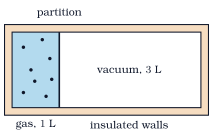
The figure shows an insulated vessel. The partition is suddenly removed and the gas fills the whole vessel.
Why is the work done by the gas zero?
Why is the heat exchanged zero?
What happens to the internal energy and to the temperature of an ideal gas?
Answer(i) no external pressure (ii) insulated (iii) unchanged
Solution
The gas expands into a vacuum. There is nothing to push against, so no force acts through a distance and \(W = 0\).
The walls are insulated, so no heat can enter or leave: \(Q = 0\).
\(\Delta U = Q - W = 0\). For an ideal gas \(U\) depends only on \(T\), so the temperature does not change.
How did it go?
Q54
In the figure of Question 9 the gas is ideal, at \(300\) K and \(4\) atm in \(1\) L. Find its final temperature and final pressure after it fills \(4\) L.
Answer\(300\) K; \(1\) atm
Solution
The temperature stays at \(300\) K. With \(T\) fixed and the volume four times larger, \(P_2 = P_1\dfrac{V_1}{V_2} = 4 \times \dfrac{1}{4} = 1\) atm.
How did it go?
Q55
The initial and final temperatures in a free expansion are equal. Why is it still wrong to call it an isothermal process? Can the process be drawn on a \(P\)-\(V\) diagram?
Answernot quasi-static; no
Solution
An isothermal process passes slowly through equilibrium states, each with a definite \(P\), \(V\) and \(T\). In a free expansion the gas rushes out and is in turmoil. It has no single pressure or temperature until it settles. Only the end states are equilibrium states, so the process cannot be drawn as a curve on a \(P\)-\(V\) diagram.
How did it go?
Cycles
Q56
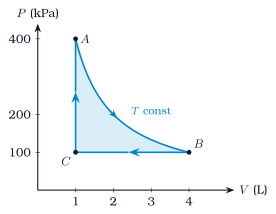
The figure shows a cycle \(ABCA\). \(AB\) is isothermal.
Find the work done in \(AB\), in \(BC\) and in \(CA\). Note that \(1\) kPa L \(= 1\) J.
Find the net work done in the cycle. What does the shaded area represent?
Answer(i) \(554\); \(-300\); \(0\) J (ii) \(254\) J; net work
\(AB\) (constant \(V\)): \(Q = C_V\Delta T = 12.45 \times 300 = 3735\) J. \(BC\) (constant \(P\)): \(Q = C_P\Delta T = 20.75 \times 600 = 12450\) J. \(CD\): \(Q = 12.45 \times (-600) = -7470\) J. \(DA\): \(Q = 20.75 \times (-300) = -6225\) J.
\(Q_{net} = 3735 + 12450 - 7470 - 6225 = 2490\) J. Area \(= 100\) kPa \(\times 24.9\) L \(= 2490\) J. They agree, as they must, since \(\Delta U = 0\) in a cycle.
Heat absorbed \(= 3735 + 12450 = 16185\) J. Efficiency \(= \dfrac{2490}{16185} = 0.154\), about \(15\%\).
How did it go?
Q58
The figure shows a cycle traversed anticlockwise.
Find the net work done by the gas, with its sign.
Does the gas absorb or give out heat over the cycle? How much?
What kind of machine works on an anticlockwise cycle?
Answer(i) \(-400\) J (ii) gives out \(400\) J (iii) refrigerator
Solution
Area of the triangle \(= \dfrac{1}{2} \times 4 \times 200 = 400\) J. Anticlockwise, so \(W_{net} = -400\) J: net work is done on the gas.
\(\Delta U = 0\) in a cycle, so \(Q_{net} = W_{net} = -400\) J. The gas gives out \(400\) J of heat.
A refrigerator or heat pump: work is put in and heat is moved from a cold body to a hot one.
How did it go?
Q59
Air is compressed in a compressor along \(PV^{1.5} = \) constant from \(1\) atm and \(300\) K to \(8\) atm. Find the final temperature.
Answer\(600\) K
Solution
From Question 16, \(TP^{(1 - x)/x} = \) constant, so \(T_2 = T_1\left(\dfrac{P_2}{P_1}\right)^{(x - 1)/x} = 300 \times 8^{0.5/1.5} = 300 \times 8^{1/3} = 600\) K.
How did it go?
Q60
Starting from \(PV^x = \) constant and \(PV = nRT\), show that \(TP^{(1 - x)/x} = \) constant.
Answer\(TP^{(1 - x)/x} = \) constant
Solution
\(V = \dfrac{nRT}{P}\). Put this in \(PV^x = \) constant: \(P\left(\dfrac{nRT}{P}\right)^x = (nR)^x\,T^xP^{1 - x} = \) constant.
Take the \(x\)-th root: \(TP^{(1 - x)/x} = \) constant.
How did it go?
Q61
For a monatomic gas, find the polytropic index \(x\) of the process whose molar heat capacity is \(3R\).
Answer\(\frac{1}{3}\)
Solution
\(C_V + \dfrac{R}{1 - x} = 3R\) with \(C_V = \dfrac{3}{2}R\): \(\dfrac{R}{1 - x} = \dfrac{3}{2}R\), so \(1 - x = \dfrac{2}{3}\) and \(x = \dfrac{1}{3}\).
How did it go?
Q62
In a cycle a gas absorbs \(2000\) J of heat and the enclosed area on the \(P\)-\(V\) diagram is \(800\) J. Find the heat rejected and the efficiency.
Answer\(1200\) J; \(40\%\)
Solution
\(W_{net} = \) enclosed area \(= 800\) J. \(Q_{out} = Q_{in} - W = 2000 - 800 = 1200\) J. Efficiency \(= \dfrac{800}{2000} = 40\%\).
How did it go?
Q63
State the sign of the net work when a cycle is traversed clockwise on a \(P\)-\(V\) diagram, and when anticlockwise. Give the reason.
Answer\(+\); \(-\); expansion along the upper curve
Solution
Clockwise: the expansion happens along the upper curve, where \(P\) is higher, so the positive work of expansion exceeds the negative work of compression. \(W_{net}\) is positive. Anticlockwise the compression is along the upper curve, so \(W_{net}\) is negative.
How did it go?
Q64
A real gas cools slightly in a free expansion, although an ideal gas does not. Explain.
Answerattraction between molecules
Solution
The molecules of a real gas attract each other. As the gas spreads out the molecules move apart against this attraction, so their potential energy rises. With \(\Delta U = 0\) the kinetic energy must fall, and the temperature drops a little. An ideal gas has no such attraction.
How did it go?
Q65
A gas expands from \(V\) to \(4V\), once isothermally and once freely, both at \(300\) K. Compare \(\Delta U\), \(W\) and \(Q\) for the two expansions. Take \(1\) mol.
Both start and end at \(300\) K, so \(\Delta U = 0\) in each.
Isothermal: \(W = nRT\ln 4 = 8.3 \times 300 \times 1.386 = 3452\) J, and \(Q = W = 3452\) J. Free: \(W = 0\) and \(Q = 0\). The same change of state, but the isothermal path turns heat into work and the free expansion does nothing useful.
How did it go?
Q66
Why is a free expansion irreversible?
Answergas never returns by itself
Solution
The gas spreads into the vacuum by itself, but it never gathers back into one half of the vessel by itself. To restore the initial state the surroundings must do work on the gas and take heat from it. This leaves a permanent change in the surroundings. A process that cannot be undone without such a change is irreversible.