Questions on Heat Engines, the Second Law and Entropy, the kind your examinations ask. Solve one on paper. Then tell the book how it went. The book believes you, and it uses your answer to plan your revision.
0%
Nothing marked yetMark honestly. Peek at the answer only after your own attempt.
Second Law, Carnot Engine and Refrigerators
22 questions · after Lesson 4, Refrigerators and Heat Pumps
Second law and heat engines
Q1
State the second law of thermodynamics in the Kelvin-Planck form and in the Clausius form. Which one is about engines and which about refrigerators?
AnswerKP: no engine turns all its heat into work (engines); C: heat never flows cold to hot by itself (refrigerators)
Solution
Kelvin-Planck: no engine working in a cycle can take heat from a single reservoir and turn all of it into work. This is about engines.
Clausius: no device working in a cycle can move heat from a colder body to a hotter body with no other effect. This is about refrigerators.
How did it go?
Q2
An engine takes heat \(Q_1\) from the source, gives heat \(Q_2\) to the sink and does work \(W\). Define its efficiency \(\eta\) in terms of these. An engine takes \(1000\) J from the source and gives \(600\) J to the sink. Find \(W\) and \(\eta\).
Why can the efficiency of a heat engine never be \(100\%\)? Which statement of the second law says so?
Answersome heat must go to the sink; Kelvin-Planck
Solution
\(\eta = 1\) would need \(Q_2 = 0\): all the heat taken from the source would become work, with nothing given to a sink. The Kelvin-Planck statement forbids exactly this. Some heat must always be rejected to a colder body.
How did it go?
Q4
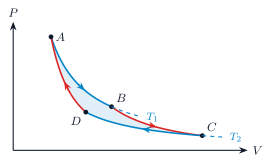
The figure shows the Carnot cycle of an ideal gas.
Name each of the four processes \(AB\), \(BC\), \(CD\) and \(DA\).
In which process is heat absorbed, and in which is it rejected?
What does the enclosed area represent?
Answer(i) isothermal, adiabatic, isothermal, adiabatic (ii) \(AB\); \(CD\) (iii) net work
Solution
\(AB\): isothermal expansion at \(T_1\). \(BC\): adiabatic expansion, \(T_1\) to \(T_2\). \(CD\): isothermal compression at \(T_2\). \(DA\): adiabatic compression, \(T_2\) back to \(T_1\).
Heat \(Q_1\) is absorbed in \(AB\) (the gas expands at constant \(T\), so it must take in heat). Heat \(Q_2\) is rejected in \(CD\). No heat flows in \(BC\) or \(DA\).
The enclosed area is the net work done per cycle, \(W = Q_1 - Q_2\).
How did it go?
Q5
Write the efficiency of a Carnot engine in terms of the source temperature \(T_1\) and the sink temperature \(T_2\). Find \(\eta\) for \(T_1 = 500\) K and \(T_2 = 300\) K.
The engine of Question 5 keeps its source at \(500\) K. Find its efficiency if the sink is cooled to \(250\) K. Instead, with the sink at \(300\) K, to what temperature must the source be raised for \(\eta = 50\%\)?
\(\eta = 0.5\) with \(T_2 = 300\) K: \(\dfrac{300}{T_1} = 0.5\), so \(T_1 = 600\) K. The source must be raised by \(100\) K, while the sink needed to fall by only \(50\) K for the same gain.
How did it go?
Q7
A Carnot engine takes \(1000\) J per cycle from a source at \(400\) K and works with a sink at \(300\) K. Find the heat given to the sink and the work done per cycle. Show that \(\frac{Q_2}{Q_1} = \frac{T_2}{T_1}\).
Answer\(750\) J; \(250\) J
Solution
\(\eta = 1 - \dfrac{300}{400} = 0.25\). \(W = \eta Q_1 = 250\) J. \(Q_2 = Q_1 - W = 750\) J.
\(\dfrac{Q_2}{Q_1} = \dfrac{750}{1000} = 0.75\) and \(\dfrac{T_2}{T_1} = \dfrac{300}{400} = 0.75\). For a Carnot engine the heats are in the ratio of the absolute temperatures.
How did it go?
Q8
State Carnot's theorem. Does the efficiency of a Carnot engine depend on the gas used in it?
Answerno engine beats Carnot; no
Solution
No engine working between two given temperatures can be more efficient than a Carnot engine between the same temperatures. All Carnot engines between those temperatures have the same efficiency.
So \(\eta\) depends only on \(T_1\) and \(T_2\), not on the gas or any other working substance.
How did it go?
Q9
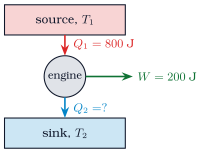
The figure shows the energy flow in one cycle of an engine.
Find \(Q_2\).
Find the efficiency.
If the sink is at \(300\) K, find the lowest source temperature that could allow this efficiency.
No engine can beat Carnot, so \(1 - \dfrac{300}{T_1} \geq 0.25\), giving \(T_1 \geq 400\) K. The lowest possible source temperature is \(400\) K.
How did it go?
Refrigerators and heat pumps
Q10
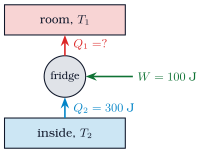
The figure shows the energy flow in one cycle of a refrigerator.
Find \(Q_1\), the heat given to the room.
Define the coefficient of performance \(\beta\) of a refrigerator and find it here.
Why does a refrigerator not break the second law?
Answer(i) \(400\) J (ii) \(\beta = Q_2/W = 3\) (iii) work is supplied
Solution
Energy is conserved: \(Q_1 = Q_2 + W = 300 + 100 = 400\) J.
\(\beta = \dfrac{\text{heat removed from the cold space}}{\text{work supplied}} = \dfrac{Q_2}{W} = \dfrac{300}{100} = 3\).
Heat does go from cold to hot, but not by itself: work is supplied, and the room receives more heat than the inside loses. The Clausius statement forbids only the transfer with no other effect.
How did it go?
Q11
Write the coefficient of performance of a Carnot refrigerator in terms of \(T_1\) and \(T_2\). Find \(\beta\) for a refrigerator that keeps its inside at \(270\) K in a room at \(300\) K.
Answer\(\beta = \frac{T_2}{T_1 - T_2}\); \(9\)
Solution
\(\beta = \dfrac{Q_2}{Q_1 - Q_2} = \dfrac{T_2}{T_1 - T_2}\) for a Carnot cycle run backwards.
\(\beta = \dfrac{270}{300 - 270} = 9\). Each joule of work moves \(9\) J of heat out of the refrigerator.
How did it go?
Q12
A heat pump is a refrigerator used to warm a house: the useful output is \(Q_1\). Define its coefficient of performance and write it for a Carnot heat pump. Find it for the temperatures of Question 11. Show that it is \(\beta + 1\).
\(\beta_{hp} = \dfrac{300}{30} = 10\). Since \(Q_1 = Q_2 + W\), \(\dfrac{Q_1}{W} = \dfrac{Q_2}{W} + 1\), so \(\beta_{hp} = \beta + 1 = 9 + 1 = 10\). A heat pump delivers \(10\) J of heat to the house for each joule of electrical work.
How did it go?
Q13
Show that the coefficient of performance of a Carnot refrigerator and the efficiency of the same cycle run as an engine obey \(\beta = \frac{1 - \eta}{\eta}\). Find \(\beta\) when \(\eta = 0.4\).
A refrigerator is left running with its door open in a closed room. Does the room become cooler or warmer? Give the reason.
Answerwarmer; \(Q_1 = Q_2 + W > Q_2\)
Solution
Warmer. The refrigerator takes heat \(Q_2\) from the air in front of it and gives \(Q_1 = Q_2 + W\) to the air behind it. The net effect on the room is the work \(W\), which all ends up as heat. The room gains energy at the rate of the refrigerator's power.
How did it go?
Q15
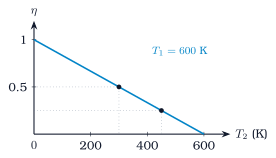
The graph shows the efficiency of a Carnot engine against the sink temperature, for a source at \(600\) K.
Read \(\eta\) for \(T_2 = 300\) K and for \(T_2 = 450\) K.
Why does \(\eta\) reach \(1\) only at \(T_2 = 0\)?
At which \(T_2\) is \(\eta = 0\)? What does the engine do then?
Answer(i) \(0.5\); \(0.25\) (ii) no heat rejected only at \(0\) K (iii) \(600\) K; no work
\(\eta = 1\) needs \(Q_2 = 0\), that is \(T_2 = 0\) K. A sink at absolute zero cannot be reached, so \(\eta\) is always less than \(1\).
\(\eta = 0\) when \(T_2 = T_1 = 600\) K. With both reservoirs at the same temperature the engine does no work: all the heat taken in is given straight back.
How did it go?
Q16
A Carnot engine has efficiency \(\frac{1}{6}\). When the sink temperature is lowered by \(62\) K, the efficiency becomes \(\frac{1}{3}\). Find the source and sink temperatures.
Subtract: \(62 = \dfrac{5}{6}T_1 - \dfrac{2}{3}T_1 = \dfrac{1}{6}T_1\), so \(T_1 = 372\) K and \(T_2 = 310\) K.
How did it go?
Q17
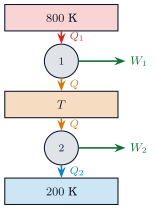
Two Carnot engines work in series. Engine \(1\) works between \(800\) K and \(T\). Engine \(2\) takes the heat rejected by engine \(1\) and works between \(T\) and \(200\) K.
Find \(T\) if the two engines do equal work.
Find \(T\) if the two engines have equal efficiencies.
\(W_1 = W_2\): \(800 - T = T - 200\), so \(T = 500\) K, the mean of the two temperatures.
\(1 - \dfrac{T}{800} = 1 - \dfrac{200}{T}\), so \(T^2 = 800 \times 200\) and \(T = 400\) K, the geometric mean.
How did it go?
Q18
A Carnot refrigerator removes heat at \(600\) W from a cold space at \(250\) K and rejects it to a room at \(300\) K. Find the power it needs.
Answer\(120\) W
Solution
\(\beta = \dfrac{T_2}{T_1 - T_2} = \dfrac{250}{50} = 5\). Power \(= \dfrac{\text{heat removed per second}}{\beta} = \dfrac{600}{5} = 120\) W.
How did it go?
Q19
An inventor claims an engine that takes heat at \(500\) K, rejects it at \(300\) K and has an efficiency of \(60\%\). Is the claim possible? Give the reason.
Answerno; maximum \(40\%\)
Solution
No. The Carnot efficiency between \(500\) K and \(300\) K is \(1 - \dfrac{300}{500} = 40\%\), and no engine between these temperatures can do better. A \(60\%\) engine would break the second law.
How did it go?
Q20
A Carnot engine works between \(400\) K and \(300\) K. In each cycle the gas does \(2301\) J of work during the isothermal expansion. Find the heat absorbed, the net work per cycle and the heat rejected.
Answer\(2301\) J; \(575\) J; \(1726\) J
Solution
In the isothermal expansion \(\Delta U = 0\), so the heat absorbed equals the work done: \(Q_1 = 2301\) J.
\(\eta = 1 - \dfrac{300}{400} = 0.25\). \(W = \eta Q_1 = 575\) J. \(Q_2 = Q_1 - W = 1726\) J.
How did it go?
Q21
The entropy change of a body that absorbs heat \(Q\) at constant temperature \(T\) is \(\Delta S = \frac{Q}{T}\). \(300\) J of heat flows from a body at \(300\) K to a body at \(200\) K. Find the entropy change of each body and of the two together. What does the sign of the total tell you?
Hot body: \(\Delta S = \dfrac{-300}{300} = -1\) J/K. Cold body: \(\Delta S = \dfrac{+300}{200} = +1.5\) J/K. Total: \(+0.5\) J/K.
The total entropy rises. This is the mark of an irreversible process: heat flowing from hot to cold happens by itself and never reverses on its own.
How did it go?
Q22
What is a perpetual motion machine of the second kind? Why can it not be built?
Answerengine with one reservoir; Kelvin-Planck
Solution
A perpetual motion machine of the second kind is an engine with no sink. It takes heat from a single reservoir, such as the sea, and turns all of it into work, cycle after cycle. It would not break the first law, since energy is conserved. It breaks the Kelvin-Planck statement of the second law, so it cannot be built.
How did it go?
Entropy and T-S Diagrams
21 questions · after Lesson 6, Entropy, Irreversibility and T-S Diagrams
Definition
Q23
Write the definition of the entropy change \(dS\) of a system that absorbs heat \(dQ\) reversibly at temperature \(T\). Give its unit. Is entropy a state function or a path function? Take \(R = 8.3\) J/mol K, \(\ln 2 = 0.693\) and \(\ln 3 = 1.099\) throughout this sheet.
Answer\(dS = \frac{dQ_{rev}}{T}\); J/K; state function
Solution
\(dS = \dfrac{dQ_{rev}}{T}\), the heat absorbed reversibly divided by the absolute temperature at which it is absorbed. Unit: J/K.
Entropy is a state function. Its change between two states is the same whatever the path, though it must be calculated along a reversible path.
How did it go?
Q24
A system absorbs \(1000\) J of heat reversibly at a constant temperature of \(500\) K. Find its entropy change. What is the entropy change of the reservoir that supplied the heat?
Answer\(+2\) J/K; \(-2\) J/K
Solution
\(\Delta S = \dfrac{Q}{T} = \dfrac{1000}{500} = +2\) J/K.
The reservoir gives out \(1000\) J at \(500\) K, so its entropy change is \(-2\) J/K. For this reversible exchange the total is zero.
How did it go?
Q25
Find the entropy change when \(1\) kg of ice melts at \(273\) K. Take \(L = 3.36 \times 10^5\) J/kg.
Answer\(1231\) J/K
Solution
Melting happens at constant temperature: \(\Delta S = \dfrac{mL}{T} = \dfrac{3.36 \times 10^5}{273} = 1231\) J/K.
How did it go?
Q26
Find the entropy change when \(1\) kg of water boils away at \(373\) K. Take \(L = 2.26 \times 10^6\) J/kg. Why is this much larger than the value for melting?
Answer\(6059\) J/K; \(L\) larger
Solution
\(\Delta S = \dfrac{mL}{T} = \dfrac{2.26 \times 10^6}{373} = 6059\) J/K, about \(6.06\) kJ/K.
Boiling needs nearly seven times the latent heat of melting, at a temperature only \(37\%\) higher. Turning a liquid into a widely spread gas is a far larger increase in disorder than loosening a solid into a liquid.
How did it go?
Q27
A body of mass \(m\) and specific heat \(s\) is warmed from \(T_1\) to \(T_2\). Show that \(\Delta S = ms\ln\frac{T_2}{T_1}\). Find \(\Delta S\) when a \(1\) kg copper block (\(s = 400\) J/kg K) is warmed from \(300\) K to \(600\) K.
Answer\(\Delta S = ms\ln\frac{T_2}{T_1}\); \(277\) J/K
Solution
Each small step absorbs \(dQ = ms\,dT\) at temperature \(T\): \(dS = \dfrac{ms\,dT}{T}\). Integrating from \(T_1\) to \(T_2\): \(\Delta S = ms\ln\dfrac{T_2}{T_1}\).
Show that the entropy change of \(n\) moles of ideal gas in an isothermal expansion from \(V_1\) to \(V_2\) is \(\Delta S = nR\ln\frac{V_2}{V_1}\). Find it for \(1\) mol expanding to twice its volume.
Answer\(5.75\) J/K
Solution
Isothermal: \(\Delta U = 0\), so \(dQ = dW = P\,dV = \dfrac{nRT}{V}dV\). Then \(dS = \dfrac{dQ}{T} = nR\dfrac{dV}{V}\), and integrating gives \(\Delta S = nR\ln\dfrac{V_2}{V_1}\).
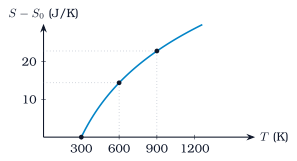
\(1\) mol of helium (\(C_V = 12.45\), \(C_P = 20.75\) J/mol K) is heated from \(300\) K to \(600\) K. Find \(\Delta S\) if the heating is at constant volume, and if it is at constant pressure. Why is the second larger?
At constant pressure the gas also expands, and more heat must be absorbed for the same rise in temperature. More heat absorbed at the same temperatures means a larger entropy change.
How did it go?
Q30
What is the entropy change of a gas in a reversible adiabatic process? Give the reason. What is such a process called?
Answerzero; isentropic
Solution
\(dQ = 0\) at every step, so \(dS = \dfrac{dQ_{rev}}{T} = 0\) and \(\Delta S = 0\). The process is isentropic: it is a vertical line on a \(T\)-\(S\) diagram.
How did it go?
T-S diagrams
Q31
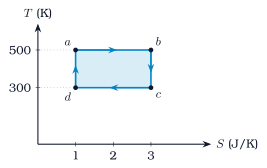
The figure shows a Carnot cycle on a \(T\)-\(S\) diagram.
Name the processes \(ab\), \(bc\), \(cd\) and \(da\). Why are two sides horizontal and two vertical?
Find the heat absorbed along \(ab\) and the heat rejected along \(cd\).
Find the net work per cycle and the efficiency. Check against \(1 - \frac{T_2}{T_1}\).
\(ab\): isothermal expansion at \(500\) K. \(bc\): adiabatic expansion. \(cd\): isothermal compression at \(300\) K. \(da\): adiabatic compression. An isothermal process has constant \(T\), so it is horizontal. A reversible adiabatic process has constant \(S\), so it is vertical.
Heat is the area under the line on a \(T\)-\(S\) diagram. \(ab\): \(Q_1 = T_1\Delta S = 500 \times 2 = 1000\) J absorbed. \(cd\): \(Q_2 = 300 \times 2 = 600\) J rejected.
\(W = Q_1 - Q_2 = 400\) J, the area of the rectangle. \(\eta = \dfrac{400}{1000} = 40\%\), and \(1 - \dfrac{300}{500} = 0.4\) agrees.
How did it go?
Q32
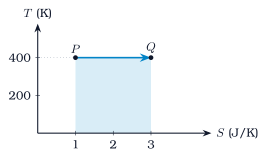
The figure shows a process \(PQ\) on a \(T\)-\(S\) diagram.
What kind of process is \(PQ\)?
What does the shaded area represent? Find it.
If the system is an ideal gas, find the work it does along \(PQ\).
Answer(i) isothermal (ii) heat absorbed; \(800\) J (iii) \(800\) J
Solution
\(T\) is constant along \(PQ\), so it is an isothermal process. The entropy rises, so heat is absorbed.
The area under a \(T\)-\(S\) curve is \(\int T\,dS = Q\), the heat absorbed. \(Q = 400 \times (3 - 1) = 800\) J.
For an ideal gas \(\Delta U = 0\) at constant \(T\), so \(W = Q = 800\) J.
How did it go?
Q33
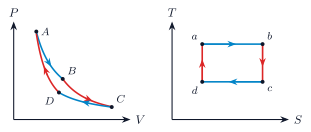
The figure shows the same Carnot cycle on a \(P\)-\(V\) diagram and on a \(T\)-\(S\) diagram. Match each leg \(AB\), \(BC\), \(CD\), \(DA\) with a leg \(ab\), \(bc\), \(cd\), \(da\). Give the reason for each match.
\(AB\) is the isothermal expansion at the higher temperature \(T_1\). Heat is absorbed, so \(S\) rises: it is \(ab\), the upper horizontal line going right.
\(BC\) is the adiabatic expansion: \(S\) is constant and \(T\) falls, so it is \(bc\), the right vertical line going down.
\(CD\) is the isothermal compression at \(T_2\), heat rejected, \(S\) falls: it is \(cd\), the lower line going left. \(DA\) is the adiabatic compression, \(T\) rising at constant \(S\): it is \(da\).
How did it go?
Q34
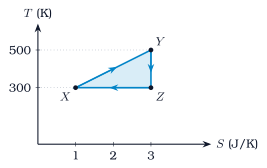
The figure shows a cycle \(XYZX\) on a \(T\)-\(S\) diagram.
Find the heat absorbed along \(XY\) and the heat rejected along \(ZX\).
Find the net work and the efficiency of the cycle.
\(XY\): area under the sloping line, a trapezium, \(\dfrac{300 + 500}{2} \times 2 = 800\) J absorbed. \(ZX\): \(300 \times 2 = 600\) J rejected. No heat flows along \(YZ\).
\(W = 800 - 600 = 200\) J, the area of the triangle. \(\eta = \dfrac{200}{800} = 25\%\).
\(YZ\) is vertical: \(S\) is constant, so it is a reversible adiabatic (isentropic) process.
How did it go?
Q35
What is the entropy change of a system over one complete cycle? Give the reason. Use this and the Carnot cycle to show that \(\frac{Q_1}{T_1} = \frac{Q_2}{T_2}\).
Answerzero
Solution
Entropy is a state function. After a complete cycle the system is back in its initial state, so \(\Delta S = 0\).
In the Carnot cycle the only entropy changes are \(+\dfrac{Q_1}{T_1}\) in the isothermal expansion and \(-\dfrac{Q_2}{T_2}\) in the isothermal compression. Their sum must be zero, so \(\dfrac{Q_1}{T_1} = \dfrac{Q_2}{T_2}\).
How did it go?
Irreversible processes
Q36
\(1000\) J of heat flows from a reservoir at \(500\) K to a reservoir at \(250\) K. Find the entropy change of each reservoir and of the universe. Is the process reversible?
The entropy of the universe has risen, so the process is irreversible. The heat will never flow back by itself.
How did it go?
Q37
In a free expansion of \(1\) mol of ideal gas to twice its volume, no heat flows. Is \(\Delta S\) zero? Find \(\Delta S\) and explain how it is calculated.
Answerno; \(5.75\) J/K
Solution
No. \(\Delta S\) depends only on the end states, which are the same as for an isothermal expansion to twice the volume. So \(\Delta S = nR\ln 2 = 5.75\) J/K.
\(\Delta S\) must be found along a reversible path between the same states, here the isothermal one. The free expansion itself has \(Q = 0\), but it is irreversible, so \(Q/T\) along it does not give the entropy change.
How did it go?
Q38
Two different gases at the same temperature and pressure are separated by a partition. The partition is removed and the gases mix. Does the entropy rise, fall or stay the same? What if the two gases were the same gas?
Answerrises; no change
Solution
The entropy rises. Each gas expands into the whole vessel, like a free expansion, and gains \(nR\ln 2\) if the volumes are equal. The mixed state is more disordered and the gases never separate by themselves.
If both sides hold the same gas at the same \(T\) and \(P\), removing the partition changes nothing that can be measured. The entropy does not change.
How did it go?
Q39
State the second law of thermodynamics in terms of entropy. What can be said about the entropy of the universe in a reversible process, and in an irreversible one?
\(dS = \dfrac{C_P\,dT}{T}\): the same heat gives a smaller entropy change when the gas is already hot. The slope of the curve is \(\dfrac{C_P}{T}\), which falls as \(T\) rises.
How did it go?
Q41
A hot body gives out \(600\) J of heat at \(400\) K to its surroundings at \(300\) K. Find the entropy change of the body, of the surroundings and of the whole.
Answer\(-1.5\); \(+2\); \(+0.5\) J/K
Solution
Body: \(\dfrac{-600}{400} = -1.5\) J/K. Surroundings: \(\dfrac{+600}{300} = +2\) J/K. Whole: \(+0.5\) J/K. The body loses entropy but the surroundings gain more.
How did it go?
Q42
A refrigerator moves heat \(Q_2\) from \(T_2\) to \(T_1\) (\(T_1 > T_2\)) using work \(W\) and rejects \(Q_1 = Q_2 + W\). Use \(\Delta S_{universe} \geq 0\) to show that \(\frac{Q_1}{T_1} \geq \frac{Q_2}{T_2}\), and hence that \(W\) cannot be zero.
Answer\(\frac{Q_1}{T_1} \geq \frac{Q_2}{T_2}\); \(W = 0\) would need \(T_1 \leq T_2\)
Solution
The cold body loses \(Q_2\) at \(T_2\): \(\Delta S_2 = -\dfrac{Q_2}{T_2}\). The hot body gains \(Q_1\) at \(T_1\): \(\Delta S_1 = +\dfrac{Q_1}{T_1}\). The refrigerator itself returns to its state each cycle.
If \(W = 0\) then \(Q_1 = Q_2\), and the inequality would need \(T_1 \leq T_2\), which is false. So \(W > 0\): heat cannot pass from cold to hot without work. This is the Clausius statement.
How did it go?
Q43
\(2\) kg of water cools from \(373\) K to \(273\) K. Find its entropy change. Take \(\ln\frac{373}{273} = 0.312\). Why is the answer negative although the entropy of the universe cannot fall?
The water is not isolated. The heat it loses goes to the cooler surroundings. Their entropy rises by more than \(2621\) J/K, because they receive the heat at a lower temperature. The total still increases.