Questions on Conduction of Heat, the kind your examinations ask. Solve one on paper. Then tell the book how it went. The book believes you, and it uses your answer to plan your revision.
0%
Nothing marked yetMark honestly. Peek at the answer only after your own attempt.
Conduction: Fourier's Law, Thermal Resistance and Rods
22 questions · after Lesson 3, Thermal Resistance and Rods in Series and in Parallel
Fourier's law
Q1
Write Fourier's law of heat conduction, \(H = \frac{dQ}{dt} = -KA\frac{dT}{dx}\), and name each symbol. Why is there a minus sign? Give the SI unit and the dimensions of \(K\).
Answerheat flows down the gradient; W/m K; \([\mathrm{MLT^{-3}K^{-1}}]\)
Solution
\(H\) is the heat current, the heat crossing a section per second. \(K\) is the thermal conductivity of the material, \(A\) the area of cross-section and \(\dfrac{dT}{dx}\) the temperature gradient.
Heat flows from hot to cold, that is towards decreasing \(T\). Where \(\dfrac{dT}{dx}\) is negative, \(H\) is positive along \(x\): the minus sign makes this so.
\(K = \dfrac{H}{A\,(dT/dx)}\) has the unit \(\dfrac{\text{W}}{\text{m}^2 \times \text{K/m}} = \) W/m K, and dimensions \(\dfrac{[\mathrm{ML^2T^{-3}}]}{[\mathrm{L^2}][\mathrm{KL^{-1}}]} = [\mathrm{MLT^{-3}K^{-1}}]\).
How did it go?
Q2
What is meant by the steady state of a rod? A rod \(1\) m long has its ends at \(100^\circ\)C and \(0^\circ\)C in the steady state. Find the temperature gradient and the temperature \(0.3\) m from the hot end.
Answer\(100\) K/m; \(70^\circ\)C
Solution
In the steady state the temperature at each point of the rod no longer changes with time, and the same heat current passes every section.
Gradient \(= \dfrac{100 - 0}{1} = 100\) K/m. At \(0.3\) m from the hot end, \(T = 100 - 100 \times 0.3 = 70^\circ\)C.
How did it go?
Q3
A copper rod (\(K = 400\) W/m K) is \(1\) m long with cross-section \(1\) cm\(^2\). Its ends are kept at \(100^\circ\)C and \(0^\circ\)C. Find the heat current through it.
Define the thermal resistance \(R = \frac{L}{KA}\) of a rod and write \(H = \frac{\Delta T}{R}\). Which electrical quantities do \(H\), \(\Delta T\) and \(R\) correspond to? Find \(R\) for the rod of Question 3 and check \(H\).
\(R = \dfrac{L}{KA}\) is the temperature difference needed per unit heat current, in K/W. \(H\) plays the part of the current \(I\), \(\Delta T\) of the potential difference \(V\) and \(R\) of the electrical resistance. \(H = \dfrac{\Delta T}{R}\) is Ohm's law for heat.
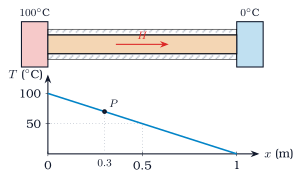
The figure shows an insulated rod between two reservoirs and the graph of its temperature against distance in the steady state.
Why is the graph a straight line?
Read the temperature at \(P\), \(0.3\) m from the hot end.
What happens to the heat current if the rod is not insulated at the sides? Sketch how the graph changes.
Answer(i) uniform gradient (ii) \(70^\circ\)C (iii) falls; curve bends down
Solution
The rod is insulated, so the same \(H\) crosses every section. With \(K\) and \(A\) uniform, \(\dfrac{dT}{dx} = -\dfrac{H}{KA}\) is the same everywhere: a constant slope.
At \(x = 0.3\) m the line gives \(70^\circ\)C.
Heat leaks out of the sides, so the current along the rod falls with \(x\) and the gradient becomes smaller further along. The graph curves, steep near the hot end and flatter near the cold end.
How did it go?
Q6
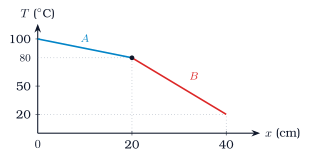
The graph shows the steady-state temperature along a rod made of two materials \(A\) and \(B\) of equal length and cross-section.
Find the temperature gradient in \(A\) and in \(B\).
Which material has the larger conductivity? Give the reason.
Find the ratio \(K_A : K_B\).
Answer(i) \(1\); \(3\) \(^\circ\)C/cm (ii) \(A\) (iii) \(3 : 1\)
Solution
\(A\): \(\dfrac{100 - 80}{20} = 1\) \(^\circ\)C per cm. \(B\): \(\dfrac{80 - 20}{20} = 3\) \(^\circ\)C per cm.
\(A\). The same heat current passes through both, and \(H = KA\dfrac{dT}{dx}\). The material with the smaller gradient must have the larger \(K\).
Two rods of the same length \(L\) and cross-section \(A\), with conductivities \(K_1\) and \(K_2\), are joined end to end. Show that the thermal resistances add and that the equivalent conductivity is \(K = \frac{2K_1K_2}{K_1 + K_2}\). Find \(K\) for \(K_1 = 400\) and \(K_2 = 100\) W/m K.
Answer\(R = R_1 + R_2\); \(160\) W/m K
Solution
The same \(H\) flows through both rods, and the temperature drops add: \(\Delta T = HR_1 + HR_2 = H(R_1 + R_2)\). So \(R = R_1 + R_2\).
\(\dfrac{2L}{KA} = \dfrac{L}{K_1A} + \dfrac{L}{K_2A}\), so \(\dfrac{2}{K} = \dfrac{1}{K_1} + \dfrac{1}{K_2}\) and \(K = \dfrac{2K_1K_2}{K_1 + K_2}\).
The rods of Question 7 are placed between \(100^\circ\)C (at the \(K_1\) end) and \(0^\circ\)C. Find the temperature of the junction.
Answer\(80^\circ\)C
Solution
\(R \propto \dfrac{1}{K}\) for equal \(L\) and \(A\), so \(R_1 : R_2 = \dfrac{1}{400} : \dfrac{1}{100} = 1 : 4\).
The temperature drop is shared in the ratio of the resistances. Drop across rod 1 \(= \dfrac{1}{5} \times 100 = 20^\circ\)C, so the junction is at \(80^\circ\)C.
How did it go?
Q9
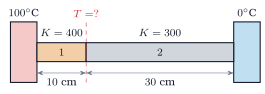
The figure shows two rods of equal cross-section joined end to end.
Find the ratio of the thermal resistances \(R_1 : R_2\).
Find the temperature of the junction.
The cross-section is \(2\) cm\(^2\). Find the heat current.
Answer(i) \(1 : 4\) (ii) \(80^\circ\)C (iii) \(16\) W
Two rods of the same length have cross-sections \(A_1\) and \(A_2\) and conductivities \(K_1\) and \(K_2\). They are placed side by side between the same two temperatures. Show that the equivalent conductivity is \(K = \frac{K_1A_1 + K_2A_2}{A_1 + A_2}\). Find \(K\) for equal areas with \(K_1 = 400\) and \(K_2 = 100\) W/m K.
Answer\(250\) W/m K
Solution
Both rods have the same \(\Delta T\) across them, so the currents add: \(H = K_1A_1\dfrac{\Delta T}{L} + K_2A_2\dfrac{\Delta T}{L} = K(A_1 + A_2)\dfrac{\Delta T}{L}\).
So \(K = \dfrac{K_1A_1 + K_2A_2}{A_1 + A_2}\). For equal areas \(K = \dfrac{400 + 100}{2} = 250\) W/m K.
How did it go?
Q11
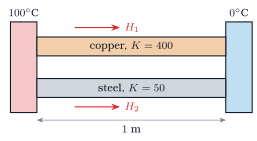
The figure shows a copper rod and a steel rod, each \(1\) m long and \(1\) cm\(^2\) in cross-section, between the same two reservoirs.
Find the heat current through each rod.
Find the total heat current and the equivalent thermal resistance.
Answer(i) \(4\) W; \(0.5\) W (ii) \(4.5\) W; \(22.2\) K/W
\(H = 4.5\) W. \(R = \dfrac{\Delta T}{H} = \dfrac{100}{4.5} = 22.2\) K/W. Check: \(R_1 = 25\) and \(R_2 = 200\) K/W in parallel give \(\dfrac{25 \times 200}{225} = 22.2\) K/W.
How did it go?
Q12
A brick wall (\(K = 1\) W/m K) has area \(10\) m\(^2\) and thickness \(20\) cm. It separates a room at \(25^\circ\)C from the outside at \(5^\circ\)C. Find the heat flowing out through the wall per second. An insulating board \(2\) cm thick (\(K = 0.05\) W/m K) is fixed on the outside. Find the new heat flow.
With the board: \(R_{wall} = \dfrac{0.2}{1 \times 10} = 0.02\) K/W and \(R_{board} = \dfrac{0.02}{0.05 \times 10} = 0.04\) K/W. \(H = \dfrac{20}{0.06} = 333\) W. A thin board of poor conductor cuts the loss to a third.
How did it go?
Q13
Show that for two slabs in series the heat current is \(H = \frac{\Delta T}{R_1 + R_2}\), and that the same \(H\) passes through both slabs.
Answer\(\Delta T = H(R_1 + R_2)\); no heat stored at the joint
Solution
In the steady state no heat collects at the joint. So the current entering the joint from slab 1 equals the current leaving into slab 2: the same \(H\) passes both.
Find the temperature at the surface between the wall and the board in Question 12.
Answer\(18.3^\circ\)C
Solution
Drop across the wall \(= HR_{wall} = 333 \times 0.02 = 6.7^\circ\)C. Interface temperature \(= 25 - 6.7 = 18.3^\circ\)C. Most of the drop, \(13.3^\circ\)C, is across the thin board.
How did it go?
Q15
A metal spoon and a wooden spoon are both at room temperature. Why does the metal one feel colder to the touch?
Answermetal conducts heat away faster
Solution
The hand is warmer than the spoon. Metal has a large \(K\), so it carries heat away from the skin quickly and the skin cools. Wood has a small \(K\), so the skin loses heat slowly. The nerves sense the rate of heat loss, not the temperature of the spoon.
How did it go?
Q16
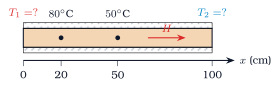
A uniform insulated rod \(1\) m long is in the steady state. The figure shows the temperatures at two points.
Find the temperature gradient.
Find the temperatures \(T_1\) and \(T_2\) of the two ends.
Answer(i) \(-1\) \(^\circ\)C/cm (ii) \(100^\circ\)C; \(0^\circ\)C
Solution
Gradient \(= \dfrac{50 - 80}{50 - 20} = -1\) \(^\circ\)C per cm. The temperature falls by \(1^\circ\)C for every centimetre along the rod.
\(T_1 = 80 + 20 \times 1 = 100^\circ\)C at \(x = 0\). \(T_2 = 50 - 50 \times 1 = 0^\circ\)C at \(x = 100\) cm.
How did it go?
Q17
An ice box has walls of total area \(1\) m\(^2\) and thickness \(5\) cm, with \(K = 0.05\) W/m K. It holds ice at \(0^\circ\)C in a room at \(30^\circ\)C. Find the heat flowing in per second and the mass of ice that melts in one hour. Take \(L = 3.36 \times 10^5\) J/kg.
In one hour \(Q = 30 \times 3600 = 1.08 \times 10^5\) J. Mass melted \(= \dfrac{1.08 \times 10^5}{3.36 \times 10^5} = 0.32\) kg.
How did it go?
Q18
State the factor by which the heat current through a rod changes when:
\(\Delta T\) is doubled,
the length is doubled,
the radius is doubled.
Answer(i) \(2\) (ii) \(\frac{1}{2}\) (iii) \(4\)
Solution
\(H \propto \Delta T\): doubles.
\(H \propto \dfrac{1}{L}\): halves.
\(H \propto A \propto r^2\): four times.
How did it go?
Q19
In the steady state the temperature at every point of the rod stays constant although heat keeps flowing. Explain how this is possible.
Answerheat in \(=\) heat out at each point
Solution
At every section the heat arriving from the hotter side each second equals the heat leaving to the colder side. No heat is stored in any part of the rod, so no part warms or cools. The rod is like a pipe with water flowing steadily through it: full of flow, but with nothing changing.
How did it go?
Q20
Two rods of the same material have lengths in the ratio \(1 : 2\) and radii in the ratio \(1 : 2\). The same temperature difference is applied across each. Find the ratio of the heat currents.
Two identical rods are given. In which arrangement, series or parallel, do they carry more heat between the same two temperatures? Find the ratio of the two heat currents.
Answerparallel; \(4 : 1\)
Solution
Parallel. In series the resistance is \(2R\), so \(H_s = \dfrac{\Delta T}{2R}\). In parallel it is \(\dfrac{R}{2}\), so \(H_p = \dfrac{2\Delta T}{R}\). \(H_p : H_s = 4 : 1\).
How did it go?
Q22
Find the dimensions of thermal conductivity from \(H = KA\frac{\Delta T}{L}\), and show that the dimensions of thermal resistance are \([\mathrm{M^{-1}L^{-2}T^{3}K}]\).
21 questions · after Lesson 5, Heat Flow Through Pipes and Shells
Growth of ice
Q23
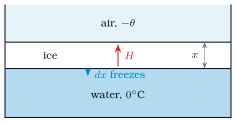
Ice of thickness \(x\) covers a lake. The air above is at \(-\theta\) and the water below at \(0^\circ\)C. In time \(dt\) a layer \(dx\) freezes. Take the density of ice as \(\rho\), its latent heat as \(L\) and its conductivity as \(K\). Show that \(x\,dx = \frac{K\theta}{\rho L}dt\), and hence that the time to grow from \(x_1\) to \(x_2\) is \(t = \frac{\rho L}{2K\theta}(x_2^2 - x_1^2)\).
Heat conducted up through the ice (area \(A\)) in time \(dt\): \(dQ = KA\dfrac{\theta}{x}dt\). This heat comes from the latent heat of the layer that freezes: \(dQ = (\rho A\,dx)L\).
Equating: \(\rho L\,dx = \dfrac{K\theta}{x}dt\), so \(x\,dx = \dfrac{K\theta}{\rho L}dt\).
Integrate from \(x_1\) to \(x_2\): \(\dfrac{x_2^2 - x_1^2}{2} = \dfrac{K\theta}{\rho L}t\), so \(t = \dfrac{\rho L}{2K\theta}(x_2^2 - x_1^2)\).
How did it go?
Q24
Take \(K = 2\) W/m K, \(\rho = 900\) kg/m\(^3\) and \(L = 3.36 \times 10^5\) J/kg for ice throughout this sheet. The air is at \(-20^\circ\)C. Find the time for the ice to grow from \(0\) to \(10\) cm, in seconds and in hours.
The second \(10\) cm takes three times as long as the first, although it is the same thickness.
How did it go?
Q26
Show that the time to grow from \(0\) to \(x\) and the time to grow from \(x\) to \(2x\) are in the ratio \(1 : 3\).
Answer\(x^2 : (4x^2 - x^2) = 1 : 3\)
Solution
\(t \propto x_2^2 - x_1^2\). From \(0\) to \(x\): \(x^2\). From \(x\) to \(2x\): \(4x^2 - x^2 = 3x^2\). Ratio \(1 : 3\).
How did it go?
Q27
The figure shows the ice layer on a lake.
In which direction does heat flow through the ice? Between which two temperatures?
Where is the latent heat released, and what does it do?
Why is the water just below the ice at \(0^\circ\)C and not colder?
Answer(i) upward; \(0\) to \(-\theta\) (ii) lower face; conducted up (iii) densest at \(4^\circ\)C, cannot supercool
Solution
Upward, from the water side at \(0^\circ\)C to the air side at \(-\theta\). Heat always flows from the warmer face to the colder face.
At the lower face, where water turns to ice. The latent heat released there is exactly the heat conducted up through the ice to the cold air. That is why the ice grows only as fast as the ice can conduct.
Water at \(0^\circ\)C touching ice at \(0^\circ\)C is at the freezing point. Any water that cools further freezes, joining the ice. Below the ice the water is at \(0^\circ\)C at the top and up to \(4^\circ\)C at the bottom, where the densest water sinks.
How did it go?
Q28
For the lake of Question 2, find the rate of growth \(\frac{dx}{dt}\) when the ice is \(5\) cm thick. Give the answer in mm per hour.
In one hour: \(2.65 \times 10^{-6} \times 3600 = 9.5 \times 10^{-3}\) m \(= 9.5\) mm per hour.
How did it go?
Q29
Why does the ice grow more slowly as it becomes thicker?
Answerlonger path, same \(\theta\)
Solution
The latent heat released at the bottom must be conducted up through the whole thickness of ice. The temperature difference across the ice stays at \(\theta\), so the heat current \(\dfrac{K\theta}{x}\) falls as \(x\) grows. Less heat removed per second means less ice frozen per second: \(\dfrac{dx}{dt} \propto \dfrac{1}{x}\).
How did it go?
Q30
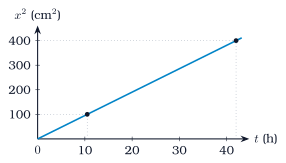
The graph shows the square of the ice thickness against time for the lake of Question 2.
Why is \(x^2\) against \(t\) a straight line through the origin?
Read the time at which the ice is \(10\) cm thick, and the time at which it is \(20\) cm thick.
Find the slope of the line and check it against \(\frac{2K\theta}{\rho L}\).
Answer(i) \(x^2 \propto t\) (ii) \(10.5\) h; \(42\) h (iii) \(2.65 \times 10^{-7}\) m\(^2\)/s
Solution
From \(x\,dx = \dfrac{K\theta}{\rho L}dt\) with \(x = 0\) at \(t = 0\): \(x^2 = \dfrac{2K\theta}{\rho L}t\). So \(x^2\) is proportional to \(t\): a straight line through the origin.
\(x = 10\) cm means \(x^2 = 100\) cm\(^2\): \(t = 10.5\) h. \(x = 20\) cm means \(x^2 = 400\) cm\(^2\): \(t = 42\) h.
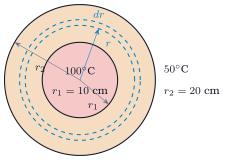
A cylindrical shell of length \(l\) has inner radius \(r_1\) at temperature \(T_1\) and outer radius \(r_2\) at \(T_2\). Consider a thin shell of radius \(r\) and thickness \(dr\). Write the heat current through it in terms of \(\frac{dT}{dr}\), and show that \(H = \frac{2\pi Kl(T_1 - T_2)}{\ln(r_2/r_1)}\).
Answer\(H = -2\pi r l K\frac{dT}{dr}\)
Solution
The thin shell has area \(2\pi r l\), so \(H = -K(2\pi r l)\dfrac{dT}{dr}\). In the steady state \(H\) is the same for every \(r\).
Separate: \(dT = -\dfrac{H}{2\pi K l}\dfrac{dr}{r}\). Integrate from \(r_1\) to \(r_2\): \(T_2 - T_1 = -\dfrac{H}{2\pi K l}\ln\dfrac{r_2}{r_1}\), so \(H = \dfrac{2\pi K l(T_1 - T_2)}{\ln(r_2/r_1)}\).
How did it go?
Q32
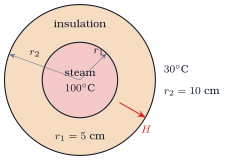
A steam pipe of outer radius \(5\) cm is wrapped in insulation (\(K = 0.1\) W/m K) up to a radius of \(10\) cm. The inner surface is at \(100^\circ\)C and the outer at \(30^\circ\)C. Find the heat lost per metre of pipe. Take \(\ln 2 = 0.693\) and \(\pi = 3.14\).
Answer\(63.4\) W
Solution
\(H = \dfrac{2\pi K l(T_1 - T_2)}{\ln(r_2/r_1)} = \dfrac{2 \times 3.14 \times 0.1 \times 1 \times 70}{\ln 2} = \dfrac{43.96}{0.693} = 63.4\) W per metre.
How did it go?
Q33
The figure shows the cross-section of the pipe of Question 10.
Write the thermal resistance of the insulation per metre, \(R = \frac{\ln(r_2/r_1)}{2\pi Kl}\), and find it.
Check the heat current from \(H = \Delta T/R\).
The outer radius is increased to \(20\) cm. By what factor does the heat loss fall?
Answer(i) \(1.10\) K/W (ii) \(63.4\) W (iii) \(\frac{1}{2}\)
\(H = \dfrac{\Delta T}{R} = \dfrac{70}{1.10} = 63.4\) W, as in Question 10.
\(H \propto \dfrac{1}{\ln(r_2/r_1)}\). The ratio \(r_2/r_1\) goes from \(2\) to \(4\), and \(\ln 4 = 2\ln 2\), so \(H\) falls to half. Doubling the thickness of insulation does not halve the loss unless the ratio of radii doubles.
How did it go?
Q34
A spherical shell has inner radius \(r_1\) at \(T_1\) and outer radius \(r_2\) at \(T_2\). Show that the steady heat current is \(H = \frac{4\pi K r_1 r_2 (T_1 - T_2)}{r_2 - r_1}\).
Answer\(H = \frac{4\pi K r_1 r_2(T_1 - T_2)}{r_2 - r_1}\)
Solution
A thin shell of radius \(r\) has area \(4\pi r^2\): \(H = -4\pi K r^2\dfrac{dT}{dr}\), the same for every \(r\).
\(\dfrac{1/r - 1/r_2}{1/r_1 - 1/r_2} = \dfrac{1/15 - 1/20}{1/10 - 1/20} = \dfrac{1/60}{1/20} = \dfrac{1}{3}\). \(T = 50 + \dfrac{1}{3} \times 50 = 66.7^\circ\)C. The midpoint is much nearer the cold temperature, because most of the drop happens near the inner surface.
How did it go?
Q36
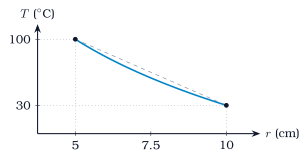
The graph shows the temperature inside the insulation of the pipe of Question 10 against the radius. The dashed line is a straight line for comparison.
Why is the graph not a straight line?
Where is the temperature gradient largest? Give the reason.
Answer(i) area grows with \(r\) (ii) inner surface
Solution
The same heat current passes through every cylindrical surface, but the area \(2\pi r l\) grows with \(r\). So the gradient \(\dfrac{dT}{dr} = -\dfrac{H}{2\pi K l r}\) falls as \(\dfrac{1}{r}\), and \(T\) falls logarithmically, not linearly.
At the inner surface, where \(r\) is smallest and the area is least. The same heat must squeeze through a smaller area, which needs a steeper gradient.
How did it go?
Q37
For the spherical shell, show that the temperature gradient at the inner surface is \(\left(\frac{r_2}{r_1}\right)^2\) times that at the outer surface.
Answer\(\frac{dT}{dr} \propto \frac{1}{r^2}\)
Solution
\(H = -4\pi K r^2\dfrac{dT}{dr}\) is the same at every \(r\), so \(\dfrac{dT}{dr} \propto \dfrac{1}{r^2}\).
A thin spherical shell has \(r_2 - r_1 = d\) much smaller than \(r_1\). Show that the formula of Question 12 reduces to \(H = KA\frac{\Delta T}{d}\) with \(A = 4\pi r_1^2\). For \(r_1 = 10\) cm and \(r_2 = 10.5\) cm, find the percentage error of this approximation.
Answer\(5\%\)
Solution
With \(r_2 - r_1 = d\) and \(r_1 r_2 \approx r_1^2\): \(H \approx \dfrac{4\pi K r_1^2\,\Delta T}{d} = KA\dfrac{\Delta T}{d}\), the slab formula with \(A = 4\pi r_1^2\).
Exact: \(r_1 r_2 = 0.1 \times 0.105 = 0.0105\). Approximate: \(r_1^2 = 0.01\). The approximation is low by \(\dfrac{0.0005}{0.0105} \approx 5\%\).
How did it go?
Small situations
Q39
On a cold night ice \(2\) cm thick forms on a pond in \(4\) hours. How long will the next \(2\) cm take, if the air temperature stays the same?
Answer\(12\) h
Solution
\(t \propto x^2\) from the start. \(4\) cm takes \(4 \times 4 = 16\) h in all, so the second \(2\) cm takes \(16 - 4 = 12\) h.
How did it go?
Q40
Ice \(5\) cm thick forms in \(8\) hours when the air is at \(-10^\circ\)C. Find the thickness that would form in \(8\) hours at \(-20^\circ\)C.
Answer\(7.07\) cm
Solution
\(x^2 \propto \theta t\). For the same \(t\), \(x \propto \sqrt{\theta}\): \(x = 5 \times \sqrt{2} = 7.07\) cm.
How did it go?
Q41
For the cylindrical shell, doubling the outer radius from \(2r_1\) to \(4r_1\) changes the heat current by what factor?
Ice \(1\) cm thick forms in \(1\) hour. Estimate the time for the ice to become \(5\) cm thick at the same air temperature.
Answer\(25\) h
Solution
\(t \propto x^2\): \(t = 1 \times 5^2 = 25\) h.
How did it go?
Q43
Why does the heat flow through a spherical shell not become zero when the shell is made very thick (\(r_2 \to \infty\))? Find the limiting value of \(H\).
Answer\(4\pi K r_1(T_1 - T_2)\)
Solution
As \(r_2 \to \infty\), \(\dfrac{r_1 r_2}{r_2 - r_1} \to r_1\), so \(H \to 4\pi K r_1(T_1 - T_2)\), which is not zero.
The extra insulation far from the sphere has a very large area, so it adds very little resistance. Almost all the resistance lies in the first few radii around the inner surface.