Questions on Radiation, Convection and Cooling, the kind your examinations ask. Solve one on paper. Then tell the book how it went. The book believes you, and it uses your answer to plan your revision.
0%
Nothing marked yetMark honestly. Peek at the answer only after your own attempt.
Radiation: Kirchhoff, Stefan-Boltzmann, Wien and the Sun
22 questions · after Lesson 4, The Sun and the Earth
Prevost and Kirchhoff
Q1
State Prevost's theory of heat exchange. A body is at the same temperature as its surroundings. Does it stop radiating? Explain. Take \(\sigma = 5.67 \times 10^{-8}\) W/m\(^2\) K\(^4\) and Wien's constant \(b = 2.9 \times 10^{-3}\) m K throughout this sheet.
Answerno; emits and absorbs equally
Solution
Every body at a temperature above absolute zero radiates heat at all times, at a rate that depends on its temperature. It also absorbs the radiation falling on it from its surroundings.
No. At the same temperature as its surroundings the body still radiates, but it absorbs exactly as much as it emits. The exchange is dynamic, and the net loss is zero.
How did it go?
Q2
Define the absorptive power \(a\), reflective power \(r\) and transmissive power \(t\) of a surface, and write the relation between them. What is \(a\) for a perfectly black body? A surface reflects \(30\%\) and transmits \(10\%\) of the radiation falling on it. Find \(a\).
Answer\(a + r + t = 1\); \(a = 1\); \(0.6\)
Solution
\(a\), \(r\) and \(t\) are the fractions of the incident radiant energy that are absorbed, reflected and transmitted. Energy is conserved, so \(a + r + t = 1\).
A perfectly black body absorbs everything: \(a = 1\), \(r = t = 0\). Here \(a = 1 - 0.3 - 0.1 = 0.6\).
How did it go?
Q3
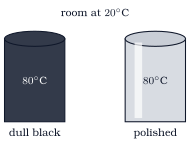
The two cans in the figure are identical except for their surfaces. Both hold water at \(80^\circ\)C.
State Kirchhoff's law of radiation.
Which can cools faster? Give the reason.
The cans are emptied and filled with cold water, then placed in sunlight. Which warms faster?
Answer(i) \(e/a\) same for all (ii) black (iii) black
Solution
At a given temperature the ratio of emissive power to absorptive power is the same for all surfaces. It equals the emissive power of a black body. Good absorbers are good emitters.
The black can. A dull black surface absorbs well, so by Kirchhoff's law it emits well and radiates heat away faster. The polished surface is a poor absorber, so it is a poor emitter.
The black can again: a good absorber takes in the sunlight, while the polished can reflects most of it.
How did it go?
Stefan-Boltzmann
Q4
Write the Stefan-Boltzmann law for the power radiated by a black body of area \(A\) at temperature \(T\). Write the form for a body of emissivity \(e\). Find the power radiated by a black sphere of surface area \(0.1\) m\(^2\) at \(500\) K.
Answer\(P = \sigma AT^4\); \(P = e\sigma AT^4\); \(354\) W
Solution
\(P = \sigma AT^4\) for a black body; \(P = e\sigma AT^4\) for a grey body with emissivity \(e\) between \(0\) and \(1\).
Write the net rate of heat loss by a body at \(T\) in surroundings at \(T_0\). The sphere of Question 4 has \(e = 0.5\) and is in a room at \(300\) K. Find its net rate of heat loss.
Answer\(e\sigma A(T^4 - T_0^4)\); \(154\) W
Solution
The body radiates \(e\sigma AT^4\) and absorbs \(e\sigma AT_0^4\) from the surroundings, so the net loss is \(P = e\sigma A(T^4 - T_0^4)\).
By what factor does the radiated power change when the absolute temperature is doubled? By what factor must \(T\) rise for the power to become four times?
Answer\(16\); \(\sqrt{2}\)
Solution
\(P \propto T^4\): doubling \(T\) makes \(P\) sixteen times. For \(P\) to become four times, \(T^4\) must become four times, so \(T\) rises by a factor \(4^{1/4} = \sqrt{2} = 1.41\).
How did it go?
Q7
A person has skin area \(1.5\) m\(^2\) at \(300\) K and stands in a room at \(290\) K. Take \(e = 1\). Find the net power radiated by the person.
A resting person produces about \(100\) W, so most of it is lost as radiation.
How did it go?
Wien's law
Q8
State Wien's displacement law. The Sun's spectrum peaks at \(500\) nm. Find the temperature of its surface. Find the wavelength at which the radiation from a body at \(300\) K peaks, and name the region of the spectrum.
Answer\(5800\) K; \(9.7\ \mu\)m, infrared
Solution
The wavelength at which a black body radiates most strongly is inversely proportional to its absolute temperature: \(\lambda_{max}T = b\).
Sun: \(T = \dfrac{2.9 \times 10^{-3}}{5 \times 10^{-7}} = 5800\) K. Body at \(300\) K: \(\lambda_{max} = \dfrac{2.9 \times 10^{-3}}{300} = 9.7 \times 10^{-6}\) m \(= 9.7\ \mu\)m, in the infrared. That is why warm bodies do not glow visibly.
How did it go?
Q9
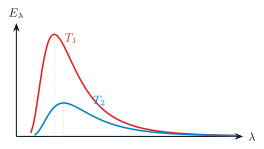
The graph shows the spectrum of a black body at two temperatures.
Which curve is at the higher temperature? Give two reasons.
What does the area under each curve represent? How do the two areas compare if \(T_1 = 2T_2\)?
Answer(i) \(T_1\) (ii) total power; \(16 : 1\)
Solution
\(T_1\). Its peak is at a shorter wavelength (Wien's law), and its curve is higher everywhere, so it radiates more at every wavelength (Stefan's law).
The area under the curve is the total power radiated per unit area, \(\sigma T^4\). If \(T_1 = 2T_2\) the areas are in the ratio \(2^4 = 16 : 1\).
How did it go?
Q10
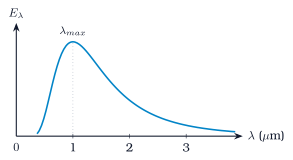
The graph shows the spectrum of a black body. Read \(\lambda_{max}\) and find the temperature of the body.
Answer\(1\ \mu\)m; \(2900\) K
Solution
The peak is at \(\lambda_{max} = 1\ \mu\)m. \(T = \dfrac{b}{\lambda_{max}} = \dfrac{2.9 \times 10^{-3}}{10^{-6}} = 2900\) K, about the temperature of a bulb filament.
How did it go?
Q11
A star's spectrum peaks at \(250\) nm. Find its surface temperature. Is the star redder or bluer than the Sun?
Its peak is in the ultraviolet, so within the visible range it emits more blue than red. The star looks bluish-white; the Sun, peaking in the green-yellow, looks yellowish-white.
How did it go?
Q12
Two black bodies of equal area are at \(300\) K and \(600\) K. Find the ratio of the powers they radiate and the ratio of their peak wavelengths.
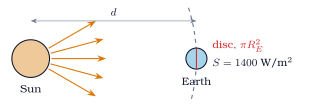
The solar constant \(S = 1400\) W/m\(^2\) is the power of sunlight per unit area at the Earth. The Earth is at a distance \(d = 1.5 \times 10^{11}\) m from the Sun. Find the total power radiated by the Sun. Take \(\pi = 3.14\).
Answer\(3.96 \times 10^{26}\) W
Solution
At the Earth's distance the Sun's power is spread evenly over a sphere of radius \(d\): \(P = 4\pi d^2 S = 4 \times 3.14 \times (1.5 \times 10^{11})^2 \times 1400 = 12.56 \times 2.25 \times 10^{22} \times 1400 = 3.96 \times 10^{26}\) W.
How did it go?
Q14
The figure shows the Sun and the Earth.
Why is the total power of the Sun equal to \(4\pi d^2 S\)?
The Earth has radius \(R_E = 6.4 \times 10^6\) m. Find the power it receives from the Sun.
Answer(i) power spread over a sphere of area \(4\pi d^2\) (ii) \(1.8 \times 10^{17}\) W
Solution
The Sun radiates equally in all directions. All of its power crosses the sphere of radius \(d\) centred on the Sun, whose area is \(4\pi d^2\). \(S\) is the power per unit area on that sphere, so \(P = 4\pi d^2 S\).
The Earth blocks a disc of area \(\pi R_E^2\) facing the Sun: \(P_E = \pi R_E^2 S = 3.14 \times (6.4 \times 10^6)^2 \times 1400 = 3.14 \times 4.1 \times 10^{13} \times 1400 = 1.8 \times 10^{17}\) W.
How did it go?
Q15
The Sun has radius \(R = 7 \times 10^8\) m. Use the power found in Question 13 and the Stefan-Boltzmann law to find the surface temperature of the Sun. Compare it with the value from Wien's law in Question 8.
\(T = (1.13 \times 10^{15})^{1/4} = 5800\) K, the same as the value from Wien's law. Two different laws give the same temperature, which confirms that the Sun radiates nearly as a black body.
How did it go?
Q16
Treat the Earth as a black body. It absorbs sunlight over its disc of area \(\pi R_E^2\) and radiates from its whole surface \(4\pi R_E^2\). Show that its steady temperature is \(T = \left(\frac{S}{4\sigma}\right)^{1/4}\) and find it.
Answer\(280\) K
Solution
Absorbed: \(\pi R_E^2 S\). Radiated: \(\sigma(4\pi R_E^2)T^4\). In the steady state they are equal, so \(T^4 = \dfrac{S}{4\sigma}\) and \(T = \left(\dfrac{S}{4\sigma}\right)^{1/4}\).
\(T^4 = \dfrac{1400}{4 \times 5.67 \times 10^{-8}} = 6.17 \times 10^9\), so \(T = 280\) K, about \(7^\circ\)C. The real average is about \(288\) K; the difference is the greenhouse effect of the atmosphere.
How did it go?
Q17
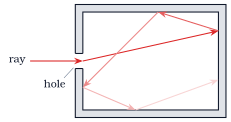
The figure shows a hollow box with a small hole.
Why does the hole behave as a nearly perfect black body?
What kind of radiation comes out of the hole when the box is heated?
Answer(i) ray absorbed after many reflections (ii) black-body radiation
Solution
A ray that enters the hole strikes the inner wall, and part of it is absorbed. The rest is reflected to another part of the wall, where more is absorbed. After many reflections almost nothing finds its way back out through the small hole. So the hole absorbs nearly all the radiation that enters: \(a \approx 1\).
Black-body radiation at the temperature of the walls. Its spectrum depends only on the temperature, not on the material of the box.
How did it go?
Q18
Define the emissive power \(E\) of a surface and give its unit. Write Kirchhoff's law as an equation using \(E\), \(a\) and the emissive power \(E_b\) of a black body.
AnswerW/m\(^2\); \(E/a = E_b\)
Solution
The emissive power \(E\) is the radiant energy emitted per second per unit area of the surface, in W/m\(^2\).
Kirchhoff's law: \(\dfrac{E}{a} = E_b\), the same for every surface at a given temperature. So \(E = aE_b\): a surface that absorbs a fraction \(a\) emits the same fraction of the black-body value.
How did it go?
Q19
A bulb filament at \(3000\) K has \(e = 0.5\) and radiates \(100\) W. Find the surface area of the filament in cm\(^2\).
Why do people wear white clothes in summer? Why is the inside of a vacuum flask silvered?
Answerwhite reflects; silver stops radiation
Solution
White cloth reflects most of the sunlight, so it absorbs little heat. Dark cloth absorbs most of it. A silvered surface is a poor absorber and, by Kirchhoff's law, a poor emitter. The silvering on both walls of the flask stops heat from leaving the hot liquid by radiation, or from entering a cold one.
How did it go?
Q21
A body at \(T\) is in surroundings at \(T_0\), with \(T - T_0\) small. Show that the net power radiated, \(e\sigma A(T^4 - T_0^4)\), is approximately \(4e\sigma AT_0^3(T - T_0)\). What law does this lead to?
AnswerNewton's law of cooling
Solution
\(T^4 - T_0^4 = (T^2 + T_0^2)(T + T_0)(T - T_0)\). For \(T\) close to \(T_0\), \(T^2 + T_0^2 \approx 2T_0^2\) and \(T + T_0 \approx 2T_0\), so \(T^4 - T_0^4 \approx 4T_0^3(T - T_0)\).
The net power is then \(4e\sigma AT_0^3(T - T_0)\), proportional to the excess temperature. This is Newton's law of cooling.
How did it go?
Q22
Find the SI unit of \(\sigma\) from the Stefan-Boltzmann law, and the unit of Wien's constant \(b\).
AnswerW m\(^{-2}\) K\(^{-4}\); m K
Solution
\(\sigma = \dfrac{P}{AT^4}\): unit \(\dfrac{\text{W}}{\text{m}^2\,\text{K}^4} = \) W m\(^{-2}\) K\(^{-4}\).
\(b = \lambda_{max}T\): unit m K.
How did it go?
Newton's Law of Cooling and Convection
22 questions · after Lesson 6, Newton's Law of Cooling
Newton's law of cooling
Q23
State Newton's law of cooling and write it as \(\frac{dT}{dt} = -k(T - T_0)\). Name \(T_0\) and \(k\). Under what conditions does the law hold well? Take \(\ln 2 = 0.693\) throughout this sheet.
Answerrate \(\propto\) excess; small excess, forced convection
Solution
The rate of loss of heat of a body is proportional to its excess temperature over the surroundings. So is the rate of fall of temperature: \(\dfrac{dT}{dt} = -k(T - T_0)\). \(T_0\) is the temperature of the surroundings and \(k\) is a constant that depends on the body's surface, area and heat capacity.
The law holds well when the excess temperature is small, up to a few tens of degrees. It holds best when there is forced convection, as in a steady draught.
How did it go?
Q24
A body of mass \(m\) and specific heat \(s\) loses heat at the rate \(hA(T - T_0)\). Show that it obeys Newton's law with \(k = \frac{hA}{ms}\). Which body cools faster, a large one or a small one of the same shape and material? Give the reason.
Answersmall one; \(k \propto A/m\)
Solution
Heat lost per second \(= hA(T - T_0)\). The temperature falls by \(dT\) when heat \(ms\,dT\) is lost: \(-ms\dfrac{dT}{dt} = hA(T - T_0)\), so \(\dfrac{dT}{dt} = -\dfrac{hA}{ms}(T - T_0)\) and \(k = \dfrac{hA}{ms}\).
The small body. For the same shape \(A \propto r^2\) and \(m \propto r^3\), so \(k \propto \dfrac{1}{r}\). A small body has more surface per unit mass and cools faster. This is why small animals lose heat quickly.
How did it go?
Q25
In the approximate form of the law, the rate of fall of temperature over a short interval is \(k\) times the average excess: \(\frac{T_1 - T_2}{t} = k\left(\frac{T_1 + T_2}{2} - T_0\right)\). A body cools from \(80^\circ\)C to \(70^\circ\)C in \(5\) minutes in a room at \(30^\circ\)C. Find \(k\) and the time to cool from \(70^\circ\)C to \(60^\circ\)C.
Answer\(\frac{2}{45}\) per min; \(6.4\) min
Solution
\(\dfrac{80 - 70}{5} = k(75 - 30)\), so \(2 = 45k\) and \(k = \dfrac{2}{45}\) per minute.
From \(70\) to \(60\): \(\dfrac{10}{t} = \dfrac{2}{45}(65 - 30) = \dfrac{70}{45}\), so \(t = \dfrac{450}{70} = 6.4\) minutes. The second fall takes longer because the excess is smaller.
How did it go?
Q26
Show that the exact solution of \(\frac{dT}{dt} = -k(T - T_0)\) is \(T - T_0 = (T_1 - T_0)e^{-kt}\). A body cools from \(100^\circ\)C to \(60^\circ\)C in \(10\) minutes in a room at \(20^\circ\)C. Find \(k\) and the further time to cool to \(40^\circ\)C.
Answer\(0.0693\) per min; \(10\) min
Solution
Write \(\theta = T - T_0\): \(\dfrac{d\theta}{dt} = -k\theta\), so \(\dfrac{d\theta}{\theta} = -k\,dt\). Integrating, \(\ln\theta = -kt + \) constant, and with \(\theta = T_1 - T_0\) at \(t = 0\): \(\theta = (T_1 - T_0)e^{-kt}\).
\(\dfrac{60 - 20}{100 - 20} = \dfrac{1}{2} = e^{-10k}\), so \(k = \dfrac{\ln 2}{10} = 0.0693\) per minute.
From \(60\) to \(40\): \(\dfrac{40 - 20}{60 - 20} = \dfrac{1}{2} = e^{-kt}\), so \(t = \dfrac{\ln 2}{k} = 10\) minutes again. Each halving of the excess takes the same time.
How did it go?
Q27
The excess temperature of a body over its surroundings halves every \(10\) minutes. It starts at \(100^\circ\)C in a room at \(20^\circ\)C. Find its temperature after \(30\) minutes.
Answer\(30^\circ\)C
Solution
Excess at start \(= 80^\circ\)C. After \(30\) minutes, three halvings: \(\dfrac{80}{8} = 10^\circ\)C. Temperature \(= 20 + 10 = 30^\circ\)C.
How did it go?
Q28
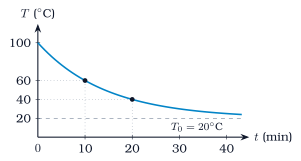
The graph shows the temperature of a body cooling in a room at \(20^\circ\)C.
Read the temperature at \(10\) min and at \(20\) min. Show that the excess over \(20^\circ\)C halves every \(10\) minutes.
Find the temperature at \(40\) min.
Why does the curve become flatter with time?
Answer(i) \(60^\circ\)C; \(40^\circ\)C (ii) \(25^\circ\)C (iii) smaller excess
Solution
\(60^\circ\)C at \(10\) min and \(40^\circ\)C at \(20\) min. The excess goes \(80 \to 40 \to 20\), halving every \(10\) minutes.
At \(40\) min the excess has halved four times: \(\dfrac{80}{16} = 5^\circ\)C. \(T = 25^\circ\)C.
The rate of cooling is proportional to the excess. As the body approaches room temperature the excess shrinks, so the slope of the curve shrinks with it.
How did it go?
Q29
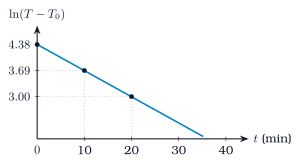
The graph shows \(\ln(T - T_0)\) against time for the body of Question 6.
Why is this graph a straight line? What is its slope in terms of \(k\)?
Find \(k\) from the graph, in per minute.
Answer(i) \(\ln(T - T_0) = \ln(T_1 - T_0) - kt\); slope \(-k\) (ii) \(0.069\) per min
Solution
Taking logs of \(T - T_0 = (T_1 - T_0)e^{-kt}\): \(\ln(T - T_0) = \ln(T_1 - T_0) - kt\). This is a straight line in \(t\) with slope \(-k\) and intercept \(\ln(T_1 - T_0)\).
Slope \(= \dfrac{3.69 - 4.38}{10} = -0.069\) per minute, so \(k = 0.069\) per minute, in agreement with \(\dfrac{\ln 2}{10}\).
How did it go?
Q30
A body at \(60^\circ\)C cools at \(2^\circ\)C per minute in a room at \(20^\circ\)C. Find its rate of cooling when it is at \(40^\circ\)C.
Answer\(1^\circ\)C per min
Solution
Rate \(\propto\) excess. At \(60^\circ\)C the excess is \(40^\circ\)C, at \(40^\circ\)C it is \(20^\circ\)C, half as much. The rate is \(1^\circ\)C per minute.
How did it go?
Q31
Two spheres of the same material and the same surface finish have radii in the ratio \(1 : 2\). Both start at the same temperature in the same room. Find the ratio of their initial rates of cooling.
Answer\(2 : 1\)
Solution
\(k = \dfrac{hA}{ms} \propto \dfrac{r^2}{r^3} = \dfrac{1}{r}\). With the same excess, the rate of cooling is proportional to \(k\): \(\dfrac{1}{1} : \dfrac{1}{2} = 2 : 1\). The small sphere cools twice as fast.
How did it go?
Q32
A body cools from \(60^\circ\)C to \(50^\circ\)C in \(10\) minutes in a room at \(25^\circ\)C. Use the approximate form of the law to find the time it takes to cool from \(50^\circ\)C to \(40^\circ\)C.
Answer\(15\) min
Solution
\(\dfrac{10}{10} = k(55 - 25)\), so \(k = \dfrac{1}{30}\) per minute.
What is convection? Distinguish between natural and forced convection. Write the rate of heat transfer from a surface to a fluid as \(\frac{dQ}{dt} = hA(T_s - T_f)\) and give the unit of \(h\).
Answerbulk motion of a fluid; natural: density; forced: fan; W/m\(^2\) K
Solution
Convection is heat transfer by the bulk movement of a fluid: the warm fluid itself moves and carries its heat with it. In natural convection the fluid moves because of the density change on heating. In forced convection a fan or pump drives it.
\(h\) is the convective heat transfer coefficient, the power transferred per unit area per kelvin of temperature difference: W/m\(^2\) K.
How did it go?
Q34
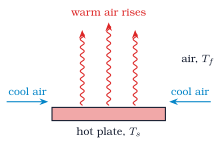
The figure shows the air around a hot plate.
Explain, step by step, why the air moves as shown.
What happens to \(h\) if a fan blows air across the plate? Give the reason.
Answer(i) warm air lighter, rises (ii) \(h\) larger
Solution
Air touching the plate is warmed by conduction. It expands, becomes less dense than the air around it, and the denser cool air pushes it up. Cool air flows in from the sides to take its place, is warmed in turn, and rises. A steady circulation results.
\(h\) becomes larger. The fan sweeps the warm air away as fast as it forms. So the air next to the plate is always cool, and the temperature difference across the thin layer at the surface stays large. Forced convection can raise \(h\) by ten times or more.
How did it go?
Q35
A radiator of surface area \(2\) m\(^2\) is at \(20^\circ\)C above the air in the room. Take \(h = 10\) W/m\(^2\) K for natural convection. Find the heat it gives to the room per second.
A surface at \(320\) K faces surroundings at \(300\) K. It loses heat by convection with \(h = 10\) W/m\(^2\) K and by radiation with \(e = 1\). Find the heat lost per square metre per second by each process, and the total. Take \(\sigma = 5.67 \times 10^{-8}\) W/m\(^2\) K\(^4\).
Total \(= 335\) W/m\(^2\). At ordinary temperatures the two processes are of similar size, and both are proportional to the small excess, which is why Newton's law works.
How did it go?
Q37
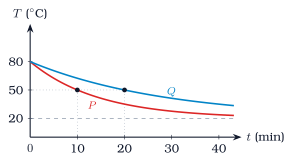
The graph shows two bodies \(P\) and \(Q\) cooling from \(80^\circ\)C in the same room.
Which body has the larger \(k\)? Give the reason.
Read the time each body takes to reach \(50^\circ\)C and find \(k_P : k_Q\).
Give one difference between \(P\) and \(Q\) that could explain this.
Answer(i) \(P\) (ii) \(10\) min; \(20\) min; \(2 : 1\) (iii) smaller mass or larger area
Solution
\(P\). It falls faster from the same start in the same room, so its rate of cooling per degree of excess is larger.
\(P\) reaches \(50^\circ\)C (excess halved from \(60\) to \(30\)) at \(10\) min, \(Q\) at \(20\) min. The halving time is \(\dfrac{\ln 2}{k}\), so \(k_P : k_Q = 20 : 10 = 2 : 1\).
\(k = \dfrac{hA}{ms}\). \(P\) could have a smaller mass, a larger surface area, or a blacker, rougher surface with a larger \(h\).
How did it go?
Q38
A cup holds \(0.2\) kg of tea (\(s = 4200\) J/kg K). Its surface area in contact with the air is \(0.05\) m\(^2\) and \(h = 10\) W/m\(^2\) K. Find \(k\) in per minute, and the time for the excess temperature of the tea to halve.
Answer\(0.036\) per min; \(19\) min
Solution
\(k = \dfrac{hA}{ms} = \dfrac{10 \times 0.05}{0.2 \times 4200} = 5.95 \times 10^{-4}\) per second \(= 0.036\) per minute.
Halving time \(= \dfrac{\ln 2}{k} = \dfrac{0.693}{0.036} = 19\) minutes. Hot tea at \(60^\circ\)C above room temperature is \(30^\circ\)C above it after about \(19\) minutes.
How did it go?
Q39
A fan does not cool the air in a room, yet it makes you feel cooler. Explain.
Answerforced convection and evaporation
Solution
The fan drives forced convection. It replaces the warm air next to the skin with cooler room air, so the skin loses heat faster. It also carries away the moist air near the skin, so sweat evaporates faster and takes its latent heat from the body. The air is no cooler, but the body loses heat faster.
How did it go?
Q40
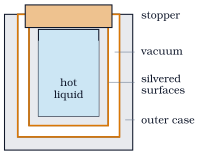
The figure shows a vacuum flask. For each of the following, state which mode of heat transfer it prevents and how.
the vacuum,
the silvered surfaces,
the stopper.
Answer(i) conduction, convection (ii) radiation (iii) convection, evaporation
Solution
The vacuum stops conduction and convection between the walls. Both need a material medium, and there is almost no gas to carry heat.
The silvered surfaces stop radiation. Silver is a poor emitter, so the hot inner wall radiates little, and a poor absorber, so the outer wall reflects what does arrive.
The stopper stops convection and evaporation from the open top, and is a poor conductor itself.
How did it go?
Q41
Explain the sea breeze during the day and the land breeze at night in terms of convection.
Answerland heats and cools faster
Solution
Land has a smaller specific heat than water and warms faster in the day. The air over the land is heated, rises, and cooler air from over the sea flows in to replace it: the sea breeze.
At night the land cools faster than the sea. Now the air over the sea is warmer and rises, and air flows from the land to the sea: the land breeze.
How did it go?
Q42
A hot water pipe of radius \(2\) cm carries water at \(50^\circ\)C above the air temperature. Take \(h = 10\) W/m\(^2\) K and \(\pi = 3.14\). Find the heat lost by convection per metre of pipe per second.
Answer\(62.8\) W
Solution
Surface area per metre \(= 2\pi r \times 1 = 2 \times 3.14 \times 0.02 = 0.1256\) m\(^2\).
\(\dfrac{dQ}{dt} = hA\Delta T = 10 \times 0.1256 \times 50 = 62.8\) W per metre.
How did it go?
Q43
Compare conduction, convection and radiation: which needs a medium, which involves bulk motion of the medium, and which can cross a vacuum?
Answerradiation crosses vacuum; convection has bulk motion
Solution
Conduction needs a medium and the medium does not move; heat passes from molecule to molecule. Convection needs a fluid medium that moves in bulk, carrying its heat. Radiation needs no medium at all and crosses a vacuum, as sunlight does; it is the only one of the three that can.
How did it go?
Q44
Why is the Newton's law of cooling approximation \(\frac{T_1 - T_2}{t} = k\left(\frac{T_1 + T_2}{2} - T_0\right)\) good only for a small fall in temperature?
Answerrate changes during the fall
Solution
The true rate of cooling changes as the body cools, because the excess keeps falling. Over a short interval the excess changes little, so its average, \(\dfrac{T_1 + T_2}{2} - T_0\), is a good stand-in for the actual excess. Over a large fall the rate at the start is much larger than at the end, and the average excess underestimates the time.