Questions on Kinematics of SHM, the kind your examinations ask. Solve one on paper. Then tell the book how it went. The book believes you, and it uses your answer to plan your revision.
0%
Nothing marked yetMark honestly. Peek at the answer only after your own attempt.
Equations of SHM and Phasors
22 questions · after Lesson 5, SHM as the Shadow of Circular Motion
Reading the equations
Q1
A particle moves as \(x = 0.05\sin(10\pi t)\), in SI units.
Write the amplitude and the angular frequency. Find the time period and the frequency.
Find the maximum speed and the maximum acceleration.
Answer(i) \(0.05\) m, \(10\pi\) rad/s, \(0.2\) s, \(5\) Hz (ii) \(0.5\pi\) m/s, \(5\pi^2\) m/s\(^2\)
Solution
Compare with \(x = A\sin\omega t\): \(A = 0.05\) m, \(\omega = 10\pi\) rad/s. \(T = \dfrac{2\pi}{\omega} = 0.2\) s, \(f = \dfrac{1}{T} = 5\) Hz.
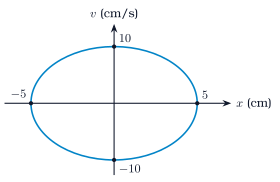
\(v^2 = \omega^2(A^2 - x^2)\) gives \(\dfrac{x^2}{A^2} + \dfrac{v^2}{A^2\omega^2} = 1\), the equation of an ellipse with semi-axes \(A\) along \(x\) and \(A\omega\) along \(v\).
How did it go?
The reference circle
Q12
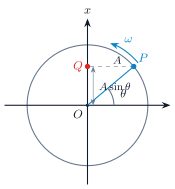
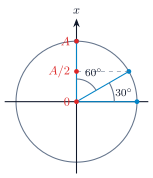
In the figure \(P\) moves on a circle of radius \(A\) at a steady angular speed \(\omega\). \(Q\) is the foot of the perpendicular from \(P\) on the vertical diameter.
Write the displacement of \(Q\) from \(O\) as a function of time, if \(\theta = 0\) at \(t = 0\).
Show that the acceleration of \(Q\) is \(-\omega^2 x\), so that \(Q\) performs SHM.
What do the radius and the angular speed of the circle represent for the SHM?
Answer(i) \(x = A\sin\omega t\) (ii) \(\ddot{x} = -\omega^2 A\sin\omega t\) (iii) amplitude; angular frequency
Solution
\(\theta = \omega t\), and \(OQ = A\sin\theta\). So \(x = A\sin\omega t\).
\(P\) has centripetal acceleration \(\omega^2 A\) towards \(O\). Its component along the vertical diameter is \(-\omega^2 A\sin\theta = -\omega^2 x\), and this is the acceleration of \(Q\).
\(a = -\omega^2 x\) is the defining equation of SHM.
The radius of the circle is the amplitude, and the angular speed of \(P\) is the angular frequency \(\omega\) of the SHM. The angle \(\theta\) is the phase.
How did it go?
Q13
A particle performs SHM of period \(T\). Use the reference circle to find the time it takes in each case.
From the mean position to \(x = A/2\).
From \(x = A/2\) to \(x = A\).
Why are the two times different although the distances are equal?
Answer(i) \(T/12\) (ii) \(T/6\)
Solution
\(x = A\sin\theta = \dfrac{A}{2}\) needs \(\theta = 30^\circ\). \(P\) turns \(360^\circ\) in \(T\), so \(30^\circ\) takes \(\dfrac{T}{12}\).
From \(\theta = 30^\circ\) to \(90^\circ\) is \(60^\circ\): a time \(\dfrac{T}{6}\), twice as long.
The particle slows down as it nears the extreme, so the outer half of the amplitude takes longer than the inner half.
How did it go?
Q14
Find the time a particle in SHM of period \(T\) takes to go
from \(x = A/\sqrt{2}\) to \(x = A\),
from \(x = -A/2\) to \(x = +A/2\).
Answer(i) \(T/8\) (ii) \(T/6\)
Solution
\(\sin\theta = \dfrac{1}{\sqrt{2}}\) at \(\theta = 45^\circ\). From \(45^\circ\) to \(90^\circ\) is \(45^\circ\): \(\dfrac{T}{8}\).
From \(\theta = -30^\circ\) to \(+30^\circ\) is \(60^\circ\): \(\dfrac{T}{6}\).
How did it go?
Q15
A particle in SHM has period \(12\) s and amplitude \(6\) cm. Starting from the mean position, find the time it takes to reach \(x = 3\) cm, and then the further time to reach \(x = 6\) cm.
Answer\(1\) s; \(2\) s
Solution
\(x = 3\) cm is \(\dfrac{A}{2}\): time \(= \dfrac{T}{12} = 1\) s. From \(\dfrac{A}{2}\) to \(A\): \(\dfrac{T}{6} = 2\) s.
How did it go?
Q16
Three particles move as \(x_1 = A\sin\omega t\), \(x_2 = A\cos\omega t\) and \(x_3 = A\sin(\omega t + \pi)\).
State the phase difference between \(x_2\) and \(x_1\). Which leads?
How does \(x_3\) move compared with \(x_1\)?
Answer(i) \(\pi/2\); \(x_2\) leads (ii) opposite phase
Solution
\(x_2 = A\cos\omega t = A\sin\left(\omega t + \dfrac{\pi}{2}\right)\): \(x_2\) leads \(x_1\) by \(\dfrac{\pi}{2}\). It reaches its maximum a quarter period earlier.
\(x_3 = -A\sin\omega t = -x_1\). The two are always at opposite displacements: opposite phase, a difference of \(\pi\).
How did it go?
Q17
Show that a particle in SHM spends two thirds of each period farther than \(A/2\) from the mean position. Use the reference circle.
Answer\(240^\circ\) of \(360^\circ\)
Solution
\(|x| > \dfrac{A}{2}\) means \(|\sin\theta| > \dfrac{1}{2}\): \(\theta\) between \(30^\circ\) and \(150^\circ\), or between \(210^\circ\) and \(330^\circ\).
That is \(120^\circ + 120^\circ = 240^\circ\) out of \(360^\circ\), a fraction \(\dfrac{2}{3}\) of the period. The particle moves slowly near the extremes and lingers there.
How did it go?
Q18
Two particles perform the same SHM. At one instant particle \(P\) is at \(x = +A\) while particle \(Q\) passes through the mean position moving towards \(+x\). Find the phase difference between them. Which particle leads?
Answer\(\pi/2\); \(P\) leads
Solution
\(Q\) at the mean position moving towards \(+x\) has phase \(0\) (\(x = A\sin\omega t\)). \(P\) at \(x = +A\) has phase \(\dfrac{\pi}{2}\).
The phase difference is \(\dfrac{\pi}{2}\), and \(P\) leads: \(Q\) will be where \(P\) is a quarter period later.
How did it go?
Q19
A particle in SHM has amplitude \(5\) cm and period \(2\) s.
Find the average speed over one full period.
Compare it with the maximum speed.
Answer(i) \(10\) cm/s (ii) \(v_{\max} = 5\pi \approx 15.7\) cm/s
Solution
In one period the particle covers \(4A = 20\) cm. Average speed \(= \dfrac{20}{2} = 10\) cm/s.
\(v_{\max} = A\omega = 5 \times \pi = 5\pi \approx 15.7\) cm/s. In general \(\dfrac{\text{average}}{v_{\max}} = \dfrac{4A/T}{2\pi A/T} = \dfrac{2}{\pi}\).
How did it go?
Small situations
Q20
The piston of an engine moves in SHM with amplitude \(5\) cm at \(600\) revolutions per minute. Find its maximum speed and its maximum acceleration. Take \(\pi^2 = 10\).
A small block rests on a platform that oscillates vertically in SHM with amplitude \(10\) cm. Take \(g = 10\) m/s\(^2\). At what frequency does the block just begin to leave the platform? At which point of the motion does it leave?
Answer\(5/\pi \approx 1.6\) Hz; top
Solution
The block leaves when the platform accelerates downward faster than \(g\). This first happens at the top of the motion, where the downward acceleration is \(A\omega^2\).
\(A\omega^2 = g\): \(\omega^2 = \dfrac{10}{0.1} = 100\), \(\omega = 10\) rad/s, \(f = \dfrac{\omega}{2\pi} = \dfrac{5}{\pi} \approx 1.6\) Hz. The block leaves at the highest point.
How did it go?
Q22
A particle starts from the mean position towards \(+x\) with amplitude \(6\) cm and period \(4\) s. Find its displacement and its velocity at \(t = \frac{1}{3}\) s. Take \(\sqrt{3} = 1.73\).
Answer\(3\) cm; \(\approx 8.2\) cm/s
Solution
\(\omega = \dfrac{2\pi}{4} = \dfrac{\pi}{2}\) rad/s and \(x = 6\sin\dfrac{\pi t}{2}\). At \(t = \dfrac{1}{3}\) s the phase is \(\dfrac{\pi}{6}\).
\(x = 6\sin\dfrac{\pi}{6} = 3\) cm. \(v = A\omega\cos\dfrac{\pi}{6} = 6 \times \dfrac{\pi}{2} \times \dfrac{1.73}{2} \approx 8.2\) cm/s, towards \(+x\).