Questions on Dynamics of SHM, the kind your examinations ask. Solve one on paper. Then tell the book how it went. The book believes you, and it uses your answer to plan your revision.
0%
Nothing marked yetMark honestly. Peek at the answer only after your own attempt.
Spring-Mass Systems
21 questions · after Lesson 3, Springs in Combination
The period of a spring-mass system
Q1
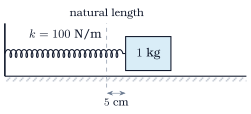
A block of mass \(1\) kg is attached to a spring of stiffness \(100\) N/m on a smooth floor. Take \(g = 10\) m/s\(^2\) throughout this sheet.
Find \(\omega\).
Find the time period.
Find the frequency.
Answer(i) \(10\) rad/s (ii) \(\pi/5 \approx 0.63\) s (iii) \(\approx 1.6\) Hz
A spring of stiffness \(100\) N/m is cut into two parts whose lengths are in the ratio \(1 : 2\). Find the stiffness of each part. Give the reason.
Answer\(300\) N/m, \(150\) N/m
Solution
For a given force each coil stretches by the same amount, so the total stretch is proportional to the length. The stiffness is therefore inversely proportional to the length: \(k \propto \dfrac{1}{L}\).
The shorter part (\(\dfrac{1}{3}\) of the length) has \(3k = 300\) N/m; the longer part (\(\dfrac{2}{3}\)) has \(\dfrac{3k}{2} = 150\) N/m. Check: in series they give \(\dfrac{300 \times 150}{450} = 100\) N/m.
How did it go?
Q6
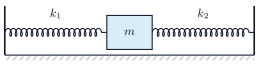
A block of mass \(1\) kg is held between two springs, \(k_1 = 300\) N/m and \(k_2 = 100\) N/m, on a smooth floor.
The block is displaced by \(x\) to the right. Find the net restoring force and the effective stiffness.
Find the period.
Answer(i) \(-400x\); \(400\) N/m (ii) \(\pi/10 \approx 0.31\) s
Solution
Moving right by \(x\) stretches \(k_1\) and compresses \(k_2\). Both push the block back: \(F = -k_1x - k_2x = -(k_1 + k_2)x = -400x\).
The springs act like a parallel pair: \(k_{\text{eff}} = 400\) N/m.
\(T = 2\pi\sqrt{\dfrac{1}{400}} = \dfrac{2\pi}{20} = \dfrac{\pi}{10} \approx 0.31\) s.
How did it go?
Q7
A \(1\) kg block on a smooth incline of \(30^\circ\) is attached to a spring of stiffness \(100\) N/m fixed at the top.
Find the stretch of the spring at equilibrium.
Find the period of oscillation along the incline.
Answer(i) \(5\) cm (ii) \(\pi/5\) s
Solution
Along the incline: \(kx_0 = mg\sin 30^\circ = 5\) N, so \(x_0 = \dfrac{5}{100} = 0.05\) m \(= 5\) cm.
Gravity only shifts the equilibrium; the restoring force for a displacement from it is still \(-kx\). \(T = 2\pi\sqrt{\dfrac{1}{100}} = \dfrac{\pi}{5}\) s, the same as on a horizontal floor.
How did it go?
Q8
The block of Question 2 oscillates vertically with amplitude \(5\) cm.
Find the largest and the smallest tension in the spring.
For what amplitude does the spring just become slack at the top of the motion?
Answer(i) \(15\) N, \(5\) N (ii) \(10\) cm
Solution
The stretch varies between \(x_0 - A = 5\) cm and \(x_0 + A = 15\) cm.
\(T_{\max} = k(x_0 + A) = 100 \times 0.15 = 15\) N at the lowest point; \(T_{\min} = 100 \times 0.05 = 5\) N at the highest point.
The spring is slack when the stretch is zero at the top: \(A = x_0 = 10\) cm. For a larger amplitude the block would leave the spring's control near the top.
How did it go?
Q9
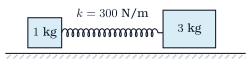
Blocks of \(1\) kg and \(3\) kg are joined by a spring of stiffness \(300\) N/m on a smooth floor. The spring is stretched and released.
Which point stays at rest during the motion? Give the reason.
Find the reduced mass \(\mu = \frac{m_1 m_2}{m_1 + m_2}\) and the period \(T = 2\pi\sqrt{\mu/k}\).
Answer(i) centre of mass (ii) \(0.75\) kg; \(\pi/10 \approx 0.31\) s
Solution
No external horizontal force acts, so the centre of mass stays at rest. It is \(3\) times closer to the \(3\) kg block, so the \(1\) kg block moves \(3\) times as far.
\(\mu = \dfrac{1 \times 3}{1 + 3} = 0.75\) kg. \(T = 2\pi\sqrt{\dfrac{0.75}{300}} = 2\pi\sqrt{\dfrac{1}{400}} = \dfrac{\pi}{10} \approx 0.31\) s.
How did it go?
Q10
The block of Question 2 hangs in a lift that accelerates upward at \(2\) m/s\(^2\). Does the period change? By how much does the equilibrium position shift?
Answerno; \(2\) cm lower
Solution
No. The period depends only on \(m\) and \(k\); the acceleration of the lift changes neither.
In the lift the effective gravity is \(12\) m/s\(^2\), so the equilibrium stretch is \(\dfrac{1 \times 12}{100} = 12\) cm, that is, \(2\) cm lower than before. The block oscillates about this new point.
How did it go?
Q11
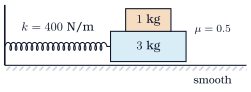
A \(1\) kg block rests on a \(3\) kg block, which is attached to a spring of stiffness \(400\) N/m on a smooth floor. The friction coefficient between the blocks is \(0.5\).
Find \(\omega\) for the two blocks moving together.
What force makes the upper block oscillate? Find the largest amplitude for which it does not slip.
Answer(i) \(10\) rad/s (ii) friction; \(5\) cm
Solution
Together the blocks have mass \(4\) kg: \(\omega = \sqrt{\dfrac{400}{4}} = 10\) rad/s.
Only friction acts horizontally on the upper block, so friction supplies its restoring force \(ma\). The largest friction available is \(\mu mg = 0.5 \times 1 \times 10 = 5\) N, giving \(a_{\max} = 5\) m/s\(^2\).
The upper block follows without slipping while \(\omega^2 A \le 5\): \(A \le \dfrac{5}{100} = 0.05\) m \(= 5\) cm.
How did it go?
Q12
A \(1\) kg block rests on a light platform fixed to a vertical spring of stiffness \(100\) N/m. The platform is pushed down and released.
Does the block leave the platform if the amplitude is \(5\) cm? Give the reason.
The amplitude is \(15\) cm. Where does the block leave the platform?
Answer(i) no, \(a_{\max} = 5\) m/s\(^2\) (ii) \(10\) cm above equilibrium
Solution
\(\omega^2 = \dfrac{100}{1} = 100\). The largest downward acceleration of the platform is \(\omega^2 A = 100 \times 0.05 = 5\) m/s\(^2\), less than \(g\). The platform never falls away faster than the block would fall, so the block stays on.
The block leaves where the platform's downward acceleration reaches \(g\): \(\omega^2 x = 10\), \(x = 0.1\) m \(= 10\) cm above the equilibrium position, on the way up. With \(A = 15\) cm this point is reached.
How did it go?
Q13
Start from the energy \(E = \frac{1}{2}mv^2 + \frac{1}{2}kx^2\) of a spring-block system. Differentiate with respect to time and show that \(a = -\frac{k}{m}x\), so that \(T = 2\pi\sqrt{m/k}\).
Answer\(mva + kxv = 0\)
Solution
\(E\) is constant, so \(\dfrac{dE}{dt} = 0\): \(mv\dfrac{dv}{dt} + kx\dfrac{dx}{dt} = 0\).
With \(\dfrac{dx}{dt} = v\) and \(\dfrac{dv}{dt} = a\): \(v(ma + kx) = 0\). Since \(v\) is not always zero, \(a = -\dfrac{k}{m}x\).
This is SHM with \(\omega^2 = \dfrac{k}{m}\), so \(T = 2\pi\sqrt{\dfrac{m}{k}}\).
How did it go?
Q14
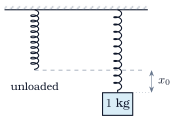
A \(1\) kg block is attached to the lower end of an unstretched vertical spring of stiffness \(100\) N/m and released from rest.
About which point does it oscillate?
Find the amplitude.
Find the largest extension of the spring.
Answer(i) \(10\) cm below the start (ii) \(10\) cm (iii) \(20\) cm
Solution
About the equilibrium position, where \(kx_0 = mg\): \(x_0 = 10\) cm below the release point.
The block is released from rest \(10\) cm from the equilibrium position, so that is the amplitude: \(A = 10\) cm.
The lowest point is \(A\) below equilibrium: extension \(x_0 + A = 20\) cm, twice the static stretch.
How did it go?
Q15
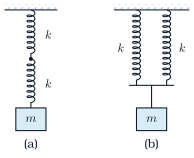
Springs of stiffness \(100\) N/m and \(300\) N/m are joined end to end and hold a block of \(0.75\) kg. Find the effective stiffness and the period.
\(\left[\sqrt{\dfrac{m}{k}}\right] = \sqrt{\dfrac{\mathrm{M}}{\mathrm{MT^{-2}}}} = \sqrt{\mathrm{T^2}} = \mathrm{T}\), a time. The \(2\pi\) has no dimension.
How did it go?
Q20
The block of Question 1 passes the mean position at \(1\) m/s.
Find the amplitude.
Find the time to reach \(x = 5\) cm.
Answer(i) \(10\) cm (ii) \(\pi/60 \approx 0.05\) s
Solution
\(v_{\max} = A\omega\): \(A = \dfrac{1}{10} = 0.1\) m \(= 10\) cm.
\(x = 5\) cm is \(\dfrac{A}{2}\), reached after \(\dfrac{T}{12}\) from the mean position (phase \(30^\circ\)): \(t = \dfrac{\pi/5}{12} = \dfrac{\pi}{60} \approx 0.05\) s.
How did it go?
Q21
A car of mass \(1000\) kg rests on four identical springs, each of stiffness \(2.5 \times 10^{4}\) N/m.
Find the period of vertical oscillation of the empty car.
Four passengers of total mass \(300\) kg get in. By how much does the car sink?
Answer(i) \(\pi/5 \approx 0.63\) s (ii) \(3\) cm
Solution
Four springs in parallel: \(k = 4 \times 2.5 \times 10^{4} = 10^{5}\) N/m. \(T = 2\pi\sqrt{\dfrac{1000}{10^{5}}} = 2\pi \times 0.1 = \dfrac{\pi}{5} \approx 0.63\) s.
Extra weight \(= 300 \times 10 = 3000\) N. Extra compression \(= \dfrac{3000}{10^{5}} = 0.03\) m \(= 3\) cm.
How did it go?
Compound Pendulum and Centre of Percussion
24 questions · after Lesson 5, Pendulums That Twist and Swing
Period of a physical pendulum
Q22
Write the period of a compound (physical) pendulum. What does \(d\) stand for? Show that the formula gives \(2\pi\sqrt{L/g}\) for a small bob on a light string.
Answer\(T = 2\pi\sqrt{\frac{I}{mgd}}\); pivot to centre of mass; \(I = mL^2\), \(d = L\)
Solution
\(T = 2\pi\sqrt{\dfrac{I}{mgd}}\), where \(I\) is about the pivot and \(d\) is the distance from the pivot to the centre of mass. For a point bob, \(I = mL^2\) and \(d = L\): \(T = 2\pi\sqrt{\dfrac{mL^2}{mgL}} = 2\pi\sqrt{\dfrac{L}{g}}\).
How did it go?
Q23
A uniform rod of length \(1.5\) m swings about a pivot at one end. Take \(g = 10\) m/s\(^2\). Find the period of small oscillations.
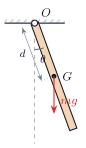
A body of mass \(m\) and moment of inertia \(I\) about a pivot is displaced by a small angle \(\theta\). Its centre of mass is \(d\) from the pivot. Derive \(T = 2\pi\sqrt{\frac{I}{mgd}}\).
Answer\(I\alpha = -mgd\,\theta\)
Solution
Displaced by \(\theta\), the weight has lever arm \(d\sin\theta\) about the pivot, giving a restoring torque \(-mgd\sin\theta \approx -mgd\,\theta\). So \(I\dfrac{d^2\theta}{dt^2} = -mgd\,\theta\): simple harmonic motion with \(\omega^2 = \dfrac{mgd}{I}\) and \(T = 2\pi\sqrt{\dfrac{I}{mgd}}\).
How did it go?
Equivalent length and the pivot position
Q28
Define the equivalent length of a compound pendulum and show that \(L_{\text{eq}} = \frac{k^2 + d^2}{d}\), where \(k\) is the radius of gyration about the centre of mass. Evaluate it for a rod pivoted at one end.
The equivalent length is the length of the simple pendulum with the same period: \(2\pi\sqrt{L_{\text{eq}}/g} = 2\pi\sqrt{I/mgd}\) gives \(L_{\text{eq}} = \dfrac{I}{md}\). With \(I = m(k^2 + d^2)\) by the parallel axis theorem: \(L_{\text{eq}} = \dfrac{k^2 + d^2}{d}\). Rod at its end: \(k^2 = \dfrac{L^2}{12}\), \(d = \dfrac{L}{2}\): \(L_{\text{eq}} = \dfrac{L^2/12 + L^2/4}{L/2} = \dfrac{2L}{3}\).
How did it go?
Q29
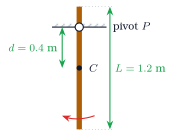
Show that \(L_{\text{eq}}\), and so the period, is least when \(d = k\). Find \(k\) for a uniform rod of length \(1.2\) m.
\(L_{\text{eq}} = \dfrac{k^2}{d} + d\). \(\dfrac{dL_{\text{eq}}}{dd} = -\dfrac{k^2}{d^2} + 1 = 0\) at \(d = k\), and the second derivative \(\dfrac{2k^2}{d^3}\) is positive, so it is a minimum. For the rod: \(k = \dfrac{L}{\sqrt{12}} = \dfrac{1.2}{3.46} \approx 0.35\) m.
How did it go?
Q30
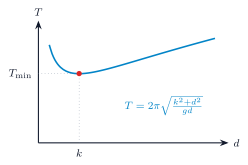
The graph shows how \(T\) depends on the distance \(d\) of the pivot from the centre of mass.
Why does \(T\) grow without limit as \(d \to 0\)?
Why does \(T\) grow again for large \(d\)?
Answer(i) restoring torque \(\to 0\) (ii) \(I\) grows as \(d^2\)
Solution
As \(d \to 0\) the pivot approaches the centre of mass and the restoring torque \(mgd\,\theta\) vanishes. With no torque to bring it back, the body takes longer and longer to swing.
For large \(d\), \(I \approx md^2\) grows as \(d^2\) while the torque grows only as \(d\). So \(T \approx 2\pi\sqrt{d/g}\) grows like a long simple pendulum.
How did it go?
Q31
Two pivots at distances \(d_1\) and \(d_2\) from the centre of mass, on the same side, give the same period. Show that \(d_1d_2 = k^2\). For the rod of Q3, find the second distance and check that \(d_1 + d_2 = L_{\text{eq}}\).
Answer\(\frac{k^2 + d_1^2}{d_1} = \frac{k^2 + d_2^2}{d_2}\); \(0.3\) m; \(0.7\) m
Solution
Equal periods mean equal \(L_{\text{eq}}\): \(\dfrac{k^2}{d_1} + d_1 = \dfrac{k^2}{d_2} + d_2\), so \(k^2\dfrac{d_2 - d_1}{d_1d_2} = d_2 - d_1\) and \(d_1d_2 = k^2\). For the rod, \(k^2 = 0.12\) and \(d_1 = 0.4\): \(d_2 = 0.3\) m. \(d_1 + d_2 = 0.7\) m \(= L_{\text{eq}}\), as in Q3.
How did it go?
Q32
Two pivots on opposite sides of the centre of mass of a bar give the same period \(T = 2\) s. They are \(1\) m apart. Find \(g\) from these data.
Answer\(\pi^2 \approx 9.9\) m/s\(^2\)
Solution
For pivots on opposite sides with the same period, \(d_1 + d_2 = L_{\text{eq}}\) (Q10). So \(T = 2\pi\sqrt{\dfrac{d_1 + d_2}{g}}\) and \(g = \dfrac{4\pi^2(d_1 + d_2)}{T^2} = \dfrac{4\pi^2 \times 1}{4} = \pi^2 \approx 9.9\) m/s\(^2\). This is the idea of Kater's pendulum.
How did it go?
Q33
For a uniform \(1.2\) m rod, compare the periods about a pivot at its end and about a pivot \(0.3\) m from the centre. Which is shorter and why?
Answer\(L_{\text{eq}}\): \(0.8\) m and \(0.7\) m; pivot at \(0.3\) m, nearer \(k\)
Solution
\(k^2 = 0.12\) m\(^2\). End: \(d = 0.6\), \(L_{\text{eq}} = \dfrac{0.12 + 0.36}{0.6} = 0.8\) m. Pivot at \(0.3\) m: \(L_{\text{eq}} = \dfrac{0.12 + 0.09}{0.3} = 0.7\) m. The shorter \(L_{\text{eq}}\) gives the shorter period, so the pivot at \(0.3\) m, which is closer to \(k \approx 0.35\) m.
How did it go?
Q34
A small bob on a light string of length \(L\) and a uniform rod of length \(L\) pivoted at its end swing side by side. Find the ratio of their periods. Which swings faster?
Answer\(T_{\text{rod}} : T_{\text{bob}} = \sqrt{2/3} \approx 0.82\); the rod
Solution
\(T_{\text{bob}} = 2\pi\sqrt{L/g}\) and \(T_{\text{rod}} = 2\pi\sqrt{2L/3g}\). Ratio \(\dfrac{T_{\text{rod}}}{T_{\text{bob}}} = \sqrt{\dfrac{2}{3}} \approx 0.82\). The rod swings faster: its mass is spread nearer the pivot, so its equivalent length is only \(\dfrac{2L}{3}\).
How did it go?
Centre of percussion
Q35
What is the centre of percussion of a pivoted body? Show that its distance from the pivot is \(q = \frac{I}{md}\), the same as \(L_{\text{eq}}\).
The centre of percussion is the point where a blow produces no impulsive reaction at the pivot. With an impulse \(J\) at distance \(q\) and no pivot impulse: linear, \(J = m\,v_{\text{cm}} = m\omega d\); angular about the pivot, \(Jq = I\omega\). Dividing: \(q = \dfrac{I}{md}\), which is exactly \(L_{\text{eq}}\).
How did it go?
Q36
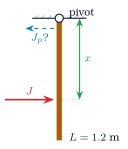
The uniform \(1.2\) m rod is struck at distance \(x\) from the pivot.
Find \(x\) for which the pivot feels no impulse.
For \(J = 6\) N s at the free end (\(x = 1.2\) m), find the impulse at the pivot.
Find the pivot impulse for the same \(J\) at \(x = 0.6\) m, and its direction.
Answer(i) \(0.8\) m (ii) \(3\) N s, same sense as \(J\) (iii) \(1.5\) N s, opposite
Solution
\(q = \dfrac{I}{md} = \dfrac{mL^2/3}{mL/2} = \dfrac{2L}{3} = 0.8\) m.
\(J_p = J\left(\dfrac{3x}{2L} - 1\right) = 6\left(\dfrac{3.6}{2.4} - 1\right) = 6 \times 0.5 = 3\) N s, in the same sense as \(J\).
\(J_p = 6\left(\dfrac{1.8}{2.4} - 1\right) = 6 \times (-0.25) = -1.5\) N s: \(1.5\) N s opposite to \(J\).
How did it go?
Q37
For the rod of Q15 struck at distance \(x\), show that the pivot impulse is \(J_p = J\left(\frac{3x}{2L} - 1\right)\).
Let the pivot supply an impulse \(J_p\) in the direction of \(J\). Linear: \(J + J_p = m\omega\dfrac{L}{2}\). Angular about the pivot: \(Jx = \dfrac{mL^2}{3}\omega\), so \(m\omega = \dfrac{3Jx}{L^2}\). Then \(J_p = \dfrac{3Jx}{L^2}\cdot\dfrac{L}{2} - J = J\left(\dfrac{3x}{2L} - 1\right)\). It vanishes at \(x = \dfrac{2L}{3}\).
How did it go?
Q38
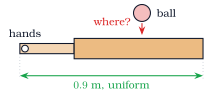
Treat the bat as a uniform rod pivoted at the hands.
How far from the hands should the ball strike so that the hands feel no jar?
What do the hands feel if the ball strikes the very tip?
Answer(i) \(0.6\) m (ii) a jar in the direction of the ball
Solution
The sweet spot is the centre of percussion: \(\dfrac{2L}{3} = \dfrac{2 \times 0.9}{3} = 0.6\) m from the hands.
At the tip \(x = L\), so \(J_p = J\left(\dfrac{3}{2} - 1\right) = \dfrac{J}{2}\): the hands must supply half the ball's impulse, in the ball's direction. That is the sting felt on a mistimed shot.
How did it go?
Q39
A uniform door \(0.9\) m wide is hinged at one edge. Where should a doorstop touch it so that the hinges feel no jerk when the door swings into it?
Answer\(0.6\) m from the hinge
Solution
The door is a rod pivoted at its hinged edge. The stop should meet it at the centre of percussion, \(\dfrac{2}{3} \times 0.9 = 0.6\) m from the hinge line.
How did it go?
Q40
Why is the centre of percussion of a pivoted rod the same point as the equivalent simple-pendulum length? Give the physical reason in two sentences.
Answerboth are \(I/md\): the point that moves as a free particle would
Solution
Both distances equal \(\dfrac{I}{md}\). A blow at that point makes the body start moving exactly as a free particle placed there would, so the pivot has nothing to do. In the same way, a bob at that distance swings with the same period as the body, so the pivot's constraint again adds nothing.
How did it go?
Q41
A \(2\) kg, \(1.2\) m rod pivoted at one end is struck at its centre of percussion with \(J = 3\) N s. Find the angular velocity given to it and the impulse at the pivot.
Answer\(2.5\) rad/s; \(0\)
Solution
Centre of percussion at \(0.8\) m. \(I = \dfrac{2 \times 1.44}{3} = 0.96\) kg m\(^2\). \(Jq = I\omega\): \(3 \times 0.8 = 0.96\,\omega\), so \(\omega = 2.5\) rad/s. Check: \(m\omega d = 2 \times 2.5 \times 0.6 = 3\) N s \(= J\), so the pivot impulse is zero.
How did it go?
Small situations
Q42
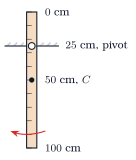
A metre stick swings about a pivot at the \(25\) cm mark. Take \(g = 10\) m/s\(^2\).
Find \(k^2\) and \(d\).
Find \(L_{\text{eq}}\) and the period.
Answer(i) \(\frac{1}{12}\) m\(^2\); \(0.25\) m (ii) \(\frac{7}{12} \approx 0.58\) m; \(\approx 1.5\) s
Solution
\(k^2 = \dfrac{L^2}{12} = \dfrac{1}{12}\) m\(^2\). The centre is at \(50\) cm, so \(d = 0.25\) m.
A simple pendulum keeps time with the rod of Q2. Find its length.
Answer\(1\) m
Solution
Same period means the same equivalent length: \(L_{\text{eq}} = \dfrac{2L}{3} = \dfrac{2 \times 1.5}{3} = 1\) m.
How did it go?
Q44
A uniform rod of length \(L\) is pivoted at one end. Show, by requiring zero pivot impulse, that the centre of percussion is \(\frac{2L}{3}\) from the pivot.
With no pivot impulse the blow \(J\) alone changes the momentum: \(J = m\,v_{\text{cm}} = m\omega\dfrac{L}{2}\). Angular momentum about the pivot: \(Jq = \dfrac{mL^2}{3}\omega\). Dividing the second by the first: \(q = \dfrac{mL^2\omega/3}{m\omega L/2} = \dfrac{2L}{3}\).
How did it go?
Q45
A hammer is swung about the wrist. Where along the handle should it be held so that the wrist feels no jar when the head strikes a nail? Answer in terms of \(I\), \(m\) and \(d\).
Answerhead at \(\frac{I}{md}\) from the wrist
Solution
The wrist is the pivot. The head, where the blow lands, should be at the centre of percussion, a distance \(\dfrac{I}{md}\) from the wrist. Here \(I\) is the hammer's moment of inertia about the wrist and \(d\) the distance of its centre of mass from the wrist. The hand position sets \(d\) and \(I\); choose it so that this distance equals the wrist-to-head length.
How did it go?
Simple, Physical and Torsional Pendulums
21 questions · after Lesson 5, Pendulums That Twist and Swing
The simple pendulum
Q46
Take \(g = 10\) m/s\(^2\) and \(\pi^2 = 10\) throughout this sheet. Find the period of a simple pendulum of length \(1\) m.
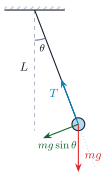
The tension is perpendicular to the arc; only the component \(mg\sin\theta\) of the weight acts along the arc, back towards the lowest point: \(F = -mg\sin\theta\).
For small \(\theta\), \(\sin\theta \approx \theta = \dfrac{x}{L}\), so \(F \approx -\dfrac{mg}{L}x\).
\(F = -kx\) with \(k = \dfrac{mg}{L}\), so \(T = 2\pi\sqrt{\dfrac{m}{k}} = 2\pi\sqrt{\dfrac{L}{g}}\). The mass cancels.
The motion is SHM only while \(\sin\theta \approx \theta\). For large swings the restoring force is smaller than \(-\frac{mg}{L}x\) and the period grows slightly with amplitude.
How did it go?
Q49
The period of a simple pendulum is \(T\). State the new period in each case.
The mass of the bob is doubled.
The length is made four times.
The pendulum is taken to the Moon (\(g/6\)).
Answer(i) \(T\) (ii) \(2T\) (iii) \(\sqrt{6}\,T\)
Solution
The mass does not appear in \(T = 2\pi\sqrt{L/g}\): still \(T\).
A pendulum clock keeps correct time at sea level. It is taken to a hill where \(g\) is smaller by \(1\) percent.
By what percentage does the period change? Does the clock gain or lose?
How many seconds does it gain or lose in a day?
Answer(i) \(+0.5\) percent; loses (ii) \(432\) s
Solution
\(T \propto g^{-1/2}\), so a \(1\) percent fall in \(g\) raises \(T\) by \(\dfrac{1}{2}\) percent. Each swing takes longer, so the clock counts fewer seconds: it loses.
\(0.5\) percent of a day \(= 0.005 \times 86400 = 432\) s, about \(7\) minutes.
How did it go?
Q51
The \(1\) m pendulum of Question 1 hangs in a lift. Find its period in each case.
The lift accelerates upward at \(6\) m/s\(^2\).
The lift accelerates downward at \(6\) m/s\(^2\).
The lift falls freely.
Answer(i) \(\pi/2 \approx 1.57\) s (ii) \(\pi \approx 3.14\) s (iii) no oscillation
Solution
In the lift the pendulum feels \(g_{\text{eff}} = g + a\) (accelerating up) or \(g - a\) (accelerating down).
\(g_{\text{eff}} = 0\): no restoring force. The bob stays wherever it is put; there is no oscillation.
How did it go?
Q52
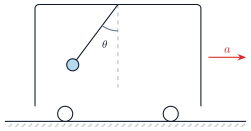
The \(1\) m pendulum hangs from the roof of a car that accelerates horizontally at \(7.5\) m/s\(^2\).
Find the angle the string makes with the vertical at equilibrium.
Find the effective \(g\) and the period of small oscillations about this position.
Answer(i) \(\tan\theta = 0.75\), \(\theta \approx 37^\circ\) (ii) \(12.5\) m/s\(^2\); \(\approx 1.8\) s
Solution
In the car's frame a pseudo force \(ma\) acts backward. The string settles along the resultant of \(mg\) and \(ma\): \(\tan\theta = \dfrac{a}{g} = 0.75\), so \(\theta \approx 37^\circ\).
\(2\pi\sqrt{\dfrac{L_{\text{eq}}}{g}} = 2\pi\sqrt{\dfrac{2L}{3g}}\) gives \(L_{\text{eq}} = \dfrac{2L}{3} \approx 0.67\) m. The rod swings like a simple pendulum two thirds as long.
How did it go?
Q56
A rigid body of mass \(m\) hangs from a horizontal pivot. Its moment of inertia about the pivot is \(I\), and its centre of gravity is a distance \(d\) below the pivot. It is turned through a small angle \(\theta\). Write the restoring torque and show that \(T = 2\pi\sqrt{I/(mgd)}\).
Answer\(\tau = -mgd\,\theta\)
Solution
The weight \(mg\) acts at \(G\), a perpendicular distance \(d\sin\theta\) from the pivot: \(\tau = -mgd\sin\theta \approx -mgd\,\theta\) for small \(\theta\).
\(I\alpha = -mgd\,\theta\), so \(\alpha = -\dfrac{mgd}{I}\theta\): angular SHM with \(\omega^2 = \dfrac{mgd}{I}\) and \(T = 2\pi\sqrt{\dfrac{I}{mgd}}\).
How did it go?
Q57
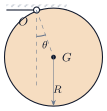
A uniform disc of radius \(R = 0.2\) m is pivoted at a point on its rim and swings in its own plane. Take \(\sqrt{0.3} = 0.55\).
Find \(I\) about the pivot, using the parallel axis theorem.
Find the period.
Answer(i) \(\frac{3}{2}mR^2\) (ii) \(\approx 1.1\) s
A thin ring of radius \(0.2\) m hangs from a nail on its rim and swings in its own plane. Find its period. Compare with a simple pendulum of length \(2R\).
Answer\(0.4\pi \approx 1.26\) s; equal
Solution
\(I = mR^2 + mR^2 = 2mR^2\) about the nail, \(d = R\): \(T = 2\pi\sqrt{\dfrac{2mR^2}{mgR}} = 2\pi\sqrt{\dfrac{2R}{g}} = 2\pi\sqrt{0.04} = 0.4\pi \approx 1.26\) s.
A simple pendulum of length \(2R\) has exactly the same period: the ring's equivalent length is its diameter.
How did it go?
Q59
What is the equivalent length of a physical pendulum? A physical pendulum has a period of \(2\) s. Find its equivalent length.
Answer\(I/(md)\); \(1\) m
Solution
The equivalent length is the length of the simple pendulum with the same period: \(L_{\text{eq}} = \dfrac{I}{md}\).
For \(T = 2\) s: \(L_{\text{eq}} = \dfrac{gT^2}{4\pi^2} = 1\) m, whatever the shape of the body.
How did it go?
Q60
A body has radius of gyration \(k\) about its centre of gravity and is pivoted at a distance \(d\) from it. Show that \(T^2 \propto \frac{k^2 + d^2}{d}\), and that the period is least when \(d = k\). Find this \(d\) for a uniform rod of length \(1\) m. Take \(\sqrt{12} = 3.46\).
Answer\(d = k = L/\sqrt{12} \approx 0.29\) m
Solution
\(I = m(k^2 + d^2)\) by the parallel axis theorem, so \(T^2 = 4\pi^2\dfrac{k^2 + d^2}{gd}\).
\(\dfrac{k^2 + d^2}{d} = \dfrac{k^2}{d} + d\). Its derivative \(-\dfrac{k^2}{d^2} + 1\) is zero at \(d = k\), a minimum. Very small \(d\) (pivot near \(G\)) and very large \(d\) both give long periods.
Rod: \(k^2 = \dfrac{L^2}{12}\), so \(d = \dfrac{L}{\sqrt{12}} = \dfrac{1}{3.46} \approx 0.29\) m from the centre.
How did it go?
Torsional pendulum
Q61
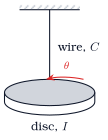
A disc of moment of inertia \(I = 0.01\) kg m\(^2\) hangs from a wire of torsion constant \(C = 0.1\) N m/rad. It is twisted and released.
Find the period.
Does the period depend on the angle of twist? Give the reason.
No. The restoring torque is exactly proportional to \(\theta\); no small-angle approximation is needed. So the motion is SHM for any twist within the elastic limit, and the period does not depend on the amplitude.
How did it go?
Q62
The wire of Question 16 provides a restoring torque \(\tau = -C\theta\). Show that \(T = 2\pi\sqrt{I/C}\). What is the SI unit of \(C\)?
AnswerN m/rad
Solution
\(I\alpha = -C\theta\), so \(\alpha = -\dfrac{C}{I}\theta\): angular SHM with \(\omega^2 = \dfrac{C}{I}\) and \(T = 2\pi\sqrt{\dfrac{I}{C}}\).
\(C\) is torque per unit angle: N m per radian, written N m/rad (or simply N m, since the radian has no dimension).
How did it go?
Q63
Consider the torsional pendulum of Question 16. State the new period in each case.
The disc is replaced by one of twice the moment of inertia.
The wire is replaced by one of the same material and radius but twice the length.
Answer(i) \(2\sqrt{2} \approx 2.8\) s (ii) \(2\sqrt{2} \approx 2.8\) s
Solution
\(T \propto \sqrt{I}\): \(2\sqrt{2} \approx 2.8\) s.
For a wire \(C \propto \dfrac{1}{\text{length}}\), so doubling the length halves \(C\). \(T \propto \dfrac{1}{\sqrt{C}}\): again \(2\sqrt{2} \approx 2.8\) s.
How did it go?
Q64
A seconds pendulum clock is correct at \(20^\circ\)C. On a hot day the pendulum rod is longer by \(0.02\) percent. Does the clock gain or lose, and by how much in a day?
Answerloses; \(8.64\) s
Solution
\(T \propto \sqrt{L}\): a \(0.02\) percent increase in \(L\) gives a \(0.01\) percent increase in \(T\). The clock runs slow and loses.
Loss per day \(= 0.0001 \times 86400 = 8.64\) s.
How did it go?
Q65
Two simple pendulums of lengths \(1\) m and \(4\) m are released together from the same side. After what time are they next in phase, both at the same side at the same instant?
Answer\(4\) s
Solution
\(T_1 = 2\) s and \(T_2 = 2\pi\sqrt{\dfrac{4}{10}} = 4\) s.
They are in phase again when both have completed whole numbers of oscillations. After \(4\) s the short pendulum has made \(2\) swings and the long one \(1\).
How did it go?
Q66
The torsional pendulum of Question 16 is used to measure the moment of inertia of an irregular body. The body is placed on the disc, and the period rises from \(2\) s to \(3\) s. Find the moment of inertia of the body.
\(v_{\max} = A\omega = 0.1 \times 20 = 2\) m/s. \(\dfrac{1}{2}mv_{\max}^2 = \dfrac{1}{2} \times 0.5 \times 4 = 1\) J \(= E\): at the mean position all the energy is kinetic.
How did it go?
Q68
For the block of Question 1, find the potential energy and the kinetic energy at \(x = A/2\). Write the ratio \(K : U\) there.
Answer\(U = 0.25\) J, \(K = 0.75\) J; \(3 : 1\)
Solution
\(U = \dfrac{1}{2}kx^2 = \dfrac{1}{2} \times 200 \times (0.05)^2 = 0.25\) J, one quarter of \(E\) because \(x = A/2\) and \(U \propto x^2\).
\(K = E - U = 1 - 0.25 = 0.75\) J. \(K : U = 3 : 1\).
How did it go?
Q69
At what displacement are the kinetic and the potential energies of a particle in SHM equal? Give the answer as a fraction of \(A\) and as a number for \(A = 10\) cm.
Answer\(A/\sqrt{2}\); \(\approx 7.1\) cm
Solution
\(K = U\) means \(U = \dfrac{E}{2}\): \(\dfrac{1}{2}kx^2 = \dfrac{1}{2} \times \dfrac{1}{2}kA^2\), so \(x^2 = \dfrac{A^2}{2}\) and \(x = \pm\dfrac{A}{\sqrt{2}}\).
For \(A = 10\) cm: \(x \approx \pm 7.1\) cm.
How did it go?
Q70
A particle moves as \(x = A\sin\omega t\). Write \(U(t) = \frac{1}{2}m\omega^2 x^2\) and \(K(t) = \frac{1}{2}mv^2\), and show that their sum is constant and equal to \(\frac{1}{2}m\omega^2 A^2\).
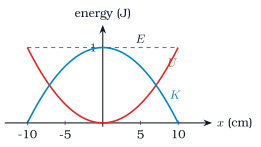
The graph shows \(U\), \(K\) and \(E\) against displacement for a particle in SHM.
Read the amplitude and the total energy.
Why is the \(U\) curve a parabola? Why is the \(K\) curve an inverted parabola?
At what \(x\) do the two curves cross? Read the energy there.
Answer(i) \(10\) cm, \(1\) J (ii) \(U = \frac{1}{2}kx^2\); \(K = E - U\) (iii) \(\pm 7.1\) cm; \(0.5\) J
Solution
The curves end at \(x = \pm 10\) cm: \(A = 10\) cm. The horizontal line is at \(1\) J: \(E = 1\) J.
\(U = \dfrac{1}{2}kx^2\) is proportional to \(x^2\), a parabola opening upward. \(K = E - U = E - \dfrac{1}{2}kx^2\) is the same parabola turned over and lifted to \(E\).
They cross where \(K = U = \dfrac{E}{2} = 0.5\) J, at \(x = \pm\dfrac{A}{\sqrt{2}} \approx \pm 7.1\) cm.
How did it go?
Q75
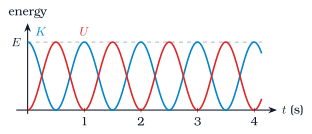
The graph shows \(K\) and \(U\) against time for a particle that starts at the mean position at \(t = 0\).
Read the time between two successive maxima of \(K\). What is the period of the motion?
Why does the energy oscillate twice as fast as the particle?
At what times is \(K = U\)?
Answer(i) \(1\) s; \(2\) s (ii) \(K \propto \cos^2\omega t\), period \(\pi/\omega\) (iii) \(0.25, 0.75, 1.25, \ldots\) s
Solution
\(K\) peaks every \(1\) s. The particle passes the mean position twice per period, so the period of the motion is \(2\) s.
\(K\) depends on \(v^2\) and \(U\) on \(x^2\). Squaring removes the sign, so the energies repeat every half period, at twice the frequency of the motion.
Where the curves cross: \(t = 0.25\) s, \(0.75\) s, \(1.25\) s, and so on, every quarter period.
How did it go?
Q76
For \(x = A\sin\omega t\), write \(K(t)\) and use \(\cos^2\theta = \frac{1 + \cos 2\theta}{2}\) to show that \(K\) varies with angular frequency \(2\omega\). Show that the average of \(K\) over a period is \(E/2\).
Answer\(K = \frac{E}{2}(1 + \cos 2\omega t)\)
Solution
\(K = \dfrac{1}{2}m\omega^2 A^2\cos^2\omega t = E\cos^2\omega t = \dfrac{E}{2}(1 + \cos 2\omega t)\).
The time-varying part is \(\cos 2\omega t\), of angular frequency \(2\omega\). Over a full period \(\cos 2\omega t\) averages to zero, so the average kinetic energy is \(\dfrac{E}{2}\), and the average potential energy is also \(\dfrac{E}{2}\).
How did it go?
Q77
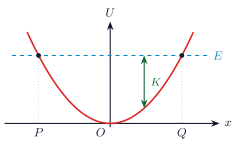
The curve is \(U = \frac{1}{2}kx^2\) and the dashed line is the total energy \(E\) of a particle.
What happens at the points \(P\) and \(Q\)? Why can the particle not go beyond them?
What does the vertical gap between the line and the curve represent?
The line is raised. How do \(P\) and \(Q\) move? Does the period change?
Answer(i) turning points; \(K\) would be negative (ii) \(K\) (iii) apart; no
Solution
At \(P\) and \(Q\) the potential energy equals the total energy, so the kinetic energy is zero: the particle stops and turns back. Beyond them \(U\) would exceed \(E\) and \(K\) would be negative, which is impossible.
The gap \(E - U\) is the kinetic energy at that position. It is largest at \(O\).
A higher line meets the parabola farther out: \(P\) and \(Q\) move apart, the amplitude grows. The period of SHM does not depend on the amplitude, so it stays the same.
How did it go?
Q78
A particle performs SHM with total energy \(E\). State its kinetic and potential energies at the extreme position and at the mean position. Is the total energy ever zero?
Answerextreme: \(0\), \(E\); mean: \(E\), \(0\); no
Solution
At the extreme: \(K = 0\) and \(U = E\). At the mean position: \(K = E\) and \(U = 0\).
The total energy is never zero while the particle oscillates. It is constant, equal to \(\dfrac{1}{2}kA^2\), and only a stopped particle at the mean position has zero energy.
How did it go?
Small situations
Q79
A \(1\) kg block on a smooth floor is attached to a spring of stiffness \(100\) N/m. It is pulled \(5\) cm from the natural length and released.
Find the total energy.
Find the maximum speed.
Find the speed at \(x = 3\) cm.
Answer(i) \(0.125\) J (ii) \(0.5\) m/s (iii) \(0.4\) m/s
A \(1\) kg block on a spring of stiffness \(400\) N/m is at rest at the mean position. It is struck and moves off at \(2\) m/s. Find the amplitude of the resulting SHM and its total energy.
Answer\(0.1\) m; \(2\) J
Solution
At the mean position all the energy is kinetic: \(E = \dfrac{1}{2} \times 1 \times 4 = 2\) J.
\(\dfrac{1}{2}kA^2 = 2\) gives \(A^2 = \dfrac{4}{400} = 0.01\), so \(A = 0.1\) m. (Or \(A = \dfrac{v_{\max}}{\omega} = \dfrac{2}{20}\).)
How did it go?
Q81
A \(1\) kg block on a spring of stiffness \(100\) N/m is observed at \(x = 3\) cm moving at \(0.4\) m/s. Find the total energy and the amplitude. Compare with Question 13.
\(A = \sqrt{\dfrac{2E}{k}} = \sqrt{\dfrac{0.25}{100}} = 0.05\) m \(= 5\) cm. This is the same motion as in Question 13, seen at a different instant.
How did it go?
Q82
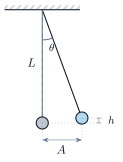
A pendulum has a bob of mass \(0.1\) kg on a string of length \(1\) m. It swings with a small amplitude \(A = 0.1\) m along the arc. Take \(g = 10\) m/s\(^2\) and \(\sqrt{10} = 3.16\).
Show that for small angles the rise of the bob at the extreme is \(h \approx \frac{A^2}{2L}\), and find \(h\).
Find the total energy and the maximum speed of the bob.
Answer(i) \(5\) mm (ii) \(5 \times 10^{-3}\) J; \(\approx 0.32\) m/s
Solution
For a small angle \(\theta = \dfrac{A}{L}\), the rise is \(h = L(1 - \cos\theta) \approx L\dfrac{\theta^2}{2} = \dfrac{A^2}{2L}\).
\(h = \dfrac{0.01}{2} = 5 \times 10^{-3}\) m \(= 5\) mm.
A block hangs from a vertical spring and oscillates. Gravity acts on it as well as the spring. Why can we still write the total energy as \(\frac{1}{2}kx^2 + \frac{1}{2}mv^2\), with \(x\) measured from the equilibrium position?
Answergravity only shifts the equilibrium
Solution
At the equilibrium position the spring is already stretched by \(x_0 = mg/k\). For a further displacement \(x\) the net force is \(-k(x_0 + x) + mg = -kx\), the same as for a horizontal spring.
Gravity only shifts the equilibrium point. Measured from it, the combined potential energy of spring and gravity is \(\dfrac{1}{2}kx^2\) plus a constant, so the energy equation keeps its usual form.
How did it go?
Q84
A particle starts from the mean position at \(t = 0\). Find the ratio \(U : K\) at
\(t = T/8\),
\(t = T/12\).
Answer(i) \(1 : 1\) (ii) \(1 : 3\)
Solution
\(x = A\sin\omega t\), \(U = E\sin^2\omega t\), \(K = E\cos^2\omega t\), so \(U : K = \tan^2\omega t\).
\(t = \dfrac{T}{8}\): \(\omega t = 45^\circ\), \(\tan^2 45^\circ = 1\). \(U : K = 1 : 1\).
\(t = \dfrac{T}{12}\): \(\omega t = 30^\circ\), \(\tan^2 30^\circ = \dfrac{1}{3}\). \(U : K = 1 : 3\).
How did it go?
Q85
The time average of the potential energy over a period is \(E/2\). Show that the average of \(U\) over the positions from \(x = 0\) to \(x = A\), taken equally, is only \(E/3\). Why are the two averages different?
The time average is larger, \(\dfrac{E}{2}\), because the particle moves slowly near the extremes and spends more time where \(U\) is large. Averaging equally over positions ignores this.
How did it go?
Q86
A particle's total energy is \(8\) J. Its potential energy at the mean position is \(2\) J, because the zero of potential energy is placed elsewhere. The force constant is \(300\) N/m. Find the maximum kinetic energy and the amplitude.
Answer\(6\) J; \(0.2\) m
Solution
Only the energy above the minimum of the potential is available for motion: \(K_{\max} = 8 - 2 = 6\) J.
A \(2\) kg block on a spring of stiffness \(50\) N/m has kinetic energy \(3\) J when it is \(0.2\) m from the mean position. Find the total energy and the amplitude.
Answer\(4\) J; \(0.4\) m
Solution
\(U = \dfrac{1}{2} \times 50 \times (0.2)^2 = 1\) J. \(E = K + U = 3 + 1 = 4\) J.
\(A = \sqrt{\dfrac{2E}{k}} = \sqrt{\dfrac{8}{50}} = \sqrt{0.16} = 0.4\) m.