Questions on Superposition, Damped and Forced Oscillations, the kind your examinations ask. Solve one on paper. Then tell the book how it went. The book believes you, and it uses your answer to plan your revision.
0%
Nothing marked yetMark honestly. Peek at the answer only after your own attempt.
Superposition, Damped and Forced Oscillations
21 questions · after Lesson 5, Forced Oscillations and Resonance
Superposition of SHMs
Q1
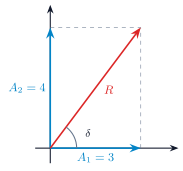
Two SHMs along the same line, \(x_1 = 3\sin\omega t\) and \(x_2 = 4\sin\left(\omega t + \frac{\pi}{2}\right)\), act on a particle. Here \(x\) is in centimetres. Find the amplitude and the phase of the resultant motion. Take \(\tan^{-1}\frac{4}{3} = 53^\circ\).
Answer\(5\) cm; \(53^\circ\) ahead of \(x_1\)
Solution
Same frequency, phase difference \(\dfrac{\pi}{2}\): \(R = \sqrt{3^2 + 4^2 + 2 \times 3 \times 4\cos 90^\circ} = 5\) cm.
\(\tan\delta = \dfrac{4\sin 90^\circ}{3 + 4\cos 90^\circ} = \dfrac{4}{3}\), so \(\delta = 53^\circ\). \(x = 5\sin(\omega t + 53^\circ)\).
How did it go?
Q2
Two collinear SHMs have the same amplitude \(A\) and frequency, with a phase difference \(\phi\). Write the resultant amplitude and find it for
\(\phi = 60^\circ\),
\(\phi = 90^\circ\),
\(\phi = 180^\circ\).
Answer\(2A\cos\frac{\phi}{2}\); (i) \(\sqrt{3}A\) (ii) \(\sqrt{2}A\) (iii) \(0\)
Why can SHMs of the same frequency be added like vectors?
Draw the phasor diagram for two SHMs of amplitude \(4\) cm with a phase difference of \(120^\circ\), and find the resultant amplitude.
Answer(i) phasors turn together at \(\omega\) (ii) \(4\) cm
Solution
Each SHM is the projection of a rotating phasor. Two phasors of the same \(\omega\) keep a fixed angle between them, so they rotate together as a rigid pair. The projection of their vector sum is the sum of the projections.
Two phasors of length \(4\) at \(120^\circ\): \(R = 2 \times 4\cos 60^\circ = 4\) cm. The resultant bisects the angle, \(60^\circ\) from each.
How did it go?
Q4
Find the resultant of \(x_1 = 5\sin\omega t\) and \(x_2 = 5\sin\left(\omega t + \frac{2\pi}{3}\right)\) in the form \(x = R\sin(\omega t + \delta)\).
Answer\(x = 5\sin(\omega t + \frac{\pi}{3})\)
Solution
\(R = 2 \times 5\cos 60^\circ = 5\) cm, and the resultant lies midway in phase: \(\delta = \dfrac{\pi}{3}\).
\(x = 5\sin\left(\omega t + \dfrac{\pi}{3}\right)\). Check with the formula: \(\tan\delta = \dfrac{5\sin 120^\circ}{5 + 5\cos 120^\circ} = \dfrac{\sqrt{3}/2}{1/2} = \sqrt{3}\).
How did it go?
Q5
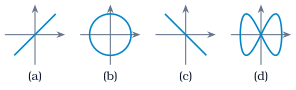
A particle has two perpendicular SHMs, \(x = A\sin\omega t\) along \(x\) and one of the following along \(y\). Match each to a path in the figure.
\(y = A\sin\omega t\)
\(y = A\cos\omega t\)
\(y = A\sin(\omega t + \pi)\)
\(y = A\sin 2\omega t\)
Answer(i) a (ii) b (iii) c (iv) d
Solution
\(y = x\) at every instant: the straight line (a).
\(x^2 + y^2 = A^2\): the circle (b).
\(y = -x\): the line of negative slope (c).
\(y\) completes two oscillations while \(x\) completes one: the figure of eight (d), a Lissajous figure.
How did it go?
Q6
Show that \(x = A\sin\omega t\) and \(y = A\cos\omega t\) together give motion on a circle of radius \(A\). What path results if the \(y\)-amplitude is \(B \ne A\)?
Answer\(x^2 + y^2 = A^2\); ellipse
Solution
\(x^2 + y^2 = A^2\sin^2\omega t + A^2\cos^2\omega t = A^2\): every point of the path is at distance \(A\) from the origin, a circle.
With \(y = B\cos\omega t\): \(\dfrac{x^2}{A^2} + \dfrac{y^2}{B^2} = 1\), an ellipse with semi-axes \(A\) and \(B\) along the axes.
How did it go?
Q7
Two collinear SHMs of equal amplitude have frequencies \(10\) Hz and \(12\) Hz. Describe the resultant motion. How many times per second does its amplitude become zero?
Answerbeats at \(11\) Hz; \(2\) times
Solution
The sum is \(2A\cos(2\pi \times 1\,t)\sin(2\pi \times 11\,t)\): an oscillation at the average frequency \(11\) Hz whose amplitude swells and fades at \(1\) Hz. These are beats.
The amplitude \(2A\cos(2\pi t)\) is zero twice in every second, at \(t = 0.25\) s and \(0.75\) s. So the motion dies away \(2\) times per second: the beat frequency is \(12 - 10 = 2\) Hz.
How did it go?
Damped oscillations
Q8
A block of mass \(m\) on a spring of stiffness \(k\) moves through a fluid that resists with a force \(-bv\).
Write the equation of motion. What is the SI unit of \(b\)?
For light damping the amplitude is \(A(t) = A_0 e^{-bt/2m}\). What does "light damping" mean?
\(m\dfrac{d^2x}{dt^2} = -kx - b\dfrac{dx}{dt}\). \(b\) is force per unit speed: N/(m/s) \(=\) kg/s.
Light damping means the damping rate \(\dfrac{b}{2m}\) is much smaller than \(\omega_0 = \sqrt{k/m}\). The system then makes many oscillations before the amplitude falls appreciably, and the frequency is almost unchanged.
How did it go?
Q9
A damped oscillator has \(m = 0.5\) kg and \(b = 0.1\) kg/s. Take \(\ln 2 = 0.69\). Find the time in which the amplitude falls to half its initial value.
The energy of the oscillator of Question 9 is proportional to the square of the amplitude. Show that the energy falls as \(e^{-bt/m}\) and find the time in which it halves.
Answer\(3.45\) s
Solution
\(E \propto A^2 = A_0^2 e^{-bt/m}\), so \(E = E_0 e^{-bt/m}\): the energy decays twice as fast as the amplitude.
\(\dfrac{b}{m} = 0.2\) s\(^{-1}\); \(E\) halves when \(0.2t = 0.69\), \(t = 3.45\) s, half the time of Question 9.
How did it go?
Q11
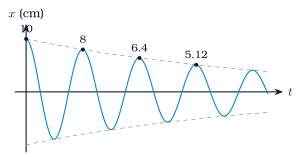
The figure shows a damped oscillation with successive maxima marked. Take \(\ln 1.25 = 0.22\).
Find the ratio of successive amplitudes.
The logarithmic decrement is \(\delta = \ln\frac{A_n}{A_{n+1}}\). Find \(\delta\).
Find the amplitude five oscillations after the \(5.12\) cm maximum. Take \(0.8^5 = 0.33\).
Answer(i) \(0.8\) (ii) \(0.22\) (iii) \(\approx 1.7\) cm
Solution
\(\dfrac{8}{10} = \dfrac{6.4}{8} = \dfrac{5.12}{6.4} = 0.8\). Each cycle the amplitude falls to \(0.8\) of its value.
\(\delta = \ln\dfrac{10}{8} = \ln 1.25 = 0.22\).
Five more cycles multiply the amplitude by \(0.8^5 = 0.33\): \(5.12 \times 0.33 \approx 1.7\) cm.
How did it go?
Q12
The energy of a damped oscillator obeys \(E = E_0 e^{-bt/m}\). Show that the power lost to the damping force is \(P = \frac{b}{m}E\). Find \(P\) when \(E = 2\) J for the oscillator of Question 9.
Answer\(0.4\) W
Solution
\(P = -\dfrac{dE}{dt} = \dfrac{b}{m}E_0 e^{-bt/m} = \dfrac{b}{m}E\). The power lost is proportional to the energy that remains.
\(P = 0.2 \times 2 = 0.4\) W.
How did it go?
Q13
The oscillator of Question 9 has \(k = 50\) N/m. Its damped angular frequency is \(\omega' = \sqrt{\omega_0^2 - \gamma^2}\) with \(\gamma = \frac{b}{2m}\).
Find \(\omega_0\), \(\gamma\) and \(\omega'\). Does the damping change the frequency much?
Find the value of \(b\) for which the damping just stops the oscillation (critical damping). Where is critical damping wanted?
Answer(i) \(10\), \(0.1\), \(\approx 10\) rad/s; no (ii) \(10\) kg/s
The change is one part in twenty thousand: light damping leaves the frequency practically unchanged.
Critical damping: \(\gamma = \omega_0\), so \(\dfrac{b}{2m} = 10\) and \(b = 2m\omega_0 = 10\) kg/s.
A critically damped system returns to rest in the shortest time without overshooting. It is wanted in car shock absorbers, meter needles and door closers.
How did it go?
Q14
A pendulum swinging in air slowly comes to rest. Where does its energy go? Why does a pendulum clock keep swinging?
Answerheat in air and pivot; driven by the spring
Solution
Air resistance and friction at the pivot do negative work on the bob. The energy becomes heat in the air and the support, and the amplitude decays.
In a clock a wound spring (or a falling weight) gives the pendulum a small push every swing through the escapement. This supplies exactly the energy lost, so the amplitude stays constant. The pendulum is a driven oscillator.
How did it go?
Forced oscillations and resonance
Q15
A force \(F_0\cos\omega t\) drives the oscillator of Question 13 (\(m = 0.5\) kg, \(b = 0.1\) kg/s, \(\omega_0 = 10\) rad/s). In the steady state its amplitude is \(A = \frac{F_0/m}{\sqrt{(\omega_0^2 - \omega^2)^2 + (b\omega/m)^2}}\).
At what frequency does it oscillate in the steady state?
Find the amplitude at resonance, \(\omega = \omega_0\), for \(F_0 = 0.01\) N.
Answer(i) driving frequency (ii) \(1\) cm
Solution
At the driving frequency \(\omega\), not at \(\omega_0\). After the initial transient dies away, the oscillator follows the force.
At \(\omega = \omega_0\) the first term under the root vanishes: \(A = \dfrac{F_0/m}{b\omega_0/m} = \dfrac{F_0}{b\omega_0} = \dfrac{0.01}{0.1 \times 10} = 0.01\) m \(= 1\) cm.
How did it go?
Q16
For the driven oscillator of Question 15, find the amplitude when \(\omega\) is very small compared with \(\omega_0\). Compare it with the resonance amplitude. What happens when \(\omega\) is very large?
Answer\(0.2\) mm, \(50\) times smaller; amplitude tends to zero
Solution
For \(\omega \ll \omega_0\): \(A \approx \dfrac{F_0/m}{\omega_0^2} = \dfrac{F_0}{k} = \dfrac{0.01}{50} = 2 \times 10^{-4}\) m \(= 0.2\) mm, the static stretch under \(F_0\).
The resonance amplitude, \(1\) cm, is \(50\) times larger. This factor \(\dfrac{m\omega_0}{b} = 50\) measures the sharpness of the resonance.
For \(\omega \gg \omega_0\): \(A \approx \dfrac{F_0}{m\omega^2} \to 0\). The mass cannot follow a very fast force.
How did it go?
Q17
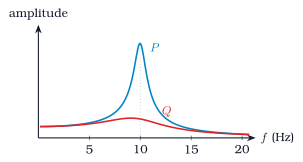
The figure shows the amplitude of a driven oscillator against the driving frequency for two amounts of damping.
Read the natural frequency of the oscillator.
Which curve has the lighter damping? Give the reason.
Why does the peak of \(Q\) lie slightly below \(10\) Hz?
Answer(i) \(10\) Hz (ii) \(P\), taller and sharper (iii) damping lowers the peak frequency
Solution
The sharp peak is at \(10\) Hz: the natural frequency.
\(P\). With less damping the amplitude at resonance \(\dfrac{F_0}{b\omega_0}\) is larger and the peak is narrower.
Heavy damping shifts the maximum of the amplitude formula to a frequency a little below \(\omega_0\). The reason is that the damping term \(b\omega/m\) grows with \(\omega\).
How did it go?
Q18
What is resonance? Give two examples where resonance is useful and one where it is dangerous.
Answerdriving frequency \(=\) natural frequency
Solution
Resonance is the large response of an oscillator driven at, or very near, its natural frequency. The energy is then fed in step with the motion.
Useful: tuning a radio, where the circuit resonates with the chosen station. Pushing a swing in time with its motion. The resonance column used to find the speed of sound.
Dangerous: soldiers marching in step can set a bridge into resonance, which is why they break step. Wind set the Tacoma Narrows bridge oscillating until it broke.
How did it go?
Multi-concept archetypes
Q19
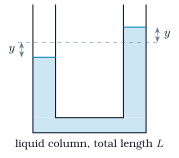
A liquid column of total length \(L = 0.5\) m fills a U-tube of uniform cross-section \(A\). The liquid is displaced so that one surface is \(y\) above its rest level. Take \(g = 10\) m/s\(^2\) and \(\pi^2 = 10\).
Find the restoring force on the whole column in terms of \(\rho\), \(A\), \(g\) and \(y\).
Show that the motion is SHM with \(T = 2\pi\sqrt{L/2g}\), and find \(T\).
Answer(i) \(-2\rho A g y\) (ii) \(1\) s
Solution
One surface is \(y\) up and the other \(y\) down, so the level difference is \(2y\). The unbalanced column of height \(2y\) has weight \(\rho A(2y)g\), which pushes the liquid back: \(F = -2\rho A g y\).
The whole column of mass \(\rho A L\) moves: \(\rho A L\,a = -2\rho A g y\), so \(a = -\dfrac{2g}{L}y\): SHM with \(\omega^2 = \dfrac{2g}{L}\) and \(T = 2\pi\sqrt{\dfrac{L}{2g}}\).
A cylinder floats upright in a liquid with a length \(h = 0.1\) m submerged. It is pushed down a little and released. Show that \(T = 2\pi\sqrt{h/g}\), and find \(T\). Take \(\pi^2 = 10\).
Answer\(0.2\pi \approx 0.63\) s
Solution
Pushing the cylinder down by \(y\) submerges an extra volume \(Ay\) and adds a buoyant force \(\rho_L A g y\) upward, a restoring force \(-\rho_L A g y\).
The mass of the cylinder equals the mass of the liquid it displaces at rest, \(\rho_L A h\). So \(\rho_L A h\,a = -\rho_L A g y\), \(a = -\dfrac{g}{h}y\), and \(T = 2\pi\sqrt{\dfrac{h}{g}}\), like a pendulum of length \(h\).
\(T = 2\pi\sqrt{0.01} = 0.2\pi \approx 0.63\) s.
How did it go?
Q21
A straight tunnel is bored through the centre of the Earth (\(R = 6.4 \times 10^{6}\) m). Inside a uniform Earth the gravitational acceleration at distance \(x\) from the centre is \(g\,x/R\). A stone is dropped into the tunnel.
Why is the motion simple harmonic?
Find the period. Take \(\pi = 3.14\).
Answer(i) \(a = -(g/R)x\) (ii) \(\approx 5000\) s \(\approx 84\) min
Solution
The acceleration \(g\dfrac{x}{R}\) is proportional to the distance from the centre and always directed towards the centre. So \(a = -\dfrac{g}{R}x\), the defining equation of SHM with \(\omega^2 = \dfrac{g}{R}\).