Questions on Introduction to Waves, the kind your examinations ask. Solve one on paper. Then tell the book how it went. The book believes you, and it uses your answer to plan your revision.
0%
Nothing marked yetMark honestly. Peek at the answer only after your own attempt.
Wave Equation and Wave Kinematics
24 questions · after Lesson 5, Harmonic Waves
Reading the harmonic wave equation
Q1
The displacement of a wave on a string is \(y = 0.05\sin(20\pi t - 4\pi x)\). Here \(x\) and \(y\) are in metres and \(t\) is in seconds.
Write the amplitude \(A\), the angular frequency \(\omega\) and the wave number \(k\).
Find the frequency \(f\), the time period \(T\) and the wavelength \(\lambda\).
Find the wave speed \(v\). State the direction in which the wave travels.
Answer(i) \(0.05\) m, \(20\pi\) rad/s, \(4\pi\) rad/m (ii) \(10\) Hz, \(0.1\) s, \(0.5\) m (iii) \(5\) m/s, along \(+x\)
Solution
Compare \(y = 0.05\sin(20\pi t - 4\pi x)\) with the standard form \(y = A\sin(\omega t - kx)\).
The phase is \((\omega t - kx)\). The signs of \(t\) and \(x\) are opposite. So the wave travels along \(+x\).
How did it go?
Q2
A wave is given by \(y = 2\sin(0.4\pi x + 100\pi t)\). Here \(x\) and \(y\) are in centimetres and \(t\) is in seconds. Find the wavelength, the frequency, the wave speed and the direction of travel.
Answer\(\lambda = 5\) cm, \(f = 50\) Hz, \(v = 2.5\) m/s, along \(-x\)
Solution
Compare \(y = 2\sin(0.4\pi x + 100\pi t)\) with \(y = A\sin(kx + \omega t)\).
\(k = 0.4\pi\) rad/cm, so \(\lambda = \dfrac{2\pi}{k} = \dfrac{2\pi}{0.4\pi} = 5\) cm.
\(\omega = 100\pi\) rad/s, so \(f = \dfrac{\omega}{2\pi} = 50\) Hz.
Phase at \(x = 1\) m, \(t = 0.1\) s: \(2\pi\left(\dfrac{0.1}{0.2} - \dfrac{1}{4}\right) = 2\pi(0.5 - 0.25) = \dfrac{\pi}{2}\).
\(y = 0.1\sin\dfrac{\pi}{2} = 0.1\) m. The particle is at its highest point at this moment.
How did it go?
Q5
Write the equation of a wave with amplitude \(3\) cm, frequency \(25\) Hz and speed \(10\) m/s. The wave travels along \(+x\). At \(t = 0\), the particle at \(x = 0\) is at \(y = 0\) and is moving upward.
Answer\(y = 0.03\sin(50\pi t - 5\pi x)\) (SI)
Solution
Wavelength: \(\lambda = \dfrac{v}{f} = \dfrac{10}{25} = 0.4\) m.
Angular frequency: \(\omega = 2\pi f = 50\pi\) rad/s.
The wave travels along \(+x\), so the phase is \((\omega t - kx)\). Write \(y = 0.03\sin(50\pi t - 5\pi x)\) with \(y\) in metres.
Check the starting condition. At \(x = 0\), \(t = 0\): \(y = 0.03\sin 0 = 0\). The particle velocity is \(v_p = \dfrac{\partial y}{\partial t} = 0.03 \times 50\pi\cos(0) > 0\). So the particle moves upward. The equation is correct.
How did it go?
f, lambda, v relations
Q6
A wave has frequency \(4\) Hz and wavelength \(0.5\) m. Find the wave speed \(v\), the time period \(T\), the wave number \(k\) and the angular frequency \(\omega\).
A wave of frequency \(50\) Hz travels from a thin string into a thick string. The wave speed is \(300\) m/s in the thin string and \(150\) m/s in the thick string. The frequency does not change.
Find the wavelength in each string.
Which of \(f\), \(v\) and \(\lambda\) is decided by the source, and which by the string?
Answer(i) \(6\) m; \(3\) m (ii) \(f\): source; \(v\): string; \(\lambda = v/f\)
Solution
Use \(\lambda = \dfrac{v}{f}\) in each string.
Thin string: \(\lambda_1 = \dfrac{300}{50} = 6\) m. Thick string: \(\lambda_2 = \dfrac{150}{50} = 3\) m.
The frequency \(f\) is decided by the source that shakes the string. The frequency stays the same when the wave enters a new string.
The wave speed \(v\) is decided by the string (its tension and its mass per unit length).
The wavelength then follows from \(\lambda = v/f\). When \(v\) becomes half, \(\lambda\) also becomes half.
How did it go?
Reading graphs
Q8
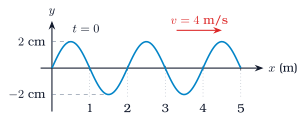
The figure shows a wave on a string at \(t = 0\). The wave moves along \(+x\) with speed \(4\) m/s.
Read the wavelength and the amplitude from the figure.
Find the frequency and the time period.
Write the equation \(y(x, t)\) of the wave.
Answer(i) \(\lambda = 2\) m, \(A = 2\) cm (ii) \(2\) Hz, \(0.5\) s (iii) \(y = 0.02\sin(\pi x - 4\pi t)\)
Solution
Crests are at \(x = 0.5\) m and \(x = 2.5\) m. The distance between neighbouring crests is the wavelength: \(\lambda = 2\) m.
The highest displacement is \(2\) cm, so \(A = 2\) cm \(= 0.02\) m.
\(f = \dfrac{v}{\lambda} = \dfrac{4}{2} = 2\) Hz. \(T = \dfrac{1}{f} = 0.5\) s.
\(k = \dfrac{2\pi}{\lambda} = \pi\) rad/m and \(\omega = 2\pi f = 4\pi\) rad/s.
At \(t = 0\) the figure is \(y = 0.02\sin(\pi x)\): check \(x = 0.5\) m gives \(\sin(\pi/2) = 1\), a crest.
The wave moves along \(+x\), so the phase is \((kx - \omega t)\). Therefore \(y = 0.02\sin(\pi x - 4\pi t)\), in SI units.
How did it go?
Q9
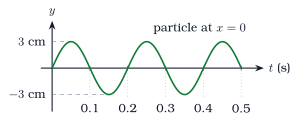
The figure shows the displacement of the particle at \(x = 0\) against time. The wave travels along \(+x\) with speed \(10\) m/s.
Read the amplitude and the time period from the figure.
Find \(f\), \(\omega\), \(\lambda\) and \(k\).
Write the equation of the wave.
Answer(i) \(3\) cm, \(0.2\) s (ii) \(5\) Hz, \(10\pi\) rad/s, \(2\) m, \(\pi\) rad/m (iii) \(y = 0.03\sin(10\pi t - \pi x)\)
Solution
The graph reaches \(3\) cm, so \(A = 3\) cm \(= 0.03\) m.
The graph repeats after \(0.2\) s, so \(T = 0.2\) s.
\(f = \dfrac{1}{T} = 5\) Hz. \(\omega = 2\pi f = 10\pi\) rad/s.
At \(x = 0\) the graph is \(y = 0.03\sin(10\pi t)\): it starts at zero and rises.
The wave travels along \(+x\), so \(y = 0.03\sin(10\pi t - \pi x)\), in SI units. Put \(x = 0\) to check that the equation gives the graph.
How did it go?
Q10
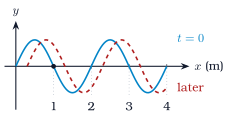
The solid curve shows a wave at \(t = 0\). The dashed curve shows the same wave a short time later.
In which direction does the wave travel? Give the reason.
Just after \(t = 0\), does the particle at \(x = 1\) m (the dot) move up or move down?
Answer(i) along \(+x\) (ii) up
Solution
Every crest of the dashed curve is to the right of the matching crest of the solid curve. The whole shape has moved towards \(+x\).
So the wave travels along \(+x\).
At \(x = 1\) m the solid curve is at \(y = 0\) and is going down to the right: the slope is negative.
Slope rule for a wave along \(+x\): \(v_p = -v\dfrac{\partial y}{\partial x}\). A negative slope gives a positive \(v_p\). The particle moves up.
Check with the figure: at \(x = 1\) m the dashed curve is above the axis. The particle has indeed moved up.
How did it go?
Phase difference
Q11
The wavelength of a wave is \(2\) m. Find the phase difference between two particles that are
\(0.5\) m apart,
\(1\) m apart,
\(2\) m apart.
Answer(i) \(\pi/2\) (ii) \(\pi\) (iii) \(2\pi\) (in phase)
Solution
Two points a distance \(\Delta x\) apart differ in phase by \(\Delta\phi = \dfrac{2\pi}{\lambda}\Delta x\). Here \(\lambda = 2\) m, so \(\Delta\phi = \pi\,\Delta x\).
\(\Delta x = 0.5\) m: \(\Delta\phi = \dfrac{\pi}{2}\).
\(\Delta x = 1\) m: \(\Delta\phi = \pi\). The two particles always move in opposite directions.
\(\Delta x = 2\) m \(= \lambda\): \(\Delta\phi = 2\pi\). The two particles are in phase; they move exactly together.
How did it go?
Q12
The frequency of a wave is \(5\) Hz. By how much does the phase of one particle change in
\(0.05\) s,
\(0.1\) s,
\(0.2\) s?
Answer(i) \(\pi/2\) (ii) \(\pi\) (iii) \(2\pi\)
Solution
The phase of one particle changes by \(\Delta\phi = \omega\,\Delta t = 2\pi f\,\Delta t\). Here \(f = 5\) Hz, so \(\Delta\phi = 10\pi\,\Delta t\).
\(\Delta t = 0.05\) s: \(\Delta\phi = \dfrac{\pi}{2}\).
\(\Delta t = 0.1\) s: \(\Delta\phi = \pi\).
\(\Delta t = 0.2\) s \(= T\): \(\Delta\phi = 2\pi\). After one full period the particle returns to the same state.
How did it go?
Q13
Two points on a string are \(10\) cm apart. The phase difference between them is \(\frac{\pi}{3}\). Find the wavelength.
Answer\(0.6\) m
Solution
\(\Delta\phi = \dfrac{2\pi}{\lambda}\Delta x\), so \(\lambda = \dfrac{2\pi\,\Delta x}{\Delta\phi}\).
A wave is \(y = 0.02\sin(100\pi t - 2\pi x)\), in SI units.
Find the phase difference between the points \(x = 0.25\) m and \(x = 0.75\) m at the same instant.
Find the change in phase of one particle in a time interval of \(0.005\) s.
At any instant, do the two points in part (i) move in the same direction or in opposite directions?
Answer(i) \(\pi\) (ii) \(\pi/2\) (iii) opposite
Solution
From \(y = 0.02\sin(100\pi t - 2\pi x)\): \(\omega = 100\pi\) rad/s and \(k = 2\pi\) rad/m.
\(\Delta x = 0.75 - 0.25 = 0.5\) m. \(\Delta\phi = k\,\Delta x = 2\pi \times 0.5 = \pi\).
\(\Delta\phi = \omega\,\Delta t = 100\pi \times 0.005 = \dfrac{\pi}{2}\).
A phase difference of \(\pi\) means the two points are always in opposite states. When one is at a crest, the other is at a trough. They move in opposite directions.
How did it go?
Particle velocity and acceleration
Q15
A wave is \(y = 0.05\sin(10\pi t - 2\pi x)\), in SI units. Find:
the maximum particle speed,
the maximum particle acceleration,
the wave speed.
Is the maximum particle speed larger or smaller than the wave speed?
Answer(i) \(0.5\pi \approx 1.57\) m/s (ii) \(5\pi^2 \approx 49.3\) m/s\(^2\) (iii) \(5\) m/s; smaller
Solution
From \(y = 0.05\sin(10\pi t - 2\pi x)\): \(A = 0.05\) m, \(\omega = 10\pi\) rad/s, \(k = 2\pi\) rad/m.
The maximum particle speed (\(1.57\) m/s) is smaller than the wave speed (\(5\) m/s). The particles only move up and down a small distance; the wave shape moves along the string.
How did it go?
Q16
For the wave of Question 15, find the particle velocity and the particle acceleration at \(x = 0.25\) m when \(t = 0.05\) s.
At \(x = 0.25\) m, \(t = 0.05\) s the phase is \(10\pi(0.05) - 2\pi(0.25) = 0.5\pi - 0.5\pi = 0\).
\(v_p = 0.5\pi\cos 0 = 0.5\pi \approx 1.57\) m/s. The sign is positive, so the particle moves upward.
Particle acceleration: \(a_p = -\omega^2 y\). Here \(y = 0.05\sin 0 = 0\), so \(a_p = 0\). The particle is passing through its mean position with maximum speed.
How did it go?
Q17
A wave travels along \(+x\) with speed \(20\) m/s. At one instant, the slope of the string at a point \(P\) is \(\frac{\partial y}{\partial x} = +0.02\).
Find the particle velocity at \(P\). Is the particle moving up or down?
What is the particle velocity at \(P\) if the same wave travels along \(-x\) instead?
Answer(i) \(-0.4\) m/s, down (ii) \(+0.4\) m/s, up
Solution
For a wave along \(+x\): \(v_p = -v\dfrac{\partial y}{\partial x} = -20 \times 0.02 = -0.4\) m/s.
The negative sign means the particle is moving down.
For a wave along \(-x\), \(y = f(x + vt)\), so \(\dfrac{\partial y}{\partial t} = +v\dfrac{\partial y}{\partial x}\).
\(v_p = +20 \times 0.02 = +0.4\) m/s. The particle is moving up.
How did it go?
Q18
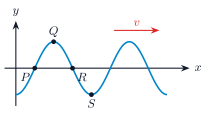
The figure shows a snapshot of a wave moving along \(+x\). Points \(P\) and \(R\) are on the mean position. \(Q\) is at a crest and \(S\) is at a trough.
At this instant, state whether each of \(P\), \(Q\), \(R\), \(S\) moves up, moves down, or is momentarily at rest.
Ratio: \(\dfrac{v_{p,\max}}{v} = \dfrac{A\omega}{\omega/k} = Ak = A \times \dfrac{2\pi}{\lambda} = \dfrac{2\pi A}{\lambda}\).
The two speeds are equal when \(\dfrac{2\pi A}{\lambda} = 1\), that is, \(\lambda = 2\pi A\).
\(\lambda = 2\pi \times 0.5\) cm \(= \pi\) cm \(\approx 3.14\) cm.
How did it go?
General travelling wave f(x - vt)
Q20
A wave is given by \(y = \dfrac{2}{(x - 3t)^2 + 1}\). Here \(x\) and \(y\) are in centimetres and \(t\) is in seconds.
Why does this equation represent a travelling wave?
Find the wave speed and the direction of travel.
Find the maximum displacement. Where is this maximum at \(t = 2\) s?
Answer(i) function of \((x - 3t)\) (ii) \(3\) cm/s, \(+x\) (iii) \(2\) cm, at \(x = 6\) cm
Solution
The displacement depends on \(x\) and \(t\) only through the combination \((x - 3t)\). Any function of \((x - vt)\) is a travelling wave.
Compare \((x - 3t)\) with \((x - vt)\): \(v = 3\) cm/s. The sign is minus, so the wave travels along \(+x\).
The denominator \((x - 3t)^2 + 1\) is smallest when \(x - 3t = 0\). Then \(y_{\max} = \dfrac{2}{1} = 2\) cm.
At \(t = 2\) s the maximum is at \(x = 3 \times 2 = 6\) cm.
How did it go?
Q21
A wave pulse is given by \(y = \dfrac{4}{1 + (2x + 6t)^2}\), in SI units. Find the speed of the pulse and its direction of travel.
Answer\(3\) m/s along \(-x\)
Solution
Take out the factor of \(x\): \(2x + 6t = 2(x + 3t)\).
So \(y = \dfrac{4}{1 + 4(x + 3t)^2}\), a function of \((x + 3t)\).
Compare with \((x + vt)\): the speed is \(3\) m/s and the plus sign means the pulse travels along \(-x\).
How did it go?
Q22
Which of the following can represent a travelling wave? Here \(A\), \(a\) and \(b\) are positive constants. Give the wave speed where possible.
\(y = A\sin(ax)\cos(bt)\)
\(y = A\,e^{-(ax - bt)^2}\)
\(y = A\sin(ax^2 - bt^2)\)
Answer(i) no (ii) yes, \(v = b/a\), \(+x\) (iii) no
Solution
A travelling wave must be a function of \((ax \pm bt)\) only, with \(x\) and \(t\) appearing in this single combination.
\(A\sin(ax)\cos(bt)\) is a product of a function of \(x\) and a function of \(t\). It is a standing wave, not a travelling wave.
\(A\,e^{-(ax - bt)^2}\) depends only on \((ax - bt) = a\left(x - \dfrac{b}{a}t\right)\). It is a travelling wave with speed \(v = \dfrac{b}{a}\) along \(+x\).
\(A\sin(ax^2 - bt^2)\) contains \(x^2\) and \(t^2\) separately, not the combination \((ax \pm bt)\). It is not a travelling wave.
How did it go?
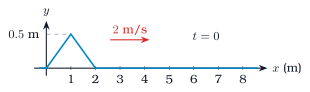
Q23
The figure shows a triangular pulse on a long string at \(t = 0\). The pulse moves along \(+x\) with speed \(2\) m/s.
Where is the peak of the pulse at \(t = 3\) s?
Between which values of \(x\) is the string disturbed at \(t = 3\) s?
The shape at \(t = 0\) is \(y = f(x)\). Write \(y(x, t)\) for any later time \(t\).
Answer(i) \(x = 7\) m (ii) \(6\) m to \(8\) m (iii) \(y = f(x - 2t)\)
Solution
A pulse keeps its shape and moves with the wave speed. In \(3\) s the whole pulse shifts by \(2 \times 3 = 6\) m along \(+x\).
The peak was at \(x = 1\) m. At \(t = 3\) s the peak is at \(x = 1 + 6 = 7\) m.
The pulse occupied \(0 \le x \le 2\) m at \(t = 0\). At \(t = 3\) s the string is disturbed for \(6\) m \(\le x \le 8\) m.
For a shape moving along \(+x\) with speed \(v\): \(y(x, t) = f(x - vt) = f(x - 2t)\).
How did it go?
Q24
At \(t = 0\) a pulse on a string is \(y = \dfrac{3}{x^2 + 4}\), in SI units. The pulse moves along \(-x\) with speed \(5\) m/s.
Write \(y(x, t)\).
Find the displacement at \(x = -10\) m when \(t = 2\) s.
Answer(i) \(y = 3/[(x + 5t)^2 + 4]\) (ii) \(0.75\) m
Solution
The pulse moves along \(-x\) with speed \(5\) m/s, so replace \(x\) by \((x + 5t)\): \(y(x, t) = \dfrac{3}{(x + 5t)^2 + 4}\).
At \(x = -10\) m, \(t = 2\) s: \(x + 5t = -10 + 10 = 0\).
\(y = \dfrac{3}{0 + 4} = 0.75\) m. This is the peak of the pulse, which has reached \(x = -10\) m at this time.