Questions on Propagating Waves on a String, the kind your examinations ask. Solve one on paper. Then tell the book how it went. The book believes you, and it uses your answer to plan your revision.
0%
Nothing marked yetMark honestly. Peek at the answer only after your own attempt.
Speed, Energy and Power of Waves, and the Hanging Rope
24 questions · after Lesson 5, The Power a Wave Carries
Wave speed v = sqrt(T / mu)
Q1
A string of mass \(0.1\) kg and length \(2.5\) m is held at a tension of \(16\) N.
Find the mass per unit length \(\mu\) of the string.
Find the speed \(v\) of a transverse wave on the string.
A source of frequency \(50\) Hz shakes one end. Find the wavelength.
Answer(i) \(0.04\) kg/m (ii) \(20\) m/s (iii) \(0.4\) m
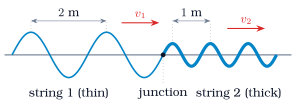
A thin string (string 1) is joined to a thick string (string 2). The figure shows a snapshot of a wave that has crossed the junction. Both strings carry the same tension.
Read the wavelength in each string. In which string is the wave faster?
Find the ratio \(v_1/v_2\) of the wave speeds.
Find the ratio \(\mu_2/\mu_1\) of the masses per unit length.
Answer(i) \(2\) m, \(1\) m; string 1 (ii) \(2\) (iii) \(4\)
Solution
In string 1 the crests are \(2\) m apart: \(\lambda_1 = 2\) m. In string 2 they are \(1\) m apart: \(\lambda_2 = 1\) m.
The frequency is the same in both strings, and \(v = f\lambda\). The longer wavelength means the faster wave. String 1 carries the faster wave.
A rope has a mass per unit length of \(0.1\) kg/m and is held at a tension of \(40\) N. One end is shaken at \(5\) Hz with an amplitude of \(10\) cm. Find the average power carried by the wave.
\(\omega = 2\pi f = 10\pi\) rad/s and \(A = 0.1\) m.
\(P = \dfrac{1}{2}\mu\omega^2 A^2 v = \dfrac{1}{2} \times 0.1 \times (10\pi)^2 \times (0.1)^2 \times 20 = \pi^2 \approx 9.87\) W.
How did it go?
Q12
The average power carried by a wave on a string is \(P\). State the new power when, with everything else unchanged,
the amplitude is doubled,
the frequency is doubled,
the tension is made \(4\) times.
Answer(i) \(4P\) (ii) \(4P\) (iii) \(2P\)
Solution
\(P = \dfrac{1}{2}\mu\omega^2 A^2 v\), with \(\omega = 2\pi f\) and \(v = \sqrt{T/\mu}\).
\(P \propto A^2\). Doubling \(A\) makes the power \(4P\).
\(P \propto f^2\). Doubling \(f\) makes the power \(4P\).
\(P \propto v \propto \sqrt{T}\). Four times the tension doubles \(v\), so the power is \(2P\).
How did it go?
Q13
Consider the wave of Question 11.
Find the average energy per unit length of the rope.
Find the energy contained in one wavelength of the rope.
Find the time in which one wavelength passes a point. Show that this energy divided by this time is the power found in Question 11.
Answer(i) \(0.05\pi^2 \approx 0.49\) J/m (ii) \(0.2\pi^2 \approx 1.97\) J (iii) \(0.2\) s
Solution
Energy per unit length: \(u = \dfrac{1}{2}\mu\omega^2 A^2 = \dfrac{1}{2} \times 0.1 \times (10\pi)^2 \times (0.1)^2 = 0.05\pi^2 \approx 0.49\) J/m.
\(\lambda = \dfrac{v}{f} = \dfrac{20}{5} = 4\) m. Energy in one wavelength: \(E = u\lambda = 0.05\pi^2 \times 4 = 0.2\pi^2 \approx 1.97\) J.
One wavelength passes a point in one time period: \(T = \dfrac{1}{f} = 0.2\) s.
\(\dfrac{E}{T} = \dfrac{0.2\pi^2}{0.2} = \pi^2\) W. This equals the power of Question 11, because \(P = u\,v = u\lambda f\).
How did it go?
Q14
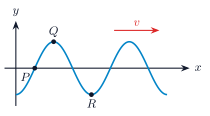
The figure shows a snapshot of a travelling wave. \(P\) is at the mean position, \(Q\) is at a crest and \(R\) is at a trough.
At which of these points is the kinetic energy per unit length the largest? Give the reason.
At which of these points is the string stretched the most, so that the potential energy per unit length is the largest?
What is the total energy per unit length at \(Q\) at this instant?
Answer(i) \(P\) (ii) \(P\) (iii) zero
Solution
At \(P\). A particle at the mean position moves with its maximum speed \(A\omega\). So the kinetic energy per unit length is largest at \(P\).
At \(Q\) and \(R\) the particles are momentarily at rest, so the kinetic energy there is zero.
At \(P\). The slope of the string is steepest at the mean position. A steep piece of string is stretched more than a flat piece.
At a crest or a trough the slope is zero, and the string there is not stretched at all.
Zero. At \(Q\) the kinetic energy is zero (the particle is at rest) and the potential energy is zero (the string is unstretched).
In a travelling wave both energies are largest at the same place, unlike in simple harmonic motion.
How did it go?
Q15
The same source drives two strings held at the same tension. The amplitude and the frequency are the same in both. String 2 has \(4\) times the mass per unit length of string 1. Find the ratio \(P_2/P_1\) of the average powers carried by the two waves.
Answer\(2\)
Solution
\(P = \dfrac{1}{2}\mu\omega^2 A^2 v\) and \(v = \sqrt{T/\mu}\). So \(P = \dfrac{1}{2}\omega^2 A^2\sqrt{\mu T}\).
With the same \(\omega\), \(A\) and \(T\): \(P \propto \sqrt{\mu}\).
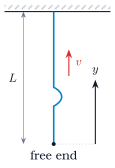
A uniform rope of length \(L = 10\) m and mass per unit length \(0.2\) kg/m hangs from a ceiling. The lower end is free. Distance \(y\) is measured upward from the lower end. Take \(g = 10\) m/s\(^2\).
Find the tension in the rope at \(y = 2.5\) m and at the top.
Find the speed of a transverse pulse at \(y = 2.5\) m and at the top.
Why does the pulse speed change along the rope?
Answer(i) \(5\) N, \(20\) N (ii) \(5\) m/s, \(10\) m/s (iii) tension grows with \(y\)
Solution
The tension at height \(y\) holds up the rope below that point. The mass below is \(\mu y\), so \(T = \mu g y\).
At \(y = 2.5\) m: \(T = 0.2 \times 10 \times 2.5 = 5\) N. At the top (\(y = 10\) m): \(T = 0.2 \times 10 \times 10 = 20\) N.
\(v = \sqrt{T/\mu}\). At \(y = 2.5\) m: \(v = \sqrt{5/0.2} = \sqrt{25} = 5\) m/s. At the top: \(v = \sqrt{20/0.2} = \sqrt{100} = 10\) m/s.
The tension is not the same everywhere. Higher points carry the weight of more rope, so the tension grows with \(y\).
The pulse speed depends on the tension, so the speed grows with \(y\) as well.
How did it go?
Q17
A rope hangs as in Question 16.
Show that the pulse speed at height \(y\) is \(v = \sqrt{gy}\), whatever the mass per unit length.
Show that a pulse takes a time \(t = 2\sqrt{L/g}\) to travel from the lower end to the top.
Find this time for \(L = 10\) m.
Answer(i) \(T = \mu g y\) (ii) \(\int_0^L \frac{dy}{\sqrt{gy}}\) (iii) \(2\) s
Solution
\(T = \mu g y\), so \(v = \sqrt{\dfrac{T}{\mu}} = \sqrt{\dfrac{\mu g y}{\mu}} = \sqrt{gy}\).
The mass per unit length cancels. A thick rope and a thin rope of the same length give the same pulse speed at the same height.
In a small time \(dt\) the pulse climbs \(dy = v\,dt = \sqrt{gy}\,dt\). So \(dt = \dfrac{dy}{\sqrt{gy}}\).
The pulse takes \(1\) s for the lower \(2.5\) m and only \(1\) s more for the upper \(7.5\) m.
How did it go?
Q21
The pulse of Question 17 takes a time \(t_0\) to climb the whole rope. Where is the pulse when half this time has passed? Express the answer as a fraction of \(L\).
Answer\(y = L/4\)
Solution
The time to reach height \(y\) from the lower end is \(t = 2\sqrt{y/g}\). So \(y = \dfrac{g t^2}{4}\): the height grows as the square of the time.
Half the time takes the pulse only a quarter of the way up. For the \(10\) m rope this is \(y = 2.5\) m at \(t = 1\) s, as in Question 20.
How did it go?
Q22
A pulse climbs a hanging rope. Show that the pulse moves with a constant acceleration of \(g/2\). Start from \(v = \sqrt{gy}\).
Answer\(a = g/2\)
Solution
\(v = \sqrt{gy}\), so \(v^2 = gy\). Differentiate with respect to time: \(2v\dfrac{dv}{dt} = g\dfrac{dy}{dt}\).
But \(\dfrac{dy}{dt} = v\), the pulse speed. So \(2v\,a = g\,v\), which gives \(a = \dfrac{g}{2}\).
The acceleration is constant and does not depend on \(y\) or on the rope. A pulse climbing a hanging rope moves like a body with acceleration \(g/2\).
How did it go?
Q23
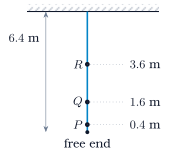
A rope of length \(6.4\) m hangs from a ceiling. The points \(P\), \(Q\) and \(R\) are \(0.4\) m, \(1.6\) m and \(3.6\) m above the free end. Take \(g = 10\) m/s\(^2\).
Find the pulse speed at \(P\), at \(Q\), at \(R\) and at the top.
A pulse is sent downward from the top. Does the pulse speed up or slow down?
Find the time the pulse takes to reach the free end.
Answer(i) \(2\), \(4\), \(6\), \(8\) m/s (ii) slows down (iii) \(1.6\) s
Going down, the pulse passes through smaller tension. The speed falls from \(8\) m/s at the top to zero at the free end. The pulse slows down.
The time down equals the time up: \(t = 2\sqrt{\dfrac{L}{g}} = 2\sqrt{\dfrac{6.4}{10}} = 2 \times 0.8 = 1.6\) s.
How did it go?
Q24
Two pulses start at the same instant on the \(10\) m rope of Question 16, one from the lower end and one from the top. Find where and when they meet. Take \(g = 10\) m/s\(^2\).
Answer\(2.5\) m above the lower end, at \(t = 1\) s
Solution
The pulse from the lower end reaches height \(y\) after \(t_1 = 2\sqrt{y/g}\).
Coming down from the top to \(y\) takes the pulse the same time as climbing from \(y\) to the top. So \(t_2 = 2\sqrt{L/g} - 2\sqrt{y/g}\).
They meet when \(t_1 = t_2\): \(2\sqrt{y/g} = 2\sqrt{L/g} - 2\sqrt{y/g}\), so \(2\sqrt{y} = \sqrt{L}\) and \(y = \dfrac{L}{4} = 2.5\) m.
Time: \(t = 2\sqrt{2.5/10} = 1\) s. The pulses meet \(2.5\) m above the lower end, one second after they start.