Questions on Standing Waves on a String, the kind your examinations ask. Solve one on paper. Then tell the book how it went. The book believes you, and it uses your answer to plan your revision.
0%
Nothing marked yetMark honestly. Peek at the answer only after your own attempt.
Reflection, Interference and Standing Waves
22 questions · after Lesson 4, The Harmonics of a String
Reflection at a boundary and superposition
Q1
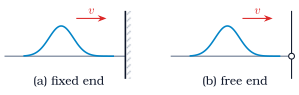
A crest pulse moves along a string towards its end. In figure (a) the end is fixed to a wall. In figure (b) the end is a light ring that slides on a smooth rod.
Draw the reflected pulse in each case: crest or trough?
State the phase change on reflection in each case.
Does the speed or the shape of the pulse change on reflection?
Answer(i) a: trough, b: crest (ii) a: \(\pi\), b: \(0\) (iii) no
Solution
(a) The wall cannot move. The string pulls up on the wall, and the wall pulls down on the string with an equal force. This downward pull sends back a trough. The reflected pulse is an inverted crest, that is, a trough moving left.
(b) The ring is free to slide. The pulse lifts the ring to twice the crest height, and the ring then falls back, sending out a crest. The reflected pulse is a crest moving left.
Fixed end: the pulse is inverted, a phase change of \(\pi\). Free end: the pulse is not inverted, no phase change.
Neither changes. The speed is fixed by the tension and the mass per unit length of the same string. The shape is the same, only turned over in case (a).
How did it go?
Q2
A wave \(y_i = 2\sin(100\pi t - 2\pi x)\) travels along \(+x\) towards the end of a string at \(x = 0\). Here \(x\) is in metres, \(y\) in centimetres and \(t\) in seconds.
Write the reflected wave \(y_r\) if the end is fixed.
Write \(y_r\) if the end is free.
For the fixed end, show that the total displacement at \(x = 0\) is always zero.
Answer(i) \(-2\sin(100\pi t + 2\pi x)\) (ii) the same with \(+2\) (iii) \(y_i + y_r = 0\) at \(x = 0\)
Solution
The reflected wave travels along \(-x\), so its phase is \((100\pi t + 2\pi x)\). The amplitude stays \(2\) cm.
A fixed end inverts the wave: \(y_r = -2\sin(100\pi t + 2\pi x)\). This equals \(2\sin(100\pi t + 2\pi x + \pi)\), a phase change of \(\pi\).
A free end does not invert the wave: \(y_r = 2\sin(100\pi t + 2\pi x)\).
At \(x = 0\): \(y_i + y_r = 2\sin(100\pi t) - 2\sin(100\pi t) = 0\) for every \(t\).
The fixed end is a node. The inversion is exactly what keeps the end at rest.
How did it go?
Q3
Two waves of wavelength \(4\) m start in phase from two sources and meet at a point. Find the phase difference, and say whether the waves cancel or add fully, for a path difference of
\(1\) m,
\(2\) m,
\(4\) m.
Answer(i) \(\pi/2\) (ii) \(\pi\), cancel (iii) \(2\pi\), add fully
Two waves of amplitudes \(3\) cm and \(4\) cm and the same frequency meet at a point.
Find the largest and the smallest possible resultant amplitude.
Find the resultant amplitude for a phase difference of \(\frac{\pi}{2}\).
Find the ratio of the maximum to the minimum intensity.
Answer(i) \(7\) cm, \(1\) cm (ii) \(5\) cm (iii) \(49\)
Solution
\(R = \sqrt{A_1^2 + A_2^2 + 2A_1A_2\cos\phi}\) with \(A_1 = 3\) cm and \(A_2 = 4\) cm.
Largest when \(\phi = 0\): \(R = 3 + 4 = 7\) cm. Smallest when \(\phi = \pi\): \(R = 4 - 3 = 1\) cm.
\(\phi = \dfrac{\pi}{2}\): \(\cos\phi = 0\), so \(R = \sqrt{9 + 16} = 5\) cm.
Intensity is proportional to the square of the amplitude: \(\dfrac{I_{\max}}{I_{\min}} = \left(\dfrac{7}{1}\right)^2 = 49\).
How did it go?
Q6
Two waves \(y_1 = 3\sin(\omega t - kx)\) and \(y_2 = 4\sin(\omega t - kx + \frac{\pi}{2})\) travel together on a string. Here \(y\) is in centimetres. Write the resultant wave in the form \(y = R\sin(\omega t - kx + \delta)\). Take \(\tan^{-1}\frac{4}{3} = 53^\circ\).
Answer\(y = 5\sin(\omega t - kx + 53^\circ)\)
Solution
Both waves have the same \(\omega\) and \(k\), so they add like two phasors at \(90^\circ\).
\(R = \sqrt{3^2 + 4^2} = 5\) cm. The resultant leads \(y_1\) by \(\delta\) with \(\tan\delta = \dfrac{4\sin(\pi/2)}{3 + 4\cos(\pi/2)} = \dfrac{4}{3}\), so \(\delta = 53^\circ\).
\(y = 5\sin(\omega t - kx + 53^\circ)\), with \(y\) in centimetres.
How did it go?
Q7
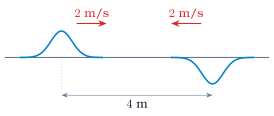
A crest and a trough of the same size and shape move towards each other on a string. Each moves at \(2\) m/s. Their peaks are \(4\) m apart.
After what time do the two pulses overlap completely?
At that instant the string is straight. Where is the energy of the pulses?
What do the pulses look like a long time later?
Answer(i) \(1\) s (ii) kinetic (iii) unchanged shapes
Solution
The peaks close at \(2 + 2 = 4\) m/s. They meet after \(\dfrac{4}{4} = 1\) s.
By superposition the displacements add: crest plus equal trough gives zero everywhere. The string is straight.
The particles are still moving. The energy is entirely kinetic at that instant.
Each pulse passes through the other unchanged. Later the crest is far to the right and the trough far to the left, each with its original shape and speed.
How did it go?
The standing wave equation
Q8
Two waves \(y_1 = 2\sin(\pi x - 50\pi t)\) and \(y_2 = 2\sin(\pi x + 50\pi t)\) travel in opposite directions on a string. Here \(x\) is in metres, \(y\) in centimetres and \(t\) in seconds.
Write the resultant wave. Show that the resultant is a standing wave.
Find the positions of the nodes and of the antinodes for \(x \ge 0\).
Find the amplitude at an antinode and the distance between two neighbouring nodes.
Answer(i) \(4\sin(\pi x)\cos(50\pi t)\) (ii) N at \(0, 1, 2, \ldots\) m (iii) \(4\) cm; \(1\) m
Solution
Use \(\sin C + \sin D = 2\sin\dfrac{C + D}{2}\cos\dfrac{C - D}{2}\).
The \(x\) part and the \(t\) part are separate factors. Each particle oscillates with its own fixed amplitude \(4\sin(\pi x)\). The shape does not travel. This is a standing wave.
Nodes: \(\sin(\pi x) = 0\), so \(\pi x = 0, \pi, 2\pi, \ldots\), that is, \(x = 0, 1, 2, \ldots\) m.
Antinodes: \(\sin(\pi x) = \pm 1\), so \(x = 0.5, 1.5, 2.5, \ldots\) m.
At an antinode the amplitude is \(4\) cm, twice the amplitude of each travelling wave.
Neighbouring nodes are \(\dfrac{\lambda}{2}\) apart. Here \(k = \pi\), so \(\lambda = 2\) m and the node spacing is \(1\) m.
How did it go?
Q9
A standing wave on a string is \(y = 3\sin(0.5\pi x)\cos(100\pi t)\). Here \(x\) and \(y\) are in centimetres and \(t\) is in seconds.
Find the wavelength, the frequency and the wave speed.
Find the positions of the nodes and the antinodes between \(x = 0\) and \(x = 8\) cm.
Find the amplitude of the particle at \(x = \frac{1}{3}\) cm.
Answer(i) \(4\) cm, \(50\) Hz, \(2\) m/s (ii) N at even cm, A at odd cm (iii) \(1.5\) cm
Solution
Compare with \(y = 2A\sin(kx)\cos(\omega t)\): \(2A = 3\) cm, \(k = 0.5\pi\) rad/cm, \(\omega = 100\pi\) rad/s.
\(\lambda = \dfrac{2\pi}{k} = \dfrac{2\pi}{0.5\pi} = 4\) cm. \(f = \dfrac{\omega}{2\pi} = 50\) Hz.
Nodes where \(\sin(0.5\pi x) = 0\): \(x = 0, 2, 4, 6, 8\) cm. Antinodes halfway between: \(x = 1, 3, 5, 7\) cm.
Amplitude at \(x\): \(3\sin(0.5\pi x)\). At \(x = \dfrac{1}{3}\) cm: \(3\sin\dfrac{\pi}{6} = 3 \times \dfrac{1}{2} = 1.5\) cm.
How did it go?
Q10
Answer for a standing wave on a string, with a reason in each case.
Do all the particles have the same amplitude?
Compare the phases of the particles in one loop, and in two neighbouring loops.
Does the standing wave carry energy along the string?
Answer(i) no (ii) same phase; opposite phase (iii) no
Solution
No. The amplitude is \(2A\sin(kx)\), which depends on the position. Particles at the nodes never move; particles at the antinodes move the most.
All particles in one loop have the same sign of \(\sin(kx)\). They reach their extreme positions together and pass through the mean position together: they are in phase.
In the next loop \(\sin(kx)\) has the opposite sign. Those particles are in opposite phase, a phase difference of \(\pi\).
No. A node never moves, so no energy can pass through a node. The energy of each loop stays in that loop and changes between kinetic and potential.
How did it go?
Q11
In a standing wave on a string, neighbouring nodes are \(25\) cm apart. The wave speed on the string is \(100\) m/s.
Find the wavelength.
Find the frequency.
Find the distance from a node to the nearest antinode.
Answer(i) \(50\) cm (ii) \(200\) Hz (iii) \(12.5\) cm
Solution
Node spacing is \(\dfrac{\lambda}{2}\). So \(\lambda = 2 \times 25 = 50\) cm.
\(f = \dfrac{v}{\lambda} = \dfrac{100}{0.5} = 200\) Hz.
An antinode lies halfway between two nodes: \(\dfrac{\lambda}{4} = 12.5\) cm from a node.
How did it go?
Q12
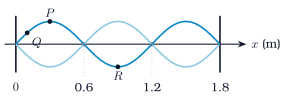
The figure shows a string of length \(1.8\) m fixed at both ends and vibrating in three loops. The amplitude at an antinode is \(4\) cm. \(P\) and \(R\) are at antinodes. \(Q\) is at \(x = 0.1\) m. The wave speed on the string is \(60\) m/s.
Find the wavelength and the frequency.
Find the amplitude of the particle at \(Q\).
State the phase difference between \(P\) and \(Q\), and between \(P\) and \(R\).
Answer(i) \(1.2\) m, \(50\) Hz (ii) \(2\) cm (iii) \(0\); \(\pi\)
Solution
Three loops fill \(1.8\) m. One loop is \(\dfrac{\lambda}{2}\), so \(\dfrac{3\lambda}{2} = 1.8\) m and \(\lambda = 1.2\) m.
\(f = \dfrac{v}{\lambda} = \dfrac{60}{1.2} = 50\) Hz.
Amplitude at \(x\): \(4\sin(kx)\) with \(k = \dfrac{2\pi}{1.2}\) rad/m. At \(x = 0.1\) m: \(kx = \dfrac{2\pi \times 0.1}{1.2} = \dfrac{\pi}{6}\).
Amplitude at \(Q\): \(4\sin\dfrac{\pi}{6} = 2\) cm.
\(P\) and \(Q\) are in the same loop: phase difference \(0\). \(P\) and \(R\) are in neighbouring loops: phase difference \(\pi\).
When \(P\) is at its highest point, \(Q\) is at its highest point (only \(2\) cm up) and \(R\) is at its lowest point.
How did it go?
Q13
The standing wave of Question 8 is \(y = 4\sin(\pi x)\cos(50\pi t)\).
Find the time period and the first two instants after \(t = 0\) at which the whole string is straight.
In what form is the energy of the string at those instants?
Answer(i) \(0.04\) s; \(0.01\) s, \(0.03\) s (ii) all kinetic
Solution
\(\omega = 50\pi\) rad/s, so \(T = \dfrac{2\pi}{\omega} = 0.04\) s.
The string is straight when \(\cos(50\pi t) = 0\): \(50\pi t = \dfrac{\pi}{2}, \dfrac{3\pi}{2}\), that is, \(t = 0.01\) s and \(t = 0.03\) s.
The string is straight twice in every period, at \(\dfrac{T}{4}\) and \(\dfrac{3T}{4}\).
At those instants every particle is passing through its mean position with its maximum speed. The energy is entirely kinetic.
How did it go?
String fixed at both ends
Q14
A string of length \(1\) m is fixed at both ends. The wave speed on the string is \(200\) m/s.
Find the fundamental wavelength and frequency.
Find the second and the third harmonic frequencies.
Answer(i) \(2\) m, \(100\) Hz (ii) \(200\) Hz, \(300\) Hz
Solution
In the fundamental mode the string is one loop: \(L = \dfrac{\lambda}{2}\), so \(\lambda = 2L = 2\) m.
\(f_1 = \dfrac{v}{\lambda} = \dfrac{200}{2} = 100\) Hz. In general \(f_1 = \dfrac{v}{2L}\).
\(f_n = n f_1\): \(f_2 = 200\) Hz and \(f_3 = 300\) Hz.
How did it go?
Q15
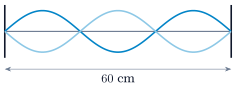
A string of length \(60\) cm is fixed at both ends. The figure shows the string vibrating in three loops at a frequency of \(300\) Hz.
Find the wavelength and the wave speed.
Find the fundamental frequency of the string.
Which harmonic and which overtone is this mode?
Answer(i) \(40\) cm, \(120\) m/s (ii) \(100\) Hz (iii) 3rd; 2nd overtone
Solution
Three loops: \(\dfrac{3\lambda}{2} = 60\) cm, so \(\lambda = 40\) cm \(= 0.4\) m.
For \(150\) Hz: \(\dfrac{T'}{T} = \left(\dfrac{150}{100}\right)^2 = 2.25\). The tension must become \(2.25\) times.
How did it go?
Q18
A string of length \(2\) m is fixed at both ends. The wave speed is \(80\) m/s. The string vibrates in its fourth harmonic with an amplitude of \(2\) cm at the antinodes.
Find the wavelength and the frequency of this mode.
Write the equation of the standing wave, in SI units. Take a node at \(x = 0\).
List the positions of all the nodes.
Answer(i) \(1\) m, \(80\) Hz (ii) \(0.02\sin(2\pi x)\cos(160\pi t)\) (iii) \(0, 0.5, \ldots, 2\) m
Solution
Fourth harmonic: four loops, \(L = 4 \times \dfrac{\lambda}{2}\), so \(\lambda = \dfrac{2L}{4} = 1\) m.
\(f = \dfrac{v}{\lambda} = \dfrac{80}{1} = 80\) Hz.
\(k = \dfrac{2\pi}{\lambda} = 2\pi\) rad/m and \(\omega = 2\pi f = 160\pi\) rad/s. The antinode amplitude is \(0.02\) m.
\(y = 0.02\sin(2\pi x)\cos(160\pi t)\). Check: \(x = 0\) and \(x = 2\) m give \(\sin(2\pi x) = 0\), nodes at both fixed ends.
Nodes every \(\dfrac{\lambda}{2} = 0.5\) m: \(x = 0, 0.5, 1, 1.5, 2\) m.
How did it go?
Q19
A string of length \(1\) m fixed at both ends vibrates as \(y = 0.5\sin(3\pi x)\cos(600\pi t)\). Here \(x\) is in metres, \(y\) in centimetres and \(t\) in seconds.
Which harmonic is this?
Find the wave speed.
Find the fundamental frequency.
Answer(i) 3rd (ii) \(200\) m/s (iii) \(100\) Hz
Solution
Compare with \(y = 2A\sin(kx)\cos(\omega t)\): \(k = 3\pi\) rad/m and \(\omega = 600\pi\) rad/s.
\(\lambda = \dfrac{2\pi}{k} = \dfrac{2}{3}\) m. Number of loops \(= \dfrac{L}{\lambda/2} = \dfrac{1}{1/3} = 3\). This is the third harmonic.
The fixed end is a node and the free end is an antinode. The simplest mode is a quarter wavelength: \(L = \dfrac{\lambda}{4}\), so \(\lambda = 4\) m.
\(f_1 = \dfrac{v}{4L} = \dfrac{200}{4} = 50\) Hz.
Only odd multiples are allowed: \(f = (2n - 1)f_1\). The next two are \(3f_1 = 150\) Hz and \(5f_1 = 250\) Hz.
A node at one end and an antinode at the other need an odd number of quarter wavelengths: \(L = (2n - 1)\dfrac{\lambda}{4}\).
An even harmonic would need a whole number of half wavelengths, which puts a node at both ends. The free end cannot be a node.
How did it go?
Q21
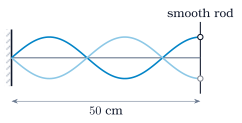
A string of length \(50\) cm is fixed at the left end. The right end carries a light ring on a smooth rod. The figure shows one mode of vibration. The wave speed is \(80\) m/s.
Find the wavelength of this mode.
Find its frequency and the fundamental frequency.
Which harmonic and which overtone is this mode?
Answer(i) \(40\) cm (ii) \(200\) Hz, \(40\) Hz (iii) 5th; 2nd overtone
Solution
Count the quarter wavelengths from the node at the wall to the antinode at the ring: there are five. \(L = \dfrac{5\lambda}{4}\), so \(\lambda = \dfrac{4 \times 50}{5} = 40\) cm.
\(f = \dfrac{v}{\lambda} = \dfrac{80}{0.4} = 200\) Hz.
\(200\) Hz \(= 5f_1\): the fifth harmonic. The allowed modes are \(f_1, 3f_1, 5f_1, \ldots\), so this is the second overtone.
How did it go?
Q22
A string fixed at one end and free at the other resonates at \(150\) Hz and \(250\) Hz, with nothing in between.
Find the fundamental frequency.
Which harmonics are these?
Find the length if the wave speed is \(100\) m/s.
Answer(i) \(50\) Hz (ii) 3rd, 5th (iii) \(0.5\) m
Solution
For one end free, the resonant frequencies are \(f_1, 3f_1, 5f_1, \ldots\). Consecutive ones differ by \(2f_1\).
\(2f_1 = 250 - 150 = 100\) Hz, so \(f_1 = 50\) Hz.
\(150 = 3 \times 50\) and \(250 = 5 \times 50\): the third and the fifth harmonics.
\(f_1 = \dfrac{v}{4L}\), so \(L = \dfrac{v}{4f_1} = \dfrac{100}{200} = 0.5\) m.
How did it go?
Sonometer, Melde's Experiment and Transmission
23 questions · after Lesson 5, The Laws of a Vibrating String
Laws of vibrating strings, the sonometer
Q23
Write the formula for the fundamental frequency \(f\) of a string of length \(L\) under tension \(T\), with mass per unit length \(\mu\). State the three laws of a vibrating string that follow from the formula. Say which quantities are held constant in each law.
The law of length. A higher frequency needs a shorter wire.
How did it go?
Q26
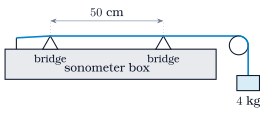
A sonometer wire of fixed length has a fundamental frequency of \(200\) Hz when the pan carries \(4\) kg. Find the mass in the pan for a fundamental frequency of \(300\) Hz.
Answer\(9\) kg
Solution
At fixed length, \(f \propto \sqrt{T}\), and \(T = mg\). So \(f \propto \sqrt{m}\).
\(\dfrac{m_2}{m_1} = \left(\dfrac{f_2}{f_1}\right)^2 = \left(\dfrac{300}{200}\right)^2 = \dfrac{9}{4}\), so \(m_2 = 4 \times \dfrac{9}{4} = 9\) kg.
How did it go?
Q27
Two wires of the same material and the same length are held at the same tension. Their diameters are \(d\) and \(2d\). Find the ratio of their fundamental frequencies.
Answer\(2 : 1\)
Solution
\(\mu = \rho A = \rho \dfrac{\pi d^2}{4}\), so \(\mu \propto d^2\) for the same material.
At the same \(L\) and \(T\), \(f \propto \dfrac{1}{\sqrt{\mu}} \propto \dfrac{1}{d}\).
\(\dfrac{f_1}{f_2} = \dfrac{2d}{d} = 2\). The thinner wire has twice the frequency: the ratio is \(2 : 1\).
How did it go?
Q28
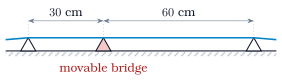
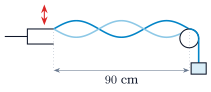
A sonometer wire of length \(90\) cm has a fundamental frequency of \(200\) Hz. A movable bridge is placed \(30\) cm from one end, as in the figure. The tension is unchanged.
Find the fundamental frequency of each part.
Where should the bridge be placed so that the fundamental frequencies of the two parts are in the ratio \(3 : 2\)?
Answer(i) \(600\) Hz, \(300\) Hz (ii) \(36\) cm from one end
Solution
\(fL\) is constant: \(fL = 200 \times 90 = 18000\) Hz cm.
\(30\) cm part: \(f = \dfrac{18000}{30} = 600\) Hz. \(60\) cm part: \(f = \dfrac{18000}{60} = 300\) Hz.
\(f \propto \dfrac{1}{L}\), so frequencies in the ratio \(3 : 2\) need lengths in the ratio \(2 : 3\).
\(L_1 = \dfrac{2}{5} \times 90 = 36\) cm and \(L_2 = 54\) cm. Place the bridge \(36\) cm from one end.
How did it go?
Q29
A small paper rider sits on a sonometer wire. A vibrating tuning fork is held on the box and the wire length is changed slowly.
Why does the rider fall off at one particular length?
Where on the wire should the rider be placed, and why?
Answer(i) resonance (ii) middle, the antinode
Solution
The fork forces the wire at the fork frequency. At one length the natural frequency of the wire equals the fork frequency.
This is resonance: the wire vibrates with a large amplitude and throws the rider off.
At the middle of the vibrating length. In the fundamental mode the middle is the antinode, where the amplitude is largest.
Near a bridge the wire is almost at rest (a node), and the rider would stay on even at resonance.
How did it go?
Melde's experiment
Q30
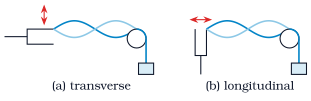
The figure shows the two arrangements of Melde's experiment. The tuning fork has a frequency of \(100\) Hz.
Find the frequency of the string in the transverse arrangement (a).
Find the frequency of the string in the longitudinal arrangement (b). Give the reason.
Answer(i) \(100\) Hz (ii) \(50\) Hz
Solution
In the transverse arrangement the prong moves across the string. Each swing of the prong is one swing of the string end.
The string vibrates at the fork frequency: \(100\) Hz.
In the longitudinal arrangement the prong moves along the string. The string is pulled tight and then slackened once in every fork vibration.
The string end goes up in one tightening and down in the next. One string vibration takes two fork vibrations, so the string frequency is \(\dfrac{100}{2} = 50\) Hz.
How did it go?
Q31
In the transverse arrangement, a fork of \(50\) Hz drives a string of length \(1\) m and mass per unit length \(8\) g/m. The string vibrates in \(4\) loops. Take \(g = 10\) m/s\(^2\).
Find the wavelength and the wave speed.
Find the tension.
Find the mass in the pan.
Answer(i) \(0.5\) m, \(25\) m/s (ii) \(5\) N (iii) \(0.5\) kg
Solution
Four loops in \(1\) m: \(\lambda = \dfrac{2 \times 1}{4} = 0.5\) m. In the transverse arrangement \(f = 50\) Hz, so \(v = f\lambda = 25\) m/s.
\(T = \mu v^2 = 0.008 \times 625 = 5\) N.
\(T = mg\), so \(m = \dfrac{5}{10} = 0.5\) kg.
How did it go?
Q32
For the string of Question 9, find the tension for which the string vibrates in
\(2\) loops,
\(8\) loops.
Answer(i) \(20\) N (ii) \(1.25\) N
Solution
With \(f\), \(L\) and \(\mu\) fixed, \(p^2 T\) is constant (Question 12). From Question 9: \(p^2 T = 16 \times 5 = 80\) N.
\(p = 2\): \(T = \dfrac{80}{4} = 20\) N. Fewer loops need a larger tension.
\(p = 8\): \(T = \dfrac{80}{64} = 1.25\) N.
How did it go?
Q33
The fork of Question 9 is turned to the longitudinal arrangement. Find the tension for which the same string again vibrates in \(4\) loops. Compare with the tension of Question 9.
Answer\(1.25\) N, one quarter
Solution
In the longitudinal arrangement the string frequency is half the fork frequency: \(f = 25\) Hz.
Four loops again means \(\lambda = 0.5\) m, so \(v = f\lambda = 25 \times 0.5 = 12.5\) m/s.
\(T = \mu v^2 = 0.008 \times 156.25 = 1.25\) N. This is one quarter of the \(5\) N of Question 9, because \(v\) is halved and \(T \propto v^2\).
How did it go?
Q34
In Melde's experiment the fork frequency, the string length and the mass per unit length are fixed.
Show that the number of loops \(p\) and the tension \(T\) obey \(p^2 T =\) constant.
A string vibrates in \(3\) loops at a tension of \(4\) N. Find the tension for \(2\) loops.
Answer(i) \(f = \frac{p}{2L}\sqrt{T/\mu}\) fixed, so \(p\sqrt{T}\) fixed (ii) \(9\) N
Solution
With \(p\) loops, \(L = p\dfrac{\lambda}{2}\), so \(\lambda = \dfrac{2L}{p}\). Also \(v = f\lambda = \sqrt{T/\mu}\).
\(f \times \dfrac{2L}{p} = \sqrt{\dfrac{T}{\mu}}\). Square both sides: \(\dfrac{4L^2 f^2}{p^2} = \dfrac{T}{\mu}\), so \(p^2 T = 4L^2 f^2 \mu\), a constant.
\(p_1^2 T_1 = p_2^2 T_2\): \(9 \times 4 = 4 \times T_2\), so \(T_2 = 9\) N.
How did it go?
Q35
In the transverse arrangement a fork of \(60\) Hz sets a string of length \(90\) cm into \(3\) loops at a tension \(T\).
Find the wavelength and the wave speed.
The tension is made \(9T\). How many loops form now?
The fork is turned to the longitudinal position. What tension gives \(3\) loops again?
Answer(i) \(60\) cm, \(36\) m/s (ii) \(1\) (iii) \(T/4\)
Solution
Three loops in \(90\) cm: \(\lambda = \dfrac{2 \times 90}{3} = 60\) cm. \(v = f\lambda = 60 \times 0.6 = 36\) m/s.
\(p^2 T\) is constant, so \(p \propto \dfrac{1}{\sqrt{T}}\). Nine times the tension gives \(p = \dfrac{3}{\sqrt{9}} = 1\) loop.
In the longitudinal position the string frequency is halved, so \(v = f\lambda\) is halved for the same \(\lambda\).
\(T \propto v^2\), so the tension needed is \(\dfrac{T}{4}\).
How did it go?
Transmission and reflection at a junction
Q36
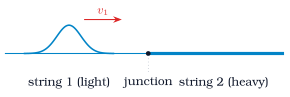
A wave of amplitude \(A_i\) travels from string 1 (wave speed \(v_1\)) into string 2 (wave speed \(v_2\)). The reflected and transmitted amplitudes are \(A_r = \frac{v_2 - v_1}{v_2 + v_1}A_i\) and \(A_t = \frac{2v_2}{v_1 + v_2}A_i\). Take \(v_1 = 30\) m/s, \(v_2 = 10\) m/s and \(A_i = 4\) mm.
Find \(A_r\) and \(A_t\). Is the reflected wave inverted?
The two strings carry the same tension. Find the ratio \(\mu_2/\mu_1\).
The minus sign means the reflected wave is inverted. A wave reflected from a heavier string always inverts.
\(v = \sqrt{T/\mu}\) with the same \(T\): \(\dfrac{\mu_2}{\mu_1} = \left(\dfrac{v_1}{v_2}\right)^2 = \left(\dfrac{30}{10}\right)^2 = 9\).
How did it go?
Q37
Now the same wave of amplitude \(4\) mm travels the other way. It goes from the heavy string (\(v_1 = 10\) m/s) into the light string (\(v_2 = 30\) m/s).
Find \(A_r\) and \(A_t\). Is the reflected wave inverted?
The transmitted amplitude is larger than the incident amplitude. Is energy still conserved? Give the reason.
Answer(i) \(+2\) mm, \(6\) mm; no (ii) yes
Solution
\(A_r = \dfrac{30 - 10}{30 + 10} \times 4 = +2\) mm. The reflected wave is not inverted: reflection from a lighter string keeps the sign.
Yes. Power depends on the string as well as on the amplitude: \(P = \dfrac{1}{2}\mu\omega^2A^2v = \dfrac{T\omega^2}{2}\cdot\dfrac{A^2}{v}\) at equal tension.
The light string carries a larger amplitude with a smaller \(\mu\). Check: \(\dfrac{P_r}{P_i} = \dfrac{2^2}{4^2} = \dfrac{1}{4}\) and \(\dfrac{P_t}{P_i} = \dfrac{6^2}{4^2} \times \dfrac{v_1}{v_2} = \dfrac{36}{16} \times \dfrac{1}{3} = \dfrac{3}{4}\). Sum \(= 1\).
How did it go?
Q38
For the strings of Question 14 (\(v_1 = 30\) m/s, \(v_2 = 10\) m/s), find the fraction of the incident power that is:
reflected,
transmitted.
Check that the two fractions add up to \(1\).
Answer(i) \(1/4\) (ii) \(3/4\)
Solution
At equal tension and frequency, \(P \propto \dfrac{A^2}{v}\) (see Question 15).
A wave crosses a junction. The reflected wave is inverted and has half the amplitude of the incident wave. Find \(v_2/v_1\) and, for equal tension, \(\mu_2/\mu_1\).
\(2v_2 - 2v_1 = -v_2 - v_1\), so \(3v_2 = v_1\) and \(\dfrac{v_2}{v_1} = \dfrac{1}{3}\).
\(\dfrac{\mu_2}{\mu_1} = \left(\dfrac{v_1}{v_2}\right)^2 = 9\). String 2 is nine times heavier per metre.
How did it go?
Q44
The wave \(y_i = 3\sin(100\pi t - 2\pi x)\) travels along string 1 towards the junction at \(x = 0\) with string 2. Here \(x\) is in metres, \(y\) in millimetres and \(t\) in seconds. Both strings carry the same tension, and \(\mu_2 = 4\mu_1\).
Find the wave speed in each string.
Write the reflected wave \(y_r\).
Write the transmitted wave \(y_t\).
Answer(i) \(50\) m/s, \(25\) m/s (ii) \(-\sin(100\pi t + 2\pi x)\) (iii) \(2\sin(100\pi t - 4\pi x)\)
\(y_t = 2\sin(100\pi t - 4\pi x)\) mm. Check at \(x = 0\): \(y_i + y_r = 3\sin(100\pi t) - \sin(100\pi t) = 2\sin(100\pi t) = y_t\). The string is continuous at the junction.
How did it go?
Q45
A wave of amplitude \(6\) mm crosses from string 1 into string 2. The transmitted amplitude is \(4\) mm.