Questions on Energy, Power, Intensity and Loudness, the kind your examinations ask. Solve one on paper. Then tell the book how it went. The book believes you, and it uses your answer to plan your revision.
0%
Nothing marked yetMark honestly. Peek at the answer only after your own attempt.
Sound: Speed, Pressure Amplitude, Intensity and Loudness
22 questions · after Lesson 4, The Decibel Scale
Longitudinal waves and pressure amplitude
Q1
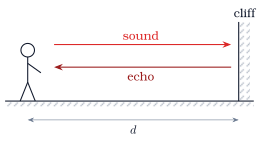
A person claps once in front of a cliff. The echo returns after \(2\) s. The speed of sound is \(340\) m/s.
Find the distance \(d\) to the cliff.
The person now stands \(17\) m from a wall and claps steadily. What clapping rate makes each echo arrive with the next clap?
Answer(i) \(340\) m (ii) \(10\) claps per second
Solution
The sound travels to the cliff and back, a distance \(2d\), in \(2\) s. \(2d = 340 \times 2 = 680\) m, so \(d = 340\) m.
Each echo travels \(2 \times 17 = 34\) m and takes \(\dfrac{34}{340} = 0.1\) s.
The echo arrives with the next clap when the claps are \(0.1\) s apart: \(10\) claps per second.
How did it go?
Q2
The human ear hears frequencies from \(20\) Hz to \(20000\) Hz. The speed of sound is \(340\) m/s. Find the longest and the shortest wavelength of audible sound in air.
Answer\(17\) m; \(1.7\) cm
Solution
\(\lambda = \dfrac{v}{f}\). Longest: \(\dfrac{340}{20} = 17\) m. Shortest: \(\dfrac{340}{20000} = 0.017\) m \(= 1.7\) cm.
How did it go?
Q3
Is a sound wave in air transverse or longitudinal? Give the reason. Can sound travel through a vacuum?
Answerlongitudinal; no
Solution
Longitudinal. The air particles move back and forth along the direction in which the sound travels, making compressions and rarefactions.
Air has no rigidity, so it cannot support a sideways (shear) displacement. A transverse wave needs rigidity; a longitudinal wave needs only a bulk modulus.
Sound cannot travel through a vacuum. There are no particles to compress.
How did it go?
Q4
The displacement of air particles in a sound wave is \(s = 4 \times 10^{-6}\sin(680\pi t - 2\pi x)\), in SI units. The bulk modulus of air is \(1.4 \times 10^{5}\) Pa.
Write the displacement amplitude \(s_0\). Find the frequency, the wavelength and the wave speed.
Find the pressure amplitude \(\Delta P_0 = Bks_0\).
Answer(i) \(4\ \mu\)m, \(340\) Hz, \(1\) m, \(340\) m/s (ii) \(1.12\pi \approx 3.5\) Pa
Solution
Compare with \(s = s_0\sin(\omega t - kx)\): \(s_0 = 4 \times 10^{-6}\) m \(= 4\ \mu\)m, \(\omega = 680\pi\) rad/s, \(k = 2\pi\) rad/m.
\(f = \dfrac{\omega}{2\pi} = 340\) Hz. \(\lambda = \dfrac{2\pi}{k} = 1\) m. \(v = f\lambda = 340\) m/s.
A displacement of a few micrometres gives a pressure swing of a few pascals, far smaller than the atmospheric pressure of \(10^{5}\) Pa.
How did it go?
Q5
A sound wave of wavelength \(1\) m has a pressure amplitude of \(8.8\) Pa. The bulk modulus of air is \(1.4 \times 10^{5}\) Pa. Find the displacement amplitude. Take \(\pi = \frac{22}{7}\).
\(1.4 \times 2 \times \dfrac{22}{7} = 8.8\), so \(s_0 = \dfrac{8.8}{8.8 \times 10^{5}} = 10^{-5}\) m.
How did it go?
Q6
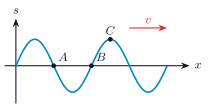
The figure shows the displacement \(s\) of the air particles against \(x\) at one instant. A positive \(s\) means a shift along \(+x\). Points \(A\) and \(B\) are at \(s = 0\); \(C\) is at the maximum displacement.
At which point is the air most compressed? Give the reason.
At which point is the air most rarefied?
What is the pressure change at \(C\)?
Answer(i) \(A\) (ii) \(B\) (iii) zero
Solution
The pressure change is \(\Delta P = -B\dfrac{\partial s}{\partial x}\). Pressure is highest where the slope of the \(s\)-\(x\) curve is most negative.
At \(A\) the slope is negative. Particles to the left of \(A\) are shifted to the right, and particles to the right of \(A\) are shifted to the left. Both move towards \(A\), so the air at \(A\) is most compressed.
At \(B\) the slope is positive. Particles on both sides move away from \(B\), so the air at \(B\) is most rarefied.
At \(C\) the slope is zero, so \(\Delta P = 0\). The particles at \(C\) are displaced the most, but their neighbours are displaced by the same amount. So the air there is neither compressed nor rarefied.
How did it go?
Q7
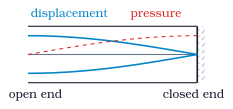
The figure shows a pipe closed at one end vibrating in its fundamental mode. The solid curves show the displacement amplitude and the dashed curve shows the pressure amplitude.
At the closed end, is there a displacement node or antinode? A pressure node or antinode?
Answer the same for the open end.
Why is the pressure at the open end always the atmospheric pressure?
Answer(i) disp. node, pressure antinode (ii) disp. antinode, pressure node (iii) open to the air
Solution
The closed end is a wall. The air there cannot move: a displacement node. The air is squeezed against the wall and released, so the pressure swing is largest: a pressure antinode.
The open end is free to move: a displacement antinode. The pressure there stays at the outside pressure: a pressure node.
The open end is in contact with the open air. Any extra pressure is released at once into the surroundings, so the pressure there cannot rise or fall.
\(\dfrac{T}{300} = \left(\dfrac{495}{330}\right)^2 = 1.5^2 = 2.25\), so \(T = 675\) K (about \(402^\circ\)C).
How did it go?
Q10
The speed of sound at \(0^\circ\)C is \(v_0 = 332\) m/s. Show that for a small rise of \(t\,^\circ\)C the speed becomes \(v \approx v_0\left(1 + \frac{t}{546}\right)\). By how much does the speed rise per degree?
For small \(t\), \((1 + x)^{1/2} \approx 1 + \dfrac{x}{2}\). So \(v \approx v_0\left(1 + \dfrac{t}{546}\right)\).
Rise per degree: \(\dfrac{v_0}{546} = \dfrac{332}{546} \approx 0.61\) m/s. The speed of sound rises by about \(0.6\) m/s for every degree of warming.
How did it go?
Q11
At a fixed temperature, the pressure of the air is doubled. What happens to the speed of sound? Give the reason.
Answerno change
Solution
No change. At a fixed temperature, Boyle's law gives \(\rho \propto P\): doubling the pressure doubles the density.
The ratio \(P/\rho\) stays the same, so \(v = \sqrt{\gamma P/\rho}\) stays the same. The speed of sound depends on the temperature, not on the pressure.
How did it go?
Q12
Hydrogen and oxygen are at the same temperature. Both have \(\gamma = 1.4\). Their molar masses are \(2\) g/mol and \(32\) g/mol. The speed of sound in oxygen is \(330\) m/s. Find the speed of sound in hydrogen.
Answer\(1320\) m/s
Solution
\(v = \sqrt{\gamma RT/M}\). With the same \(\gamma\) and \(T\): \(v \propto \dfrac{1}{\sqrt{M}}\).
Is the speed of sound larger in moist air or in dry air at the same temperature and pressure? Give the reason.
Answermoist air
Solution
Moist air. A water molecule (\(M = 18\) g/mol) is lighter than the nitrogen and oxygen molecules it replaces (\(28\) and \(32\) g/mol).
Moist air therefore has a smaller average molar mass and a smaller density at the same pressure. \(v \propto 1/\sqrt{M}\), so sound travels a little faster in moist air.
How did it go?
Q14
Find the speed of sound in oxygen at \(300\) K from \(v = \sqrt{\gamma RT/M}\). Take \(\gamma = 1.4\), \(R = 8.3\) J/(mol K) and \(M = 32\) g/mol.
The power spreads over a sphere of area \(4\pi r^2\). The same energy per second crosses a larger and larger area, so the energy per square metre falls.
How did it go?
Q16
The threshold of hearing is \(I_0 = 10^{-12}\) W/m\(^2\). Find the sound level in decibels for an intensity of
\(10^{-6}\) W/m\(^2\),
\(10^{-9}\) W/m\(^2\),
\(1\) W/m\(^2\).
Answer(i) \(60\) dB (ii) \(30\) dB (iii) \(120\) dB
Solution
\(L = 10\log_{10}\dfrac{I}{I_0}\) with \(I_0 = 10^{-12}\) W/m\(^2\).
\(L = 10\log 10^{6} = 60\) dB.
\(L = 10\log 10^{3} = 30\) dB.
\(L = 10\log 10^{12} = 120\) dB. This is the threshold of pain.
How did it go?
Q17
Find the intensity of a sound of level
\(80\) dB,
\(20\) dB,
\(0\) dB.
Answer(i) \(10^{-4}\) (ii) \(10^{-10}\) (iii) \(10^{-12}\) W/m\(^2\)
Solution
From \(L = 10\log(I/I_0)\): \(I = I_0 \times 10^{L/10}\).
A sound has a level of \(50\) dB. Take \(\log 2 = 0.3\). Find the new level when the intensity is made
\(2\) times,
\(10\) times,
\(100\) times.
Answer(i) \(53\) dB (ii) \(60\) dB (iii) \(70\) dB
Solution
If \(I\) becomes \(nI\), the level rises by \(10\log n\). The change does not depend on the starting level.
\(10\log 2 = 3\) dB. New level \(53\) dB.
\(10\log 10 = 10\) dB. New level \(60\) dB.
\(10\log 100 = 20\) dB. New level \(70\) dB.
How did it go?
Q19
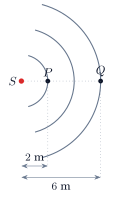
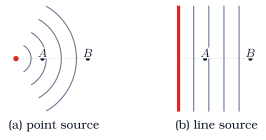
In figure (a) a point source sends out spherical waves. In figure (b) a long busy road acts as a line source and sends out cylindrical waves. \(A\) is \(10\) m from the source and \(B\) is \(100\) m from the source. The level at \(A\) is \(60\) dB in both cases.
Find the level at \(B\) for the point source.
Find the level at \(B\) for the line source.
Answer(i) \(40\) dB (ii) \(50\) dB
Solution
Point source: \(I \propto \dfrac{1}{r^2}\). From \(10\) m to \(100\) m the intensity falls by a factor of \(100\).
The level falls by \(10\log 100 = 20\) dB: \(60 - 20 = 40\) dB.
Line source: the power spreads over a cylinder of area \(2\pi r \ell\), so \(I \propto \dfrac{1}{r}\). The intensity falls by a factor of \(10\).
The level falls by \(10\log 10 = 10\) dB: \(60 - 10 = 50\) dB. The road is still loud at \(100\) m, while the point source has become quiet.
How did it go?
Q20
How does the intensity of a sound wave depend on its displacement amplitude? A sound has a level of \(70\) dB. Find the new level when the amplitude is
doubled,
halved.
Answer\(I \propto s_0^2\); (i) \(76\) dB (ii) \(64\) dB
Solution
\(I = \dfrac{1}{2}\rho v\omega^2 s_0^2\), so \(I \propto s_0^2\).
Doubling \(s_0\) makes \(I\) four times: the level rises by \(10\log 4 = 20\log 2 = 6\) dB. New level \(76\) dB.
Halving \(s_0\) makes \(I\) one quarter: the level falls by \(6\) dB. New level \(64\) dB.
How did it go?
Q21
The intensity of a sound wave is \(I = \frac{\Delta P_0^2}{2\rho v}\). The pressure amplitude is \(20\) Pa, the density of air is \(1.25\) kg/m\(^3\) and the speed of sound is \(320\) m/s. Take \(\log 5 = 0.7\).
A pressure swing of only \(20\) Pa, one five-thousandth of atmospheric pressure, is already painfully loud.
How did it go?
Q22
The intensity can also be written as \(I = \frac{1}{2}\rho v\omega^2 s_0^2\). A sound of frequency \(1000\) Hz is just audible, at \(10^{-12}\) W/m\(^2\). Take \(\rho = 1.25\) kg/m\(^3\) and \(v = 320\) m/s. Find the displacement amplitude \(s_0\). Compare the answer with the size of an atom, about \(10^{-10}\) m.
Answer\(\approx 1.1 \times 10^{-11}\) m, about a tenth of an atom
Solution
\(\omega = 2\pi \times 1000 = 2000\pi\) rad/s and \(\rho v = 400\) kg/(m\(^2\) s).