Questions on Standing Sound Waves, the kind your examinations ask. Solve one on paper. Then tell the book how it went. The book believes you, and it uses your answer to plan your revision.
0%
Nothing marked yetMark honestly. Peek at the answer only after your own attempt.
Organ Pipes and the Resonance Column
22 questions · after Lesson 4, The End Correction and the Resonance Tube
Open pipes
Q1
An organ pipe open at both ends is \(0.5\) m long. The speed of sound is \(330\) m/s.
Find the fundamental frequency.
Find the frequencies of the second and the third harmonics.
Answer(i) \(330\) Hz (ii) \(660\) Hz, \(990\) Hz
Solution
Open pipe: \(f_1 = \dfrac{v}{2L} = \dfrac{330}{2 \times 0.5} = 330\) Hz.
\(f_n = nf_1\): \(f_2 = 660\) Hz and \(f_3 = 990\) Hz.
How did it go?
Q2
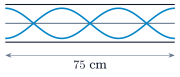
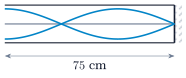
The figure shows an open pipe of length \(75\) cm vibrating in one of its modes. The speed of sound is \(330\) m/s.
Find the wavelength and the frequency of this mode.
Find the fundamental frequency of the pipe.
Which harmonic and which overtone is this mode?
Answer(i) \(50\) cm, \(660\) Hz (ii) \(220\) Hz (iii) 3rd; 2nd overtone
Solution
Three nodes: the pipe holds three half wavelengths. \(\dfrac{3\lambda}{2} = 75\) cm, so \(\lambda = 50\) cm.
\(f = \dfrac{v}{\lambda} = \dfrac{330}{0.5} = 660\) Hz.
\(660 = 3f_1\): the third harmonic. The overtones are counted above the fundamental, so this is the second overtone.
How did it go?
Q3
An open pipe resonates at \(660\) Hz and at \(880\) Hz, with nothing in between. The speed of sound is \(330\) m/s.
Find the fundamental frequency.
Which harmonics are these?
Find the length of the pipe.
Answer(i) \(220\) Hz (ii) 3rd, 4th (iii) \(0.75\) m
Solution
In an open pipe consecutive resonances differ by \(f_1\): \(f_1 = 880 - 660 = 220\) Hz.
\(660 = 3 \times 220\) and \(880 = 4 \times 220\): the third and the fourth harmonics.
\(L = \dfrac{v}{2f_1} = \dfrac{330}{440} = 0.75\) m.
How did it go?
Q4
Find the length of an open pipe whose fundamental frequency is \(330\) Hz, with the speed of sound \(330\) m/s. Write the ratio of the frequencies of its first three harmonics.
Answer\(0.5\) m; \(1 : 2 : 3\)
Solution
\(L = \dfrac{v}{2f_1} = \dfrac{330}{660} = 0.5\) m.
The harmonics of an open pipe are \(f_1, 2f_1, 3f_1\): the ratio is \(1 : 2 : 3\).
How did it go?
Q5
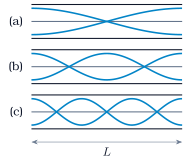
The figure shows the three lowest modes of an open pipe of length \(L\). The curves show the displacement amplitude.
Count the nodes in each mode. Which harmonic is each?
Write the wavelength of each mode in terms of \(L\).
Why must both ends be displacement antinodes? Why does this allow every harmonic?
Answer(i) \(1, 2, 3\) nodes: 1st, 2nd, 3rd (ii) \(2L\), \(L\), \(2L/3\) (iii) air free at open ends; \(L = n\lambda/2\)
Solution
(a) has one node, (b) two, (c) three. The number of nodes is the harmonic number: (a) first, (b) second, (c) third harmonic.
Each mode holds \(n\) half wavelengths: \(L = \dfrac{n\lambda}{2}\), so \(\lambda = \dfrac{2L}{n}\).
An open end is in contact with the outside air. The air there is free to move, so the displacement is largest: an antinode.
Antinodes at both ends fit whenever the length is a whole number of half wavelengths, \(L = n\lambda/2\), for every \(n\). So every harmonic is allowed.
How did it go?
Q6
The open pipe of Question 1 is filled with hydrogen, in which the speed of sound is \(1320\) m/s. Find the new fundamental frequency.
Answer\(1320\) Hz
Solution
\(f_1 = \dfrac{v}{2L} \propto v\) for the same pipe. The speed becomes \(4\) times, so \(f_1 = 4 \times 330 = 1320\) Hz.
How did it go?
Closed pipes
Q7
A pipe closed at one end is \(0.25\) m long. The speed of sound is \(330\) m/s.
\(330 = 3f_1\): the third harmonic. A closed pipe has only odd harmonics, so this is its first overtone.
How did it go?
Q9
A closed pipe resonates at \(550\) Hz and at \(770\) Hz, with nothing in between. The speed of sound is \(330\) m/s.
Find the fundamental frequency.
Which harmonics are these?
Find the length of the pipe.
Answer(i) \(110\) Hz (ii) 5th, 7th (iii) \(0.75\) m
Solution
In a closed pipe consecutive resonances differ by \(2f_1\): \(2f_1 = 770 - 550 = 220\) Hz, so \(f_1 = 110\) Hz.
\(550 = 5 \times 110\) and \(770 = 7 \times 110\): the fifth and the seventh harmonics.
\(L = \dfrac{v}{4f_1} = \dfrac{330}{440} = 0.75\) m.
How did it go?
Q10
An open pipe and a closed pipe have the same length.
Find the ratio of their fundamental frequencies.
Which pipe gives the richer sound, with more harmonics? Give the reason.
A closed pipe has the same fundamental as an open pipe. Find the ratio of their lengths.
Answer(i) \(2 : 1\) (ii) open (iii) \(L_c : L_o = 1 : 2\)
Solution
\(\dfrac{f_{\text{open}}}{f_{\text{closed}}} = \dfrac{v/2L}{v/4L} = 2\). The open pipe sounds an octave higher.
The open pipe. It gives all the harmonics, \(f_1, 2f_1, 3f_1, \ldots\), while the closed pipe gives only the odd ones, \(f_1, 3f_1, 5f_1, \ldots\).
\(\dfrac{v}{4L_c} = \dfrac{v}{2L_o}\), so \(L_o = 2L_c\). The ratio \(L_c : L_o = 1 : 2\).
How did it go?
Q11
The second overtone of a closed pipe has the same frequency as the second overtone of an open pipe. The closed pipe is \(50\) cm long. Find the length of the open pipe.
Answer\(60\) cm
Solution
Closed pipe: second overtone \(= 5f_1 = \dfrac{5v}{4L_c}\). Open pipe: second overtone \(= 3f_1 = \dfrac{3v}{2L_o}\).
Equal frequencies: \(\dfrac{5}{4L_c} = \dfrac{3}{2L_o}\), so \(L_o = \dfrac{6}{5}L_c = \dfrac{6}{5} \times 50 = 60\) cm.
How did it go?
Q12
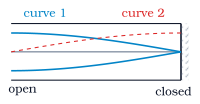
The figure shows a pipe closed at the right end in its fundamental mode. One curve shows the displacement amplitude and the other the pressure amplitude.
Which curve is the displacement and which is the pressure? Give the reason.
A small microphone responds to pressure changes. Where should it be placed for the loudest signal?
Where would a light powder placed in the pipe be shaken the most?
Answer(i) 1 disp., 2 pressure (ii) closed end (iii) open end
Solution
Curve 1 is the displacement: it is largest at the open end and zero at the closed wall, where the air cannot move.
Curve 2 is the pressure: it is zero at the open end (atmospheric pressure) and largest at the closed end. There the air is squeezed against the wall.
At the closed end, the pressure antinode.
At the open end, the displacement antinode, where the air moves the most.
How did it go?
End correction
Q13
The end correction of a pipe of radius \(r\) is \(e = 0.6r\). A pipe closed at one end has a length of \(23.8\) cm and a radius of \(2\) cm. The speed of sound is \(330\) m/s.
Find the end correction.
Find the effective length.
Find the fundamental frequency.
Answer(i) \(1.2\) cm (ii) \(25\) cm (iii) \(330\) Hz
Solution
\(e = 0.6r = 0.6 \times 2 = 1.2\) cm.
The antinode lies a little outside the open end. Effective length \(= L + e = 23.8 + 1.2 = 25\) cm.
An open pipe has a length of \(48.8\) cm and a radius of \(1\) cm. The speed of sound is \(330\) m/s. Find the effective length and the fundamental frequency. Remember that an open pipe has two open ends.
Answer\(50\) cm; \(330\) Hz
Solution
Each open end adds \(e = 0.6 \times 1 = 0.6\) cm. Effective length \(= L + 2e = 48.8 + 1.2 = 50\) cm.
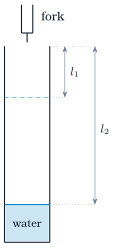
The antinode is a distance \(e\) above the open end. So the effective air columns are \(l_1 + e\) and \(l_2 + e\).
First resonance: \(l_1 + e = \dfrac{\lambda}{4}\). Second resonance: \(l_2 + e = \dfrac{3\lambda}{4}\).
Subtract: \(l_2 - l_1 = \dfrac{\lambda}{2}\), so \(\lambda = 2(l_2 - l_1)\). The unknown \(e\) cancels.
From the two equations, \(l_2 + e = 3(l_1 + e)\), so \(l_2 - 3l_1 = 2e\) and \(e = \dfrac{l_2 - 3l_1}{2}\).
How did it go?
Q16
A student finds the fundamental frequency of a closed pipe as \(v/4L\), using the measured length \(L\). Is the true frequency higher or lower? Give the reason. Which pipe needs the larger correction, one of radius \(1\) cm or one of radius \(3\) cm?
Answerlower; \(3\) cm
Solution
Lower. The true air column is \(L + e\), longer than \(L\), so the true fundamental \(\dfrac{v}{4(L + e)}\) is smaller than \(\dfrac{v}{4L}\).
\(e = 0.6r\) grows with the radius. The pipe of radius \(3\) cm needs the larger correction, \(1.8\) cm against \(0.6\) cm.
How did it go?
Resonance column
Q17
A tuning fork of \(330\) Hz is held over a resonance tube. The water level is lowered slowly. The first resonance is found at \(l_1 = 24\) cm and the second at \(l_2 = 74\) cm below the top.
Find the wavelength and the speed of sound.
Find the end correction and the radius of the tube.
Why is the second resonance length not exactly three times the first?
Answer(i) \(1\) m, \(330\) m/s (ii) \(1\) cm, \(\approx 1.7\) cm (iii) \(l_2 + e = 3(l_1 + e)\)
Solution
\(\lambda = 2(l_2 - l_1) = 2 \times (74 - 24) = 100\) cm \(= 1\) m.
\(e = 0.6r\), so \(r = \dfrac{1}{0.6} = \dfrac{5}{3} \approx 1.7\) cm.
The antinode sits \(e\) above the open end. The quarter and three-quarter wavelengths are \(l_1 + e\) and \(l_2 + e\), and \(l_2 + e = 3(l_1 + e)\) gives \(l_2 = 3l_1 + 2e\), a little more than \(3l_1\).
How did it go?
Q18
With a fork of \(512\) Hz the two resonance lengths of a tube are \(16\) cm and \(49.5\) cm. Find the speed of sound and the end correction.
Answer\(\approx 343\) m/s; \(0.75\) cm
Solution
\(\lambda = 2(l_2 - l_1) = 2 \times (49.5 - 16) = 67\) cm \(= 0.67\) m.
With a fork of \(330\) Hz the first resonance of a tube is at \(25\) cm. Neglect the end correction.
Find the speed of sound.
Predict the next two resonance lengths.
Answer(i) \(330\) m/s (ii) \(75\) cm, \(125\) cm
Solution
\(l_1 = \dfrac{\lambda}{4}\), so \(\lambda = 100\) cm \(= 1\) m. \(v = f\lambda = 330\) m/s.
Resonances at \(\dfrac{\lambda}{4}, \dfrac{3\lambda}{4}, \dfrac{5\lambda}{4}\): the next two are \(75\) cm and \(125\) cm.
How did it go?
Q20
In the resonance tube experiment,
why does the water surface act as a closed end?
why is the first resonance found when the air column is a quarter wavelength long?
how does the student know that resonance has been reached?
Answer(i) air cannot enter water (ii) node to antinode (iii) loudest sound
Solution
The air cannot move into the water. The air particles at the surface stay at rest, which is exactly what a closed end does: a displacement node.
The open top is an antinode and the water surface is a node. The shortest column with a node at one end and an antinode at the other is a quarter wavelength.
At resonance the air column vibrates with a large amplitude and the sound becomes suddenly loud. The student lowers the water until the loudness is greatest.
How did it go?
Q21
A resonance tube is \(1\) m long. The speed of sound is \(330\) m/s. Neglect the end correction. Find the lengths of the air column at which resonance occurs with a fork of
\(330\) Hz,
\(660\) Hz.
Answer(i) \(25\), \(75\) cm (ii) \(12.5\), \(37.5\), \(62.5\), \(87.5\) cm
Solution
Resonance lengths are \(\dfrac{\lambda}{4}, \dfrac{3\lambda}{4}, \dfrac{5\lambda}{4}, \ldots\), as long as they fit in the \(100\) cm tube.
\(\lambda = \dfrac{330}{330} = 1\) m: lengths \(25\) cm, \(75\) cm (\(125\) cm does not fit). Two resonances.
\(\lambda = \dfrac{330}{660} = 0.5\) m: lengths \(12.5\), \(37.5\), \(62.5\), \(87.5\) cm. Four resonances.
How did it go?
Q22
With the same \(330\) Hz fork, the first resonance length is \(25\) cm on a cold day and \(26\) cm on a hot day. Neglect the end correction. Find the speed of sound on each day. Why does the length change?
Answer\(330\) m/s; \(343.2\) m/s
Solution
\(l_1 = \dfrac{\lambda}{4} = \dfrac{v}{4f}\), so \(v = 4fl_1\).
The speed of sound rises with temperature, so the wavelength of the same fork is longer on the hot day. A longer quarter wavelength needs a longer air column.