Questions on Beats and the Doppler Effect, the kind your examinations ask. Solve one on paper. Then tell the book how it went. The book believes you, and it uses your answer to plan your revision.
0%
Nothing marked yetMark honestly. Peek at the answer only after your own attempt.
Beats and Quincke's Tube
22 questions · after Lesson 2, Hearing Beats and Tuning
Beats: the basics
Q1
Two tuning forks of \(256\) Hz and \(260\) Hz are sounded together.
Find the beat frequency.
Find the time between two loud moments.
What frequency does the ear hear?
Answer(i) \(4\) Hz (ii) \(0.25\) s (iii) \(258\) Hz
Solution
Beat frequency \(= f_1 - f_2 = 260 - 256 = 4\) Hz: four loud moments every second.
Time between loud moments \(= \dfrac{1}{4} = 0.25\) s.
The ear hears the average, \(\dfrac{256 + 260}{2} = 258\) Hz, rising and falling in loudness \(4\) times a second.
How did it go?
Q2
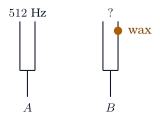
Fork \(A\) has a frequency of \(512\) Hz. Forks \(A\) and \(B\) together give \(3\) beats per second. A little wax is put on a prong of \(B\), and the beats rise to \(5\) per second.
What are the two possible frequencies of \(B\) before the wax?
What does wax do to the frequency of a fork?
Find the frequency of \(B\). Give the reason.
Answer(i) \(509\) or \(515\) Hz (ii) lowers (iii) \(509\) Hz
Solution
\(3\) beats per second means \(|f_B - 512| = 3\): \(f_B = 509\) Hz or \(515\) Hz.
Wax adds mass to the prong. A heavier prong vibrates more slowly, so the frequency falls.
If \(f_B\) were \(515\) Hz, lowering it would bring it closer to \(512\) Hz and the beats would fall. The beats rose, so \(f_B\) moved away from \(512\) Hz.
That happens when \(f_B\) was already below \(512\) Hz: \(f_B = 509\) Hz. Check: \(509 - 2 = 507\) gives \(512 - 507 = 5\) beats.
How did it go?
Q3
A fork \(X\) gives \(4\) beats per second with a fork of \(400\) Hz. A prong of \(X\) is filed a little, and the beats rise to \(6\) per second.
What does filing do to the frequency of a fork? Find the original frequency of \(X\).
What would you conclude if the beats had fallen to \(2\) per second instead?
Answer(i) raises; \(404\) Hz (ii) \(X = 396\) Hz
Solution
Filing removes mass from the prong, so the frequency rises.
\(X\) was \(396\) Hz or \(404\) Hz. Raising \(396\) Hz would reduce the beats; raising \(404\) Hz increases them. So \(X = 404\) Hz. Check: \(406 - 400 = 6\).
Falling beats mean the frequency moved towards \(400\) Hz. Raising it did that, so \(X\) was below \(400\) Hz: \(X = 396\) Hz.
How did it go?
Q4
Two sound waves \(y_1 = a\sin(512\pi t)\) and \(y_2 = a\sin(520\pi t)\) reach the ear together. Here \(t\) is in seconds.
Find the two frequencies. Write the resultant in the form \(y = A(t)\sin(2\pi f t)\).
What frequency \(f\) is heard?
The amplitude \(A(t)\) varies at \(2\) Hz. Why is the beat frequency \(4\) Hz and not \(2\) Hz?
The fast factor \(\sin(516\pi t)\) has frequency \(\dfrac{516}{2} = 258\) Hz. This is the note heard.
The amplitude \(2a\cos(4\pi t)\) has frequency \(2\) Hz. But the ear responds to loudness, which depends on \(A^2\).
\(A^2 = 4a^2\cos^2(4\pi t)\) is largest twice in every cycle of \(\cos(4\pi t)\), at \(\cos = +1\) and at \(\cos = -1\). So there are \(2 \times 2 = 4\) loud moments per second.
How did it go?
Q5
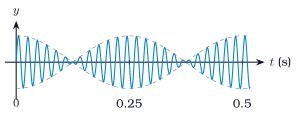
The figure shows the resultant displacement of two forks against time. The dashed curve is the envelope.
Read the time between two loud moments. Find the beat frequency.
One fork is \(256\) Hz. What are the possible frequencies of the other?
Answer(i) \(0.25\) s; \(4\) Hz (ii) \(252\) or \(260\) Hz
Solution
The envelope is widest at \(t = 0\), \(0.25\) s and \(0.5\) s. The loud moments are \(0.25\) s apart, so the beat frequency is \(\dfrac{1}{0.25} = 4\) Hz.
The other fork differs from \(256\) Hz by \(4\) Hz: \(252\) Hz or \(260\) Hz. The graph alone cannot tell which.
How did it go?
Q6
Two waves \(y_1 = 5\sin(500\pi t)\) and \(y_2 = 5\sin(506\pi t)\) reach a point. Here \(y\) is in millimetres and \(t\) in seconds.
Find the beat frequency.
Find the largest resultant amplitude.
Find the time from a loud moment to the next silent moment.
Answer(i) \(3\) Hz (ii) \(10\) mm (iii) \(\frac{1}{6}\) s
Solution
\(f_1 = \dfrac{500}{2} = 250\) Hz and \(f_2 = \dfrac{506}{2} = 253\) Hz. Beat frequency \(= 3\) Hz.
When the two waves are in phase the amplitudes add: \(5 + 5 = 10\) mm.
Loud moments are \(\dfrac{1}{3}\) s apart. A silent moment lies halfway between two loud ones, so the time is \(\dfrac{1}{6}\) s.
How did it go?
Beats in situations
Q7
A sonometer wire and a fork of \(256\) Hz give \(4\) beats per second. The tension of the wire is raised slightly, and the beats become fewer. Find the original frequency of the wire. Give the reason.
Answer\(252\) Hz
Solution
The wire is \(252\) Hz or \(260\) Hz. Raising the tension raises the frequency of the wire (\(f \propto \sqrt{T}\)).
The beats became fewer, so the wire's frequency moved towards \(256\) Hz. A rising frequency moves towards \(256\) Hz only if it started below: the wire was \(252\) Hz.
How did it go?
Q8
The speed of sound is \(330\) m/s.
Two notes have wavelengths \(5\) m and \(5.5\) m. Find the number of beats per second.
Two notes have wavelengths \(1\) m and \(1.1\) m. Find the beat frequency. Can the ear count these beats?
Answer(i) \(6\) (ii) \(30\) Hz; no
Solution
\(f = \dfrac{v}{\lambda}\): \(\dfrac{330}{5} = 66\) Hz and \(\dfrac{330}{5.5} = 60\) Hz. Beats \(= 66 - 60 = 6\) per second.
\(\dfrac{330}{1} = 330\) Hz and \(\dfrac{330}{1.1} = 300\) Hz. Beat frequency \(= 30\) Hz.
No. The ear cannot separate more than about \(10\) loud moments per second; the sensation of one sound lasts about \(0.1\) s. At \(30\) Hz the beats blur into a rough continuous sound.
How did it go?
Q9
An open pipe of length \(0.5\) m gives \(5\) beats per second with a tuning fork. The speed of sound is \(330\) m/s. When the air in the pipe is warmed a little, the beats increase. Find the frequency of the fork.
Answer\(325\) Hz
Solution
Open pipe: \(f = \dfrac{v}{2L} = \dfrac{330}{2 \times 0.5} = 330\) Hz. The fork is \(325\) Hz or \(335\) Hz.
Warming the air raises the speed of sound, so the pipe's frequency rises above \(330\) Hz. The beats increased, so the pipe moved away from the fork: the fork is below \(330\) Hz. Fork \(= 325\) Hz.
How did it go?
Q10
A set of \(25\) tuning forks is arranged in order of increasing frequency. Each fork gives \(4\) beats per second with the next. The last fork has twice the frequency of the first. Find the frequencies of the first and the last fork.
Answer\(96\) Hz, \(192\) Hz
Solution
Each fork is \(4\) Hz above the one before. From the first to the last there are \(24\) steps, so \(f_{25} = f_1 + 24 \times 4 = f_1 + 96\).
Also \(f_{25} = 2f_1\). So \(2f_1 = f_1 + 96\), giving \(f_1 = 96\) Hz and \(f_{25} = 192\) Hz.
How did it go?
Q11
A fork \(A\) of unknown frequency gives \(6\) beats per second with a fork \(B\) of \(384\) Hz. When \(A\) is loaded with wax, the beats fall to \(2\) per second. Find the frequency of \(A\).
Answer\(390\) Hz
Solution
\(A\) is \(378\) Hz or \(390\) Hz. Wax lowers the frequency of \(A\).
The beats fell, so \(A\) moved towards \(384\) Hz. A falling frequency moves towards \(384\) Hz only from above: \(A = 390\) Hz. Check: \(390 - 4 = 386\) gives \(2\) beats.
How did it go?
Q12
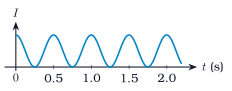
The figure shows the intensity heard when two forks sound together.
Find the beat frequency.
One fork is \(400\) Hz. What are the possible frequencies of the other?
How would the graph change if the frequencies differed by \(4\) Hz?
Answer(i) \(2\) Hz (ii) \(398\) or \(402\) Hz (iii) peaks every \(0.25\) s
Solution
The intensity peaks every \(0.5\) s, so the beat frequency is \(\dfrac{1}{0.5} = 2\) Hz.
The other fork differs by \(2\) Hz: \(398\) Hz or \(402\) Hz.
The beat frequency would be \(4\) Hz, so the peaks would come every \(0.25\) s, twice as close together.
How did it go?
Quincke's tube and interference
Q13
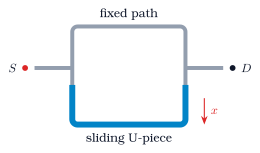
The figure shows Quincke's tube. Sound from \(S\) travels along two paths and meets again at \(D\). The U-piece can slide.
Why does moving the U-piece by \(x\) change the path difference by \(2x\)?
Write the condition on the path difference for a loud sound at \(D\), and for a faint sound.
Answer(i) both arms lengthen by \(x\) (ii) \(n\lambda\); \((2n+1)\lambda/2\)
Solution
The sound in the lower path goes down one arm of the U-piece and up the other. Moving the U-piece down by \(x\) lengthens both arms by \(x\).
So the lower path grows by \(2x\), and the path difference between the two routes changes by \(2x\).
Loud (maximum): path difference \(= n\lambda\), the two waves arrive in phase.
Faint (minimum): path difference \(= (2n + 1)\dfrac{\lambda}{2}\), the two waves arrive in opposite phase.
How did it go?
Q14
The source of Question 13 has a frequency of \(2000\) Hz. Moving the U-piece by \(8.25\) cm takes the sound at \(D\) from one minimum to the next minimum.
Find the wavelength.
Find the speed of sound.
Answer(i) \(16.5\) cm (ii) \(330\) m/s
Solution
From one minimum to the next the path difference changes by \(\lambda\). So \(2x = \lambda\): \(\lambda = 2 \times 8.25 = 16.5\) cm.
\(v = f\lambda = 2000 \times 0.165 = 330\) m/s.
How did it go?
Q15
In a Quincke's tube, successive maxima are heard when the U-piece is moved by \(10\) cm. The speed of sound is \(330\) m/s. Find the wavelength and the frequency.
Answer\(20\) cm; \(1650\) Hz
Solution
Successive maxima are also \(\lambda\) apart in path difference: \(\lambda = 2 \times 10 = 20\) cm.
\(f = \dfrac{v}{\lambda} = \dfrac{330}{0.2} = 1650\) Hz.
How did it go?
Q16
The U-piece of a Quincke's tube is moved by \(5\) cm to go from a maximum to the next minimum. The speed of sound is \(330\) m/s. Find the wavelength and the frequency.
Answer\(20\) cm; \(1650\) Hz
Solution
From a maximum to the next minimum the path difference changes by \(\dfrac{\lambda}{2}\). So \(2x = \dfrac{\lambda}{2}\): \(\lambda = 4x = 20\) cm.
\(f = \dfrac{330}{0.2} = 1650\) Hz.
How did it go?
Q17
The two paths of a Quincke's tube are \(100\) cm and \(116.5\) cm long. The frequency is \(1000\) Hz and the speed of sound is \(330\) m/s.
Is the sound at \(D\) a maximum or a minimum? Give the reason.
By how much must the U-piece be moved to reach the nearest maximum?
Answer(i) minimum, \(\lambda/2\) (ii) \(8.25\) cm
Solution
\(\lambda = \dfrac{v}{f} = \dfrac{330}{1000} = 0.33\) m \(= 33\) cm. Path difference \(= 116.5 - 100 = 16.5\) cm \(= \dfrac{\lambda}{2}\).
The waves arrive in opposite phase: a minimum.
The nearest maxima are at path differences \(0\) and \(\lambda = 33\) cm, each \(16.5\) cm away from the present value.
A change of \(16.5\) cm needs a movement of \(x = \dfrac{16.5}{2} = 8.25\) cm, in either direction.
How did it go?
Q18
The two waves reach \(D\) with amplitudes \(a\) and \(2a\).
Find the ratio of the maximum intensity to the minimum intensity.
Why is the minimum in a real Quincke's tube never completely silent?
Answer(i) \(9 : 1\) (ii) unequal amplitudes
Solution
Maximum amplitude \(= a + 2a = 3a\); minimum amplitude \(= 2a - a = a\).
Intensity is proportional to the square of the amplitude: \(\dfrac{I_{\max}}{I_{\min}} = \dfrac{(3a)^2}{a^2} = 9\).
The two waves lose different amounts of energy on their two paths, so they reach \(D\) with different amplitudes. Unequal amplitudes cannot cancel completely.
How did it go?
Q19
In a Quincke's tube successive minima are \(8.25\) cm apart for a certain frequency. The frequency is doubled. Find the new distance between successive minima.
Answer\(4.125\) cm
Solution
Successive minima are \(\dfrac{\lambda}{2}\) apart in tube movement. Doubling the frequency halves the wavelength.
New distance \(= \dfrac{8.25}{2} = 4.125\) cm.
How did it go?
Q20
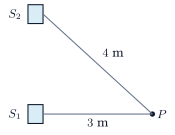
Two loudspeakers \(S_1\) and \(S_2\) are driven in phase by the same signal. A point \(P\) is \(3\) m from \(S_1\) and \(4\) m from \(S_2\). The speed of sound is \(330\) m/s.
Find the lowest frequency for which \(P\) is a minimum.
Find the lowest frequency for which \(P\) is a maximum.
Find the next frequency for which \(P\) is a minimum.
Answer(i) \(165\) Hz (ii) \(330\) Hz (iii) \(495\) Hz
Solution
Path difference at \(P\): \(4 - 3 = 1\) m. The speakers are in phase, so only the path difference matters.
Minimum when \(1\) m \(= \dfrac{\lambda}{2}\), so \(\lambda = 2\) m. Lowest frequency \(f = \dfrac{330}{2} = 165\) Hz.
Maximum when \(1\) m \(= \lambda\) (the case \(n = 1\); \(n = 0\) would need infinite wavelength). \(f = \dfrac{330}{1} = 330\) Hz.
Next minimum when \(1\) m \(= \dfrac{3\lambda}{2}\), so \(\lambda = \dfrac{2}{3}\) m and \(f = 330 \times \dfrac{3}{2} = 495\) Hz.
How did it go?
Q21
The two loudspeakers of Question 20 are \(4\) m apart and driven at \(330\) Hz.
A listener walks along the perpendicular bisector of \(S_1S_2\). What does the listener hear? Give the reason.
The listener walks along the line from \(S_1\) to \(S_2\). Find the positions of the maxima, measured from \(S_1\).
Answer(i) always loud (ii) \(1, 1.5, 2, 2.5, 3\) m
Solution
\(\lambda = \dfrac{330}{330} = 1\) m.
Every point on the perpendicular bisector is equally far from both speakers. The path difference is zero everywhere, so the listener hears a steady loud sound.
At a distance \(x\) from \(S_1\) the path difference is \(|x - (4 - x)| = |2x - 4|\).
Maxima at \(|2x - 4| = 0, 1, 2\) m: \(x = 2\) m, \(x = 1.5\) and \(2.5\) m, \(x = 1\) and \(3\) m. The maxima are \(\dfrac{\lambda}{2} = 0.5\) m apart, like the antinodes of a standing wave.
How did it go?
Q22
A Quincke's tube is filled with hydrogen, in which the speed of sound is \(1320\) m/s. The frequency is \(2000\) Hz. Find the distance between successive minima. Compare with the value in air of Question 14.
Answer\(33\) cm, four times
Solution
\(\lambda = \dfrac{v}{f} = \dfrac{1320}{2000} = 0.66\) m \(= 66\) cm.
Successive minima need a tube movement of \(\dfrac{\lambda}{2} = 33\) cm. In air the same frequency needed \(8.25\) cm, four times less, because the speed of sound in hydrogen is four times larger.
How did it go?
Doppler Effect
21 questions · after Lesson 5, Wavefronts of a Moving Source
One thing moves
Q23
A source emits sound of frequency \(600\) Hz. The speed of sound is \(330\) m/s in every question of this sheet. The source moves at \(30\) m/s. Find the frequency heard by a stationary listener when the source moves
towards the listener,
away from the listener.
Answer(i) \(660\) Hz (ii) \(550\) Hz
Solution
Moving source, listener at rest: \(f' = f\,\dfrac{v}{v \mp v_s}\), minus for approach.
No. The wavelength is fixed by the source and the air. A moving listener simply meets the crests more often (or less often), so the frequency changes although the wavelength does not.
How did it go?
Q26
The source (\(600\) Hz) moves at \(30\) m/s and the listener moves at \(33\) m/s. Find the frequency heard when
they move towards each other,
they move away from each other.
Answer(i) \(726\) Hz (ii) \(495\) Hz
Solution
General formula: \(f' = f\,\dfrac{v \pm v_o}{v \mp v_s}\), upper signs for approach.
A train sounds its whistle as it passes a person standing beside the track. The person hears \(660\) Hz while the train approaches and \(550\) Hz after it passes. Find the speed of the train and the true frequency of the whistle.
With \(v_s = v\) the denominator \(v - v_s\) is zero and the formula gives an infinite frequency.
Physically, the source keeps up with its own wavefronts. All the crests it emits pile up on top of one another into a single strong pulse, a shock wave. The formula no longer applies.
How did it go?
Q29
A source of \(600\) Hz and a listener both move at \(30\) m/s in the same direction, the listener behind the source.
Find the frequency heard. Give the reason.
The listener now moves away from a stationary source at \(330\) m/s. What does the listener hear?
Answer(i) \(600\) Hz (ii) nothing, \(f' = 0\)
Solution
Listener behind a receding source: \(f' = f\,\dfrac{v + v_o}{v + v_s} = 600 \times \dfrac{360}{360} = 600\) Hz.
The distance between source and listener does not change, so the listener receives crests at the same rate as they are sent out.
\(f' = f\,\dfrac{v - v_o}{v} = f \times \dfrac{330 - 330}{330} = 0\). The sound moves at the same speed as the listener and never catches up. The listener hears nothing.
How did it go?
Q30
A source of \(600\) Hz moves at \(40\) m/s towards a stationary listener. A wind of \(10\) m/s blows from the source towards the listener.
Find the frequency heard.
If the source and the listener were both at rest, would the wind change the frequency heard?
Answer(i) \(680\) Hz (ii) no
Solution
Wind carries the whole sound pattern with it. Replace \(v\) by \(v + w\) when the wind blows from source to listener.
No. With both at rest, \(f' = f\,\dfrac{v + w}{v + w} = f\). The wind changes the speed and the wavelength of the sound, but every crest still reaches the listener once per period.
How did it go?
Reflections, two-step problems
Q31
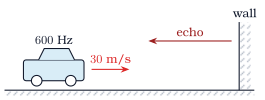
A car moving at \(30\) m/s towards a wall sounds its horn at \(600\) Hz.
Find the frequency of the sound reaching the wall.
The wall reflects the sound. Find the frequency of the echo heard by the driver.
Answer(i) \(660\) Hz (ii) \(720\) Hz
Solution
The wall is a stationary listener and the car is an approaching source: \(f_1 = 600 \times \dfrac{330}{330 - 30} = 660\) Hz.
The wall now acts as a stationary source of \(660\) Hz. The driver is a listener approaching it at \(30\) m/s.
The car re-emits \(600\) Hz as a source approaching the siren at \(30\) m/s: \(f_2 = 600 \times \dfrac{330}{330 - 30} = 660\) Hz.
How did it go?
Q33
Two cars approach each other, each at \(30\) m/s. One car sounds its horn at \(600\) Hz. Find the frequency heard in the other car
before they cross,
after they cross.
Answer(i) \(720\) Hz (ii) \(500\) Hz
Solution
Source and listener approach at \(30\) m/s each: \(f' = 600 \times \dfrac{330 + 30}{330 - 30} = 600 \times \dfrac{360}{300} = 720\) Hz.
After crossing they move apart: \(f' = 600 \times \dfrac{330 - 30}{330 + 30} = 600 \times \dfrac{300}{360} = 500\) Hz.
How did it go?
Q34
A source of \(600\) Hz moves at \(30\) m/s away from a stationary listener and towards a wall.
Find the frequency of the direct sound and of the sound reflected from the wall, as heard by the listener.
How many beats per second do the two sounds make? Can the listener count them?
Answer(i) \(550\) Hz, \(660\) Hz (ii) \(110\); no
Solution
Direct sound, source receding: \(f_1 = 600 \times \dfrac{330}{360} = 550\) Hz.
The wall receives \(600 \times \dfrac{330}{300} = 660\) Hz from the approaching source and reflects it unchanged to the stationary listener: \(f_2 = 660\) Hz.
Beats \(= 660 - 550 = 110\) per second. No: the ear cannot count more than about \(10\) beats per second, so the listener hears two separate notes.
How did it go?
Q35
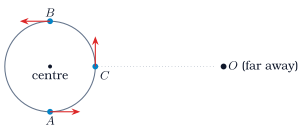
A whistle of \(600\) Hz is tied to a string of length \(1.5\) m and whirled in a horizontal circle at \(20\) rad/s. An observer \(O\) stands far away in the plane of the circle.
Find the speed of the whistle.
Find the highest and the lowest frequency heard by \(O\). At which points \(A\), \(B\), \(C\) are they heard?
What does an observer at the centre of the circle hear?
Answer(i) \(30\) m/s (ii) \(660\) Hz at \(A\), \(550\) Hz at \(B\) (iii) \(600\) Hz
Solution
\(v_s = r\omega = 1.5 \times 20 = 30\) m/s.
Only the velocity component along the line to \(O\) matters. At \(A\) the whistle moves straight towards \(O\): \(f' = 600 \times \dfrac{330}{300} = 660\) Hz, the highest.
At \(B\) the whistle moves straight away from \(O\): \(f' = 600 \times \dfrac{330}{360} = 550\) Hz, the lowest. At \(C\) the velocity is perpendicular to the line to \(O\), so the frequency is \(600\) Hz.
The whistle's velocity is always perpendicular to the line to the centre. The distance to the centre never changes, so the observer there hears a steady \(600\) Hz.
How did it go?
Q36
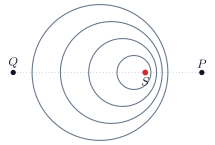
The figure shows the wavefronts sent out by a moving source \(S\) at equal time intervals.
In which direction is the source moving? Give the reason.
Which observer, \(P\) or \(Q\), hears the higher frequency?
The source moves at \(30\) m/s. Find the ratio of the wavelength at \(P\) to the wavelength at \(Q\).
Answer(i) right (ii) \(P\) (iii) \(5 : 6\)
Solution
To the right. Each wavefront is a circle centred on the point where the source was when it was emitted. The smallest, newest circle is centred farthest to the right, so the source has been moving right.
\(P\). The wavefronts are crowded ahead of the source, so the wavelength is shorter and the frequency higher at \(P\).
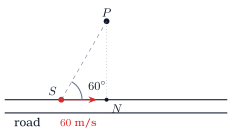
A source of \(600\) Hz moves along a straight road at \(60\) m/s. The observer \(P\) stands off the road. At the instant shown the line \(SP\) makes \(60^\circ\) with the road.
Find the component of the source velocity along \(SP\).
Find the frequency heard at this instant.
Find the frequency heard when the source is at \(N\), the point nearest to \(P\).
Answer(i) \(30\) m/s (ii) \(660\) Hz (iii) \(600\) Hz
Solution
Component along \(SP\): \(v_s\cos 60^\circ = 60 \times 0.5 = 30\) m/s, towards \(P\).
Use this component as the source speed: \(f' = 600 \times \dfrac{330}{330 - 30} = 660\) Hz.
At \(N\) the velocity is perpendicular to \(NP\). The component along the line to \(P\) is zero, so \(f' = 600\) Hz.
How did it go?
Q38
A source of \(600\) Hz is at rest. A listener moves at \(33\) m/s along a line that makes \(60^\circ\) with the line joining the listener to the source, getting closer. Find the frequency heard.
Answer\(630\) Hz
Solution
Component of the listener's velocity along the line to the source: \(33\cos 60^\circ = 16.5\) m/s, towards the source.
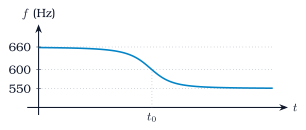
The figure shows the frequency heard by a person beside a road as a source passes. The sound heard at \(t_0\) was sent from the nearest point of the road.
Read the frequency heard when the source is far away and approaching, and when it is far away and receding.
Find the speed of the source.
Find the true frequency of the source. Check it against the reading at \(t_0\).
Answer(i) \(660\) Hz, \(550\) Hz (ii) \(30\) m/s (iii) \(600\) Hz
Solution
Far away and approaching the graph is flat at \(660\) Hz. Far away and receding it is flat at \(550\) Hz. Far away the motion is almost along the line to the observer, so these are the full approach and recession values.
The sound heard at \(t_0\) left the source when it moved perpendicular to the line to the observer, so the true frequency is heard then. The graph passes through \(600\) Hz at \(t_0\): it checks.
How did it go?
Q40
A stationary source emits \(600\) Hz. A listener wants to hear \(720\) Hz.
At what speed must the listener move towards the source?
Instead, at what speed must the source move towards a stationary listener?
Answer(i) \(66\) m/s (ii) \(55\) m/s
Solution
\(720 = 600 \times \dfrac{330 + v_o}{330}\), so \(330 + v_o = 396\) and \(v_o = 66\) m/s.
\(720 = 600 \times \dfrac{330}{330 - v_s}\), so \(330 - v_s = 275\) and \(v_s = 55\) m/s. A smaller source speed gives the same rise.
How did it go?
Q41
A source of \(600\) Hz moves at \(30\) m/s along a road. A listener follows it along the same road at \(33\) m/s. Find the frequency heard.
Answer\(605\) Hz
Solution
The source moves away from the listener and the listener moves towards the source.