Questions on Electric Charge, Coulomb's Law and the Electric Field, the kind your examinations ask. Solve one on paper. Then tell the book how it went. The book believes you, and it uses your answer to plan your revision.
0%
Nothing marked yetMark honestly. Peek at the answer only after your own attempt.
Coulomb's Law and Superposition
24 questions · after Lesson 3, Superposition and Equilibrium
Reading Coulomb's law
Q1
Two point charges of \(2\,\mu\)C and \(3\,\mu\)C are \(30\) cm apart in air. Take \(\frac{1}{4\pi\varepsilon_0} = 9 \times 10^9\) N m\(^2\)/C\(^2\) throughout this sheet.
Find the force between the charges.
Is the force attractive or repulsive? Give the reason.
Answer(i) \(0.6\) N (ii) repulsive
Solution
Coulomb's law: \(F = \dfrac{1}{4\pi\varepsilon_0}\dfrac{q_1 q_2}{r^2} = \dfrac{k q_1 q_2}{r^2}\) with \(k = 9 \times 10^9\) N m\(^2\)/C\(^2\).
Both charges are positive. Like charges repel, so the force is repulsive.
How did it go?
Q2
The force between the charges \(+4\,\mu\)C and \(-6\,\mu\)C is \(2.4\) N. Find the distance between them. State whether the force is attractive or repulsive.
Two charges in air attract each other with a force of \(0.8\) N. The same charges, at the same separation, are placed inside a liquid of dielectric constant \(K = 4\).
Write Coulomb's law for a medium in terms of \(\varepsilon_0\) and \(K\).
Find the force in the liquid.
Answer(i) \(F_{\text{air}}/K\) (ii) \(0.2\) N
Solution
In a medium the permittivity is \(\varepsilon = K\varepsilon_0\). So \(F = \dfrac{1}{4\pi K\varepsilon_0}\dfrac{q_1 q_2}{r^2}\). The force becomes \(\dfrac{1}{K}\) times the force in air.
\(F_{\text{liquid}} = \dfrac{F_{\text{air}}}{K} = \dfrac{0.8}{4} = 0.2\) N.
How did it go?
Q5
The force between two point charges is \(F\). Write the new force when
the distance is doubled,
one charge is tripled,
both charges are doubled and the distance is halved.
Answer(i) \(F/4\) (ii) \(3F\) (iii) \(16F\)
Solution
\(F \propto \dfrac{q_1 q_2}{r^2}\).
\(r \to 2r\): the force becomes \(\dfrac{F}{4}\).
\(q_1 \to 3q_1\): the force becomes \(3F\).
\(q_1 q_2 \to 4 q_1 q_2\) and \(r^2 \to \dfrac{r^2}{4}\): the force becomes \(4 \times 4 F = 16F\).
How did it go?
Vector form and Newton's third law
Q6
A charge \(q_1 = +2\,\mu\)C is at the origin. A charge \(q_2 = -8\,\mu\)C is on the \(x\)-axis at \(x = 0.3\) m.
Find the force on \(q_2\) as a vector, using the unit vector \(\hat{i}\).
Write the force on \(q_1\) as a vector.
Answer(i) \(-1.6\,\hat{i}\) N (ii) \(+1.6\,\hat{i}\) N
The charges are unlike, so \(q_2\) is pulled towards \(q_1\) at the origin, that is, along \(-x\). \(\vec{F}_{2} = -1.6\,\hat{i}\) N.
By Newton's third law the force on \(q_1\) is equal and opposite: \(\vec{F}_{1} = +1.6\,\hat{i}\) N. The charge \(q_1\) is pulled towards \(q_2\).
How did it go?
Q7
A ball of mass \(10\) g carries \(1\,\mu\)C and a ball of mass \(20\) g carries \(4\,\mu\)C. The balls are \(60\) cm apart and free to move.
Find the force on each ball.
Which ball experiences the larger force? Give the reason.
Find the acceleration of each ball at this instant.
Answer(i) \(0.1\) N (ii) equal (iii) \(10\), \(5\) m/s\(^2\)
Solution
\(F = \dfrac{9 \times 10^9 \times 1 \times 10^{-6} \times 4 \times 10^{-6}}{(0.6)^2} = \dfrac{0.036}{0.36} = 0.1\) N on each ball.
The two forces are an action and reaction pair. They are equal in magnitude even though the charges and the masses are different.
\(a = \dfrac{F}{m}\). For the \(10\) g ball: \(a = \dfrac{0.1}{0.01} = 10\) m/s\(^2\). For the \(20\) g ball: \(a = \dfrac{0.1}{0.02} = 5\) m/s\(^2\).
The forces are equal but the lighter ball accelerates more.
How did it go?
Q8
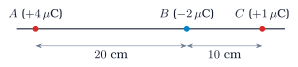
The figure shows three charges on a straight line.
Find the force on \(C\) due to \(A\) and the force on \(C\) due to \(B\). Give their directions.
Find the net force on \(C\).
Find the net force on \(B\).
Answer(i) \(0.4\) N, \(1.8\) N (ii) \(1.4\) N to \(B\) (iii) \(0\)
Solution
\(C\) is \(30\) cm from \(A\): \(F_{CA} = \dfrac{9 \times 10^9 \times 4 \times 10^{-6} \times 1 \times 10^{-6}}{(0.3)^2} = \dfrac{0.036}{0.09} = 0.4\) N. \(A\) and \(C\) are both positive, so this force pushes \(C\) away from \(A\).
\(C\) is \(10\) cm from \(B\): \(F_{CB} = \dfrac{9 \times 10^9 \times 2 \times 10^{-6} \times 1 \times 10^{-6}}{(0.1)^2} = \dfrac{0.018}{0.01} = 1.8\) N. \(B\) is negative, so this force pulls \(C\) towards \(B\).
The two forces are opposite. Net force \(= 1.8 - 0.4 = 1.4\) N, towards \(B\).
Force on \(B\) due to \(A\): \(\dfrac{9 \times 10^9 \times 4 \times 10^{-6} \times 2 \times 10^{-6}}{(0.2)^2} = \dfrac{0.072}{0.04} = 1.8\) N, towards \(A\) (attraction).
Force on \(B\) due to \(C\): \(1.8\) N, towards \(C\) (attraction). The two forces are equal and opposite, so the net force on \(B\) is zero.
How did it go?
Q9
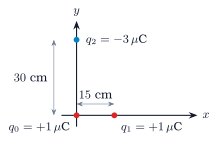
In the figure, \(q_0 = +1\,\mu\)C sits at the origin. The charges \(q_1 = +1\,\mu\)C and \(q_2 = -3\,\mu\)C lie on the \(x\)-axis and the \(y\)-axis.
Find the force on \(q_0\) due to \(q_1\) and the force on \(q_0\) due to \(q_2\). Give their directions.
Find the magnitude of the net force on \(q_0\) and the angle it makes with the \(x\)-axis.
Answer(i) \(0.4\) N, \(0.3\) N (ii) \(0.5\) N at \(37^\circ\)
Solution
Due to \(q_1\): \(F_1 = \dfrac{9 \times 10^9 \times 1 \times 10^{-6} \times 1 \times 10^{-6}}{(0.15)^2} = \dfrac{0.009}{0.0225} = 0.4\) N. Like charges, so \(q_0\) is pushed away from \(q_1\), along \(-x\).
Due to \(q_2\): \(F_2 = \dfrac{9 \times 10^9 \times 1 \times 10^{-6} \times 3 \times 10^{-6}}{(0.3)^2} = \dfrac{0.027}{0.09} = 0.3\) N. Unlike charges, so \(q_0\) is pulled towards \(q_2\), along \(+y\).
The two forces are at right angles. \(F = \sqrt{0.4^2 + 0.3^2} = 0.5\) N.
\(\tan\theta = \dfrac{0.3}{0.4} = \dfrac{3}{4}\), so \(\theta = 37^\circ\) measured from the \(-x\) direction towards \(+y\).
How did it go?
Null points and equilibrium
Q10
Charges \(+4\,\mu\)C and \(+1\,\mu\)C are \(30\) cm apart.
Find the point on the line joining them where a third charge \(q\) feels no net force.
Does the position of this point depend on the sign or the size of \(q\)?
Answer(i) \(20\) cm from \(4\,\mu\)C (ii) no
Solution
Both charges are positive, so the null point lies between them. Let it be \(x\) from the \(4\,\mu\)C charge and \((0.3 - x)\) from the \(1\,\mu\)C charge.
\(0.6 - 2x = x\), so \(x = 0.2\) m. The null point is \(20\) cm from the \(4\,\mu\)C charge.
No. The charge \(q\) cancels from the equation. The point is fixed by the two given charges only.
How did it go?
Q11
Charges \(+4\,\mu\)C and \(-1\,\mu\)C are \(30\) cm apart. Find the point on the line through them where a third charge feels no net force.
Answer\(30\) cm beyond \(-1\,\mu\)C
Solution
The charges are unlike, so between them the two forces on a third charge point the same way. The null point lies outside, on the side of the smaller charge.
Let the point be \(x\) from \(+4\,\mu\)C, so \((x - 0.3)\) from \(-1\,\mu\)C: \(\dfrac{4}{x^2} = \dfrac{1}{(x - 0.3)^2}\).
\(2(x - 0.3) = x\), so \(x = 0.6\) m. The point is \(60\) cm from \(+4\,\mu\)C, that is, \(30\) cm beyond the \(-1\,\mu\)C charge.
How did it go?
Q12
A charge of \(+4\,\mu\)C is placed at \(x = 0\) and another \(+4\,\mu\)C at \(x = 40\) cm.
Where on the line joining them should a third charge be placed so that it stays in equilibrium?
Find the sign and value of the third charge so that all three charges are in equilibrium.
Answer(i) \(x = 20\) cm (ii) \(-1\,\mu\)C
Solution
The two charges are equal, so the forces on a third charge cancel only at the midpoint, \(x = 20\) cm.
Now the charge at \(x = 0\) must also be in equilibrium. It is pushed by the other \(+4\,\mu\)C at \(40\) cm and pulled by \(q\) at \(20\) cm.
The pull must balance the push, so \(q\) is negative: \(q = -1\,\mu\)C. By symmetry the charge at \(x = 40\) cm is then also in equilibrium.
How did it go?
Q13
Three equal charges of \(2\,\mu\)C are placed at the corners of an equilateral triangle of side \(20\) cm.
Find the force on one charge due to each of the other two.
Find the net force on that charge. State its direction.
Answer(i) \(0.9\) N (ii) \(0.9\sqrt{3} \approx 1.56\) N
Solution
\(F = \dfrac{kq^2}{a^2} = \dfrac{9 \times 10^9 \times (2 \times 10^{-6})^2}{(0.2)^2} = \dfrac{0.036}{0.04} = 0.9\) N from each of the other two charges.
The two forces have equal magnitude and the angle between them is \(60^\circ\).
By symmetry the net force lies along the bisector of the angle at that corner, pointing away from the centre of the triangle.
How did it go?
Q14
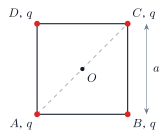
Four equal charges \(q = 1\,\mu\)C sit at the corners \(A\), \(B\), \(C\), \(D\) of a square of side \(a = 10\) cm.
Find the force on the charge at \(A\) due to the charges at \(B\), at \(C\) and at \(D\).
Find the net force on the charge at \(A\). State its direction.
A fifth charge \(Q\) is placed at the centre \(O\). Find the net force on \(Q\).
Answer(i) \(0.9\), \(0.45\), \(0.9\) N (ii) \(1.72\) N (iii) \(0\)
Solution
\(\dfrac{kq^2}{a^2} = \dfrac{9 \times 10^9 \times (10^{-6})^2}{(0.1)^2} = 0.9\) N.
Due to \(B\) (distance \(a\)): \(0.9\) N along \(BA\). Due to \(D\) (distance \(a\)): \(0.9\) N along \(DA\).
Due to \(C\) (distance \(a\sqrt{2}\)): \(\dfrac{kq^2}{2a^2} = 0.45\) N along \(CA\).
The forces due to \(B\) and \(D\) are at right angles. Their resultant is \(0.9\sqrt{2}\) N along the diagonal \(CA\), the same line as the force due to \(C\).
\(F_{\text{net}} = 0.9\sqrt{2} + 0.45 = 0.9\left(\sqrt{2} + \dfrac{1}{2}\right) \approx 1.72\) N, along \(CA\) away from the square.
\(O\) is equidistant from the four equal charges. The forces due to \(A\) and \(C\) cancel, and so do the forces due to \(B\) and \(D\). The net force on \(Q\) is zero.
How did it go?
Q15
Six equal charges \(q\) sit at the corners of a regular hexagon of side \(a\). A charge \(q_0\) is at the centre.
Find the net force on \(q_0\).
One of the six charges is removed. Find the net force on \(q_0\) now, with its direction.
Answer(i) \(0\) (ii) \(kqq_0/a^2\), to the gap
Solution
In a regular hexagon each corner is a distance \(a\) from the centre. The six forces on \(q_0\) are equal in size, and opposite corners act in opposite directions. The net force is zero.
The six forces add to zero, so the five remaining forces add to the negative of the missing force.
The missing charge would push \(q_0\) away from its corner with force \(\dfrac{kqq_0}{a^2}\) (like charges). So the five charges give \(\dfrac{kqq_0}{a^2}\) directed towards the empty corner.
How did it go?
Q16
Five equal charges \(q\) sit at the corners of a regular pentagon. Each corner is a distance \(R\) from the centre, where a charge \(q_0\) is placed.
Find the net force on \(q_0\).
One of the five charges is replaced by \(-q\). Find the net force on \(q_0\) now, with its direction.
Answer(i) \(0\) (ii) \(2kqq_0/R^2\), to \(-q\)
Solution
The five forces have equal size and are spaced at \(72^\circ\). By symmetry their vector sum is zero.
Replacing \(+q\) by \(-q\) at one corner reverses that one force. The change in the net force is \(-2\vec{F}_1\), where \(\vec{F}_1\) is the original force due to that charge.
Originally \(\vec{F}_1\) pushed \(q_0\) away from the corner with magnitude \(\dfrac{kqq_0}{R^2}\). So the new net force is \(\dfrac{2kqq_0}{R^2}\), directed towards the \(-q\) charge.
How did it go?
Small situations
Q17
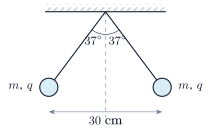
Two identical balls of mass \(120\) g hang from one point by light threads and carry equal charges \(q\). At equilibrium each thread makes \(37^\circ\) with the vertical and the balls are \(30\) cm apart. Take \(g = 10\) m/s\(^2\), \(\tan 37^\circ = 3/4\), \(\cos 37^\circ = 4/5\).
Find the electric force between the balls.
Find \(q\).
Find the tension in each thread.
Answer(i) \(0.9\) N (ii) \(3\,\mu\)C (iii) \(1.5\) N
Solution
Three forces act on each ball: the weight \(mg\) down, the tension \(T\) along the thread, and the electric force \(F\) horizontal.
In a hydrogen atom the electron is \(5.3 \times 10^{-11}\) m from the proton. Take \(e = 1.6 \times 10^{-19}\) C, \(m_e = 9.1 \times 10^{-31}\) kg, \(m_p = 1.67 \times 10^{-27}\) kg, \(G = 6.67 \times 10^{-11}\) SI units.
Find the electric force between the electron and the proton.
Find the ratio of the electric force to the gravitational force between them.
Answer(i) \(8.2 \times 10^{-8}\) N (ii) \(2.3 \times 10^{39}\)
\(\dfrac{2.4 \times 10^{-19}}{1.6 \times 10^{-19}} = 1.5\). Charge comes in whole multiples of \(e\), so a charge of \(1.5e\) is not possible.
How did it go?
Q22
Two charges are \(20\) cm apart inside a medium of dielectric constant \(K = 4\). At what separation in air would the force between them be the same?
Answer\(40\) cm
Solution
In the medium: \(F = \dfrac{kq_1 q_2}{K r^2}\). In air at distance \(r'\): \(F = \dfrac{kq_1 q_2}{r'^2}\).
Equal forces need \(r'^2 = K r^2\), so \(r' = r\sqrt{K} = 0.2 \times 2 = 0.4\) m \(= 40\) cm.
How did it go?
Q23
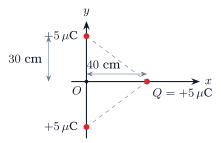
Two charges of \(+5\,\mu\)C are on the \(y\)-axis at \(y = \pm 30\) cm. A charge \(Q = +5\,\mu\)C is on the \(x\)-axis at \(x = 40\) cm.
Find the force on \(Q\) due to each of the two charges.
Find the net force on \(Q\). State its direction.
Find the net force on \(Q\) if \(Q\) is moved to the origin \(O\).
Answer(i) \(0.9\) N (ii) \(1.44\) N, \(+x\) (iii) \(0\)
Solution
Distance from each charge to \(Q\): \(\sqrt{0.3^2 + 0.4^2} = 0.5\) m.
\(F = \dfrac{9 \times 10^9 \times 5 \times 10^{-6} \times 5 \times 10^{-6}}{(0.5)^2} = \dfrac{0.225}{0.25} = 0.9\) N from each, directed away from that charge (repulsion).
Each force makes an angle \(\theta\) with the \(x\)-axis where \(\cos\theta = \dfrac{0.4}{0.5} = 0.8\). The \(y\)-components are equal and opposite and cancel.
The \(x\)-components add: \(F_{\text{net}} = 2 \times 0.9 \times 0.8 = 1.44\) N along \(+x\), away from the origin.
At \(O\) the two charges are equidistant and on opposite sides. Their forces on \(Q\) are equal and opposite, so the net force is zero.
How did it go?
Q24
The corners \(A\), \(B\), \(C\) of a square of side \(a\) carry \(+q\) each and the corner \(D\) carries \(-q\). A charge \(+Q\) is placed at the centre of the square.
Find the net force on \(Q\) in terms of \(k\), \(q\), \(Q\) and \(a\). State its direction.
Find the force for \(q = 2\,\mu\)C, \(Q = 1\,\mu\)C and \(a = 20\) cm.
Answer(i) \(4kqQ/a^2\), to \(D\) (ii) \(1.8\) N
Solution
Each corner is a distance \(\dfrac{a}{\sqrt{2}}\) from the centre, so each charge acts on \(Q\) with magnitude \(\dfrac{kqQ}{(a/\sqrt{2})^2} = \dfrac{2kqQ}{a^2}\).
\(A\) and \(C\) are opposite corners with equal charges \(+q\). Their pushes on \(Q\) are equal and opposite and cancel.
\(B\) (\(+q\)) pushes \(Q\) away from \(B\), that is, towards \(D\). \(D\) (\(-q\)) pulls \(Q\) towards \(D\). These two add.
\(F_{\text{net}} = 2 \times \dfrac{2kqQ}{a^2} = \dfrac{4kqQ}{a^2}\), directed from the centre towards \(D\).
21 questions · after Lesson 6, Rings, Arcs, Discs and Sheets
Field of a point charge
Q25
A force of \(0.01\) N acts on a charge of \(2\,\mu\)C placed at a point. Take \(k = \frac{1}{4\pi\varepsilon_0} = 9 \times 10^9\) SI units and \(\varepsilon_0 = 8.85 \times 10^{-12}\) C\(^2\)/N m\(^2\) throughout this sheet.
Find the electric field \(E\) at the point.
A charge of \(-4\,\mu\)C is placed at the same point. Find the force on it and its direction relative to \(E\).
Answer(i) \(5000\) N/C (ii) \(0.02\) N, opposite to \(E\)
Solution
\(E = \dfrac{F}{q} = \dfrac{0.01}{2 \times 10^{-6}} = 5000\) N/C. The field points along the force on the positive charge.
\(F = |q|E = 4 \times 10^{-6} \times 5000 = 0.02\) N. The charge is negative, so the force is opposite to \(E\).
How did it go?
Q26
A point charge of \(4\,\mu\)C is placed in air. Find the electric field at \(20\) cm and at \(40\) cm from the charge. State the direction of the field.
At \(40\) cm the distance is doubled, so \(E\) is one quarter: \(2.25 \times 10^5\) N/C.
The charge is positive, so the field points away from the charge at every point.
How did it go?
Q27
Charges \(+2\,\mu\)C and \(-2\,\mu\)C are \(20\) cm apart.
Find the electric field at the midpoint of the line joining them.
Find the field at the midpoint if both charges are \(+2\,\mu\)C.
Answer(i) \(3.6 \times 10^6\) N/C, towards \(-2\,\mu\)C (ii) \(0\)
Solution
Each charge is \(10\) cm from the midpoint: \(E_1 = E_2 = \dfrac{9 \times 10^9 \times 2 \times 10^{-6}}{(0.1)^2} = 1.8 \times 10^6\) N/C.
The field of \(+2\,\mu\)C points away from it, towards \(-2\,\mu\)C. The field of \(-2\,\mu\)C points towards itself. Both fields point the same way.
\(E = 1.8 \times 10^6 + 1.8 \times 10^6 = 3.6 \times 10^6\) N/C, directed from the positive charge to the negative charge.
For two equal positive charges the two fields at the midpoint are equal and opposite. \(E = 0\).
How did it go?
Q28
A particle of mass \(1\) g and charge \(2\,\mu\)C is released from rest in a uniform field of \(5000\) N/C. Ignore gravity.
Find the acceleration of the particle.
Find the time taken to travel \(20\) m.
Answer(i) \(10\) m/s\(^2\) (ii) \(2\) s
Solution
\(F = qE = 2 \times 10^{-6} \times 5000 = 0.01\) N. \(a = \dfrac{F}{m} = \dfrac{0.01}{0.001} = 10\) m/s\(^2\).
From rest, \(s = \dfrac{1}{2}at^2\): \(20 = \dfrac{1}{2} \times 10 \times t^2\), so \(t = 2\) s.
How did it go?
Q29
A charge of \(5\,\mu\)C is at the origin. Find the electric field at the point \((3\) m\(, 4\) m\()\). Give its magnitude and its \(x\) and \(y\) components.
Distance from the origin: \(r = \sqrt{3^2 + 4^2} = 5\) m.
\(E = \dfrac{kq}{r^2} = \dfrac{9 \times 10^9 \times 5 \times 10^{-6}}{25} = 1800\) N/C, directed away from the origin along the line to the point.
The unit vector along this line is \(\left(\dfrac{3}{5}, \dfrac{4}{5}\right)\). So \(E_x = 1800 \times \dfrac{3}{5} = 1080\) N/C and \(E_y = 1800 \times \dfrac{4}{5} = 1440\) N/C.
How did it go?
Line charge
Q30
A charge of \(10\,\mu\)C is spread uniformly over a rod of length \(50\) cm.
Find the linear charge density \(\lambda\).
Find the charge on a \(5\) cm piece of the rod.
Write the charge \(dq\) on a small element of length \(dx\).
Answer(i) \(20\,\mu\)C/m (ii) \(1\,\mu\)C (iii) \(dq = \lambda\,dx\)
\(E \propto \dfrac{1}{r}\), so the field halves when the distance doubles: \(r = 20\) cm.
For a long wire \(E \propto \dfrac{1}{r}\). For a point charge \(E \propto \dfrac{1}{r^2}\). The field of the wire falls more slowly with distance.
How did it go?
Q32
A rod of length \(60\) cm carries \(\lambda = 5\,\mu\)C/m. The point \(P\) is \(40\) cm from the midpoint of the rod, on its perpendicular bisector. For a straight rod, \(E_\perp = \frac{k\lambda}{r}(\sin\alpha + \sin\beta)\), where \(\alpha\) and \(\beta\) are the angles the two ends subtend at \(P\) with the perpendicular.
Find the field at \(P\).
Find the field at \(P\) if the whole charge of the rod were placed at its midpoint. Which is larger, and why?
Answer(i) \(1.35 \times 10^5\) N/C (ii) \(1.69 \times 10^5\) N/C
Solution
Each half of the rod is \(30\) cm long and \(P\) is \(40\) cm from the midpoint. The distance from \(P\) to either end is \(\sqrt{0.3^2 + 0.4^2} = 0.5\) m.
By symmetry \(\alpha = \beta\) with \(\sin\alpha = \dfrac{0.3}{0.5} = 0.6\).
\(E = \dfrac{k\lambda}{r}(2\sin\alpha) = \dfrac{9 \times 10^9 \times 5 \times 10^{-6}}{0.4} \times 1.2 = 2.25 \times 10^5 \times 0.6 = 1.35 \times 10^5\) N/C, perpendicular to the rod.
Total charge \(Q = \lambda L = 5 \times 0.6 = 3\,\mu\)C. As a point charge at \(40\) cm: \(E = \dfrac{9 \times 10^9 \times 3 \times 10^{-6}}{(0.4)^2} \approx 1.69 \times 10^5\) N/C.
The point-charge value is larger. In the real rod the ends are farther from \(P\) than the midpoint, and their fields are tilted. Only the perpendicular components add.
How did it go?
Q33
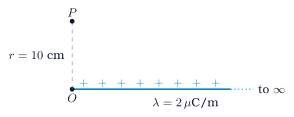
The figure shows a very long rod that starts at \(O\) and extends to the right. It carries \(\lambda = 2\,\mu\)C/m. The point \(P\) is \(10\) cm from \(O\), on the perpendicular to the rod at \(O\).
Use the formula of Question 8 to show that the component of the field at \(P\) perpendicular to the rod is \(\frac{k\lambda}{r}\). Find its value.
The component parallel to the rod is also \(\frac{k\lambda}{r}\). Find the net field at \(P\) and the angle it makes with the rod.
The near end is at the foot of the perpendicular, so \(\alpha = 0\). The far end is at infinity, so \(\beta = 90^\circ\).
\(E_\perp = \dfrac{k\lambda}{r}(\sin 0 + \sin 90^\circ) = \dfrac{k\lambda}{r} = \dfrac{9 \times 10^9 \times 2 \times 10^{-6}}{0.1} = 1.8 \times 10^5\) N/C, away from the rod.
\(E_\parallel = \dfrac{k\lambda}{r} = 1.8 \times 10^5\) N/C, directed away from the rod along its length (away from the far end).
The two components are equal, so \(E = \sqrt{2} \times 1.8 \times 10^5 \approx 2.55 \times 10^5\) N/C, at \(45^\circ\) to the rod.
How did it go?
Q34
A rod of length \(L = 30\) cm carries a charge \(Q = 6\,\mu\)C spread uniformly. The point \(P\) lies on the line of the rod, \(a = 20\) cm from the nearer end.
Show that the field at \(P\) is \(E = \frac{kQ}{a(a + L)}\).
Find \(E\) for the given values.
What does the formula become when \(a \gg L\)? Explain the result.
Put \(P\) at the origin and the rod along \(x\) from \(x = a\) to \(x = a + L\). An element \(dx\) at \(x\) carries \(dq = \lambda\,dx\) with \(\lambda = \dfrac{Q}{L}\).
Its field at \(P\) is \(dE = \dfrac{k\lambda\,dx}{x^2}\), and every element's field points the same way (away from the rod).
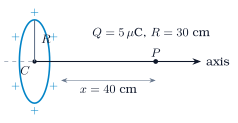
\(E = \dfrac{9 \times 10^9 \times 5 \times 10^{-6} \times 0.4}{0.125} = \dfrac{1.8 \times 10^4}{0.125} = 1.44 \times 10^5\) N/C, along the axis away from the ring.
\(E = 0\) at the centre. Every element of the ring has a partner directly opposite it, at the same distance. Their fields at \(C\) are equal and opposite, so all cancel.
For \(x \gg R\), \(R^2 + x^2 \approx x^2\) and \(E \approx \dfrac{kQx}{x^3} = \dfrac{kQ}{x^2}\). From far away the ring looks like a point charge \(Q\).
How did it go?
Q36
For the ring of Question 11, the field on the axis is largest at \(x = \frac{R}{\sqrt{2}}\).
Find this value of \(x\).
Show that the largest field is \(E_{\max} = \frac{2kQ}{3\sqrt{3}\,R^2}\) and find its value.
Answer(i) \(0.21\) m (ii) \(1.92 \times 10^5\) N/C
Solution
\(x = \dfrac{R}{\sqrt{2}} = \dfrac{0.3}{1.414} \approx 0.21\) m.
Put \(x = \dfrac{R}{\sqrt{2}}\): \(R^2 + x^2 = \dfrac{3R^2}{2}\), so \((R^2 + x^2)^{3/2} = \dfrac{3\sqrt{3}}{2\sqrt{2}}R^3\).
An arc of radius \(R = 10\) cm carries \(\lambda = 2\,\mu\)C/m. For an arc of angle \(\theta\), the field at the centre is \(E = \frac{2k\lambda}{R}\sin\frac{\theta}{2}\). Find the field at the centre for
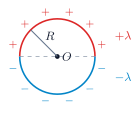
The ring in the figure has radius \(R = 10\) cm. The upper half carries \(+\lambda\) and the lower half carries \(-\lambda\), with \(\lambda = 2\,\mu\)C/m.
Find the field at \(O\) due to each half. Give the directions.
Find the net field at \(O\).
Answer(i) \(3.6 \times 10^5\) N/C each (ii) \(7.2 \times 10^5\) N/C, down
Solution
Each half is a semicircle, so each gives \(\dfrac{2k\lambda}{R} = \dfrac{2 \times 9 \times 10^9 \times 2 \times 10^{-6}}{0.1} = 3.6 \times 10^5\) N/C at \(O\).
The positive upper half pushes a test charge at \(O\) away from itself, that is, downward. The negative lower half pulls the test charge towards itself, also downward.
The two fields point the same way. \(E = 2 \times 3.6 \times 10^5 = 7.2 \times 10^5\) N/C, directed from the positive half towards the negative half.
How did it go?
Q40
Show that the field at the centre of a uniformly charged semicircular arc of radius \(R\) is \(\frac{2k\lambda}{R}\).
Answerderivation
Solution
Let the arc run from \(\theta = -\dfrac{\pi}{2}\) to \(+\dfrac{\pi}{2}\), measured from the symmetry line through the centre.
An element of length \(R\,d\theta\) carries \(dq = \lambda R\,d\theta\) and gives \(dE = \dfrac{k\lambda R\,d\theta}{R^2} = \dfrac{k\lambda}{R}d\theta\) at the centre, directed away from the element.
The component along the symmetry line is \(dE\cos\theta\). The perpendicular components cancel in pairs by symmetry.
A disc of radius \(R = 30\) cm carries \(\sigma = 1.77 \times 10^{-8}\) C/m\(^2\). On its axis, \(E = \frac{\sigma}{2\varepsilon_0}\left(1 - \frac{x}{\sqrt{x^2 + R^2}}\right)\).
Find \(\frac{\sigma}{2\varepsilon_0}\).
Find \(E\) at \(x = 40\) cm.
Find \(E\) very close to the surface of the disc.
Answer(i) \(1000\) N/C (ii) \(200\) N/C (iii) \(1000\) N/C
\(\sqrt{x^2 + R^2} = \sqrt{0.16 + 0.09} = 0.5\) m, so \(\dfrac{x}{\sqrt{x^2 + R^2}} = \dfrac{0.4}{0.5} = 0.8\).
\(E = 1000 \times (1 - 0.8) = 200\) N/C.
Very close to the surface \(x \to 0\), so the bracket becomes \(1\) and \(E = \dfrac{\sigma}{2\varepsilon_0} = 1000\) N/C.
How did it go?
Q42
A large plane sheet carries \(\sigma = 8.85 \times 10^{-9}\) C/m\(^2\).
Find the field near the sheet.
Does the field change as one moves away from the sheet? Give the reason.
A second sheet with \(-\sigma\) is placed parallel to the first. Find the field between the sheets and outside them.
Answer(i) \(500\) N/C (ii) no (iii) \(1000\) N/C, \(0\)
Solution
\(E = \dfrac{\sigma}{2\varepsilon_0} = \dfrac{8.85 \times 10^{-9}}{2 \times 8.85 \times 10^{-12}} = 500\) N/C, perpendicular to the sheet, pointing away.
No. The formula has no distance in it. For an infinite sheet the field lines are parallel and evenly spaced, so the field is uniform.
Between the sheets, the field of \(+\sigma\) points away from it and the field of \(-\sigma\) points towards it. Both point the same way: \(E = 500 + 500 = 1000\) N/C, from \(+\sigma\) to \(-\sigma\).
Outside, the two fields are opposite and equal: \(E = 0\).
How did it go?
Q43
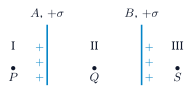
The two large sheets \(A\) and \(B\) in the figure each carry \(\sigma = 8.85 \times 10^{-9}\) C/m\(^2\). Find the field at \(P\), at \(Q\) and at \(S\), with directions.
Answer\(P\): \(1000\) N/C left; \(Q\): \(0\); \(S\): \(1000\) N/C right
Solution
Each sheet gives \(\dfrac{\sigma}{2\varepsilon_0} = 500\) N/C, pointing away from that sheet on both sides.
At \(P\) (left of both): both fields point left. \(E = 1000\) N/C to the left.
At \(S\) (right of both): both fields point right. \(E = 1000\) N/C to the right.
How did it go?
Q44
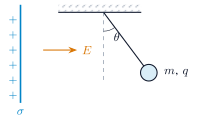
A ball of mass \(2\) g carrying \(3\,\mu\)C hangs by a thread beside a large vertical sheet with \(\sigma = 8.85 \times 10^{-8}\) C/m\(^2\). Take \(g = 10\) m/s\(^2\).
Find the field \(E\) of the sheet and the electric force on the ball.
Find the angle \(\theta\) of the thread with the vertical and the tension in the thread.
Answer(i) \(5000\) N/C, \(0.015\) N (ii) \(37^\circ\), \(0.025\) N
Solution
\(E = \dfrac{\sigma}{2\varepsilon_0} = \dfrac{8.85 \times 10^{-8}}{2 \times 8.85 \times 10^{-12}} = 5000\) N/C, horizontal, away from the sheet.
\(F = qE = 3 \times 10^{-6} \times 5000 = 0.015\) N, pushing the ball away from the sheet.
Weight \(mg = 0.002 \times 10 = 0.02\) N. Balance: \(T\sin\theta = qE\) and \(T\cos\theta = mg\).
A wire bent into a square of side \(a\) carries a uniform \(\lambda\).
Find the field at the centre of the square.
One side of the square is removed. Find the field at the centre now, with its direction.
Answer(i) \(0\) (ii) \(2\sqrt{2}\,k\lambda/a\), towards the gap
Solution
Opposite sides are identical and equidistant from the centre. Their fields at the centre are equal and opposite. Both pairs cancel, so \(E = 0\).
The four sides gave zero, so the three remaining sides give the negative of the field of the missing side.
One side is a rod of length \(a\) at perpendicular distance \(r = \dfrac{a}{2}\) from its midpoint. Each end subtends \(45^\circ\), so \(E_{\text{side}} = \dfrac{k\lambda}{a/2}(2\sin 45^\circ) = \dfrac{2\sqrt{2}\,k\lambda}{a}\).
The missing side would push a test charge away from itself, towards the opposite side. So the three sides give \(\dfrac{2\sqrt{2}\,k\lambda}{a}\) directed towards the gap.