Questions on Electric Potential, Energy and the Dipole, the kind your examinations ask. Solve one on paper. Then tell the book how it went. The book believes you, and it uses your answer to plan your revision.
0%
Nothing marked yetMark honestly. Peek at the answer only after your own attempt.
Electric Potential and Field as a Gradient
22 questions · after Lesson 4, Field from Potential and Equipotential Surfaces
Potential of point charges
Q1
An external agent slowly brings a charge of \(2\,\mu\)C from infinity to a point \(P\). The agent does \(4 \times 10^{-3}\) J of work. Take \(k = 9 \times 10^9\) SI units throughout this sheet.
Find the potential at \(P\).
Find the work needed to bring a charge of \(-1\,\mu\)C from infinity to \(P\).
\(W = qV = (-1 \times 10^{-6})(2000) = -2 \times 10^{-3}\) J. The field pulls the negative charge in, so the agent does negative work.
How did it go?
Q2
A point charge of \(4\,\mu\)C is placed in air.
Find the potential at \(20\) cm and at \(40\) cm from the charge.
Is the potential a scalar or a vector? What is the potential at infinity?
Answer(i) \(1.8 \times 10^5\) V, \(9 \times 10^4\) V (ii) scalar; \(0\)
Solution
\(V = \dfrac{kq}{r}\). At \(20\) cm: \(V = \dfrac{9 \times 10^9 \times 4 \times 10^{-6}}{0.2} = 1.8 \times 10^5\) V.
At \(40\) cm the distance is doubled, so \(V\) is halved: \(9 \times 10^4\) V.
Potential is a scalar; it has a value but no direction. At infinity \(V = 0\) by choice.
How did it go?
Q3
Charges \(+2\,\mu\)C and \(-2\,\mu\)C are \(20\) cm apart.
Find the potential at the midpoint of the line joining them.
Is the electric field at the midpoint also zero? Give the reason.
Answer(i) \(0\) (ii) no, \(3.6 \times 10^6\) N/C
Solution
Each charge is \(10\) cm from the midpoint. \(V = \dfrac{k(2 \times 10^{-6})}{0.1} + \dfrac{k(-2 \times 10^{-6})}{0.1} = 0\). Potentials add as numbers, and these two cancel.
No. The fields of the two charges at the midpoint both point from \(+2\,\mu\)C towards \(-2\,\mu\)C, so they add.
\(E = 2 \times \dfrac{9 \times 10^9 \times 2 \times 10^{-6}}{(0.1)^2} = 3.6 \times 10^6\) N/C. Zero potential does not mean zero field.
How did it go?
Q4
Charges \(+3\,\mu\)C and \(-2\,\mu\)C are \(30\) cm apart. Find the two points on the line through them where the potential is zero: one between the charges and one outside.
Answer\(18\) cm and \(90\) cm from \(+3\,\mu\)C
Solution
Between the charges, at \(x\) from \(+3\,\mu\)C: \(\dfrac{k(3)}{x} = \dfrac{k(2)}{0.3 - x}\), so \(0.9 - 3x = 2x\) and \(x = 0.18\) m.
Outside, the point must be nearer the smaller charge, at \(x\) from \(+3\,\mu\)C: \(\dfrac{3}{x} = \dfrac{2}{x - 0.3}\), so \(3x - 0.9 = 2x\) and \(x = 0.9\) m.
The two zero-potential points are \(18\) cm and \(90\) cm from the \(+3\,\mu\)C charge.
How did it go?
Q5
Four charges of \(2\,\mu\)C each sit at the corners of a square whose diagonal is \(20\) cm.
Find the potential at the centre of the square.
Find the electric field at the centre.
Answer(i) \(7.2 \times 10^5\) V (ii) \(0\)
Solution
Each corner is half a diagonal, \(10\) cm, from the centre. \(V = 4 \times \dfrac{9 \times 10^9 \times 2 \times 10^{-6}}{0.1} = 7.2 \times 10^5\) V.
The fields of opposite corners are equal and opposite at the centre. \(E = 0\). Potentials add as numbers; fields add as vectors.
How did it go?
Q6
A charge of \(5\,\mu\)C is at the origin. Find the potential at the point \((3\) m\(, 4\) m\()\). Does the answer depend on the direction of the point from the origin?
No. The potential of a point charge depends only on the distance \(r\), not on the direction.
How did it go?
Potential difference and work
Q7
The potentials at two points are \(V_A = 100\) V and \(V_B = 40\) V.
Find the work done by an external agent to move \(2\,\mu\)C slowly from \(B\) to \(A\).
Find the work done by the electric field in the same move.
Answer(i) \(1.2 \times 10^{-4}\) J (ii) \(-1.2 \times 10^{-4}\) J
Solution
\(W_{\text{ext}} = q(V_A - V_B) = 2 \times 10^{-6} \times (100 - 40) = 1.2 \times 10^{-4}\) J. Positive, since a positive charge is pushed to a higher potential.
The field does the opposite work: \(W_{\text{field}} = -1.2 \times 10^{-4}\) J.
How did it go?
Q8
An electron starts from rest and is accelerated through a potential difference of \(100\) V. Take \(e = 1.6 \times 10^{-19}\) C and \(m_e = 9.1 \times 10^{-31}\) kg.
Find its kinetic energy in joules and in electron volts.
Find its speed.
Answer(i) \(1.6 \times 10^{-17}\) J, \(100\) eV (ii) \(5.9 \times 10^6\) m/s
Solution
\(KE = eV = 1.6 \times 10^{-19} \times 100 = 1.6 \times 10^{-17}\) J. In electron volts this is simply \(100\) eV.
A charge of \(2\,\mu\)C is released from rest at a point \(B\) where \(V = 200\) V. It reaches a point \(A\) where \(V = 50\) V.
Find the change in its potential energy.
Find its kinetic energy at \(A\).
Answer(i) \(-3 \times 10^{-4}\) J (ii) \(3 \times 10^{-4}\) J
Solution
\(\Delta U = q(V_A - V_B) = 2 \times 10^{-6} \times (50 - 200) = -3 \times 10^{-4}\) J. A positive charge loses potential energy when it moves to a lower potential.
Energy is conserved: \(KE_A = -\Delta U = 3 \times 10^{-4}\) J.
How did it go?
Q10
A thin spherical shell of radius \(10\) cm carries \(2\,\mu\)C. Find the potential
on the surface,
at the centre,
at \(20\) cm from the centre.
Answer(i) \(1.8 \times 10^5\) V (ii) same (iii) \(9 \times 10^4\) V
Solution
Outside and on the surface, the shell acts like a point charge at its centre. \(V = \dfrac{kQ}{R} = \dfrac{9 \times 10^9 \times 2 \times 10^{-6}}{0.1} = 1.8 \times 10^5\) V.
Inside the shell \(E = 0\), so the potential does not change from the surface to the centre. \(V = 1.8 \times 10^5\) V.
At \(20\) cm: \(V = \dfrac{kQ}{r} = \dfrac{9 \times 10^9 \times 2 \times 10^{-6}}{0.2} = 9 \times 10^4\) V.
How did it go?
Continuous bodies
Q11
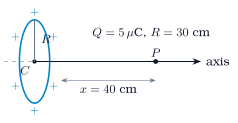
The ring in the figure has radius \(R = 30\) cm and carries \(Q = 5\,\mu\)C.
Find the potential at the centre \(C\).
Find the potential at \(P\) on the axis, where \(x = 40\) cm.
Why is the field at \(C\) zero although the potential there is not?
Answer(i) \(1.5 \times 10^5\) V (ii) \(9 \times 10^4\) V
Solution
Every element of the ring is a distance \(R\) from \(C\). \(V = \dfrac{kQ}{R} = \dfrac{9 \times 10^9 \times 5 \times 10^{-6}}{0.3} = 1.5 \times 10^5\) V.
Every element is a distance \(\sqrt{R^2 + x^2} = 0.5\) m from \(P\). \(V = \dfrac{kQ}{0.5} = 9 \times 10^4\) V.
Potential is a scalar, so the contributions of all elements add. Field is a vector, and at \(C\) the fields of opposite elements cancel in pairs.
How did it go?
Q12
A wire bent into a semicircle of radius \(10\) cm carries \(2\,\mu\)C.
Find the potential at the centre.
The same wire is bent into a full circle of the same radius. Find the potential at the centre now.
Does the potential at the centre depend on how the charge is spread along the arc?
Answer(i) \(1.8 \times 10^5\) V (ii) same (iii) no
Solution
Every element of the semicircle is \(R\) from the centre. \(V = \dfrac{kQ}{R} = \dfrac{9 \times 10^9 \times 2 \times 10^{-6}}{0.1} = 1.8 \times 10^5\) V.
The same: every element is still \(R\) from the centre. \(V = 1.8 \times 10^5\) V.
No. The potential at the centre depends only on the total charge and the radius, because every bit of charge is at the same distance.
How did it go?
Q13
A rod of length \(L = 30\) cm carries \(\lambda = 2\,\mu\)C/m. The point \(P\) lies on the line of the rod, \(a = 10\) cm from the nearer end.
Show that the potential at \(P\) is \(V = k\lambda\ln\frac{a + L}{a}\).
Put \(P\) at the origin and the rod from \(x = a\) to \(x = a + L\). An element \(dx\) carries \(dq = \lambda\,dx\) and gives \(dV = \dfrac{k\lambda\,dx}{x}\).
A disc of radius \(R = 30\) cm carries \(\sigma = 1.77 \times 10^{-8}\) C/m\(^2\). On its axis, \(V = \frac{\sigma}{2\varepsilon_0}\left(\sqrt{x^2 + R^2} - x\right)\). Take \(\varepsilon_0 = 8.85 \times 10^{-12}\) SI units.
At the centre \(x = 0\): \(V = 1000 \times (R - 0) = 1000 \times 0.3 = 300\) V.
\(\sqrt{x^2 + R^2} = \sqrt{0.16 + 0.09} = 0.5\) m. \(V = 1000 \times (0.5 - 0.4) = 100\) V.
How did it go?
Field from potential
Q15
The potential in a region is \(V = 5x + 3\), with \(V\) in volts and \(x\) in metres.
Find the electric field. State its direction.
Is the field the same at every point? Give the reason.
Answer(i) \(5\) V/m along \(-x\) (ii) yes, uniform
Solution
\(E_x = -\dfrac{dV}{dx} = -5\) V/m. The field has magnitude \(5\) V/m and points along \(-x\), from higher potential to lower potential.
Yes. The derivative of \(5x + 3\) is the constant \(5\), so \(E\) is the same everywhere. The field is uniform.
How did it go?
Q16
The potential is \(V = 2x^2 - 3y\), in SI units. Find the components \(E_x\) and \(E_y\) of the field, and the magnitude of the field at the point \((1\) m\(, 2\) m\()\).
Answer\(E_x = -4x\), \(E_y = 3\); \(5\) V/m
Solution
\(E_x = -\dfrac{\partial V}{\partial x} = -4x\) and \(E_y = -\dfrac{\partial V}{\partial y} = 3\), in V/m.
The potential around a point charge is \(V = \frac{20}{r}\), with \(V\) in volts and \(r\) in metres.
Find \(E\) as a function of \(r\), using \(E = -\frac{dV}{dr}\). State its direction.
Find \(E\) at \(r = 2\) m.
Find the charge.
Answer(i) \(20/r^2\), outward (ii) \(5\) V/m (iii) \(2.2\) nC
Solution
\(E = -\dfrac{dV}{dr} = -\dfrac{d}{dr}\left(\dfrac{20}{r}\right) = \dfrac{20}{r^2}\) V/m. It is positive, so the field points radially outward: the charge is positive.
At \(r = 2\) m: \(E = \dfrac{20}{4} = 5\) V/m.
Compare \(V = \dfrac{kq}{r}\) with \(\dfrac{20}{r}\): \(kq = 20\), so \(q = \dfrac{20}{9 \times 10^9} \approx 2.2 \times 10^{-9}\) C \(= 2.2\) nC.
How did it go?
Q18
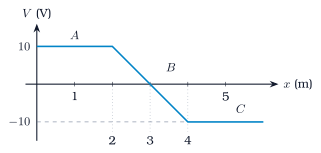
The figure shows how the potential varies along the \(x\)-axis. Find \(E_x\) in each of the regions \(A\), \(B\) and \(C\). State the direction of the field in region \(B\).
Answer\(A\): \(0\); \(B\): \(10\) V/m along \(+x\); \(C\): \(0\)
Solution
\(E_x = -\dfrac{dV}{dx}\) is the negative of the slope of the graph.
Region \(A\): \(V\) is constant, slope \(0\), so \(E_x = 0\).
Region \(B\): \(V\) falls from \(10\) V to \(-10\) V over \(2\) m. Slope \(= \dfrac{-20}{2} = -10\) V/m, so \(E_x = +10\) V/m. The field points along \(+x\), the direction in which \(V\) falls.
Region \(C\): constant \(V\), so \(E_x = 0\).
How did it go?
Q19
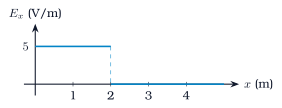
The figure shows \(E_x\) along the \(x\)-axis. The potential at \(x = 0\) is \(20\) V.
Find the potential at \(x = 2\) m.
Find the potential at \(x = 4\) m.
Does the potential rise or fall along the field? Give the reason.
Answer(i) \(10\) V (ii) \(10\) V (iii) falls
Solution
\(V(2) - V(0) = -\displaystyle\int_0^2 E_x\,dx = -(5 \times 2) = -10\) V. So \(V(2) = 20 - 10 = 10\) V. The integral is the area under the graph.
From \(2\) m to \(4\) m the field is zero, so the potential does not change. \(V(4) = 10\) V.
The potential falls along the field. Moving along \(E\) means \(dV = -E\,dx\) is negative.
How did it go?
Uniform field
Q20
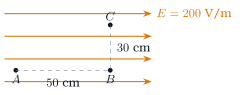
The figure shows a uniform field of \(200\) V/m along \(+x\). \(B\) is \(50\) cm from \(A\) along the field, and \(C\) is \(30\) cm from \(B\) perpendicular to the field.
Find \(V_A - V_B\). Which point is at the higher potential?
Find \(V_B - V_C\) and \(V_A - V_C\).
Answer(i) \(100\) V, \(A\) (ii) \(0\); \(100\) V
Solution
In a uniform field, \(V_A - V_B = E\,d = 200 \times 0.5 = 100\) V. Potential falls along the field, so \(A\) is at the higher potential.
\(BC\) is perpendicular to \(E\), so no potential changes along it: \(V_B - V_C = 0\).
\(V_A - V_C = (V_A - V_B) + (V_B - V_C) = 100 + 0 = 100\) V. Only the displacement along the field matters.
How did it go?
Q21
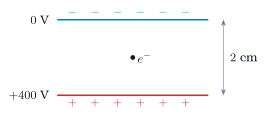
Two large parallel plates are \(2\) cm apart. The lower plate is at \(+400\) V and the upper plate is at \(0\) V. An electron is midway between them.
Find the field between the plates and its direction.
Find the force on the electron and its direction.
Find the work done by the field when the electron reaches the lower plate.
Answer(i) \(2 \times 10^4\) V/m, up (ii) \(3.2 \times 10^{-15}\) N, down (iii) \(3.2 \times 10^{-17}\) J
Solution
\(E = \dfrac{V}{d} = \dfrac{400}{0.02} = 2 \times 10^4\) V/m. The field points from the higher potential to the lower, so upward.
\(F = eE = 1.6 \times 10^{-19} \times 2 \times 10^4 = 3.2 \times 10^{-15}\) N. The electron is negative, so the force is opposite to \(E\): downward, towards the \(+400\) V plate.
The electron moves \(1\) cm along the force. \(W = F \times d = 3.2 \times 10^{-15} \times 0.01 = 3.2 \times 10^{-17}\) J. Check: \(W = e \times \Delta V = 1.6 \times 10^{-19} \times 200 = 3.2 \times 10^{-17}\) J.
How did it go?
Q22
At a point near a point charge the potential is \(900\) V and the field is \(9000\) V/m. Find the distance of the point from the charge and the value of the charge.
Answer\(10\) cm; \(10\) nC
Solution
For a point charge \(V = \dfrac{kq}{r}\) and \(E = \dfrac{kq}{r^2}\), so \(\dfrac{V}{E} = r\).
Positive energy means work had to be done to push the two like charges together from infinity. Released, they would fly apart and gain this much kinetic energy.
\(U = \dfrac{9 \times 10^9 \times 2 \times 10^{-6} \times (-3 \times 10^{-6})}{0.3} = -0.18\) J. Unlike charges have negative energy; work is needed to pull them apart.
How did it go?
Q24
Take the charges \(2\,\mu\)C and \(3\,\mu\)C of Question 1. Find the work done by an external agent to increase their separation slowly from \(30\) cm to \(60\) cm.
Answer\(-0.09\) J
Solution
\(U_1 = 0.18\) J at \(30\) cm. At \(60\) cm the distance doubles, so \(U_2 = 0.09\) J.
\(W_{\text{ext}} = U_2 - U_1 = 0.09 - 0.18 = -0.09\) J. The repulsion pushes the charges apart on its own, so the agent does negative work.
How did it go?
Q25
Charges \(+4\,\mu\)C and \(-4\,\mu\)C are \(10\) cm apart. Find the work an external agent must do to separate them slowly to a very large distance.
It is the energy of the system: the charge together with whatever charges produce the potential. A single charge alone has no interaction energy.
How did it go?
Q27
A charge of \(+2\,\mu\)C is fixed. A particle of mass \(10\) g carrying \(+3\,\mu\)C is released from rest \(30\) cm away. Find its speed when it is very far from the fixed charge.
Three charges of \(2\,\mu\)C each sit at the corners of an equilateral triangle of side \(20\) cm.
How many pairs of charges are there? Find the energy of one pair.
Find the total potential energy of the system.
Answer(i) \(3\) pairs, \(0.18\) J (ii) \(0.54\) J
Solution
Three charges make \(3\) pairs. Each pair: \(U = \dfrac{kq^2}{a} = \dfrac{9 \times 10^9 \times (2 \times 10^{-6})^2}{0.2} = 0.18\) J.
\(U = 3 \times 0.18 = 0.54\) J. The energy of a system is the sum over all pairs, each counted once.
How did it go?
Q29
In the triangle of Question 6, one of the charges is replaced by \(-2\,\mu\)C. Find the total potential energy now.
Answer\(-0.18\) J
Solution
Two pairs now contain a \(+2\,\mu\)C and a \(-2\,\mu\)C: each has \(U = -0.18\) J. One pair is still \(+0.18\) J.
\(U = 0.18 - 0.18 - 0.18 = -0.18\) J.
How did it go?
Q30
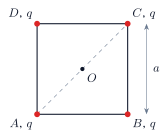
Four equal charges \(q = 1\,\mu\)C sit at the corners of a square of side \(a = 10\) cm, as in the figure.
Find the energy of one pair along a side and of one pair along a diagonal.
Show that the total energy is \(U = \frac{kq^2}{a}\left(4 + \sqrt{2}\right)\) and find its value.
Answer(i) \(0.09\) J, \(0.064\) J (ii) \(\approx 0.49\) J
Solution
Side pair: \(\dfrac{kq^2}{a} = \dfrac{9 \times 10^9 \times 10^{-12}}{0.1} = 0.09\) J.
Diagonal pair (distance \(a\sqrt{2}\)): \(\dfrac{kq^2}{a\sqrt{2}} = \dfrac{0.09}{1.414} \approx 0.064\) J.
There are \(4\) side pairs and \(2\) diagonal pairs. \(U = 4\dfrac{kq^2}{a} + 2\dfrac{kq^2}{a\sqrt{2}} = \dfrac{kq^2}{a}\left(4 + \dfrac{2}{\sqrt{2}}\right) = \dfrac{kq^2}{a}\left(4 + \sqrt{2}\right)\).
\(U = 0.09 \times (4 + 1.414) \approx 0.49\) J.
How did it go?
Q31
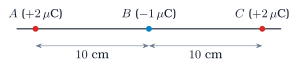
The figure shows three charges on a line.
Find the potential energy of the system.
Find the work needed to take \(C\) away to infinity, leaving \(A\) and \(B\) in place.
Answer(i) \(-0.18\) J (ii) \(0\)
Solution
\(U_{AB} = \dfrac{k(2)(-1) \times 10^{-12}}{0.1} = -0.18\) J. \(U_{BC} = \dfrac{k(-1)(2) \times 10^{-12}}{0.1} = -0.18\) J. \(U_{AC} = \dfrac{k(2)(2) \times 10^{-12}}{0.2} = 0.18\) J.
\(U = -0.18 - 0.18 + 0.18 = -0.18\) J.
Removing \(C\) takes away the two pairs that contain \(C\): \(U_{AC} + U_{BC} = 0.18 - 0.18 = 0\).
\(W_{\text{ext}} = U_{\text{final}} - U_{\text{initial}} = U_{AB} - U = -0.18 - (-0.18) = 0\). The attraction of \(B\) and the repulsion of \(A\) balance exactly.
How did it go?
Self energy
Q32
A thin spherical shell of radius \(10\) cm carries \(2\,\mu\)C. Its self-energy is \(U = \frac{kQ^2}{2R}\).
Find the self-energy.
How much energy is needed to double the charge on the shell?
In the solid sphere the charge is spread through the volume, so on average the bits of charge are closer together than on the shell. More work is needed to assemble them.
How did it go?
Q34
A point charge of \(1\,\mu\)C is placed at the centre of the shell of Question 10.
Find the interaction energy between the point charge and the shell.
Find the total electrostatic energy of the system, including the self-energy of the shell.
Answer(i) \(0.18\) J (ii) \(0.36\) J
Solution
Every bit of the shell's charge is a distance \(R\) from the centre. \(U_{\text{int}} = \dfrac{kQq}{R} = \dfrac{9 \times 10^9 \times 2 \times 10^{-6} \times 10^{-6}}{0.1} = 0.18\) J.
Total \(= \) self-energy of the shell \(+\) interaction energy \(= 0.18 + 0.18 = 0.36\) J. A point charge has no finite self-energy, so it is not counted.
How did it go?
Equipotential surfaces
Q35
Describe the shape of the equipotential surfaces of
Spheres centred on the charge, since \(V = \dfrac{kq}{r}\) depends only on \(r\).
Planes perpendicular to the field, since \(V\) changes only along the field.
Planes parallel to the sheet. The field of a large sheet is uniform and perpendicular to the sheet.
How did it go?
Q36
Why is the electric field always perpendicular to an equipotential surface?
Why can two equipotential surfaces of different potentials never cross?
Answer(i) no work along the surface (ii) one \(V\) per point
Solution
Moving a charge along the surface changes no potential, so the field does no work. Work is zero only if the force is perpendicular to the displacement. So \(E\) is perpendicular to the surface.
A point has only one value of potential. If two surfaces with different potentials crossed, the crossing point would have two potentials at once.
How did it go?
Q37
A charge of \(5\,\mu\)C is moved slowly along an equipotential surface from one point to another, \(20\) cm apart.
Find the work done by the electric field.
The charge is then moved around any closed path back to its starting point. Find the work done by the field.
Answer(i) \(0\) (ii) \(0\)
Solution
\(W_{\text{field}} = q(V_{\text{initial}} - V_{\text{final}}) = q \times 0 = 0\). The distance does not matter.
Zero. The electrostatic force is conservative: the work depends only on the end points, and here they are the same point.
How did it go?
Q38
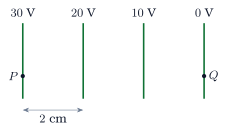
The figure shows equipotential surfaces of a uniform field, seen edge-on. Neighbouring surfaces are \(2\) cm apart.
Find the magnitude of the field. State its direction.
Find the work done by the field when a charge of \(-2\,\mu\)C moves from \(P\) to \(Q\).
Answer(i) \(500\) V/m, towards \(Q\) (ii) \(-6 \times 10^{-5}\) J
Solution
\(E = \dfrac{\Delta V}{d} = \dfrac{10}{0.02} = 500\) V/m. The field points from high potential to low, from the \(30\) V surface towards \(Q\).
\(W_{\text{field}} = q(V_P - V_Q) = (-2 \times 10^{-6})(30 - 0) = -6 \times 10^{-5}\) J. The negative charge is pushed against its motion, so the field does negative work.
How did it go?
Q39
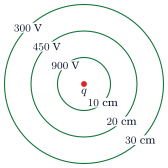
The figure shows three equipotential surfaces of a point charge \(q\), with their radii.
Find \(q\).
Find the work an external agent must do to move \(2\,\mu\)C slowly from the \(450\) V surface to the \(900\) V surface.
Does this work depend on the path taken? Give the reason.
Answer(i) \(10\) nC (ii) \(9 \times 10^{-4}\) J (iii) no
Solution
\(V = \dfrac{kq}{r}\), so \(q = \dfrac{Vr}{k} = \dfrac{900 \times 0.1}{9 \times 10^9} = 10^{-8}\) C \(= 10\) nC. Check: at \(20\) cm \(V\) halves to \(450\) V.
No. The work depends only on the potentials of the two surfaces. It does not depend on the path between them.
How did it go?
Q40
A dipole consists of \(+q\) and \(-q\) a small distance apart. Consider the plane that bisects the dipole at right angles.
Find the potential at every point of this plane.
Find the work done in moving a charge from one point of this plane to another.
Answer(i) \(0\) (ii) \(0\)
Solution
Every point of the bisecting plane is equidistant from \(+q\) and \(-q\). The two potentials cancel: \(V = 0\) everywhere on the plane.
The plane is an equipotential surface, so \(W = q\,\Delta V = 0\).
How did it go?
Small situations
Q41
A charge of \(+2\,\mu\)C is fixed. A particle of mass \(10\) g carrying \(+2\,\mu\)C is thrown straight at it from a very large distance with speed \(6\) m/s. Find the closest distance the particle reaches.
Answer\(20\) cm
Solution
Far away \(U = 0\) and \(KE = \dfrac{1}{2} \times 0.01 \times 36 = 0.18\) J.
At the closest point the particle stops for an instant, so all the kinetic energy has become potential energy: \(\dfrac{kq_1 q_2}{r} = 0.18\).
An alpha particle (charge \(2e\)) of kinetic energy \(5\) MeV is fired head-on at a gold nucleus (charge \(79e\)), which stays at rest. Take \(e = 1.6 \times 10^{-19}\) C and \(1\) MeV \(= 1.6 \times 10^{-13}\) J. Find the distance of closest approach.
Answer\(4.5 \times 10^{-14}\) m
Solution
At closest approach the alpha particle stops and \(KE = \dfrac{k(2e)(79e)}{r}\).
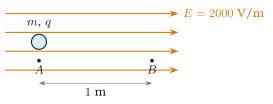
A particle of mass \(8\) g and charge \(2\,\mu\)C is released from rest at \(A\) in a uniform field of \(2000\) V/m. It moves \(1\) m along the field to \(B\).
Find the potential difference \(V_A - V_B\).
Find the work done by the field and the speed of the particle at \(B\).
Answer(i) \(2000\) V (ii) \(4 \times 10^{-3}\) J, \(1\) m/s
Solution
In a uniform field \(V_A - V_B = Ed = 2000 \times 1 = 2000\) V. \(A\) is at the higher potential.
\(\dfrac{1}{2}mv^2 = 4 \times 10^{-3}\), so \(v^2 = \dfrac{2 \times 4 \times 10^{-3}}{0.008} = 1\) and \(v = 1\) m/s.
How did it go?
Q44
In a hydrogen atom the electron is \(5.3 \times 10^{-11}\) m from the proton. Find the potential energy of the pair in joules and in electron volts. Ignore the kinetic energy of the electron.
Answer\(-4.35 \times 10^{-18}\) J \(\approx -27\) eV
In electron volts: \(\dfrac{-4.35 \times 10^{-18}}{1.6 \times 10^{-19}} \approx -27\) eV. The negative sign shows the electron is bound to the proton.
How did it go?
Electric Dipole
22 questions · after Lesson 6, The Dipole in an Electric Field
Dipole moment
Q45
Charges \(+2\,\mu\)C and \(-2\,\mu\)C are \(2\) mm apart. Take \(k = 9 \times 10^9\) SI units throughout this sheet.
Find the dipole moment \(p\).
State the direction of \(\vec{p}\).
Answer(i) \(4 \times 10^{-9}\) C m (ii) from \(-q\) to \(+q\)
Solution
\(p = q \times 2a = 2 \times 10^{-6} \times 2 \times 10^{-3} = 4 \times 10^{-9}\) C m.
\(\vec{p}\) points from the negative charge to the positive charge.
How did it go?
Q46
The dipole moment of an HCl molecule is \(3.4 \times 10^{-30}\) C m. Treat the molecule as charges \(+e\) and \(-e\) some distance apart, with \(e = 1.6 \times 10^{-19}\) C. Find that distance.
Answer\(2.1 \times 10^{-11}\) m
Solution
\(p = e\,d\), so \(d = \dfrac{p}{e} = \dfrac{3.4 \times 10^{-30}}{1.6 \times 10^{-19}} \approx 2.1 \times 10^{-11}\) m. This is about one fifth of the size of an atom.
How did it go?
Q47
Two dipoles of moment \(p\) each are placed at one point. Find the magnitude of the net dipole moment when the angle between them is
\(0^\circ\),
\(60^\circ\),
\(180^\circ\).
Answer(i) \(2p\) (ii) \(\sqrt{3}\,p\) (iii) \(0\)
Solution
Dipole moments add as vectors. For two equal vectors at angle \(\phi\), the resultant is \(2p\cos\dfrac{\phi}{2}\).
\(\phi = 180^\circ\): \(0\). The two dipoles cancel.
How did it go?
Field of a dipole
Q48
A short dipole has \(p = 4 \times 10^{-9}\) C m. Find the field at a point \(10\) cm from its centre on the axis. State the direction relative to \(\vec{p}\).
On the axis the field points along \(\vec{p}\), on both sides of the dipole.
How did it go?
Q49
For the dipole of Question 4, find the field at a point \(10\) cm from the centre on the equatorial line. State the direction relative to \(\vec{p}\). What is the ratio of the axial field to the equatorial field at the same distance?
Answer\(3.6 \times 10^4\) N/C, opposite to \(\vec{p}\); \(2\)
The field of a short dipole at a distance \(r\) is \(E\). Write the field
at \(2r\),
at \(r/2\).
Compare with a point charge, where \(E \propto \frac{1}{r^2}\).
Answer(i) \(E/8\) (ii) \(8E\)
Solution
For a short dipole \(E \propto \dfrac{1}{r^3}\).
At \(2r\): \(E \to \dfrac{E}{8}\).
At \(\dfrac{r}{2}\): \(E \to 8E\).
A point charge's field falls as \(\dfrac{1}{r^2}\), so doubling \(r\) only quarters it. The dipole field falls faster because its two charges nearly cancel from far away.
How did it go?
Q51
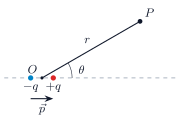
For the point \(P\) in the figure, \(E = \frac{kp}{r^3}\sqrt{1 + 3\cos^2\theta}\), and \(E\) makes an angle \(\alpha\) with \(OP\) where \(\tan\alpha = \frac{1}{2}\tan\theta\).
Put \(\theta = 0\) and \(\theta = 90^\circ\) in the formula and name the two results.
Find \(\tan\alpha\) for \(\theta = 45^\circ\).
For which \(\theta\) is \(E\) perpendicular to \(\vec{p}\)?
\(\tan\alpha = \dfrac{1}{2}\tan 45^\circ = \dfrac{1}{2}\). The field is tilted less than \(OP\) is, towards the axis.
\(OP\) makes angle \(\theta\) with \(\vec{p}\), and \(\vec{E}\) makes a further angle \(\alpha\) with \(OP\). So \(\vec{E}\) makes angle \(\theta + \alpha\) with \(\vec{p}\).
Perpendicular means \(\theta + \alpha = 90^\circ\), so \(\tan\alpha = \cot\theta\). With \(\tan\alpha = \dfrac{1}{2}\tan\theta\): \(\dfrac{1}{2}\tan\theta = \dfrac{1}{\tan\theta}\), so \(\tan^2\theta = 2\).
\(\tan\theta = \sqrt{2}\), \(\theta \approx 55^\circ\). Not on the equatorial line: there \(\vec{E}\) is antiparallel to \(\vec{p}\), not perpendicular.
How did it go?
Q52
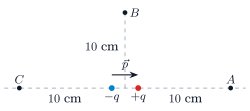
The dipole in the figure has \(p = 4 \times 10^{-9}\) C m. Find the field at \(A\), at \(B\) and at \(C\). Give each direction relative to \(\vec{p}\).
Answer\(A\): \(7.2 \times 10^4\) along \(\vec{p}\); \(B\): \(3.6 \times 10^4\) opposite; \(C\): \(7.2 \times 10^4\) along
\(A\) is axial: \(E = 2 \times 3.6 \times 10^4 = 7.2 \times 10^4\) N/C along \(\vec{p}\).
\(B\) is equatorial: \(E = 3.6 \times 10^4\) N/C, opposite to \(\vec{p}\).
\(C\) is axial on the other side: \(E = 7.2 \times 10^4\) N/C, again along \(\vec{p}\). On the axis the field points the same way on both sides.
How did it go?
Q53
A dipole has charges \(\pm q\) a distance \(2a\) apart. Show that on the axis, at a distance \(r\) from the centre with \(r \gg a\), the field is \(E = \frac{2kp}{r^3}\).
Answerderivation
Solution
Put the centre at the origin, \(+q\) at \(x = a\) and \(-q\) at \(x = -a\). At \(x = r\) on the axis, \(+q\) is a distance \((r - a)\) away and \(-q\) is \((r + a)\) away.
On the equatorial line of a dipole the potential is zero but the field is not. Explain both facts.
Answerequidistant; fields add
Solution
Potential: every point of the equatorial line is the same distance from \(+q\) and from \(-q\). The two potentials \(\dfrac{kq}{r}\) and \(-\dfrac{kq}{r}\) cancel, so \(V = 0\).
Field: the field of \(+q\) points away from \(+q\) and the field of \(-q\) points towards \(-q\). Their components along the line cancel, but their components parallel to the dipole axis both point from \(+q\) towards \(-q\) and add. So \(E \neq 0\).
How did it go?
Q57
Start from \(V = \frac{kp\cos\theta}{r^2}\). The components of the field are \(E_r = -\frac{\partial V}{\partial r}\) and \(E_\theta = -\frac{1}{r}\frac{\partial V}{\partial \theta}\).
Show that \(E_r = \frac{2kp\cos\theta}{r^3}\) and \(E_\theta = \frac{kp\sin\theta}{r^3}\).
Hence show that \(E = \frac{kp}{r^3}\sqrt{1 + 3\cos^2\theta}\).
The energy is lowest at \(\theta = 0\), with \(\vec{p}\) along \(\vec{E}\). That is the stable equilibrium. At \(180^\circ\) the torque is zero but the energy is highest: unstable.
How did it go?
Q60
Take the dipole of Question 14. Find the work an external agent must do to turn it slowly.
from \(0^\circ\) to \(90^\circ\),
from \(0^\circ\) to \(180^\circ\).
Answer(i) \(8 \times 10^{-4}\) J (ii) \(1.6 \times 10^{-3}\) J
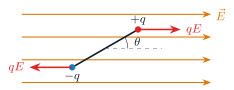
The figure shows a dipole with \(q = 2\,\mu\)C in a uniform field \(E = 2 \times 10^5\) N/C.
Find the force on each charge and the net force on the dipole.
Will the dipole turn clockwise or anticlockwise? Give the reason.
The charges are \(2\) mm apart and \(\theta = 30^\circ\). Find the torque from the two forces and check it against \(pE\sin\theta\).
Answer(i) \(0.4\) N each, \(0\) (ii) clockwise (iii) \(4 \times 10^{-4}\) N m
Solution
\(F = qE = 2 \times 10^{-6} \times 2 \times 10^5 = 0.4\) N on each charge, along \(\vec{E}\) on \(+q\) and opposite to \(\vec{E}\) on \(-q\). The two forces are equal and opposite, so the net force is zero.
The force on \(+q\) pulls the upper end to the right and the force on \(-q\) pulls the lower end to the left. This pair turns the dipole clockwise, bringing \(\vec{p}\) towards \(\vec{E}\).
The two forces form a couple. The perpendicular distance between their lines is \(2a\sin\theta = 2 \times 10^{-3} \times \dfrac{1}{2} = 10^{-3}\) m.
\(\tau = qE \times 2a\sin\theta = 0.4 \times 10^{-3} = 4 \times 10^{-4}\) N m.
A dipole released from a small angle in a uniform field oscillates with \(T = 2\pi\sqrt{\frac{I}{pE}}\), where \(I\) is its moment of inertia about the centre. Take \(p = 4 \times 10^{-9}\) C m, \(E = 2 \times 10^5\) N/C and \(I = 8 \times 10^{-9}\) kg m\(^2\). Find \(T\).
Show that the torque on a dipole follows from its potential energy: \(\tau = -\frac{dU}{d\theta}\) with \(U = -pE\cos\theta\).
Answerderivation
Solution
\(U = -pE\cos\theta\), so \(\dfrac{dU}{d\theta} = pE\sin\theta\).
The torque has magnitude \(pE\sin\theta\) and acts to decrease \(\theta\) (it turns \(\vec{p}\) towards \(\vec{E}\)). So \(\tau = -\dfrac{dU}{d\theta}\): the torque points towards lower energy, just as a force \(F = -\dfrac{dU}{dx}\) does.
How did it go?
Non-uniform field
Q64
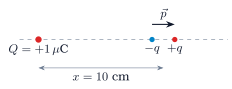
A dipole with \(p = 4 \times 10^{-9}\) C m lies along the \(x\)-axis in a field \(E_x = 5 \times 10^6\,x\) N/C, with \(x\) in metres. The force on a dipole along a non-uniform field is \(F = p\frac{dE}{dx}\). Find the force and its direction.
\(\vec{p}\) is along \(\vec{E}\), so the dipole is pulled towards the stronger field, that is, towards \(Q\). Check: \(-q\) is nearer \(Q\) than \(+q\), so the attraction wins.
How did it go?
Q66
In each case, state whether the net force on a dipole is zero. If it is not zero, give its direction.
The field is uniform.
The field is non-uniform and \(\vec{p}\) is along \(\vec{E}\).
The field is non-uniform and \(\vec{p}\) is opposite to \(\vec{E}\).
Answer(i) \(0\) (ii) towards stronger field (iii) towards weaker field
Solution
Zero. The forces \(qE\) on \(+q\) and \(-q\) are equal and opposite. Only a torque acts.
Not zero. The charge in the stronger part of the field feels the larger force. With \(\vec{p}\) along \(\vec{E}\) the net force is towards the region of stronger field.
Not zero. With \(\vec{p}\) opposite to \(\vec{E}\) the net force is towards the region of weaker field.