Questions on Electric Flux and Gauss's Law, the kind your examinations ask. Solve one on paper. Then tell the book how it went. The book believes you, and it uses your answer to plan your revision.
0%
Nothing marked yetMark honestly. Peek at the answer only after your own attempt.
Electric Flux and Gauss's Law
22 questions · after Lesson 5, The Solid Sphere and Concentric Shells
Flux
Q1
A uniform field of \(500\) N/C passes through a square of side \(20\) cm. Take \(\varepsilon_0 = 8.85 \times 10^{-12}\) C\(^2\)/N m\(^2\) and \(k = 9 \times 10^9\) SI units throughout this sheet. Find the flux through the square in each case.
The field is perpendicular to the square.
The field makes \(60^\circ\) with the normal to the square.
The field is parallel to the square.
Answer(i) \(20\) (ii) \(10\) (iii) \(0\), all in N m\(^2\)/C
Solution
\(\Phi = EA\cos\theta\), where \(\theta\) is the angle between \(\vec{E}\) and the normal to the area. \(A = 0.2 \times 0.2 = 0.04\) m\(^2\).
The outside charge does not change the flux: every line from it that enters the surface also leaves. But it does change \(\vec{E}\) at points on the surface, since \(\vec{E}\) is the sum of the fields of all charges.
How did it go?
Q4
A point charge \(q = 53.1\) nC is placed at the centre of a cube. Note that \(\frac{q}{\varepsilon_0} = 6000\) N m\(^2\)/C.
Find the flux through the whole cube and through one face.
The charge is moved to a corner of the cube. Find the flux through the whole cube now.
In part (ii), find the flux through one of the three faces that do not touch the charge.
Answer(i) \(6000\), \(1000\) (ii) \(750\) (iii) \(250\) N m\(^2\)/C
Solution
Total flux \(= \dfrac{q}{\varepsilon_0} = 6000\) N m\(^2\)/C. By symmetry the six faces share it equally: \(1000\) N m\(^2\)/C per face.
Eight identical cubes fit around a corner, and the charge sends equal flux into each. The flux through one cube is \(\dfrac{1}{8} \times 6000 = 750\) N m\(^2\)/C.
The three faces touching the charge get no flux (the field is along them). The other three share \(750\) equally: \(250\) N m\(^2\)/C each.
How did it go?
Q5
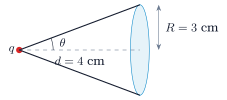
A point charge \(q\) sends out flux \(\frac{q}{\varepsilon_0}\) in all directions, that is, into a solid angle of \(4\pi\). A cone of half-angle \(\theta\) with its apex at \(q\) contains a solid angle \(\Omega = 2\pi(1 - \cos\theta)\).
Write the flux through the base of the cone in terms of \(q\) and \(\Omega\).
Find the flux through the base of a cone of half-angle \(60^\circ\) for the charge of Question 4.
Answer(i) \(\frac{q}{\varepsilon_0}\frac{\Omega}{4\pi}\) (ii) \(1500\) N m\(^2\)/C
Solution
Flux is shared in proportion to solid angle: \(\Phi = \dfrac{q}{\varepsilon_0} \times \dfrac{\Omega}{4\pi}\).
A closed surface encloses an electric dipole (\(+q\) and \(-q\)).
Find the total flux through the surface.
Is the field zero on the surface? Explain how the flux can still be as in part (i).
Answer(i) \(0\) (ii) no; lines enter and leave
Solution
The enclosed charge is \(+q - q = 0\), so \(\Phi = 0\).
The field is not zero on the surface. Field lines leave \(+q\), and every line that crosses the surface outward comes back in to end on \(-q\). Outward and inward flux cancel.
How did it go?
Q8
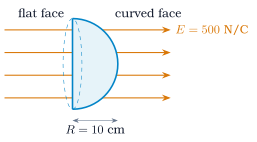
The hemisphere in the figure has radius \(10\) cm and sits in a uniform field of \(500\) N/C. Its flat face is perpendicular to the field.
Find the total flux through the closed hemisphere.
Find the flux through the flat face.
Hence find the flux through the curved face.
Answer(i) \(0\) (ii) \(-5\pi \approx -15.7\) (iii) \(+5\pi\) N m\(^2\)/C
Solution
The closed hemisphere encloses no charge, so the total flux is \(0\).
The field enters through the flat face, against its outward normal. \(\Phi_{\text{flat}} = -EA = -500 \times \pi(0.1)^2 = -5\pi \approx -15.7\) N m\(^2\)/C.
\(\Phi_{\text{flat}} + \Phi_{\text{curved}} = 0\), so \(\Phi_{\text{curved}} = +5\pi \approx 15.7\) N m\(^2\)/C. Every line that enters the flat face leaves through the curved face.
How did it go?
Applications
Q9
A very long straight wire carries \(\lambda = 5\,\mu\)C/m.
Use a cylindrical Gaussian surface of radius \(r\) and length \(L\) to show that \(E = \frac{\lambda}{2\pi\varepsilon_0 r}\).
Find \(E\) at \(r = 10\) cm.
Answer(ii) \(9 \times 10^5\) N/C
Solution
By symmetry \(\vec{E}\) points radially outward from the wire and has the same size at every point at distance \(r\).
Take a cylinder of radius \(r\) and length \(L\) around the wire. No flux crosses the flat ends (\(\vec{E}\) is parallel to them). Through the curved surface, \(\Phi = E \times 2\pi rL\).
A large flat sheet carries \(\sigma = 8.85 \times 10^{-9}\) C/m\(^2\).
Use a small closed cylinder (a pillbox) crossing the sheet to show that \(E = \frac{\sigma}{2\varepsilon_0}\).
Find \(E\). Why does the answer not depend on the distance from the sheet?
Answer(ii) \(500\) N/C; lines are parallel
Solution
By symmetry \(\vec{E}\) is perpendicular to the sheet, pointing away on both sides, with the same size on each side.
Take a pillbox of face area \(A\) with one face on each side of the sheet. No flux crosses its curved side. Each flat face gives \(EA\), total \(2EA\).
Enclosed charge \(= \sigma A\). So \(2EA = \dfrac{\sigma A}{\varepsilon_0}\) and \(E = \dfrac{\sigma}{2\varepsilon_0}\).
\(E = \dfrac{8.85 \times 10^{-9}}{2 \times 8.85 \times 10^{-12}} = 500\) N/C. The distance never entered the argument. The field lines are parallel and do not spread out, so the flux through the faces is the same at any distance.
How did it go?
Q11
A thin spherical shell of radius \(10\) cm carries \(2\,\mu\)C spread uniformly. Find \(E\) at
A sphere of radius \(5\) cm encloses no charge, so \(E = 0\) inside the shell.
Just outside, the shell acts as a point charge at its centre: \(E = \dfrac{kQ}{R^2} = \dfrac{9 \times 10^9 \times 2 \times 10^{-6}}{(0.1)^2} = 1.8 \times 10^6\) N/C.
Take a Gaussian sphere of radius \(r < R\). The charge inside it is \(Q\dfrac{r^3}{R^3}\), since the charge is spread uniformly and volume scales as \(r^3\).
At the surface: \(E = \dfrac{kQ}{R^2} = 1.8 \times 10^6\) N/C. At \(r = 20\) cm the sphere acts as a point charge: \(E = 4.5 \times 10^5\) N/C.
How did it go?
Q13
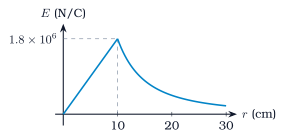
The figure shows \(E\) against \(r\) for a uniformly charged solid sphere.
Read the radius of the sphere from the graph.
Find the charge on the sphere.
Read \(E\) at \(r = 5\) cm and at \(r = 20\) cm from the graph, and check each against Question 12.
Answer(i) \(10\) cm (ii) \(2\,\mu\)C (iii) \(9 \times 10^5\), \(4.5 \times 10^5\) N/C
Solution
The graph rises in a straight line up to \(r = 10\) cm and then falls. The peak is at the surface, so \(R = 10\) cm.
At the surface \(E = \dfrac{kQ}{R^2}\), so \(Q = \dfrac{E R^2}{k} = \dfrac{1.8 \times 10^6 \times 0.01}{9 \times 10^9} = 2 \times 10^{-6}\) C \(= 2\,\mu\)C.
At \(5\) cm, half way up the straight line: \(E = 9 \times 10^5\) N/C. At \(20\) cm, twice the radius: \(E = \dfrac{1.8 \times 10^6}{4} = 4.5 \times 10^5\) N/C. Both agree with Question 12.
How did it go?
Q14
For the sphere of Question 12, the charge density is \(\rho = \frac{Q}{\frac{4}{3}\pi R^3}\).
Show that inside the sphere \(E = \frac{\rho r}{3\varepsilon_0}\).
Find \(\rho\), then use this formula to find \(E\) at \(r = 5\) cm. Compare with Question 12.
\(E\) grows with \(r\) inside and falls with \(r\) outside, so it is largest at the surface, \(r = R\).
How did it go?
Q16
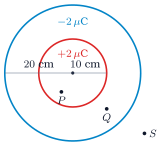
Two thin concentric non-conducting shells have radii \(10\) cm and \(20\) cm. The inner shell carries \(+2\,\mu\)C and the outer shell carries \(-2\,\mu\)C. \(P\) is at \(5\) cm, \(Q\) at \(15\) cm and \(S\) at \(30\) cm from the centre. Find \(E\) at \(P\), at \(Q\) and at \(S\).
For each point draw a Gaussian sphere through it and count the charge inside.
\(P\) (\(5\) cm): no charge inside. \(E = 0\).
\(Q\) (\(15\) cm): only the inner shell, \(+2\,\mu\)C, is inside. \(E = \dfrac{9 \times 10^9 \times 2 \times 10^{-6}}{(0.15)^2} = \dfrac{1.8 \times 10^4}{0.0225} = 8 \times 10^5\) N/C, outward.
\(S\) (\(30\) cm): both shells inside, total charge \(0\). \(E = 0\).
How did it go?
Small situations
Q17
An electron is released from rest near the sheet of Question 10. Take \(e = 1.6 \times 10^{-19}\) C and \(m_e = 9.1 \times 10^{-31}\) kg. Find its acceleration and state its direction.
Answer\(8.8 \times 10^{13}\) m/s\(^2\), towards the sheet
Solution
\(E = 500\) N/C, pointing away from the sheet. The electron is negative, so the force on it points towards the sheet.
\(a = \dfrac{eE}{m_e} = \dfrac{1.6 \times 10^{-19} \times 500}{9.1 \times 10^{-31}} \approx 8.8 \times 10^{13}\) m/s\(^2\), towards the sheet.
How did it go?
Q18
Two spheres of radii \(r\) and \(2r\) are drawn around the same point charge. Find the ratio, sphere \(r\) to sphere \(2r\), of
the flux through each,
the field on each.
Answer(i) \(1\) (ii) \(4\)
Solution
Both spheres enclose the same charge, so the flux is the same: ratio \(1\).
\(E \propto \dfrac{1}{r^2}\), so the field on the smaller sphere is \(4\) times larger: ratio \(4\). The larger sphere has \(4\) times the area, which is why the flux comes out equal.
How did it go?
Q19
A closed cylinder of cross-section \(A\) lies in a uniform field \(E\) with its axis along the field. Find the flux through the curved surface, through each flat face, and through the whole cylinder.
Answer\(0\); \(-EA\) and \(+EA\); \(0\)
Solution
Curved surface: \(\vec{E}\) is parallel to it, so the flux is \(0\).
Flat faces: the field enters one face (\(\Phi = -EA\)) and leaves the other (\(\Phi = +EA\)).
Whole cylinder: \(0 - EA + EA = 0\), as Gauss's law demands for a surface with no charge inside.
How did it go?
Q20
A point charge sits at the centre of a spherical Gaussian surface. The charge is now moved to another point, still inside the surface.
Does the total flux through the surface change?
Does the field at points on the surface change?
Answer(i) no (ii) yes
Solution
No. The flux depends only on the charge enclosed, and the charge is still inside.
Yes. The field of a point charge depends on the distance from it, so moving the charge changes \(\vec{E}\) at each point of the surface. Only the total flux stays fixed.
How did it go?
Q21
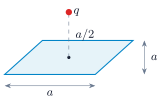
The charge \(q\) of Question 4 is placed a distance \(\frac{a}{2}\) above the centre of a square of side \(a\). Find the flux through the square. (Think of the square as one face of a cube.)
Answer\(1000\) N m\(^2\)/C
Solution
Build a cube of side \(a\) with the square as one face. The charge is at height \(\dfrac{a}{2}\) above the centre of that face, which is the centre of the cube.
The flux through the whole cube is \(\dfrac{q}{\varepsilon_0} = 6000\) N m\(^2\)/C, shared equally by six faces. Through the square: \(1000\) N m\(^2\)/C.
How did it go?
Q22
A solid sphere of radius \(R\) carries a charge \(Q\) spread uniformly through its volume.
What fraction of \(Q\) lies inside a sphere of radius \(\frac{R}{2}\)?
Hence use Gauss's law to find \(E\) at \(r = \frac{R}{2}\) in terms of \(k\), \(Q\) and \(R\).
Answer(i) \(\frac{1}{8}\) (ii) \(\frac{kQ}{2R^2}\)
Solution
Charge is proportional to volume, and volume is proportional to \(r^3\). Inside \(\dfrac{R}{2}\): \(\left(\dfrac{1}{2}\right)^3 = \dfrac{1}{8}\) of \(Q\).
Gauss's law on a sphere of radius \(\dfrac{R}{2}\): \(E \cdot 4\pi\left(\dfrac{R}{2}\right)^2 = \dfrac{Q/8}{\varepsilon_0}\), so \(E = \dfrac{Q/8}{4\pi\varepsilon_0 R^2/4} = \dfrac{kQ}{2R^2}\).