Questions on Conductors in Electrostatics, the kind your examinations ask. Solve one on paper. Then tell the book how it went. The book believes you, and it uses your answer to plan your revision.
0%
Nothing marked yetMark honestly. Peek at the answer only after your own attempt.
Conductors, Shielding and Concentric Shells
22 questions · after Lesson 5, Electrostatic Pressure and the Limits of Air
Properties of conductors
Q1
A metal body is given some charge and left alone. Take \(k = 9 \times 10^9\) SI units and \(\varepsilon_0 = 8.85 \times 10^{-12}\) C\(^2\)/N m\(^2\) throughout this sheet.
Why must the electric field inside the metal be zero?
Use Gauss's law to show that all the charge sits on the surface.
Answer(i) charges would move (ii) \(q_{\text{in}} = 0\)
Solution
A metal has free electrons. If there were a field inside, the electrons would feel a force and move. In electrostatics nothing moves, so the field inside must be zero.
Take a Gaussian surface just inside the metal surface. \(E = 0\) on it, so the flux is zero and the enclosed charge is zero. Any charge on the body must therefore lie on the surface.
How did it go?
Q2
Why is the whole of a conductor, including its surface, at one potential?
Why must the field just outside the surface be perpendicular to the surface?
Answer(i) \(E = 0\) inside (ii) else charge would flow
Solution
\(E = 0\) inside, so no work is done in moving a charge between any two points of the metal. No work means no potential difference: the whole body is one equipotential.
A field component along the surface would push the free surface charges along the surface. They would move, which does not happen in electrostatics. So the field just outside has no component along the surface.
How did it go?
Q3
The surface charge density on a conductor is \(\sigma = 8.85 \times 10^{-9}\) C/m\(^2\) at some point.
Use a pillbox to show that the field just outside is \(E = \frac{\sigma}{\varepsilon_0}\).
Find \(E\). Why is it twice the field of a thin non-conducting sheet with the same \(\sigma\)?
Answer(ii) \(1000\) N/C; one side only
Solution
Take a small pillbox of face area \(A\) with one face just outside the surface and the other inside the metal.
Inside, \(E = 0\), so that face gives no flux. The curved side gives none, since \(\vec{E}\) is perpendicular to the surface. Only the outer face gives \(EA\).
\(E = \dfrac{8.85 \times 10^{-9}}{8.85 \times 10^{-12}} = 1000\) N/C. A thin sheet sends its flux out on both sides, so each side gets \(\dfrac{\sigma}{2\varepsilon_0}\). A conductor sends all the flux out on one side, because the field inside is zero.
How did it go?
Q4
A solid metal sphere of radius \(10\) cm is given \(2\,\mu\)C.
Find \(E\) at the centre, at \(5\) cm, just outside the surface, and at \(20\) cm.
Find the potential at the surface and at the centre.
Answer(i) \(0\), \(0\), \(1.8 \times 10^6\), \(4.5 \times 10^5\) N/C (ii) \(1.8 \times 10^5\) V both
Solution
Inside the metal (centre and \(5\) cm): \(E = 0\).
Surface: \(V = \dfrac{kQ}{R} = \dfrac{1.8 \times 10^4}{0.1} = 1.8 \times 10^5\) V. The centre is at the same potential, since \(E = 0\) inside.
How did it go?
Q5
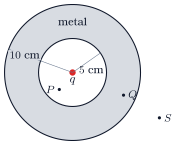
A point charge \(q = 2\,\mu\)C sits at the centre of a neutral thick conducting shell of inner radius \(5\) cm and outer radius \(10\) cm. \(P\) is at \(2\) cm, \(Q\) is inside the metal and \(S\) is at \(20\) cm from the centre.
Find the charge on the inner surface and on the outer surface of the shell.
In Question 5, the charge \(q\) is moved to another point inside the cavity, not touching the metal.
Does the field outside the shell change?
Is the charge on the inner surface still spread uniformly?
The shell is now earthed. Find the charge on its outer surface and the field outside.
Answer(i) no (ii) no (iii) \(0\); \(0\)
Solution
No. The outer surface still carries \(+2\,\mu\)C, spread uniformly, because the metal screens the outside from whatever happens in the cavity. The outside field stays \(\dfrac{kq}{r^2}\).
No. The inner surface charge crowds towards the point nearest \(q\), so that its field cancels the field of \(q\) everywhere inside the metal.
Earthing lets the \(+2\,\mu\)C on the outer surface flow to the earth. The outer surface charge becomes \(0\), and the field outside becomes \(0\). The inner surface still carries \(-2\,\mu\)C.
How did it go?
Shielding
Q7
A mobile phone kept inside a closed metal box gets no signal, and a person inside a car is safe from lightning. Explain both facts with one idea.
Answer\(E = 0\) in a cavity
Solution
Inside a closed conductor, the field due to outside charges is zero. The charges induced on the conductor's surface arrange themselves to cancel the outside field exactly.
The metal box blocks the electric field of the radio signal, so the phone receives nothing. The car body carries the lightning current round the outside; the field inside stays zero and the person is safe.
How did it go?
Q8
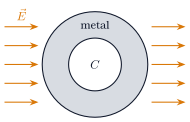
The hollow conductor in the figure is placed in a uniform field \(\vec{E}\) pointing to the right.
On which side of the conductor does negative charge collect? Give the reason.
Find the field inside the metal and inside the cavity \(C\).
Answer(i) left (ii) \(0\); \(0\)
Solution
The field pushes free electrons opposite to \(\vec{E}\), that is, to the left. Negative charge collects on the left face and positive charge on the right face.
The induced charges produce a field that cancels \(\vec{E}\) inside the metal: \(E = 0\) there. The cavity is surrounded by metal with no charge inside it, so the field in the cavity is also \(0\).
How did it go?
Concentric shells
Q9
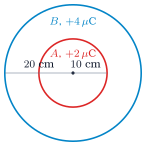
Two thin concentric conducting shells \(A\) (radius \(10\) cm) and \(B\) (radius \(20\) cm) carry \(+2\,\mu\)C and \(+4\,\mu\)C. Find the charge on the inner surface and on the outer surface of \(B\).
Answer\(-2\,\mu\)C, \(+6\,\mu\)C
Solution
A Gaussian surface inside the metal of \(B\) encloses zero charge. It contains \(A\) (\(+2\,\mu\)C) and the inner surface of \(B\). So the inner surface of \(B\) carries \(-2\,\mu\)C.
\(B\) carries \(+4\,\mu\)C in total, so its outer surface carries \(4 - (-2) = +6\,\mu\)C.
How did it go?
Q10
For the shells of Question 9, find the potential of \(A\) and the potential of \(B\).
Answer\(3.6 \times 10^5\) V, \(2.7 \times 10^5\) V
Solution
The potential at a point is the sum of the potentials of all the shells. A shell contributes \(\dfrac{kQ}{r}\) outside and \(\dfrac{kQ}{R}\) inside.
The outer shell \(B\) of Question 9 is now earthed.
Find the charge on \(B\).
Find the potential of \(A\).
Answer(i) \(-2\,\mu\)C (ii) \(9 \times 10^4\) V
Solution
Earthing makes \(V_B = 0\): \(\dfrac{k(Q_A + Q_B)}{b} = 0\), so \(Q_B = -Q_A = -2\,\mu\)C. The \(+6\,\mu\)C on the outer surface flows away; the \(-2\,\mu\)C on the inner surface stays.
The two shells of Question 9 are joined by a thin wire.
Find the final charge on each shell. Give the reason.
Find the common potential.
Answer(i) \(A\): \(0\), \(B\): \(6\,\mu\)C (ii) \(2.7 \times 10^5\) V
Solution
Joined shells form one conductor, and all the charge of a conductor sits on its outer surface. \(A\) ends with \(0\) and \(B\) with the total, \(6\,\mu\)C.
\(V = \dfrac{k \times 6 \times 10^{-6}}{0.2} = 2.7 \times 10^5\) V, the same for both shells.
How did it go?
Q14
Shell \(A\) (radius \(a\)) carries \(Q\) and shell \(B\) (radius \(b\)) carries any charge \(Q_B\). Show that \(V_A - V_B = kQ\left(\frac{1}{a} - \frac{1}{b}\right)\), whatever \(Q_B\) is. Find its value for \(Q = 2\,\mu\)C, \(a = 10\) cm, \(b = 20\) cm.
Subtracting, the \(Q_B\) terms cancel: \(V_A - V_B = kQ\left(\dfrac{1}{a} - \dfrac{1}{b}\right)\). The outer shell shifts both potentials by the same amount.
Two isolated metal spheres of radii \(10\) cm and \(20\) cm are each raised to \(9000\) V.
Find the charge on each sphere.
Find the ratio of their surface charge densities.
Answer(i) \(100\) nC, \(200\) nC (ii) \(2 : 1\)
Solution
\(Q = \dfrac{VR}{k}\). Small sphere: \(Q_1 = \dfrac{9000 \times 0.1}{9 \times 10^9} = 10^{-7}\) C \(= 100\) nC. Large sphere: \(Q_2 = 200\) nC.
\(\sigma = \dfrac{Q}{4\pi R^2}\), and with \(V\) fixed, \(Q \propto R\), so \(\sigma \propto \dfrac{1}{R}\). \(\dfrac{\sigma_1}{\sigma_2} = \dfrac{R_2}{R_1} = 2\). The smaller sphere has the denser charge.
How did it go?
Q16
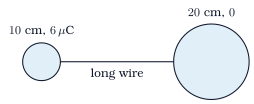
A metal sphere of radius \(10\) cm carries \(6\,\mu\)C. It is joined by a long wire to an uncharged metal sphere of radius \(20\) cm, far away.
Find the final charge on each sphere.
Find the common potential.
Answer(i) \(2\,\mu\)C, \(4\,\mu\)C (ii) \(1.8 \times 10^5\) V
Solution
Charge flows until both spheres are at the same potential: \(\dfrac{kQ_1}{R_1} = \dfrac{kQ_2}{R_2}\), so \(\dfrac{Q_1}{Q_2} = \dfrac{R_1}{R_2} = \dfrac{1}{2}\).
\(Q_1 + Q_2 = 6\,\mu\)C, so \(Q_1 = 2\,\mu\)C and \(Q_2 = 4\,\mu\)C.
Show that the outward pressure on the surface of a charged conductor is \(\frac{\sigma^2}{2\varepsilon_0}\). Start from the field that the rest of the conductor produces at a small patch of its surface.
Answerderivation
Solution
Just outside a small patch, the total field is \(\dfrac{\sigma}{\varepsilon_0}\). Just inside it is \(0\). The patch itself, like a small sheet, gives \(\dfrac{\sigma}{2\varepsilon_0}\) outward on the outside and \(\dfrac{\sigma}{2\varepsilon_0}\) inward on the inside.
So the rest of the conductor must give \(\dfrac{\sigma}{2\varepsilon_0}\) outward on both sides of the patch. This is the field that acts on the patch's own charge.
Force on a patch of area \(dA\): \(dF = (\sigma\,dA)\dfrac{\sigma}{2\varepsilon_0}\). Pressure \(= \dfrac{dF}{dA} = \dfrac{\sigma^2}{2\varepsilon_0}\), outward.
How did it go?
Q19
The pressure of Question 17 acts on a conducting sphere of radius \(10\) cm. The net force on one hemisphere equals the pressure times the projected area \(\pi R^2\). Find this force.
Answer\(0.14\) N
Solution
The outward pressure on each patch is the same, but the patches point in different directions. The net force on a hemisphere equals \(P\) times its projected area, a disc of radius \(R\).
\(F = P\pi R^2 = 4.4 \times \pi \times (0.1)^2 \approx 0.14\) N, pushing the two hemispheres apart.
How did it go?
Q20
A soap bubble of radius \(1\) cm has surface tension \(T = 0.03\) N/m. The excess pressure inside it is \(\frac{4T}{r}\). The bubble is charged until the electrostatic pressure exactly balances the surface-tension pressure.
Find the surface charge density needed.
Find the charge on the bubble.
Answer(i) \(1.46 \times 10^{-5}\) C/m\(^2\) (ii) \(18\) nC
Air breaks down when the field reaches \(3 \times 10^6\) V/m. A metal sphere of radius \(10\) cm is charged slowly in air.
Find the largest charge the sphere can hold.
Find the largest potential it can reach.
Answer(i) \(3.3\,\mu\)C (ii) \(3 \times 10^5\) V
Solution
The field is largest just outside the surface: \(\dfrac{kQ}{R^2} = 3 \times 10^6\). \(Q_{\max} = \dfrac{3 \times 10^6 \times 0.01}{9 \times 10^9} \approx 3.3 \times 10^{-6}\) C \(= 3.3\,\mu\)C.
\(V_{\max} = \dfrac{kQ_{\max}}{R} = E_{\max}R = 3 \times 10^6 \times 0.1 = 3 \times 10^5\) V. A bigger sphere can hold a higher potential.
How did it go?
Q22
Return to the shell of Question 5 with \(q\) at the centre.
Find the potential of the metal shell.
Find the potential at a point in the cavity \(2.5\) cm from the centre.
Answer(i) \(1.8 \times 10^5\) V (ii) \(5.4 \times 10^5\) V
Solution
Outside the shell the total enclosed charge is \(q\). So the field outside is \(\dfrac{kq}{r^2}\) and the potential of the outer surface is \(\dfrac{kq}{b}\).
\(V_{\text{shell}} = \dfrac{9 \times 10^9 \times 2 \times 10^{-6}}{0.1} = 1.8 \times 10^5\) V. The whole shell is at this potential.
Three charges contribute: \(q\) itself, \(-q\) on the inner surface at radius \(a\), and \(+q\) on the outer surface at radius \(b\). So \(V = \dfrac{kq}{r} - \dfrac{kq}{a} + \dfrac{kq}{b}\).