Questions on Capacitance and Dielectrics, the kind your examinations ask. Solve one on paper. Then tell the book how it went. The book believes you, and it uses your answer to plan your revision.
0%
Nothing marked yetMark honestly. Peek at the answer only after your own attempt.
Capacitors, Energy and Force Between Plates
22 questions · after Lesson 2, Energy and the Force Between the Plates
Capacitance
Q1
A capacitor holds \(4\,\mu\)C when the potential difference across it is \(200\) V. Take \(\varepsilon_0 = 8.85 \times 10^{-12}\) C\(^2\)/N m\(^2\) and \(k = 9 \times 10^9\) SI units throughout this sheet.
\(Q = CV = 2 \times 10^{-8} \times 500 = 10^{-5}\) C \(= 10\,\mu\)C. The charge is proportional to the voltage; \(C\) is fixed by the geometry.
How did it go?
Q2
Write \(1\) farad in terms of the coulomb and the volt.
Find the radius of an isolated sphere whose capacitance is \(1\) F. Comment on the size.
Answer(i) \(1\) C/V (ii) \(9 \times 10^9\) m
Solution
\(1\) F \(= 1\) C/V: one coulomb of charge for every volt of potential difference.
\(C = 4\pi\varepsilon_0 R\), so \(R = \dfrac{C}{4\pi\varepsilon_0} = kC = 9 \times 10^9 \times 1 = 9 \times 10^9\) m. This is more than a thousand times the radius of the Earth. A farad is a very large unit.
How did it go?
Q3
An isolated metal sphere has capacitance \(C = 4\pi\varepsilon_0 R\).
Find \(C\) for a sphere of radius \(9\) cm.
Find \(C\) for the Earth, radius \(6400\) km.
Answer(i) \(10\) pF (ii) \(\approx 711\,\mu\)F
Solution
\(C = 4\pi\varepsilon_0 R = \dfrac{R}{k} = \dfrac{0.09}{9 \times 10^9} = 10^{-11}\) F \(= 10\) pF.
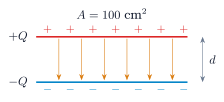
Two parallel plates of area \(A\) carry \(+Q\) and \(-Q\) and are a distance \(d\) apart. Start from the field of a charged conductor, \(E = \frac{\sigma}{\varepsilon_0}\), and show that \(C = \frac{\varepsilon_0 A}{d}\).
Answerderivation
Solution
Each plate is a conductor with surface charge density \(\sigma = \dfrac{Q}{A}\) on its inner face. The field between the plates is \(E = \dfrac{\sigma}{\varepsilon_0} = \dfrac{Q}{\varepsilon_0 A}\), uniform and perpendicular to the plates.
The potential difference is \(V = Ed = \dfrac{Qd}{\varepsilon_0 A}\).
\(C = \dfrac{Q}{V} = \dfrac{\varepsilon_0 A}{d}\). The charge cancels: \(C\) depends only on the geometry.
How did it go?
Q6
A parallel-plate capacitor has capacitance \(C\).
Write the new capacitance if the separation is doubled, and if the plate area is doubled.
Find the plate area needed for \(C = 1\) F with \(d = 1\) mm. Comment on the size.
Answer(i) \(C/2\); \(2C\) (ii) \(1.13 \times 10^8\) m\(^2\)
\(A = \dfrac{Cd}{\varepsilon_0} = \dfrac{1 \times 10^{-3}}{8.85 \times 10^{-12}} \approx 1.13 \times 10^8\) m\(^2\), a square more than \(10\) km on a side. Real farad-sized capacitors need dielectrics and very thin gaps.
How did it go?
Q7
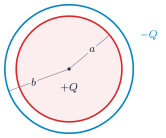
A spherical capacitor has an inner sphere of radius \(a = 9\) cm and an outer shell of radius \(b = 10\) cm, with \(C = \frac{4\pi\varepsilon_0\,ab}{b - a}\).
Find \(C\). Compare it with the isolated sphere of Question 3.
What does the formula become when \(b \to \infty\)? Explain.
Answer(i) \(100\) pF, \(10\) times (ii) \(4\pi\varepsilon_0 a\)
The isolated \(9\) cm sphere had \(10\) pF. Bringing the earthed shell close, \(1\) cm away, makes the capacitance \(10\) times larger.
For \(b \to \infty\), \(\dfrac{ab}{b - a} \to a\), so \(C \to 4\pi\varepsilon_0 a\). With the outer shell at infinity, the inner sphere is simply an isolated sphere.
How did it go?
Q8
A cylindrical capacitor of length \(L\) has inner radius \(a\) and outer radius \(b\), with \(C = \frac{2\pi\varepsilon_0 L}{\ln(b/a)}\). Find \(C\) for \(L = 1\) m and \(b = 2.72a\), so that \(\ln\frac{b}{a} = 1\).
Between: \(E = \dfrac{\sigma}{\varepsilon_0} = \dfrac{8.85 \times 10^{-7}}{8.85 \times 10^{-12}} = 10^5\) V/m. Outside, the fields of the two plates cancel: \(E = 0\).
\(V = Ed = 10^5 \times 10^{-3} = 100\) V. Check: \(C = \dfrac{Q}{V} = \dfrac{8.85 \times 10^{-9}}{100} = 88.5\) pF, as in Question 4.
How did it go?
Q10
What is meant by fringing of the field at the edges of a parallel-plate capacitor?
When may fringing be neglected? Does fringing make the true capacitance slightly larger or smaller than \(\frac{\varepsilon_0 A}{d}\)?
Answer(ii) \(d \ll\) plate size; larger
Solution
Near the edges of the plates the field lines bulge outward instead of running straight across. The field there is weaker and not uniform. This is fringing.
Fringing may be neglected when the separation is much smaller than the size of the plates. The bulging lines store some extra field outside the gap, so the true capacitance is slightly larger than \(\dfrac{\varepsilon_0 A}{d}\).
How did it go?
Energy
Q11
A \(20\) nF capacitor is charged to \(200\) V. Find the energy stored, using each of \(U = \frac{1}{2}CV^2\), \(U = \frac{1}{2}QV\) and \(U = \frac{Q^2}{2C}\).
\(\dfrac{1}{2}QV = \dfrac{1}{2} \times 4 \times 10^{-6} \times 200 = 4 \times 10^{-4}\) J. \(\dfrac{Q^2}{2C} = \dfrac{16 \times 10^{-12}}{4 \times 10^{-8}} = 4 \times 10^{-4}\) J. All three agree.
How did it go?
Q12
The capacitor of Question 11 is disconnected from the battery. Its plates are then pulled apart until the capacitance is halved.
Which of \(Q\) and \(V\) stays fixed? Find the new energy.
Where does the change in energy come from?
Answer(i) \(Q\); \(8 \times 10^{-4}\) J (ii) work of pulling
Solution
With the battery gone the charge has nowhere to go, so \(Q\) stays fixed. \(U = \dfrac{Q^2}{2C}\) doubles when \(C\) halves: \(U = 8 \times 10^{-4}\) J.
The plates attract each other. Pulling them apart needs an outside force, and the work done by that force, \(4 \times 10^{-4}\) J, is the extra energy.
How did it go?
Q13
The capacitor of Question 11 stays connected to the \(200\) V battery while its capacitance is halved. Find the new charge and the new energy.
Answer\(2\,\mu\)C, \(2 \times 10^{-4}\) J
Solution
The battery holds \(V\) at \(200\) V. New capacitance \(10\) nF, so \(Q = CV = 10^{-8} \times 200 = 2 \times 10^{-6}\) C \(= 2\,\mu\)C.
\(U = \dfrac{1}{2}CV^2 = \dfrac{1}{2} \times 10^{-8} \times 4 \times 10^4 = 2 \times 10^{-4}\) J. Half the charge has flowed back into the battery.
How did it go?
Q14
The field between the plates of Question 9 is \(10^5\) V/m. The energy density of a field is \(u = \frac{1}{2}\varepsilon_0 E^2\).
Find \(u\).
Multiply by the volume between the plates to find the stored energy. Check it against \(\frac{1}{2}QV\).
Answer(i) \(0.044\) J/m\(^3\) (ii) \(4.4 \times 10^{-7}\) J
Volume \(= Ad = 10^{-2} \times 10^{-3} = 10^{-5}\) m\(^3\). \(U = 0.044 \times 10^{-5} = 4.4 \times 10^{-7}\) J.
Check: \(\dfrac{1}{2}QV = \dfrac{1}{2} \times 8.85 \times 10^{-9} \times 100 = 4.4 \times 10^{-7}\) J. The energy of a capacitor lives in the field between its plates.
How did it go?
Q15
A capacitor \(C\) already holds charge \(q\). Moving a further charge \(dq\) from one plate to the other needs work \(dW = \frac{q}{C}dq\). Integrate from \(0\) to \(Q\) to show that \(U = \frac{Q^2}{2C} = \frac{1}{2}CV^2\).
This work is stored as \(U\). With \(Q = CV\): \(U = \dfrac{(CV)^2}{2C} = \dfrac{1}{2}CV^2\), and also \(U = \dfrac{1}{2}QV\).
The factor \(\dfrac{1}{2}\) appears because the voltage grows from \(0\) to \(V\) as the charge builds up; the average voltage during charging is \(\dfrac{V}{2}\).
How did it go?
Q16
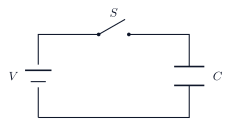
In the figure, \(C = 20\) nF and \(V = 200\) V. The switch \(S\) is closed and the capacitor charges fully.
Find the charge that flows through the battery and the work done by the battery.
Find the energy stored in the capacitor. Where has the rest of the work gone?
\(Q = CV = 2 \times 10^{-8} \times 200 = 4\,\mu\)C flows through the battery. The battery moves this charge through its full \(200\) V: \(W = QV = 4 \times 10^{-6} \times 200 = 8 \times 10^{-4}\) J.
Stored: \(U = \dfrac{1}{2}QV = 4 \times 10^{-4}\) J, only half of the battery's work. The other half is lost as heat in the wires (and as radiation), whatever the resistance.
How did it go?
Force between plates
Q17
Take the plates of Question 9 (\(Q = 8.85\) nC, \(A = 100\) cm\(^2\), \(E = 10^5\) V/m). Find the force of attraction between them using \(F = \frac{Q^2}{2\varepsilon_0 A}\). Check that it equals \(\frac{1}{2}QE\).
The field between the plates is \(E\), yet the force on a plate is \(\frac{1}{2}QE\) and not \(QE\). Explain why.
Answerother plate's field is \(E/2\)
Solution
A plate cannot push on itself. The force on a plate comes only from the field of the other plate, which is \(\dfrac{\sigma}{2\varepsilon_0} = \dfrac{E}{2}\).
The total field \(E\) between the plates is the sum of the two plates' fields, \(\dfrac{E}{2} + \dfrac{E}{2}\). So \(F = Q \times \dfrac{E}{2} = \dfrac{1}{2}QE\).
How did it go?
Q19
Two plates carry fixed charges \(\pm Q\) and are a distance \(x\) apart, so \(U = \frac{Q^2 x}{2\varepsilon_0 A}\). Use \(F = -\frac{dU}{dx}\) to find the force between the plates, and state whether it is attractive or repulsive.
The negative sign means the force acts to decrease \(x\): the plates pull towards each other. The force is attractive, with magnitude \(\dfrac{Q^2}{2\varepsilon_0 A}\), the same as in Question 17.
How did it go?
Q20
For the plates of Question 9, find the force per unit area on a plate. Compare it with the electrostatic pressure \(\frac{\sigma^2}{2\varepsilon_0}\) on a charged conductor.
\(\dfrac{\sigma^2}{2\varepsilon_0} = \dfrac{(8.85 \times 10^{-7})^2}{2 \times 8.85 \times 10^{-12}} = 0.044\) N/m\(^2\). They are the same thing: each plate is a charged conductor pulled by the field of the other, exactly the electrostatic pressure.
How did it go?
Small situations
Q21
The capacitor of Question 11 (\(20\) nF at \(200\) V) is discharged through a small bulb in \(2\) ms.
Find the energy given to the bulb.
Find the average power during the discharge.
Answer(i) \(4 \times 10^{-4}\) J (ii) \(0.2\) W
Solution
All the stored energy goes to the bulb: \(U = \dfrac{1}{2}CV^2 = 4 \times 10^{-4}\) J.
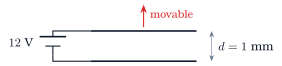
The capacitor of Question 4 (\(88.5\) pF, \(1\) mm, \(12\) V) stays connected to its battery while the separation is reduced to \(0.5\) mm. Find the new capacitance, charge, field and stored energy.
The battery keeps \(V = 12\) V, so \(Q = CV = 177 \times 10^{-12} \times 12 \approx 2.12\) nC, double the old charge.
\(E = \dfrac{V}{d} = \dfrac{12}{0.5 \times 10^{-3}} = 2.4 \times 10^4\) V/m, double the old field.
\(U = \dfrac{1}{2}CV^2 = \dfrac{1}{2} \times 1.77 \times 10^{-10} \times 144 \approx 1.27 \times 10^{-8}\) J, double the old energy. The battery supplies the extra charge and energy.
How did it go?
Combinations of Capacitors and Heat Loss
22 questions · after Lesson 4, Sharing Charge and the Heat Lost
Series and parallel
Q23
Capacitors of \(2\,\mu\)F and \(3\,\mu\)F are connected
in series,
in parallel.
Find the equivalent capacitance in each case.
Answer(i) \(1.2\,\mu\)F (ii) \(5\,\mu\)F
Solution
Series: \(\dfrac{1}{C} = \dfrac{1}{2} + \dfrac{1}{3} = \dfrac{5}{6}\), so \(C = \dfrac{6}{5} = 1.2\,\mu\)F. Less than the smaller one.
Parallel: \(C = 2 + 3 = 5\,\mu\)F. More than the larger one.
How did it go?
Q24
Three capacitors of \(6\,\mu\)F each are available. Find the equivalent capacitance when
all three are in series,
all three are in parallel,
two in parallel are in series with the third.
Answer(i) \(2\,\mu\)F (ii) \(18\,\mu\)F (iii) \(4\,\mu\)F
Solution
Series: \(C = \dfrac{6}{3} = 2\,\mu\)F.
Parallel: \(C = 3 \times 6 = 18\,\mu\)F.
Two in parallel give \(12\,\mu\)F. In series with \(6\,\mu\)F: \(\dfrac{1}{C} = \dfrac{1}{12} + \dfrac{1}{6} = \dfrac{3}{12}\), so \(C = 4\,\mu\)F.
How did it go?
Q25
Capacitors of \(2\,\mu\)F and \(3\,\mu\)F in series are connected across \(100\) V.
Find the charge on each capacitor.
Find the potential difference across each capacitor.
Answer(i) \(120\,\mu\)C each (ii) \(60\) V, \(40\) V
Solution
\(C = 1.2\,\mu\)F, so \(Q = CV = 1.2 \times 100 = 120\,\mu\)C. In series the same charge sits on every capacitor.
\(V_1 = \dfrac{Q}{C_1} = \dfrac{120}{2} = 60\) V and \(V_2 = \dfrac{120}{3} = 40\) V. Check: \(60 + 40 = 100\) V. The smaller capacitor takes the larger share of the voltage.
How did it go?
Q26
The same \(2\,\mu\)F and \(3\,\mu\)F are now connected in parallel across \(100\) V. Find the charge on each and the total charge drawn from the source.
Answer\(200\,\mu\)C, \(300\,\mu\)C; \(500\,\mu\)C
Solution
In parallel both have the full \(100\) V. \(Q_1 = 2 \times 100 = 200\,\mu\)C and \(Q_2 = 3 \times 100 = 300\,\mu\)C.
Total \(= 500\,\mu\)C, the same as \(C_{\text{eq}}V = 5 \times 100\).
How did it go?
Q27
Two capacitors \(C_1\) and \(C_2\) are in series across a potential difference \(V\). Explain why both carry the same charge, and hence show that \(\frac{1}{C} = \frac{1}{C_1} + \frac{1}{C_2}\).
Answerderivation
Solution
The plate of \(C_1\) joined to the plate of \(C_2\) forms an isolated conductor with no net charge to begin with. When \(+Q\) appears on the outer plate of \(C_1\), it pulls \(-Q\) onto the inner plate. That leaves \(+Q\) on the joined plate of \(C_2\). So both carry \(Q\).
The combination has \(C = \dfrac{Q}{V}\), so \(\dfrac{1}{C} = \dfrac{V}{Q} = \dfrac{1}{C_1} + \dfrac{1}{C_2}\).
How did it go?
Q28
\(n\) identical capacitors of capacitance \(C\) are connected first all in series and then all in parallel. Find the ratio of the parallel capacitance to the series capacitance. Evaluate it for \(n = 4\).
\(\dfrac{C_p}{C_s} = \dfrac{nC}{C/n} = n^2\). For \(n = 4\) the ratio is \(16\).
How did it go?
Networks
Q29
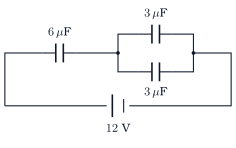
Consider the circuit in the figure.
Find the equivalent capacitance.
Find the charge supplied by the battery.
Find the potential difference across the \(6\,\mu\)F capacitor and the charge on each \(3\,\mu\)F capacitor.
Answer(i) \(3\,\mu\)F (ii) \(36\,\mu\)C (iii) \(6\) V; \(18\,\mu\)C each
Solution
The two \(3\,\mu\)F in parallel give \(6\,\mu\)F. In series with the other \(6\,\mu\)F: \(C = \dfrac{6 \times 6}{6 + 6} = 3\,\mu\)F.
\(Q = CV = 3 \times 12 = 36\,\mu\)C.
The \(6\,\mu\)F carries the full \(36\,\mu\)C, so \(V = \dfrac{36}{6} = 6\) V. The parallel pair gets the remaining \(6\) V.
Each \(3\,\mu\)F has \(6\) V across it: \(Q = 3 \times 6 = 18\,\mu\)C. Check: \(18 + 18 = 36\,\mu\)C.
How did it go?
Q30
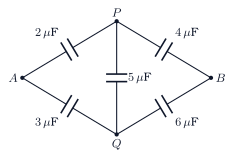
The figure shows a bridge of five capacitors.
Show that the bridge is balanced, so that \(P\) and \(Q\) are at the same potential.
Find the charge on the \(5\,\mu\)F capacitor.
Find the equivalent capacitance between \(A\) and \(B\).
Answer(i) \(\frac{2}{4} = \frac{3}{6}\) (ii) \(0\) (iii) \(\frac{10}{3} \approx 3.33\,\mu\)F
Solution
Balance condition: \(\dfrac{C_{AP}}{C_{PB}} = \dfrac{C_{AQ}}{C_{QB}}\). Here \(\dfrac{2}{4} = \dfrac{1}{2}\) and \(\dfrac{3}{6} = \dfrac{1}{2}\). Both series arms divide the voltage in the same ratio, so \(V_P = V_Q\).
No potential difference across the \(5\,\mu\)F, so its charge is \(0\). It can be removed without changing anything.
Capacitors of \(2\,\mu\)F, \(3\,\mu\)F and \(6\,\mu\)F are in series across \(60\) V. Find the equivalent capacitance, the charge on each capacitor and the potential difference across each.
Answer\(1\,\mu\)F; \(60\,\mu\)C each; \(30\), \(20\), \(10\) V
The wire short-circuits the \(6\,\mu\)F: its two plates are now at the same potential and it holds no charge. The full \(100\) V falls across the \(4\,\mu\)F: \(Q = 4 \times 100 = 400\,\mu\)C.
How did it go?
Q33
A \(6\,\mu\)F capacitor is connected in parallel with a series pair of \(2\,\mu\)F and \(3\,\mu\)F. The whole arrangement is across \(20\) V.
Find the equivalent capacitance.
Find the charge on each of the three capacitors.
Find the potential difference across the \(2\,\mu\)F and across the \(3\,\mu\)F.
Answer(i) \(7.2\,\mu\)F (ii) \(120\), \(24\), \(24\,\mu\)C (iii) \(12\) V, \(8\) V
Solution
Series pair: \(\dfrac{2 \times 3}{5} = 1.2\,\mu\)F. In parallel with \(6\,\mu\)F: \(C = 7.2\,\mu\)F.
The \(6\,\mu\)F has \(20\) V across it: \(Q = 6 \times 20 = 120\,\mu\)C.
The series pair also has \(20\) V across it: \(Q = 1.2 \times 20 = 24\,\mu\)C, the same on the \(2\,\mu\)F and on the \(3\,\mu\)F.
\(V_2 = \dfrac{24}{2} = 12\) V and \(V_3 = \dfrac{24}{3} = 8\) V. Check: \(12 + 8 = 20\) V.
How did it go?
Q34
Find the total energy stored when the \(2\,\mu\)F and \(3\,\mu\)F capacitors are connected across \(100\) V
Parallel: \(U = \dfrac{1}{2} \times 5 \times 10^{-6} \times 10^4 = 0.025\) J. The parallel combination stores more because it holds more charge at the same voltage.
How did it go?
Redistribution and heat
Q35
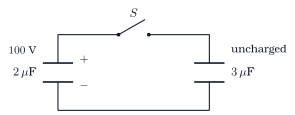
In the figure, a \(2\,\mu\)F capacitor charged to \(100\) V is joined to an uncharged \(3\,\mu\)F capacitor when the switch \(S\) is closed.
Find the total charge and the common potential difference after the switch is closed.
Find the final charge on each capacitor.
Answer(i) \(200\,\mu\)C, \(40\) V (ii) \(80\,\mu\)C, \(120\,\mu\)C
Solution
Charge before: \(Q = 2 \times 100 = 200\,\mu\)C on the \(2\,\mu\)F, none on the \(3\,\mu\)F. Charge is conserved, so the total stays \(200\,\mu\)C.
After the switch closes the two are in parallel: \(V = \dfrac{Q_{\text{total}}}{C_1 + C_2} = \dfrac{200}{5} = 40\) V.
After: \(U_f = \dfrac{1}{2} \times 5 \times 10^{-6} \times 10^2 = 2.5 \times 10^{-4}\) J. Heat \(= 0.01375 - 0.00025 = 0.0135\) J. Almost all the energy is lost.
How did it go?
Q39
Capacitors \(C_1\) at \(V_1\) and \(C_2\) at \(V_2\) are joined positive to positive. Show that the heat produced is \(H = \frac{C_1 C_2 (V_1 - V_2)^2}{2(C_1 + C_2)}\).
Answerderivation
Solution
Total charge \(Q = C_1 V_1 + C_2 V_2\) is conserved. Final common voltage: \(V = \dfrac{C_1 V_1 + C_2 V_2}{C_1 + C_2}\).
Expanding the numerator, the \(C_1^2 V_1^2\) and \(C_2^2 V_2^2\) terms cancel, leaving \(C_1 C_2 (V_1^2 + V_2^2 - 2V_1 V_2) = C_1 C_2 (V_1 - V_2)^2\). So \(H = \dfrac{C_1 C_2 (V_1 - V_2)^2}{2(C_1 + C_2)}\).
How did it go?
Q40
A capacitor charged to \(V\) is joined to an identical uncharged capacitor.
What fraction of the stored energy is lost?
Where does the lost energy go? Does the answer depend on the resistance of the connecting wires?
Answer(i) half (ii) heat and radiation; no
Solution
\(U_i = \dfrac{1}{2}CV^2\). The charge \(CV\) spreads over \(2C\), so the common voltage is \(\dfrac{V}{2}\) and \(U_f = \dfrac{1}{2}(2C)\left(\dfrac{V}{2}\right)^2 = \dfrac{1}{4}CV^2\). Half the energy is lost.
It becomes heat in the wires and, if the wires are very good, electromagnetic radiation from the spark. The fraction lost is fixed by charge conservation and does not depend on the resistance. Resistance only changes how fast the loss happens.
How did it go?
Q41
A \(4\,\mu\)F capacitor charged to \(200\) V is joined to an uncharged \(4\,\mu\)F capacitor. Find the final charge on each, the common potential difference and the heat produced.
Answer\(400\,\mu\)C each, \(100\) V, \(0.04\) J
Solution
Charge \(= 4 \times 200 = 800\,\mu\)C, shared equally by two identical capacitors: \(400\,\mu\)C each. \(V = \dfrac{400}{4} = 100\) V.
\(U_i = \dfrac{1}{2} \times 4 \times 10^{-6} \times 200^2 = 0.08\) J. \(U_f = \dfrac{1}{2} \times 8 \times 10^{-6} \times 100^2 = 0.04\) J. Heat \(= 0.04\) J, half of the original energy.
How did it go?
Small situations
Q42
A \(2\,\mu\)F capacitor can safely take \(300\) V and a \(3\,\mu\)F capacitor can safely take \(150\) V. They are connected in series. Find the largest potential difference that can safely be applied across the combination.
Answer\(375\) V
Solution
In series both carry the same charge \(Q\). Limits: \(Q \le 2 \times 300 = 600\,\mu\)C from the first, and \(Q \le 3 \times 150 = 450\,\mu\)C from the second.
The smaller limit wins: \(Q_{\max} = 450\,\mu\)C. Then \(V_1 = \dfrac{450}{2} = 225\) V (safe) and \(V_2 = 150\) V.
Largest safe total: \(225 + 150 = 375\) V.
How did it go?
Q43
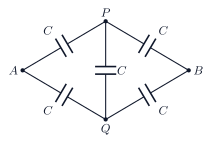
Five identical capacitors \(C\) form the bridge in the figure. Find the equivalent capacitance between \(A\) and \(B\) and the charge on the capacitor \(PQ\).
Answer\(C\); \(0\)
Solution
The bridge is balanced, since \(\dfrac{C}{C} = \dfrac{C}{C}\). \(P\) and \(Q\) are at the same potential, so the capacitor \(PQ\) carries no charge.
Remove it: each arm is two \(C\) in series, \(\dfrac{C}{2}\). The two arms in parallel give \(\dfrac{C}{2} + \dfrac{C}{2} = C\).
How did it go?
Q44
The \(2\,\mu\)F and \(3\,\mu\)F capacitors are charged in series across \(100\) V, as in Question 3. They are then disconnected and joined in parallel, positive plate to positive plate.
Find the common potential difference.
Find the heat produced.
Answer(i) \(48\) V (ii) \(2.4 \times 10^{-4}\) J
Solution
From Question 3 each holds \(120\,\mu\)C. In parallel the total is \(240\,\mu\)C over \(5\,\mu\)F: \(V = \dfrac{240}{5} = 48\) V.
After: \(U_f = \dfrac{1}{2} \times 5 \times 10^{-6} \times 48^2 = 5.76 \times 10^{-3}\) J. Heat \(= 2.4 \times 10^{-4}\) J. Check: \(V_1 = 60\) V and \(V_2 = 40\) V in the formula of Question 17 give the same.
How did it go?
Dielectrics in Capacitors
22 questions · after Lesson 6, Partial, Stacked and Varying Dielectrics
Dielectric basics
Q45
An air-filled parallel-plate capacitor has \(C_0 = 88.5\) pF (plates \(100\) cm\(^2\), gap \(1\) mm). Take \(\varepsilon_0 = 8.85 \times 10^{-12}\) C\(^2\)/N m\(^2\) throughout this sheet.
The gap is filled with a dielectric of constant \(K = 4\). Find the new capacitance.
The charge is kept the same. By what factor does the field inside change?
Answer(i) \(354\) pF (ii) \(E/4\)
Solution
\(C = KC_0 = 4 \times 88.5 = 354\) pF.
With \(Q\) fixed, \(V = \dfrac{Q}{C}\) falls to \(\dfrac{1}{4}\), and \(E = \dfrac{V}{d}\) falls to \(\dfrac{E_0}{4}\). The dielectric cancels three quarters of the field.
How did it go?
Q46
A \(20\) nF air capacitor is charged to \(200\) V and then disconnected from the battery. A slab of \(K = 4\) is inserted to fill the gap. Find the new values of \(C\), \(Q\), \(V\), \(E\) (as a fraction of the old field) and \(U\).
Battery disconnected: \(Q\) is fixed at \(CV = 2 \times 10^{-8} \times 200 = 4\,\mu\)C.
\(C = 4 \times 20 = 80\) nF. \(V = \dfrac{Q}{C} = \dfrac{4 \times 10^{-6}}{8 \times 10^{-8}} = 50\) V, a quarter of the old value. \(E = \dfrac{V}{d}\) also falls to \(\dfrac{E_0}{4}\).
\(U = \dfrac{Q^2}{2C}\) falls to a quarter: \(U = \dfrac{1}{2} \times 8 \times 10^{-8} \times 50^2 = 10^{-4}\) J (it was \(4 \times 10^{-4}\) J).
How did it go?
Q47
The same \(20\) nF capacitor stays connected to the \(200\) V battery while the slab of \(K = 4\) is inserted. Find the new values of \(C\), \(Q\), \(V\), \(E\) (as a fraction of the old field) and \(U\).
Battery connected: \(V\) is fixed at \(200\) V. \(C = 80\) nF as before.
\(Q = CV = 8 \times 10^{-8} \times 200 = 16\,\mu\)C, four times the old charge. \(E = \dfrac{V}{d}\) is unchanged.
\(U = \dfrac{1}{2}CV^2 = \dfrac{1}{2} \times 8 \times 10^{-8} \times 4 \times 10^4 = 1.6 \times 10^{-3}\) J, four times the old energy.
How did it go?
Q48
In Question 2 the stored energy fell. Where did the energy go?
In Question 3 the stored energy rose. Where did the energy come from?
Answer(i) work on the slab (ii) the battery
Solution
The field pulls the slab into the gap. The energy lost by the capacitor is the work done by this force on the slab. It appears as kinetic energy of the slab, or as work against whoever holds it.
The battery pushes the extra charge \(12\,\mu\)C through \(200\) V. It supplies \(2.4 \times 10^{-3}\) J, of which \(1.2 \times 10^{-3}\) J is stored and the rest is work done on the slab.
How did it go?
Q49
The plates of a capacitor carry \(\sigma = 8.85 \times 10^{-7}\) C/m\(^2\). A dielectric of \(K = 4\) fills the gap.
Explain, in terms of induced charges on the faces of the dielectric, why the field inside is reduced.
Find the induced charge density \(\sigma_i = \sigma\left(1 - \frac{1}{K}\right)\) on each face of the dielectric.
Answer(ii) \(6.64 \times 10^{-7}\) C/m\(^2\)
Solution
The field of the plates polarises the dielectric: its molecules turn or stretch. A negative layer appears on the face near the positive plate, and a positive layer near the negative plate. These induced layers produce a field opposite to that of the plates, so the net field inside is smaller.
\(\sigma_i = 8.85 \times 10^{-7}\left(1 - \dfrac{1}{4}\right) = 6.64 \times 10^{-7}\) C/m\(^2\). The net density \(\sigma - \sigma_i = \dfrac{\sigma}{K}\) produces the reduced field \(\dfrac{E_0}{K}\).
How did it go?
Partial dielectrics
Q50
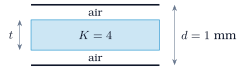
A slab of \(K = 4\) and thickness \(t = 0.5\) mm is placed in the \(1\) mm gap of the capacitor of Question 1, as in the figure. The capacitance is \(C = \frac{\varepsilon_0 A}{d - t + t/K}\). Find \(C\).
Answer\(142\) pF
Solution
\(d - t + \dfrac{t}{K} = 1 - 0.5 + \dfrac{0.5}{4} = 0.625\) mm. The gap behaves like an air gap of \(0.625\) mm.
A metal slab of thickness \(0.5\) mm is placed in the \(1\) mm gap instead. Find the capacitance. Does its position in the gap matter?
Answer\(177\) pF; no
Solution
A metal slab has no field inside it; it acts like \(K \to \infty\), so \(\dfrac{t}{K} \to 0\). \(C = \dfrac{\varepsilon_0 A}{d - t} = \dfrac{88.5}{0.5} = 177\) pF.
No. Only the total thickness of air, \(d - t\), matters, wherever the slab sits.
How did it go?
Q52
Treat the air part and the dielectric part of the gap in Question 6 as two capacitors in series. Show that \(C = \frac{\varepsilon_0 A}{d - t + t/K}\).
Answerderivation
Solution
Air part: thickness \((d - t)\), \(C_1 = \dfrac{\varepsilon_0 A}{d - t}\). Dielectric part: thickness \(t\), \(C_2 = \dfrac{K\varepsilon_0 A}{t}\). They carry the same charge, so they are in series.
\(\dfrac{1}{C} = \dfrac{d - t}{\varepsilon_0 A} + \dfrac{t}{K\varepsilon_0 A} = \dfrac{d - t + t/K}{\varepsilon_0 A}\), so \(C = \dfrac{\varepsilon_0 A}{d - t + t/K}\).
How did it go?
Q53
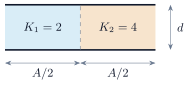
The gap of the capacitor of Question 1 is filled with two dielectrics side by side, \(K_1 = 2\) and \(K_2 = 4\), each covering half the area. Find the capacitance.
Answer\(265.5\) pF
Solution
The two halves have the same voltage across them, so they are in parallel. Each has area \(\dfrac{A}{2}\).
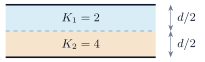
The gap is instead filled with the same two dielectrics stacked, each of thickness \(\frac{d}{2}\). Find the capacitance.
Answer\(236\) pF
Solution
The two layers carry the same charge, so they are in series. Each has thickness \(\dfrac{d}{2}\): \(C_1 = \dfrac{2K_1\varepsilon_0 A}{d}\) and \(C_2 = \dfrac{2K_2\varepsilon_0 A}{d}\).
Take the capacitor of Question 1. Find the capacitance in each case and compare.
The whole gap is filled with \(K = 2\).
Half the area is filled with \(K = 2\), the rest is air.
Answer(i) \(177\) pF (ii) \(132.75\) pF
Solution
\(C = 2 \times 88.5 = 177\) pF.
Half area with \(K = 2\) in parallel with half area of air: \(C = \dfrac{2 + 1}{2} \times 88.5 = 132.75\) pF. Filling half the area gives less than filling all of it, as expected.
How did it go?
Q56
The capacitor of Question 6 (\(t = 0.5\) mm, \(K = 4\)) is connected to \(12\) V.
Find the charge on the plates.
Find the field in the air part and in the dielectric part of the gap. Check that the two potential drops add to \(12\) V.
Air breaks down at \(3 \times 10^6\) V/m. A dielectric with \(K = 4\) breaks down at \(12 \times 10^6\) V/m. For the capacitor of Question 1 (\(d = 1\) mm), find the largest safe voltage with air and with the dielectric. By what factor does the largest stored energy rise?
\(U_{\max} = \dfrac{1}{2}CV_{\max}^2\). \(C\) rises \(4\) times and \(V_{\max}\) rises \(4\) times, so \(U_{\max}\) rises \(4 \times 16 = 64\) times. This is why real capacitors use dielectrics.
How did it go?
Variable dielectrics
Q58
The dielectric constant varies across the gap: \(K(x) = 2 + \frac{2x}{d}\), from \(K = 2\) at one plate to \(K = 4\) at the other.
A thin slice of thickness \(dx\) at \(x\) has capacitance \(\frac{K(x)\varepsilon_0 A}{dx}\). Are the slices in series or in parallel?
Show that \(\frac{1}{C} = \frac{1}{\varepsilon_0 A}\int_0^d \frac{dx}{K(x)}\) and hence that \(C = \frac{2\varepsilon_0 A}{d\ln 2}\).
Find \(C\) for the capacitor of Question 1. Take \(\ln 2 = 0.693\).
Answer(i) series (iii) \(255\) pF
Solution
Every slice carries the same charge \(Q\) on its two faces, and the voltages of the slices add. The slices are in series.
For series capacitors the reciprocals add: \(\dfrac{1}{C} = \displaystyle\int\dfrac{dx}{K(x)\varepsilon_0 A} = \dfrac{1}{\varepsilon_0 A}\int_0^d\dfrac{dx}{K(x)}\).
So \(\dfrac{1}{C} = \dfrac{d\ln 2}{2\varepsilon_0 A}\) and \(C = \dfrac{2\varepsilon_0 A}{d\ln 2}\).
\(C = \dfrac{2}{\ln 2}C_0 = \dfrac{2 \times 88.5}{0.693} \approx 255\) pF. This lies between \(2C_0\) and \(4C_0\), as it should.
How did it go?
Q59
The dielectric constant now varies along the plates, from \(K = 2\) at one edge to \(K = 4\) at the other, linearly with distance. Thin strips of the gap are now in parallel. Show that \(C = \frac{(K_1 + K_2)\varepsilon_0 A}{2d}\) and find it for the capacitor of Question 1.
Answer\(265.5\) pF
Solution
A strip of width \(dy\) at distance \(y\) along the plate (length \(L\), breadth \(b\)) has \(dC = \dfrac{K(y)\varepsilon_0\,b\,dy}{d}\). All strips have the same voltage, so they are in parallel and their capacitances add.
\(C = \dfrac{\varepsilon_0 b}{d}\displaystyle\int_0^L K(y)\,dy\). For a linear \(K\) the integral is \(L\) times the average of \(K\): \(\dfrac{K_1 + K_2}{2}L\).
\(C = \dfrac{(K_1 + K_2)\varepsilon_0 A}{2d} = \dfrac{2 + 4}{2} \times 88.5 = 265.5\) pF, the same as the side-by-side case.
How did it go?
Q60
Derive the formula used in Question 10 for two stacked dielectrics of thickness \(\frac{d}{2}\) each: \(C = \frac{2\varepsilon_0 A}{d}\frac{K_1 K_2}{K_1 + K_2}\).
Answerderivation
Solution
The two layers are in series: \(\dfrac{1}{C} = \dfrac{d/2}{K_1\varepsilon_0 A} + \dfrac{d/2}{K_2\varepsilon_0 A} = \dfrac{d}{2\varepsilon_0 A}\left(\dfrac{1}{K_1} + \dfrac{1}{K_2}\right) = \dfrac{d}{2\varepsilon_0 A}\cdot\dfrac{K_1 + K_2}{K_1 K_2}\).
A spherical capacitor has \(C = 100\) pF with air between its spheres. The space is filled with oil of \(K = 4\). Find the new capacitance. Give the reason in one line.
Answer\(400\) pF
Solution
\(C = KC_0 = 4 \times 100 = 400\) pF. Filling the whole field region with a dielectric divides the field by \(K\) for the same charge. So the voltage also falls by \(K\), whatever the shape of the capacitor.
How did it go?
Q62
A dielectric slab is half inserted into a charged capacitor that is not connected to a battery, and then released.
Is the slab pulled in or pushed out? Give the reason in terms of energy.
Would the answer change if the battery stayed connected?
Answer(i) pulled in (ii) no
Solution
Pulled in. With \(Q\) fixed, \(U = \dfrac{Q^2}{2C}\), and \(C\) grows as more of the slab enters. The system moves towards lower energy, so the force on the slab points into the gap.
No. With the battery connected the capacitor's own energy rises, but the battery supplies twice that amount. The total energy of capacitor plus battery still falls as the slab enters. The slab is pulled in either way.
How did it go?
Small situations
Q63
For Question 2 (battery disconnected, \(K = 4\)), find the work done by the external agent who inserts the slab slowly. Interpret the sign.
Negative work: the field pulls the slab in, and the agent must hold it back to insert it slowly.
How did it go?
Q64
Return to Question 3 (battery connected, \(K = 4\)). Find the work done by the battery and the change in stored energy. Hence find the work done by the external agent.
Extra charge \(\Delta Q = 16 - 4 = 12\,\mu\)C passes through the battery at \(200\) V: \(W_{\text{battery}} = 12 \times 10^{-6} \times 200 = 2.4 \times 10^{-3}\) J.
\(\Delta U = 1.6 \times 10^{-3} - 4 \times 10^{-4} = 1.2 \times 10^{-3}\) J.
Energy balance: \(W_{\text{battery}} + W_{\text{agent}} = \Delta U\), so \(W_{\text{agent}} = 1.2 \times 10^{-3} - 2.4 \times 10^{-3} = -1.2 \times 10^{-3}\) J. Again the slab is pulled in.
How did it go?
Q65
A \(20\) nF air capacitor and an identical capacitor filled with \(K = 4\) are connected in series across \(100\) V. Find the charge on each and the potential difference across each.
Air: \(V = \dfrac{1.6 \times 10^{-6}}{2 \times 10^{-8}} = 80\) V. Dielectric: \(V = \dfrac{1.6 \times 10^{-6}}{8 \times 10^{-8}} = 20\) V. Most of the voltage falls across the air capacitor.
How did it go?
Q66
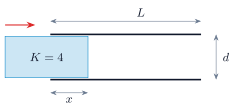
A slab of \(K = 4\) is inserted a distance \(x\) into the capacitor of Question 1, whose plates have length \(L\).
Show that \(C(x) = C_0\left[1 + (K - 1)\frac{x}{L}\right]\).
Find \(C\) when \(x = \frac{L}{4}\).
Answer(ii) \(155\) pF
Solution
The filled part (length \(x\)) and the empty part (length \(L - x\)) share the same voltage, so they are in parallel. With plate breadth \(b\), \(A = bL\).